Why would a perfectly good plane go rogue? The answer grounded 6,000 aircraft.
By
,
a science journalist and private pilot.
He is also the co-host of the podcast 'Finding MH370.'

Illustration: Kyle Ellingson
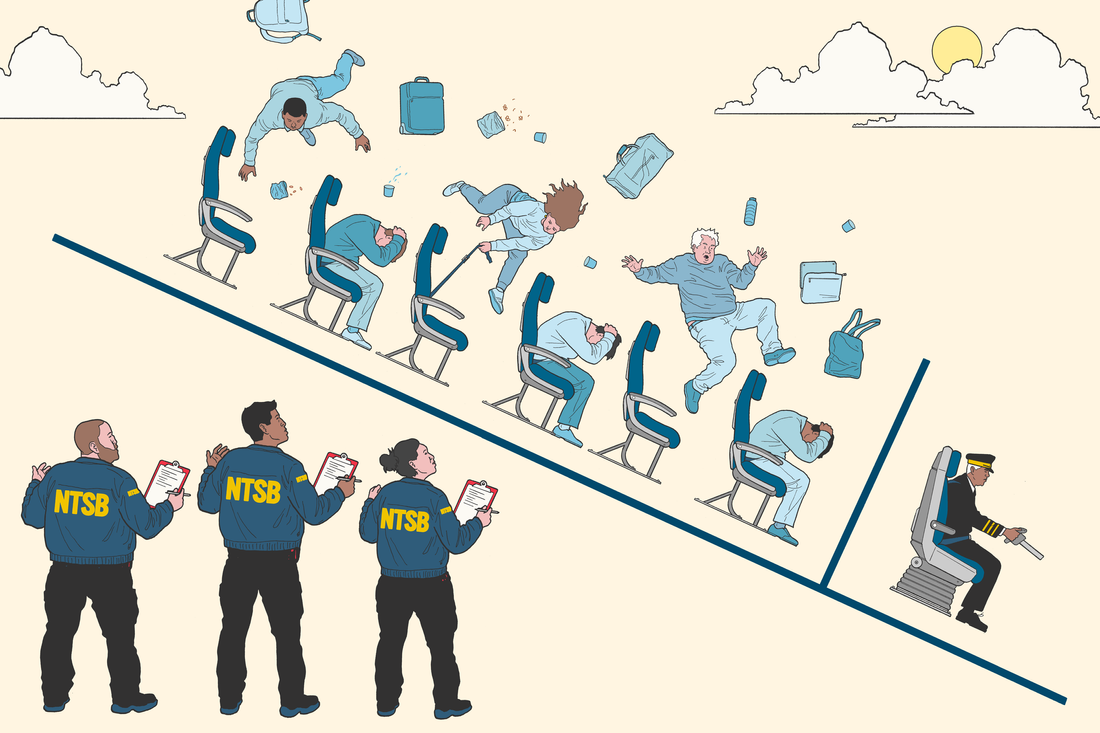
Illustration: Kyle Ellingson
Illustration: Kyle Ellingson
This article was featured in New York’s One Great Story newsletter. Sign up here.
To celebrate their second anniversary together, 22-year-old Terrica Turner and her boyfriend, Tyrese Banks, took a trip to Cancún. They flew from Newark and spent five days at a resort, relaxing and swimming in the pool. On the morning of Thursday, October 30, 2025, they boarded their flight home, JetBlue 1230, taking their seats at the back of the aircraft, two rows forward of the rear galley. After the Airbus 320 took off, Banks was nervous. This was the second leg of his first trip by air, and the normal shakes and shudders of the aircraft hitting light turbulence were alarming to him. Terrica told him that she’d experienced worse turbulence before, everything would be fine, and that he should trust his seat belt to do its job. He leaned against the window and shut his eyes.
Midway through the flight, about two hours after takeoff, as the plane approached the western coast of Florida, a flight attendant with a service cart pulled up to the couple’s row and asked Turner what kind of snack she wanted. Banks was about to fall asleep. Turner was about to ask for Goldfish when the jet went into free fall. “There was a whooshing sound,” Turner says. “The plane just started falling.” The cart and the flight attendant lurched violently upward, the heavy cart pinning the woman against the ceiling.
Though Turner and Banks were wearing seat belts, they were only loosely fastened, and they also lurched upward, their heads smacking the panel above their seats. All around them, people and objects were flying through the air, hitting the roof inside the plane. Suspended above her seat, head jammed against the hard plastic amid the fan ducts and reading lights, Turner screamed and sobbed. “No, no, no, no, no!” she remembers saying. “What the fuck!”
She thought that the plane was barreling straight for the ground and that all of them were about to die. The passengers around her were hanging in their seat belts or crumpled on the ceiling. “We were up in the air, sucked up for like 30, 40 seconds,” she says.
The JetBlue airliner that suddenly went into a dive over the Gulf of Mexico last October 30 did not crash. Despite how long the ordeal felt to passengers like Turner, the plunge lasted only about five seconds before the autopilot returned the aircraft to level flight. As the g-forces abruptly swung positive, everyone fell back down, in some cases incurring further injury. The flight crew, spooked, turned the plane toward the coast of Florida and brought it in for an emergency landing in Tampa.
Damage to the cabin ceiling where the drink cart — and flight attendant — hit it. Photo: Terrica Turner
Twenty-two people were treated for their injuries. But because no one died, the flight didn’t receive widespread coverage. At first glance, it just didn’t seem that newsworthy. Nine times a year in the U.S., on average, a commercial plane hits turbulence severe enough to injure passengers. Last year, a study by doctors at the Icahn School of Medicine at Mount Sinai in New York found that on average, 24 passengers and crew are injured by turbulence each year in the U.S. It’s just part of the business of flying.
All the same, federal officials are tasked with investigating and explaining every aviation accident in the country. Because people were hurt on Flight 1230, it fell into this category. So a dedicated team of investigators went to work. But in the days and weeks that followed, they became increasingly flummoxed. It wasn’t what had happened that puzzled them but why. As they examined the obvious potential causes of the nosedive, nothing matched up.
Working their way down the list of possibilities, they found themselves in increasingly arcane and implausible-sounding territory. And the final option left to them — the only thing that could be true so had to be true — was so extraordinarily implausible that a normal reaction would be to dismiss it out of hand. “I didn’t believe it when I first heard about it,” a veteran flight-control engineer told me.
Because the event took place in the U.S., responsibility fell to the National Transportation Safety Board, a federal agency charged with investigating transportation accidents. The black boxes — the flight-data recorder and the cockpit voice-recorder — were removed from the aircraft and sent to the NTSB Vehicle Recorder Laboratory in Washington, D.C. Records of thousands of parameters, measured multiple times per second, were uploaded and analyzed.
The leading suspect was the weather and in particular the violent movement of air that can occur at flight altitudes. The most energetic kind of turbulence is associated with updrafts and downdrafts generated within thunderstorms.
A year before the JetBlue incident, a Singapore Airlines 777 was flying from London to Singapore when it encountered severe turbulence amid thunderstorms over Myanmar. Inside the cabin, flight attendants were serving breakfast when a strong downdraft exerted a negative-1.5 g acceleration on the airframe, meaning that a 200-pound person would have been pinned to the ceiling with a force of 300 pounds. Then, within seconds, an updraft struck with equal force in the opposite direction, sending everyone and everything crashing toward the floor. Oxygen masks fell as screams filled the cabin. Because the flight crew had turned off the “Fasten Seatbelts” sign just moments prior, many passengers were out of their seats at the time and 79 of them were injured. One man, a 73-year-old with a heart condition, died.
That violent sequence took 4.6 seconds, about the same as the JetBlue 1230 incident. And the gyration from negative to positive g’s was similar. The big difference, though, was that the JetBlue flight was flying through an area of good weather — there were no thunderstorms nearby.
But blue skies can harbor dangerous forces, too. “Clear-air turbulence” occurs when jet-stream currents bump up against slower air, or when strong winds pass over the tops of mountains. Though the phenomenon doesn’t create quite the velocities of air movement that thunderstorms do, it can be just as dangerous because it strikes without warning.
Clear-air turbulence didn’t appear to be involved here, though. By studying the flight-data recorder, the NTSB could tell that the plane hadn’t been pushed down by air currents. The g-forces that the passengers experienced had been matched by a brisk movement on a part of the tail called an elevator, which pitches the nose up and down. That meant someone or something had commanded the aircraft to dive.
One disturbing possibility was that the culprit was human: that the plane had been put in danger deliberately, perhaps by one of its own pilots. This kind of malicious interference is rare but not unknown. In 1999, a disgruntled first officer on an EgyptAir flight from New York to Cairo steered the plane into a fatal dive from 33,000 feet, crashing it into the Atlantic Ocean off the coast of Nantucket and killing everyone onboard. More recently, pilots have been implicated in fatal crashes in China in 2022 and India in 2025.
There have also been failed suicide bids, including one aboard a Federal Express plane in 1994. A crew member tried to commandeer and crash the DC-10 so that his family could collect his life-insurance money. While the captain and flight engineer fought him off, the first officer pitched and rolled the aircraft violently to throw the attacker off his feet. The effort was successful, and everyone survived.
Investigators were quickly able to rule out malevolent intent in this case though. The plane had been on autopilot for the entire incident. No human hands were involved. The cause had to lie somewhere within the plane’s automatic control system, and that was a more difficult scenario to work through.
Since the first digital fly-by-wire airliners were introduced in the 1980s, the electronic control of passenger planes has become incredibly reliable. It has also become very complex. Numerous automated systems, collectively known as the autopilot, are housed in metal boxes in the electronics bay under the cockpit. These boxes take inputs from various sensors, including airspeed sensors and GPS antennae, and send outputs that make the plane turn, climb, and descend. Taken together, these systems are very robust and are able to keep the plane flying safely under a wide variety of conditions. But that same complexity can conceal hard-to-locate failure modes that can crop up in unexpected ways.
To find the problem, investigators removed various components from the JetBlue aircraft and shipped them off to their manufacturers for inspection. Of particular interest were the sensors that tell the aircraft how it is moving through space, including the angle-of-attack sensor. When working properly, this instrument gives the plane’s computers an accurate sense of whether its nose is angled too high relative to the flow of the air over its wings. This is important because, especially at low speeds close to the ground, too big an angle can cause the wing to suddenly stop generating lift and the plane will plummet uncontrollably.
This is such a dangerous possibility that aircraft manufacturers have added automatic systems to prevent it. If the plane’s flight computer detects that the angle of attack is getting too high, it will push the nose down without waiting for input from the pilot.
But that safety feature can become a positive hazard if the angle of attack sensor is faulty. In 2018, a Boeing 737 Max took off from Jakarta, Indonesia, on what was scheduled to be a short flight to the city of Pangkal Pinang, 450 miles away. Though the plane was brand new, it had been plagued with technical problems, most notably with its angle-of-attack sensor, which had been giving erroneous readings. Minutes after takeoff, the flight crew radioed that it was having trouble controlling the plane and maintaining altitude. The pilots didn’t understand it at the time, but the faulty sensor was saying the nose was too high, triggering an automated response to push the nose down. The pilots tried to fight the plane’s urge to dive, but in the end they were overwhelmed. The flight crashed into the ocean 13 minutes after takeoff, killing all 189 aboard.
Lion Air 610’s sudden, uncommanded dive began as suddenly as the upset that JetBlue 1230 experienced. But upon examining the sensors on the latter, investigators found no sign of any defect.
In fact, nothing on the plane was malfunctioning in a way that could explain what happened, and the pilots hadn’t done anything wrong. So why would a perfectly good plane suddenly go rogue?
Investigators narrowed their attention to one particular component of the plane’s flight-control system. The ELAC (“elevator aileron computers”) were sent to their manufacturer, Thales, in Chatellerault, France, where the company’s engineers examined them while NTSB investigators looked on.
The ELAC are two boxes that sit in the electronics bay and control the ailerons (flight surfaces on the wings that make the plane roll into turns) and elevators (which, as previously noted, make the nose pitch up and down). If you’ve ever sat in a window seat of an Airbus plane and watched the metal slats on the trailing edge of the wing bopping rapidly up and down, you’ve seen the ELAC at work. For the sake of safety, one ELAC does this job while the other monitors it and stands ready to take over in case of malfunction.
Since it was the ELAC units that told the elevator to make that nose-down move, the error must have arisen there. But as engineers zoomed in on this system to a microscopic level, they found nothing: no flaw in the design, no physical damage, no gremlin lurking in the software.
After spending the better part of a month chasing down the possibilities, investigators ruled out all but one. Airbus engineers concluded that what had happened must have been spontaneous. Without any input from a faulty sensor, the computer just suddenly decided that it was flying at too steep an angle of attack and told the elevator to pitch the nose vigorously downward.
And where did the error come from? The answer that Airbus engineers found disturbed them so much that the company put out an alert grounding some 6,000 planes until a fix could be applied. The move disrupted flights around the world, but the company felt the severity of the risk demanded comprehensive action. The company had found that future mishaps “may result in exceeding the aircraft’s structural capability” —in other words, the planes could come apart in flight, potentially killing everyone onboard.
The sequence of events, the engineers concluded, probably happened something like this: Long ago, in a galaxy far, far away, a dying star exploded, blasting vast quantities of matter outward at millions of miles per hour. Twisting magnetic fields accelerated swarms of protons to nearly the speed of light. One of them had a special fate.
For millions of years, this minuscule particle arced through the cosmic void, until finally, in 2025, it approached our solar system. Passing within the distances of the orbits of Neptune and Saturn and Jupiter and Mars, it hurtled toward Earth, where it finally smacked directly into an oxygen atom at the outer reaches of the atmosphere.
The amount of energy that the proton carries is not very big in absolute terms — it would take 300 trillion of them to raise the temperature of a cup of tea by one degree Fahrenheit — but when focused on the nucleus of a single atom, the effect was devastating. The oxygen atom disintegrated into a shower of exotic subatomic particles. Among them was a neutron, a particle very much like a proton but lacking an electrical charge, which meant that it can much more easily penetrate the Earth’s thick lower atmosphere. Continuing on in the same direction as its parent proton, it bored through ten miles of increasingly dense air until its path happened to intersect that of a JetBlue airliner.
It passed through the roof of the cockpit, perhaps even through the body of one of the pilots, through the floor of the cockpit, through the metal casings of the computer boxes stacked in the electronics bay, and into the circuit board of a flight-control computer, where it scored a direct hit on something that could stop it: the nucleus of another atom. This one happened to be a silicon atom within a structure called a memory bit, just 1/100th as wide as a human hair.
The force of the impact blasted that nucleus out of place in the silicon crystal. “Think of pool balls colliding,” says Stephen Wender, a staff scientist at the Los Alamos Neutron Science Center, which uses a proton accelerator to test how electronics components react to doses of high-energy particles. “As the nucleus blasts through, that energy creates charge.”
Stripped of its electrons, the silicon nucleus bulldozed through the crystal lattice of the chip, altering the electrical state of the memory bit. This, in turn, changed the meaning of the information the bit stored, turning a one to a zero, or vice versa. Engineers call this a “bit flip.” Depending on where the bit sat within the digits of a binary number, the flipped bit could have turned a two to a three, a 46 to 62, or a zero to 256. And so on.
Because the Earth is constantly bathed in cosmic rays and other forms of high-energy radiation, bits are getting flipped all the time. One study found that the average GPU chip experiences a flipped bit once every 3.2 years. In most of those cases, the change is so inconsequential that no one notices. Maybe one pixel in a frame of a video is the wrong color or there’s a bit of static in an audio file. But in the context of a jet’s flight control, a flipped bit can have massive consequences.
Inside the ELAC, the processor is constantly assessing all the variables affecting the plane’s movement through the air and calculating how it needs to move the elevator on plane’s tail. Just before the neutron struck, the ELAC correctly read that all was normal: The plane was flying at the assigned altitude at the appropriate speed. Now, based on the flipped bit, the ELAC suddenly and erroneously sensed that the plane was rocketing upward. It calculated that it must aggressively push the nose down.
The ascent was fictional; the command sent to the flight controls was real. The ELAC sent a signal that pushed down the hinged flaps on the plane’s tail. The tail went up, the nose went down, and a bunch of human beings and objects hit the cabin ceiling.
The error was momentary. Within seconds, the other ELAC detected that something was amiss and took over, leveling the nose and returning to normal flight. The faulty bit caused by the cosmic-ray strike was erased from memory, and everything went back to normal — at least from the control system’s perspective.
For the people in the plane, nothing was normal. As the plane leveled out, “we got slammed back down,” Turner remembers. The food-service cart fell from the ceiling, unpinning the flight attendant, who fell to the floor by Turner’s feet. The ceiling above the aisle was a spiderweb of cracked plastic where the cart had hit. “She disappeared into the back of the plane for what I believe was a very short time, then came right back and immediately resumed helping passengers,” Turner says.
Snack bags and luggage and belongings of all sorts littered the cabin. Everything was covered in spilled drinks. “The whole plane ride after that, things were dripping on me from the ceiling and I was all sticky and wet,” Turner recalls. Her head ached from hitting it against the hard plastic. She felt dizzy.
The contents of the drink cart when flying everywhere when it hit the ceiling. Photo: Terrica Turner
Ambulances stood waiting when the plane landed in Tampa. “Our immediate priority was the safety and well-being of our customers and crewmembers,” JetBlue said in a written statement. “Medical personnel met the aircraft upon arrival in Tampa, and our Care Team was activated to provide support to those who were injured and sought medical attention.” JetBlue put the remaining passengers on a backup aircraft that flew to Newark later that night, arriving around 3 a.m.
As it studied the incident, Airbus realized that the problem wasn’t entirely due to the flipped bit. The version of the software installed on the ELAC had failed to catch the fault before it caused mayhem. To prevent a recurrence, Airbus put out an alert directing airlines to reinstall an earlier version of the software. Around the world, airline mechanics went to work, and within days most of the grounded aircraft were back in service.
Inside the industry, the case was seen as both a reminder of the unexpected problems that can hide within vehicles built from millions of parts and running millions of lines of code and a testament to how, in the hands of competent manufacturers, airlines, and regulators, the modern air-travel industry can sniff out even the most arcane safety issues quickly and make sure they never happen again.
From the perspective of the average passenger, all of this struggle is invisible, hidden behind the customer experience. Even for those like Terrica Turner and Tyrese Banks who experience a problem firsthand, the hows and whys are opaque. “I never received any explanation at all,” Turner says. Until I reached out to her, she assumed that the incident had been caused by turbulence.
JetBlue says that “we recognize how unsettling the sudden loss of altitude was for our customers onboard,” but points out that, until the NTSB issues a final report on the incident, it can’t speculate to its customers about its cause. The airline also says that it refunded passengers’ original fares and reimbursed “eligible out-of-pocket expenses.” (It also gave each of them a $300 travel credit.)
The whole experience has left Turner reluctant to step onto a JetBlue flight again. “It’s hard to say ‘no’ forever,” she says. “But right now and for the foreseeable future, it is a ‘no.’”
This post has been updated.