The year my husband and I decided to have children, I dropped in on a talk on embryo selection at a conference that had nothing to do with genetics. The presenter claimed there was a stealth startup – now public as Herasight – offering embryo forecasts on disease risk and IQ. I asked around and got the company’s contact information. We wanted children as soon as possible, so we had to make a decision before we could see how the technology in general or the company specifically would pan out. After a long discussion, we decided to employ the new technology instead of having a baby the usual way.
It was not an obvious choice for us to do this.
First, the technology – which has improved in the several years since– was okay, but not good. Some traits have quite good predictors, but others do only a bit better than chance. Herasight doesn’t give predictions for those low-signal traits, and focuses on the traits where their predictors are better. For example, we cared a lot about depression, but unfortunately that one is hard to predict, and so not on offer by default.
Second, we were wealthy enough we could afford to be early adopters, before the tech becomes much cheaper, but not so wealthy it wouldn’t hurt. It cost us about $26,000 for two cycles of egg extraction and fertilization, which doesn’t include sequencing or prediction.
Third, our heritable health issues weren’t bad enough that it seemed obviously justified to do something expensive and difficult to avoid them.
Ultimately, we went ahead because weak signal is still powerful when we get signal on twenty traits. Even if the risk reduction for any given disease is modest, the benefits stack up. And although early adopters get the worst version of the product for the highest price, we felt good about paying towards further research and deployment for a wider consumer base. We want this to one day be an option for every parent, especially those with more debilitating heritable conditions than ours.
We talked to the company, which included a video call with their statistician so we could ask questions about their methods and how their predictors compared to those in published research. We didn’t see any red flags, but we didn’t necessarily expect to if they were untrustworthy. The published research seemed solid – embryo selection with modest improvements was already in the realm of possibility. But this was an obvious area for scams, because the deliverable is a list of numbers that is hard to verify from our end.
We wouldn’t have proceeded if we hadn’t known three different friends in the genetics space, each of whom established a chain of some trust. One of them also said that Herasight and more established companies were swapping employees, which is what you expect to see among companies in the same field doing serious work, gunning for the same small talent pool.
None of this completely satisfied us, but it was good enough to go ahead. I did quick and dirty calculations, multiplying the value of decreased disease risk by our estimated probability that the company could deliver that decreased risk. The calculations kept indicating that this would be worth it. My head was a strong yes and my gut was a weak yes. So we committed.
We decided to do two rounds of egg extraction. It was tough to deal with the total delay of 5 months1. Once we knew for sure that we wanted children, we didn’t want to wait. I wanted a baby immediately.
There are some parts of IVF that were a bit painful, many parts that were annoying or inconvenient, and a few that were scary because our future was in the hands of people whose job was to minimize liability rather than work with us on our goals. An IVF clinic sees its job as getting us one viable pregnancy, not to maximize the number of embryos we have to increase choice.
We knew that if I flew out of state, we could work with cheaper clinics, or clinics who understood and supported our particular goals. The limiting agent was me, the person who would be pregnant, and I found my mind sliding off the possibility of going out of state. Many months after we conceived, I talked to other women who had been cleverer about the process, and I think we could have saved ten thousand dollars, or gotten 10-20% more embryos, if I’d been willing to fly out. I’m a bit embarrassed to say I wasn’t. I already felt daunted by the process of IVF, and I didn’t want to be alone in some motel for several months.
We drove to a local IVF clinic several times a week for blood draws, and did injections at home to stimulate the ovaries. The two extractions, done under anesthesia, were the easiest part. Waiting for numbers after each extraction, though, was agony. How many eggs were extracted? How many fertilized into zygotes, and how many zygotes survived to day 6 for biopsy and freezing? The value of polygenic embryo forecasts grows with embryo count, and so elective IVF is a financial gamble.
After two rounds, we had eight euploid biopsied and frozen embryos, which is about what we expected given my age2. We sent the biopsies for sequencing, and when we obtained the raw sequence data from a third company, we sent the data to Herasight for analysis.
Most of the predictions were on disease risk, and the numbers were percentage risk of the embryo getting the condition in a lifetime. The exceptions were IQ, height, and BMI, where the company provided the predicted number.
What did we select for? Everything, of course! We took every piece of information into account, although we weighted some things close to zero. To do this, we made a spreadsheet – one row for each embryo and one column to each predicted trait3. We assigned a relative importance to every trait, doing research when we didn’t know enough about a disease. What percent extra lifetime risk for Alzheimer’s balances a one percent decrease in lifetime risk for bipolar? How much extra risk of ADHD cancels out against 5 more IQ points?
After we’d written our initial numbers, we went over traits where we diverged a lot, and argued. We often both changed our minds and moved our numbers closer to each other. The disagreement was usually due to one of us knowing something about a disease that the other didn’t, and in those cases we changed our minds quickly. Other times it was clear we had a values difference, and once we both aired our views and felt understood by each other, we felt okay having different numbers.
Once we had produced our individual weights, we averaged the two weights for each trait4, so our values were represented equally. In the following you can see the embryo predictions and our weights – both of which have been obfuscated a bit for privacy – and the final ranking that falls out of those numbers.
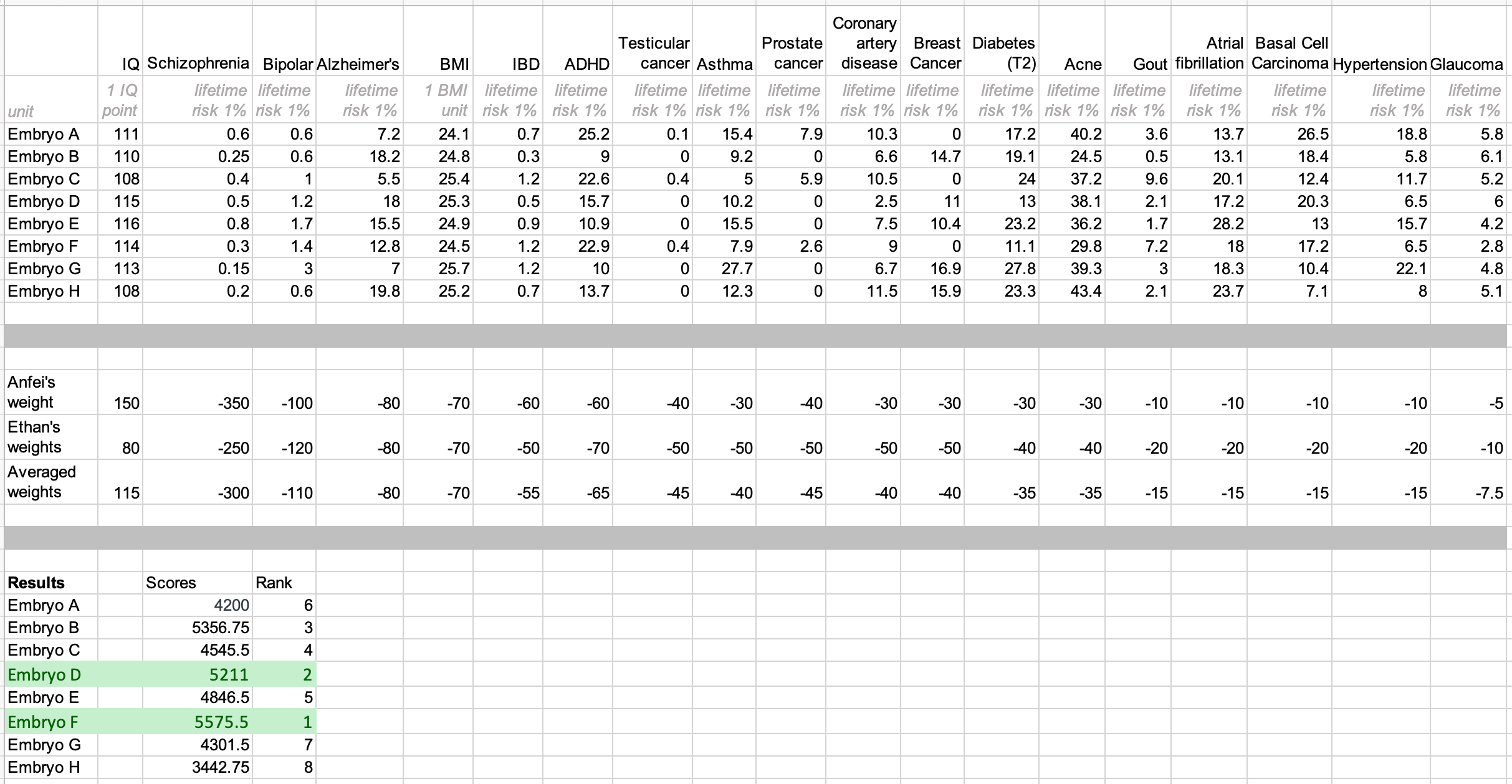
For each embryo, we multiplied the prediction for each trait by that trait’s importance, and added the results to get that embryo’s total health and capability score. Diseases had negative weights, so if an embryo had a 0.5% risk of bipolar and we had assigned a weight of -120 for each percent of bipolar risk, it would subtract 60 from the embryo’s score.
After giving the IVF clinic a ranked list, we watched with bated breath as the embryo with the highest total score was implanted. You actually see the fluid containing the embryo being released on an ultrasound monitor. Despite the clinic’s reassurance that the embryo wouldn’t fall out of me when I walked out, I attempted to levitate home horizontally. The thawed cells resumed multiplication, grew limbs and organs, and migrated outside of me to great fanfare.
My curious, demanding, determined little son!

What traits did we most care about? What did we disagree the most on?
The disease that hits me hardest emotionally is Alzheimer’s. All of my aunts and uncles have dementia now, and it’s very painful to see.
Alzheimer’s does not run in my husband’s family. It’s heartbreakingly obvious how differently the last third of his relatives’ lives are playing out. I once went to his grandfather’s ninetieth birthday. He had visible physical health issues, but he still played tennis and discussed current events with his grandchildren, with more lucidity than my much younger mom.
I would prefer my children’s old age to look like that. It felt really good to nudge the dice.
We cared about depression, but the predictor was bad enough they didn’t offer it. We cared about ADHD, which strongly runs in one of our families. Schizophrenia and bipolar don’t run in our families but are scary, so we weighted those highly. We cared about the cancers our family members got. Neither of us had a preference on gender.
IQ was the trait we disagreed most on. I valued intelligence more than twice as much as my husband did. For me, it accounted for 13% of the potential variance on scoring – for my husband, it was 5%5. Because we took many traits into account, no single trait swept the results. Our highest scoring embryo had the third highest predicted IQ, a middling risk of schizophrenia, and the lowest chance of diabetes. We can’t tell a simple story about why we chose the embryo that became our son – and we think that’s appropriate in a world where we took twenty things into account.
Broadly, we cared about intelligence for two reasons: we want our children to be happy, and to leave the world a slightly better place than they found it. You might call these the selfish and altruistic reasons.
It is pleasurable to understand the world as it acts upon us, and to be creative and effective when acting upon the world.
Whatever roles our children will have in future society, they will impact others in their decisions. We prefer they be able to take more factors into account when deciding, act efficiently, and accurately predict the consequences of their actions. There are millions of problems for humanity to solve, and we want our children to help.
If they become plumbers, we’d like if they fixed issues in a way that didn’t force you to call a different plumber the next week. If they are on highway design committees, we’d like if they designed ramps that minimize car collisions rather than the freaky ramps that force you to merge aggressively. If they are cancer treatment researchers, we’d like them to deliver solutions one day faster.
We’re glad we used embryo screening, but we rarely think about it now6. IVF and embryo selection don’t impact the reality of parenting at all. We didn’t remember any of the scores until I decided to write about it and we opened the spreadsheet again to review our decisions.
We believe in choosing potential people and committing to real people. We looked through a blurry lens to guess which child might have the best chance of being happy and making others happy. The child is here now. Every day he radiates the truth of who he is and what he wants. There is no need to treat that blurry lens as an oracle, or to feel betrayed if its “promises” don’t pan out. It is obvious to us that polygenic forecasting is an unreliable process – and just as obvious that the process is preferable to randomness.
When our children are old enough to grasp the concepts involved, we’ll tell them how we conceived them. We want them to understand the “choose potential people, commit to existing people” distinction, and if they are too young for that, they’re also too young for a full explanation. It’s also important that they understand how uncertain the process is – even if the predictors could perfectly predict the heritable component of various traits, they can’t account for the non-heritable components.
Out of curiosity, I imagined how I’d feel if the IVF clinic called me to say they’d accidentally implanted the least preferred embryo in the ranking we gave them. I’d be infuriated at their incompetence, and I’d plan on educating my son on some of the diseases he’s more at risk for than I thought, but otherwise life would be pretty much the same.
We adore our son. I won’t bore you by raving about how much I love him, except to say that an unpleasant revelation from the IVF clinic would make a dent in that love like a nickel flicked at a tank.