This article discusses the evolution of knowledge sources and how they play a crucial role in the age of AI.
You might be surprised when you realize how many people thought of LLMs as AGI, and consequently AGI causing everything else to be obsolete, including humans! Same was predominant thought about trustworthy contents that their only use case is to be fed into LLMs for training and alignment.
Well, it's not really what is happening!
AI is bringing a new dynamic of how we can consume knowledge, not only consume but also understand it, interact with it, and apply it into our day-to-day life.
What's a knowledge source? and why it is important?
Knowledge sources are the places or methods you tap into to learn stuff—basically, the origin of the information. They're not new, they can take different forms such as books, scientific papers, etc.
For example, if you want to learn about Apple's plans and operation, the primary source is Apple's annual reports or SEC filings (like their 10-k form), it details their financials, risks, and R&D spending (directly from the company). A secondary source might be Wall Street Journal article analyzing Apple’s innovation pipeline, which interprets primary data (the direct) and adds expert commentary. Also, the tertiary sources like Medium blogs or anything available on the internet. Quaternary, the very new knowledge source, LLMs, we now have the privilege of just asking an LLM (let's say ChatGPT) and it just gives you an answer from its general knowledge.
As you see there are various kinds of knowledge sources as mentioned above, as you walk away from the primary knowledge source, the information deviate from the most reliable to the least.
This hierarchy is not implying that only one or two of the above-mentioned sources of information is more useful, but rather, each source addresses different audiences, possibly even larger one as you further walk away.
Traditionally, consuming information meant collecting content and dedicating significant effort to reading and analyzing it ourselves or relying on others to do it for us, which is still common practice. Now, we have a new possibility: AI can help us process and absorb information more efficiently and pleasantly.
AI services such as ChatGPT Search, AI Overview, etc. are pursuing the path of using AI to enhance finding information from the Internet, on the other hand, services such as Nouswise are focusing on more expert and trustworthy knowledge sources, helping content providers to enhance their service for their readers and customers.
Now, it would be off the road to say LLMs made contents obsolete, but to enhance the high quality and authoritative contents that are generated by humans.
In this new era, it becomes more crucial to make these trustworthy contents accessible in a single interface, this is part of Nouswise vision on the future of high-quality contents, and we're working relentlessly to make it the new reality.

To understand this new dynamic, we need to remind ourselves of how new technologies reshaped traditional knowledge sources, and how we interact with them.
Prominent types of Knowledge Sources:
It's easy to realize that physical knowledge sources such as books and libraries have inherent limitations. Technology has helped by digitizing these resources, enabling faster and more cost-effective distribution. While a vast amount of these digital knowledge sources is now available on the internet, the fragmentation of sources has become a significant challenge in the modern age.
Nouswise can eliminate these silos and facilitate a smoother flow of information, where everyone benefits. This not only enhances access and convenience for end consumers but also adds value for knowledge source owners through wider reach and engagement.

LLMs are the new knowledge source:
Artificial intelligence models, particularly Large Language Models (LLMs), are rapidly emerging as a new source of knowledge and information. This exciting technological advancement holds great promise. However, there's a twist: these models can sometimes "hallucinate"—meaning they may generate information that isn't factual, and consequently unreliable.
As we navigate this evolving landscape, understanding both the potential and limitations of AI is more crucial than ever. By maintaining a balanced perspective, we can leverage its groundbreaking capabilities while remaining vigilant about its shortcomings.
This means AI is shaping how we consume "General Knowledge":
Speed and Scale: AI is pretty fast at responding to any query, i.e. it answers any query regardless of knowing or not knowing it. Mostly it gets it right!
Accessibility: Many AI tools are freely available or low-cost, enabling virtually anyone to tap into advanced information resources with minimal effort.
Customization and Adaptability: These models can be tailored to suit specific needs, making them highly adaptable and capable of offering personalized outputs that enhance both relevance and usability.
Democratization of Knowledge: AI breaks down traditional barriers, allowing more people to access complex information.
Cost-Effectiveness: AI reduces resource expenditure by replacing time-intensive manual tasks.
As these models are getting better, their level of 'intelligence' gets higher, and they become more reliable! Additionally, they also enhance our ability to consume and contextualize authoritative sources.
LLMs are the new knowledge source enhancers:
The contents that are high quality and usually authoritative in their own realm have been evolved in different forms, as discussed above, and has been the cornerstone of information sharing and intellectual progress for centuries. Their uniqueness is limitless but not limited to:
Depth and Structure: Their content often exhibits considerable depth, presenting information in a well-organized manner that facilitates a comprehensive understanding of complex subjects.
Creativity and Nuance: They integrate creative elements and subtle nuances, offering fresh perspectives and inventive approaches that engage and inspire readers.
Credibility and Accountability: They maintain high standards of credibility, supported by verifiable sources and a commitment to accuracy, ensuring that the information is both reliable and accountable.
Recognizing that content exists along a diverse spectrum—from freely available internet resources to paywalled academic journals and confidential internal reports—this diversity challenges both creators and consumers to effectively navigate and synthesize information from multiple sources to develop a well-rounded perspective.
The contents generated by human are a wide range of fragments:
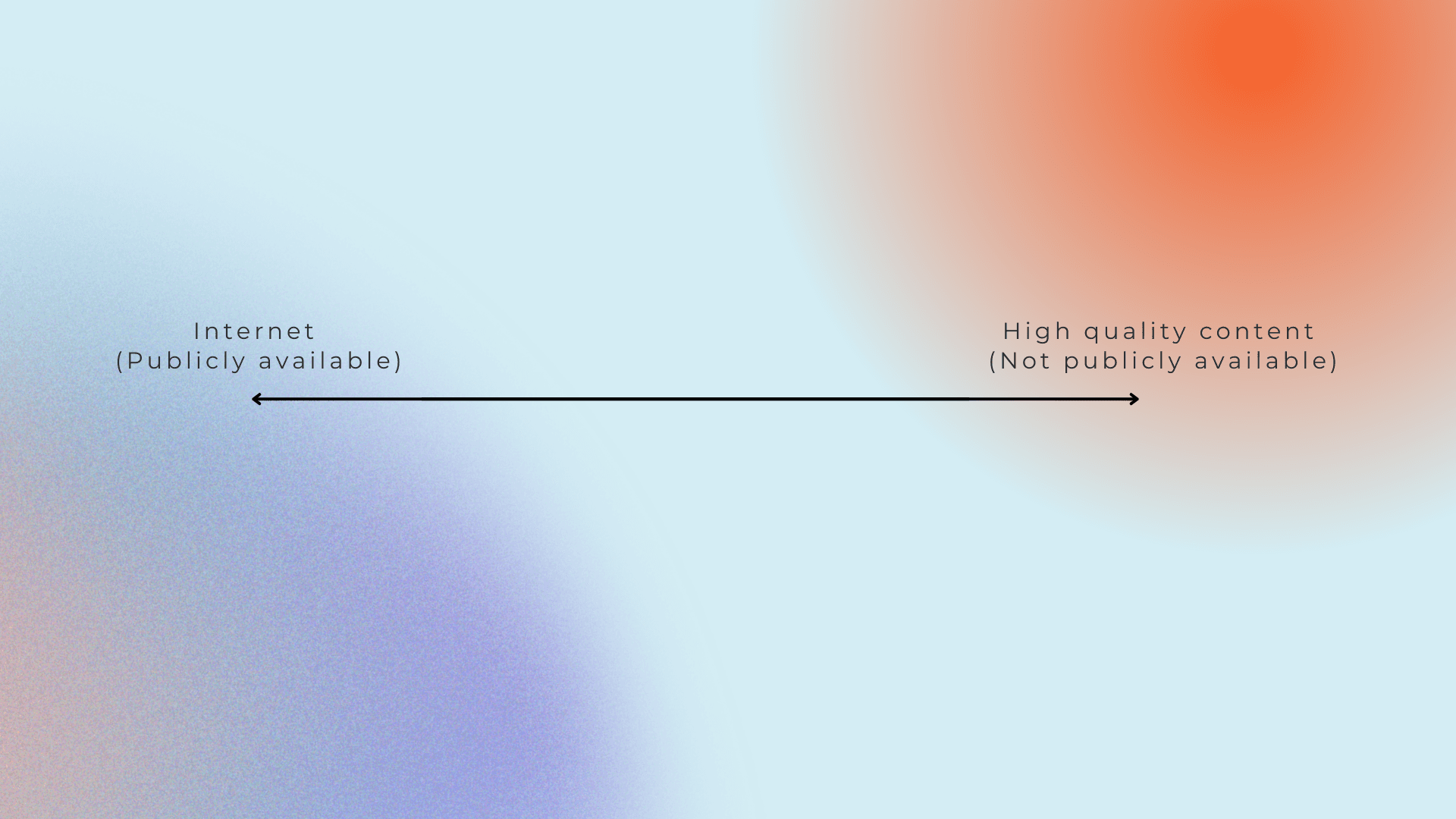
One end is open public, mostly produced by humans, and usually are very helpful for low-level queries, and real-time information. On the other end, we have the contents, that have been carefully crafted and researched on, they are mostly intellectual property of individuals or organizations.
Since the internet has been publicly available (that's exactly its value proposition!), it's been accessed for free by Google, Bing and some other search engines. Interacting with internet is changing as consumers prefer an answer instead of the famous classical 10-blue-links, and we can see its examples, Google AI overview and AI mode, Chatgpt Search, and etc.
The predominant approach for people has been like: finding 100 sources, skimming them to shrink it into 20 and then inspecting and reading carefully them to find a specific information. This is a very time consuming process, however now we can get that specific information by asking the right question.
On the other hand, as for high quality contents, the main reason that they are not publicly available has been "copyright". The story of the copyright protected contents is a bit tricky. They're not usually accessible freely, they're not in a single place to use, i.e. they're fragmented in lots of small and big knowledge repositories within a specific vertical, and sometime very niche.
Nouswise, aims to collect, unify and make these contents accessible through its Intelligent Interfaces, so the end users can get access to high quality data sources they've been using.
That says, Nouswise partners with high quality and authoritative content providers to enhance their target users' experience by using AI and benefiting from Nouswise network to make their knowledge source more complete. They can seamlessly integrate our answer engine as an API into their existing solution and enjoy Nouswise capabilities as well.
—————————————————————————————————————————————————
Our initiative of intelligent interfaces will create a new revenue stream for content providers, while enhancing the user experience when interacting with the content. Contact us if it sounds interesting to you via reza@nouswise.com or book a demo here.