Why KM Looks Different in 2026
Knowledge management used to be treated as internal housekeeping: organize the docs, keep the wiki updated, and hope people search before asking. That version is not enough anymore.
In 2026, knowledge management sits closer to the center of business operations. Teams need faster answers, cleaner onboarding, better customer experiences, and AI systems that can work from trusted material instead of guessing from general context.
The question is no longer whether a team has documentation. The question is whether the organization can turn its own knowledge into reliable answers at the moment people need them.
Platforms such as Nouswise support that shift by helping teams work with curated sources, ask grounded questions, save notes, and generate reusable outputs from trusted material. The best practices below help create the foundation that makes that kind of source-grounded AI useful.
1. Connect KM to Business Outcomes
Start every KM initiative with a business goal. A knowledge base without a goal becomes a folder system with nicer branding.
Good KM goals are specific:
Reduce support resolution time by improving troubleshooting content.
Shorten new hire onboarding with role-based learning paths.
Improve sales consistency with approved messaging and objection handling.
Preserve institutional knowledge from senior experts.
Reduce operational risk by making policies easier to find and verify.
When KM is tied to measurable outcomes, it is easier to earn leadership support, prioritize content, and prove impact.
2. Assign Clear Ownership
Knowledge decays when nobody owns it. Every important topic should have a named owner who is accountable for accuracy, updates, and review timing.
Create simple roles:
Owner: Accountable for a knowledge domain.
Contributor: Adds field expertise and new examples.
Reviewer: Checks accuracy, policy alignment, and quality.
Admin: Maintains taxonomy, permissions, and platform hygiene.
Ownership is especially important for AI-enabled knowledge work. If the source material is unclear or stale, the answers built from it become less reliable.
3. Create a Trusted Knowledge Hub
Siloed knowledge creates inconsistent answers. One team trusts a spreadsheet, another team uses a PDF, and a third team relies on what someone said in chat six months ago.
Bring the most important knowledge into a trusted hub where people know which sources are approved and current. This does not mean every file must live in one folder. It means the team needs one reliable way to search, retrieve, and verify the information that matters.
Nouswise is useful here because it is designed around trusted source libraries and verifiable answers. Instead of treating AI as a generic chatbot, teams can ground questions in the documents, notes, and source collections they already trust.
4. Design Content for Real Search Behavior
People rarely search using the perfect internal phrase. They search with the words they remember.
Improve findability by writing content around actual questions:
Use direct titles such as "How to escalate an enterprise support issue."
Keep articles focused on one task or decision.
Add synonyms and metadata for common search terms.
Use short sections with descriptive headings.
Include examples, edge cases, and links to related material.
Searchability is not cosmetic. It determines whether the knowledge base becomes part of daily work or quietly becomes shelfware.
5. Embed Knowledge Into Workflows
KM should meet people where work happens. If employees must stop what they are doing, open another system, and guess where something lives, adoption will suffer.
Look for ways to connect knowledge to:
Support workflows
Sales enablement
Onboarding paths
Research projects
Compliance reviews
Product and engineering runbooks
The closer knowledge is to the point of work, the more likely people are to use it and improve it.
6. Make Knowledge AI-Ready
AI can help teams move faster, but only if the underlying knowledge is structured and trustworthy.
To make content AI-ready:
Remove outdated duplicates.
Add clear ownership and review dates.
Separate facts, policies, procedures, and opinions.
Keep source documents organized by topic and authority.
Use consistent naming conventions and tags.
Preserve citations and links back to source material.
This is where Nouswise's source-grounded approach matters. Teams can ask questions over curated sources and work from answers that are connected back to the information behind them, which is critical when accuracy and traceability matter.
7. Reward Sharing, Not Hoarding
Knowledge sharing is a culture design problem. People will not contribute consistently if the process is painful or if contribution is invisible.
Encourage sharing by:
Making contribution templates simple.
Recognizing useful updates in team rituals.
Showing usage data to contributors.
Turning repeated questions into article requests.
Including knowledge quality in team goals.
The best KM programs make contribution feel like part of good work, not an extra chore.
8. Use Analytics to Improve Continuously
Publishing content is not the finish line. Knowledge needs maintenance.
Track the signals that reveal whether the system is working:
Search success rate
Top failed searches
Most-used articles
Articles overdue for review
Duplicate or conflicting content
Repeat questions in support or operations
Time to answer common questions
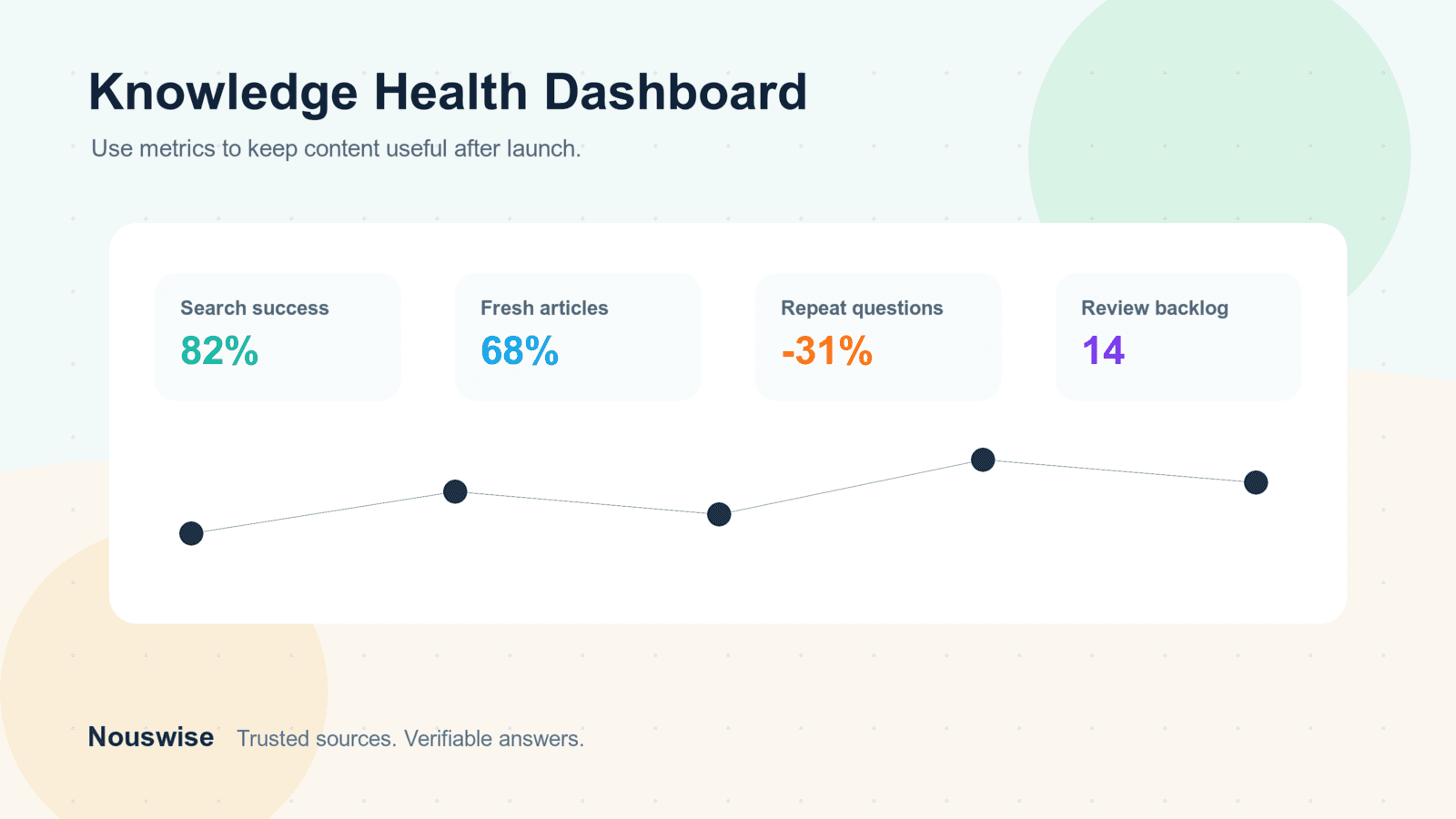
Review these metrics regularly. A quarterly audit can remove stale content, highlight gaps, and keep the knowledge base aligned with real work.
A Practical KM Checklist for 2026
Use this checklist before scaling your knowledge program:
A clear business outcome is attached to the KM initiative.
Each knowledge domain has an owner.
Important sources are centralized or connected through one trusted hub.
Articles use consistent templates, titles, and metadata.
Review cycles are defined for high-risk or high-value content.
Permissions protect sensitive information.
AI workflows are grounded in approved source material.
Teams can ask questions, save useful answers, and reuse outputs.
Analytics reveal gaps, stale content, and search failures.
Final Takeaway
Knowledge management in 2026 is about trust, speed, and reuse. The winning teams will not be the ones with the most documents. They will be the ones that can turn approved knowledge into accurate answers and practical outputs.
Nouswise is built for that future: a trusted AI research workspace where teams can work with curated sources, ask grounded questions, and turn institutional knowledge into something people can actually use.