The story ricocheting around California this winter has the neat, satisfying shape of a morality play. A sinister foreign mushroom and a few unlucky families with a tidy lesson delivered at the end like a judge’s gavel: stop foraging.
Since mid November, California Poison Control and public health agencies have been tracking what they’ve described as the largest cluster of mushroom poisonings the state has seen in decades, a chain of cases stretching from Northern California down the Central Coast, with an almost unthinkable toll: multiple liver transplants, several deaths, and dozens of hospitalizations tied to amatoxin poisoning after people ate wild mushrooms, often identified as Death Caps or close relatives.
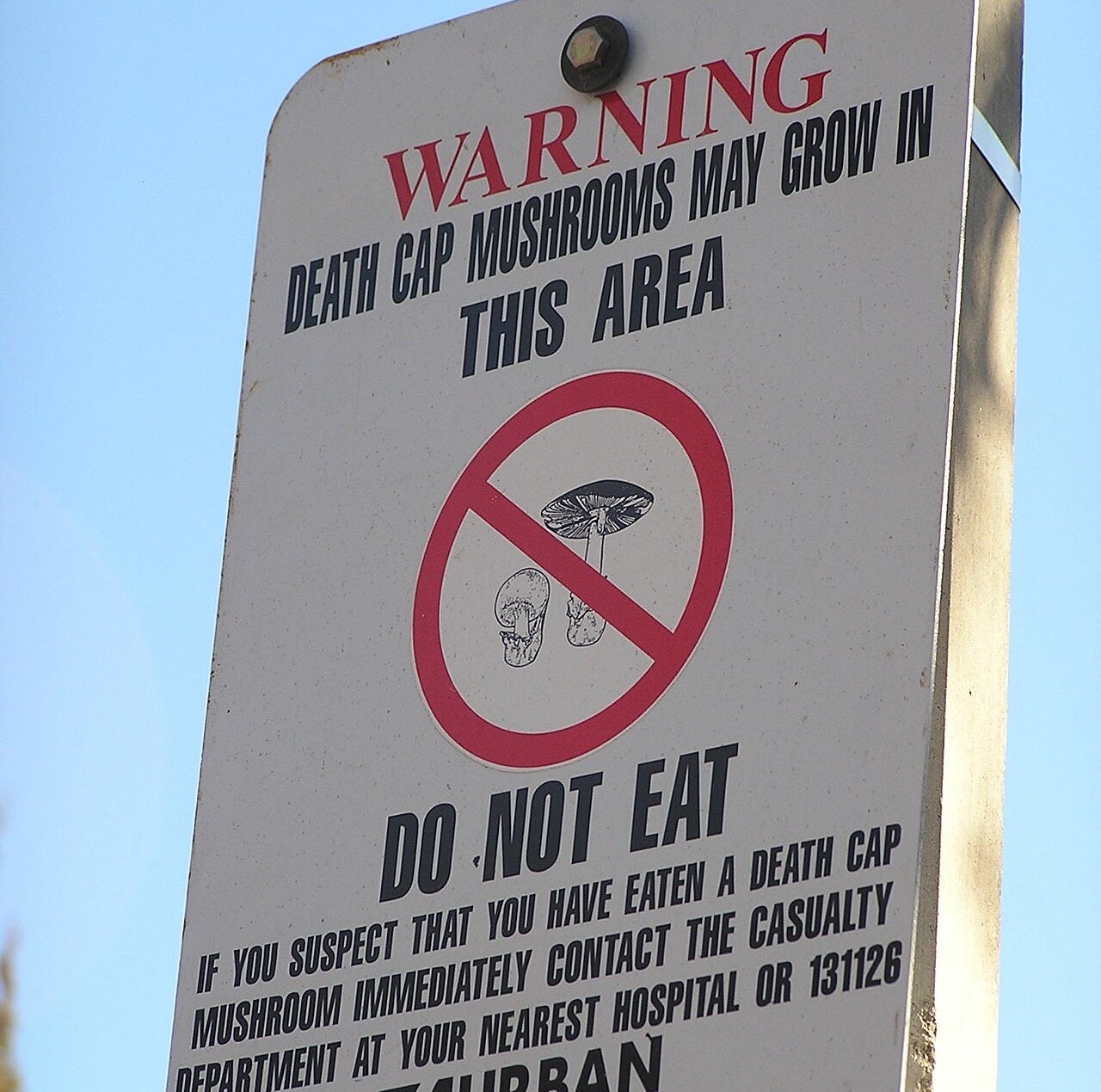
It reads, at first blush, like a horror story. The mushroom has a villain’s name, and the symptoms have a horror movie’s timing: people get violently sick, then sometimes improve just enough to think they’re in the clear, only to crash later as the liver injury reveals itself. The coverage follows the familiar arc: hyperbolic news stories about a tragic family meal lead to a public warning that lands with the rhetorical force of a slammed door. Don’t forage and don’t eat wild mushrooms.
But if you look closely at who is being harmed and why, the plot changes. The most vivid accounts do not come from the cast of wild food influencers you might expect, chasing foraging novelties and content in the woods. They come from working families and newcomers trying to keep a familiar tradition alive in an unfamiliar landscape. In one widely reported case, a couple in Salinas, originally from Oaxaca, gathered mushrooms that resembled the ones they’d known back home. Other cases, officials suggested, involved people mistaking local mushrooms for edible species from their countries of origin. Reporting and advisories have also noted language and access barriers, with many patients primarily speaking Spanish and other languages appearing in case reports.
Check out this article we made: Death Cap, Mushroom Poisonings, and Safe Foraging with Greg Marley
And then there’s the accused: the Death Cap, Amanita phalloides, cast as a mycological villain, a kind of silent assassin with a name that sounds like it was invented for a comic book. It is deadly, yes, but it’s also predictable, ecologically ordinary, and far less mysterious than the coverage implies. It fruits when conditions line up: rains, mild temperatures, and the right trees. This year those conditions did, and a banner season for mushrooms became, in the wrong hands, a banner season for poisonings.
The lesson here isn’t that the woods have turned hostile, or that foraging is an inherently reckless hobby in need of a blanket ban. The lesson is that knowledge is local. A mushroom that is safe in one region, one tradition, one language can become a lethal lookalike in another. California’s parks are full of convincing impostors, especially within the Amanita world, where edible “Caesar’s”-type mushrooms prized in Mexico can resemble dangerous relatives to the untrained eye. Foraging culture doesn’t deserve to be punished for an education gap; it deserves to be met with better outreach, better translation, more mycological literacy, and yes, a little more respect for a fungus that isn’t out to get anyone, only doing what it has always done: fruiting when it can, indifferent to the stories we tell about it.
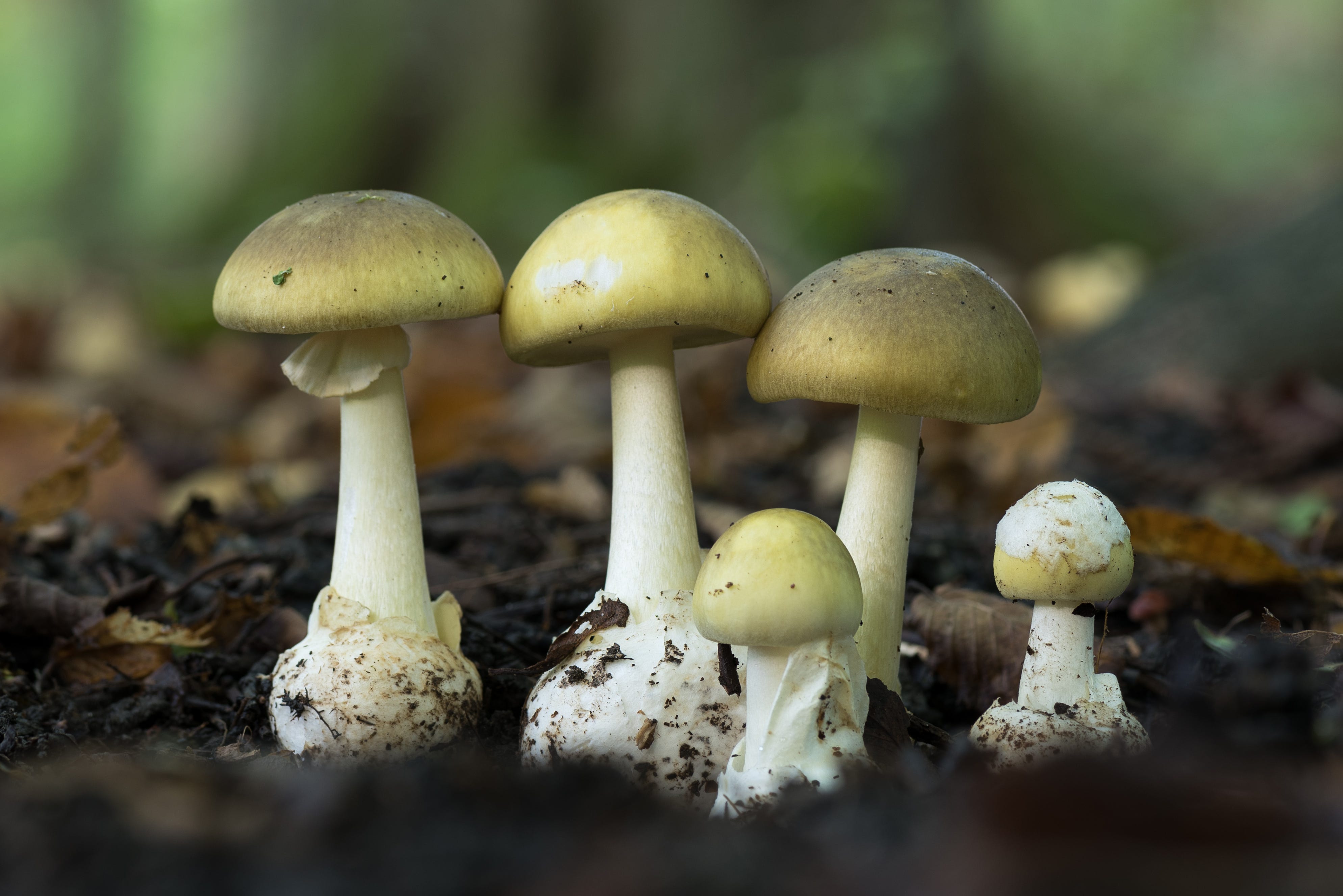
I realize the title sounds perverse and that “In defense of Death Caps” reads like a contrarian take. So let me be clear at the outset: I’m not defending the idea that Death Caps are safe because they’re not. Cooking doesn’t neutralize their toxins, and the wrong bite can set off a medical emergency that unfolds over days, not hours. If you’re a collector of wild foods, they are a species to know and be able to identify so that you can avoid putting them in your basket while foraging.
What I’m defending is something more basic: the idea that we can respond to this moment without turning mushrooms into a moral panic and foraging into a sin.
Telling people to stop foraging implies that the sensible relationship to the natural world is distance and that the price of safety is disengagement, that the only acceptable mushroom is the one shrink-wrapped in plastic or cultivated en masse.
That kind of blanket message spreads fast because it’s clean and appeals those who are less aware of their local mushroom ecologies. It doesn’t ask anyone to learn anything and it certainly doesn’t ask the media to approach the topic with any nuance. It also doesn’t ask public agencies to do the hard, unglamorous work of targeted education.
Part of what makes Amanita phalloides such a successful villain is that it is, in a visual sense, boring. It doesn’t look like danger, per sé. It looks like something that could plausibly be sautéed with garlic and folded into pasta. The cap can be pale green, yellowish, tan. It can even look white. If you’ve never learned the tell-tale signs of Amanita (the cup-like volva at the base, the ring on the stem, the white gills, the way a young specimen can be encased in an “egg”), you might not even know where to look for the giveaway.
And then there’s the toxin. Amatoxins are heat-stable. Dried, cooked, frozen, boiled, the hazard persists.
This is the point in the story where the media usually zooms in on the mushroom with a message like: “Even experts can be fooled.”
Bullshit. It’s true that the Death Cap is a master of passing as normal. But the “even experts” line tends to do a particular kind of cultural work. It implies that knowledge is futile and that identification is basically a coin flip. That the only rational posture is fear.
That’s not how mushroom identification works. Not for the people who actually do it well. Every seasoned mushroom forager I’ve ever met who learned their craft in North American forests can identify an Amanita in their sleep.
Experienced foragers are, almost without exception, conservative. Most will have a short list of species they’ll eat, often ones with distinctive features and low-risk lookalikes. They walk away from species that they aren’t 100% sure of. They don’t outsource their judgment to a photo app and most don’t gamble with species that actually do have poisonous look-alikes.
The people most at risk are not experts. They’re the folks stuck in the no-man’s land between cultural familiarity and local reality: people who know a mushroom tradition intimately, but not the specific mushrooms of the place they now live.
That’s why this outbreak has such a particular cruelty. It hits people who weren’t trying to push boundaries or eat a risky mushroom with toxic look-alikes.
For a lot of the families in these stories, the act of picking mushrooms isn’t a fashionable hobby. Instead, it’s something you grew up doing with your grandparents, the kind of knowledge passed down the way you learn what a good tomato looks like, or how to tell when corn is ready.
One of the more consistent patterns in Death Cap poisonings, not just in California but globally, is confusion with familiar edible mushrooms from elsewhere, a mismatch between a trusted mental template and a new landscape. In mycology circles, one often-cited example is confusion with the paddy straw mushroom, Volvariella volvacea, a cultivated edible mushroom in many Asian countries. In its button stage, it can resemble a young Death Cap enough to fool someone who is using cultural memory, not intimate knowledge of local species.
I actually visited a paddy straw mushroom farm in Thailand and made a video about it (pictured below is cordyceps, not paddy straw)
Even if you’ve never heard of or seen paddy straw mushrooms, you probably understand the dynamic. You move to a new place. You see a food that looks like the one you cooked at home and you assume the world is consistent. Paddy straw mushrooms do look like young amanita buttons to the untrained eye.
Mycological literacy is brutally local. The forest has dialects and what is obvious in one landscape can be lethal in another.
Somewhere along the way, the Death Cap picked up a second label, almost as potent as its toxins: invasive.
Once again, the story is too tidy. Amanita phalloides is native to Europe and introduced to North America. On the West Coast, the prevailing account is that it arrived with imported ornamental trees, then established itself and expanded its range through California’s coastal forests. Researchers have described two distinct introduced ranges in North America, one along the West Coast and another on the East Coast, with different patterns of spread and host association. And in the popular imagination, this turns into a simpler headline: “Death cap mushrooms are spreading across the country.”
But it’s worth asking what we’re really saying when we say “invasive,” and why the word feels so emotionally useful.
“Invasive” pretends to be a scientific term, but in public life it often behaves like a moral one. It suggests intent and wrongness. It also suggests that an ecosystem has a proper cast of characters, frozen in place, and that anything arriving later is a trespasser. It is, in other words, the language of border control applied to biology.
Sometimes, of course, “invasive” is a practical warning label. Introductions can be destructive and entire systems can be knocked out of balance. It’s not a fake concern, but one that is nuanced and inflected with moral dogmatism.
The Death Cap makes the label feel slippery. For one thing, it doesn’t behave like a cartoon invader. It forms ectomycorrhizal partnerships with trees, living in mutually beneficial relationships underground, doing the slow accounting work of forests: trading nutrients, moving water, threading itself into the fabric of soil. To the oak, it is not a villain, it’s a collaborator.
And then there’s the deeper problem with “invasive” as a worldview: it’s often a snapshot pretending to be a timeless truth. Ecology isn’t a still photograph; it’s more akin to a long exposure. Species ranges expand and contract and forests migrate. Shorelines move. Humans move things, intentionally and accidentally, and then time does what time does: it metabolizes the disturbance until the disturbance becomes, if not “natural,” at least normal.
Ask a landscape what was “native” five hundred years ago, and it will answer with silence. Ask what was “native” five thousand years ago, and the question becomes almost philosophical. At what point does a newcomer become a neighbor? At what point does “introduced” become “established,” and “established” become simply “here”?
In practice, “invasive” is often our way of confessing that we no longer feel part of our ecology. We relate to the living world like tourists who misplaced the guidebook. We remember, vaguely, that a place is supposed to look a certain way, and when it doesn’t, we reach for a word that frames the change as an external attack rather than the ongoing churn of life, climate, and human history. It’s also important to remember that balance often returns after a newcomer spreads rapidly through an ecological niche, it just may not happen on a timeline that fits with a human’s short term memory.
The Death Cap, ironically, becomes a symbol for that estrangement. Not only because it is introduced in parts of North America, but because it inspires a fear that spreads faster than the fungus itself. People hear “Death Cap” and their minds skip straight to “mushrooms are dangerous.” They hear “spreading” and conclude the woods are becoming hostile. It’s a kind of conceptual invasiveness: mycophobia colonizing the public imagination.
If anything deserves scrutiny here, it’s not the mushroom’s movement through a continent we’ve reshaped and replanted for centuries. It’s the way we respond to that movement by trying to step further away. As if the safest relationship to nature is to keep it at arm’s length, labeled and fenced and forbidden.
In December, the outbreak was already being described as exceptional. By January, state agencies were issuing updates like a grim tally. There were dozens of cases, deaths, and transplants.
What’s harder to measure is the secondary outbreak that follows the news coverage: a spike in mushroom fear that has nothing to do with Death Caps specifically.
Mycophobia is a strange phenomenon. People will eat raw oysters, climb ladders alone, text at stoplights, and then speak about mushrooms as if they were land mines. It’s shocking to me that there are more online searches for how to rid one’s landscape of mushrooms than to welcome them in.
This isn’t entirely irrational as fungal toxins are real. Misidentification can be catastrophic and a parent’s fear of a curious toddler or pet is worth consideration. But the public conversation tends to flatten all wild mushrooms into the danger category. And when you flatten the category, you erase the one thing that actually keeps people safe: specificity.
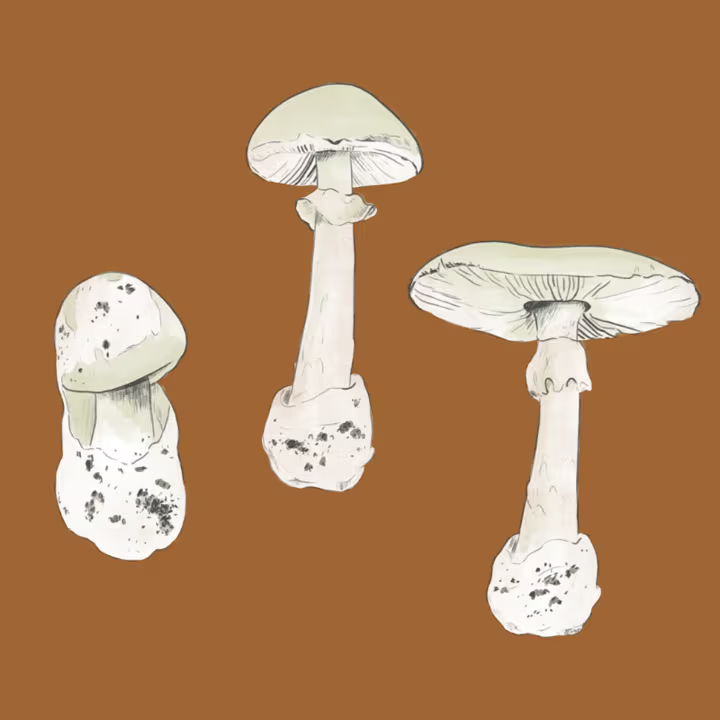
The Death Cap becomes not a particular species with particular identifying features and particular risk factors, but evidence that nature itself is untrustworthy.
And that’s where the moral panic sneaks in. Broad warnings not to forage at all may protect some beginners, but they also flatten a whole practice into taboo, while doing little to address the people that may be most likely to forage anyway, for cultural and economic reasons, without access to localized information.
If the goal is to reduce poisonings, the best possible intervention is not to frighten everyone away from mushrooms. It’s to shrink the gap between cultural tradition and local knowledge. It’s to help the new forager become a competent forager, or at least a cautious one.
There’s another reason I feel compelled to write in defense of a mushroom that can kill you. It’s because the Death Cap, as an organism, is being anthropomorphized into a malicious actor.
In reality, it’s just a fungus, doing fungusy things. It fruits when the weather cooperates. It lives in relationship with trees. It participates in nutrient cycles that keep forests alive.
Even the “invasive” framing, while not wrong in the technical sense of introduction, can distract from the practical truth: it’s here. It has been here for generations in some places. It is threaded into certain forest systems now. Moralizing it doesn’t change the fact that it will keep showing up year after year, as predictably as dandelions, European honey bees, and earthworms; all of which are considered invasive in the United States but have long since become normalized by humans living in ecosystems where they now exist.
Mushroom identification is tactile and it involves context like habitat, season, and associated trees. It involves the discipline to dig gently at the base, to check for an egg-like volva, to notice whether gills are attached, to check the color of the spores, notice whether bruising occurs, and whether the stem has a ring present.
Foraging is also communal. The safest foragers I know learned from other humans, in the woods, over time. They learned a single species at a time, becoming intimately aware of its ecology and characteristics. They learned that it’s fine, and common, to come home empty-handed. When in doubt, throw it out is the forager’s motto.
Not everyone will want to forage. Obviously, you don’t have to and can decide mushrooms are not your lane.
But telling everyone to stop is a different thing. It takes a practice that can be done safely and turns it into a taboo. It also leaves the people most at risk, the ones bridging cultures and landscapes, without the support and education that would keep them alive.
Foraging, when done responsibly and with adequate knowledge, is one of the most fulfilling means of connecting to nature, one’s local ecology, and what it means to be human.
People carry traditions across borders and ecosystems don’t come with subtitles. When those two things collide, some mistakes are catastrophic. The job of a society isn’t to shame the tradition out of existence. It’s to build the translation layer.
The Death Cap isn’t the villain, but it might be the stress test. It exposes how little mycological education exists in the public square, how unevenly information reaches people, how quickly the media defaults to fear, and how tempting it is for institutions to choose a slogan over a strategy.
It also exposes something gentler, if you’re willing to see it: that humans still want a relationship with the living world. They still want to gather food. They still want to participate in their native ecology.
That desire is not something to extinguish. The woods are not hostile; they’re indifferent. They’re also full of gifts and curiosities and thousands of species doing their quiet work as they have for milenia. Mushrooms will keep fruiting after rain. They will keep offering abundance that can feed you or harm you, depending on what you know.
The question is whether we respond with panic, or with understanding. The Death Cap will not change its behavior. It will continue to do what it has always done. We, on the other hand, can get smarter.
We can make it easier for a newcomer to learn what a local deadly mushroom looks like before it ends up in a pan. We can design warnings that don’t just say “no,” but teach “why.” We can invest in multilingual outreach that treats people like neighbors, not problems.
And we can stop pretending that the only safe relationship to nature is fear.
That, to me, is the real defense of Death Caps: not that they’re harmless, but that they’re not a reason to abandon a practice as old as humans. They are a reason to respect the local language of the forest, and to teach it widely, before the next banner season arrives.