This isn’t a post to showcase expertise, and it’s not a theoretical review either. It’s mainly things I keep committing to and executing on the 1st of December 2025.

As I mentioned before, I started working on Extruct AI, the startup that largely combines the context of this blog and my previous background.
Today, we’re building a company search product, where we help find companies across the web with natural language and solve related issues like normalization, hierarchy, entity-relationships, and so on.
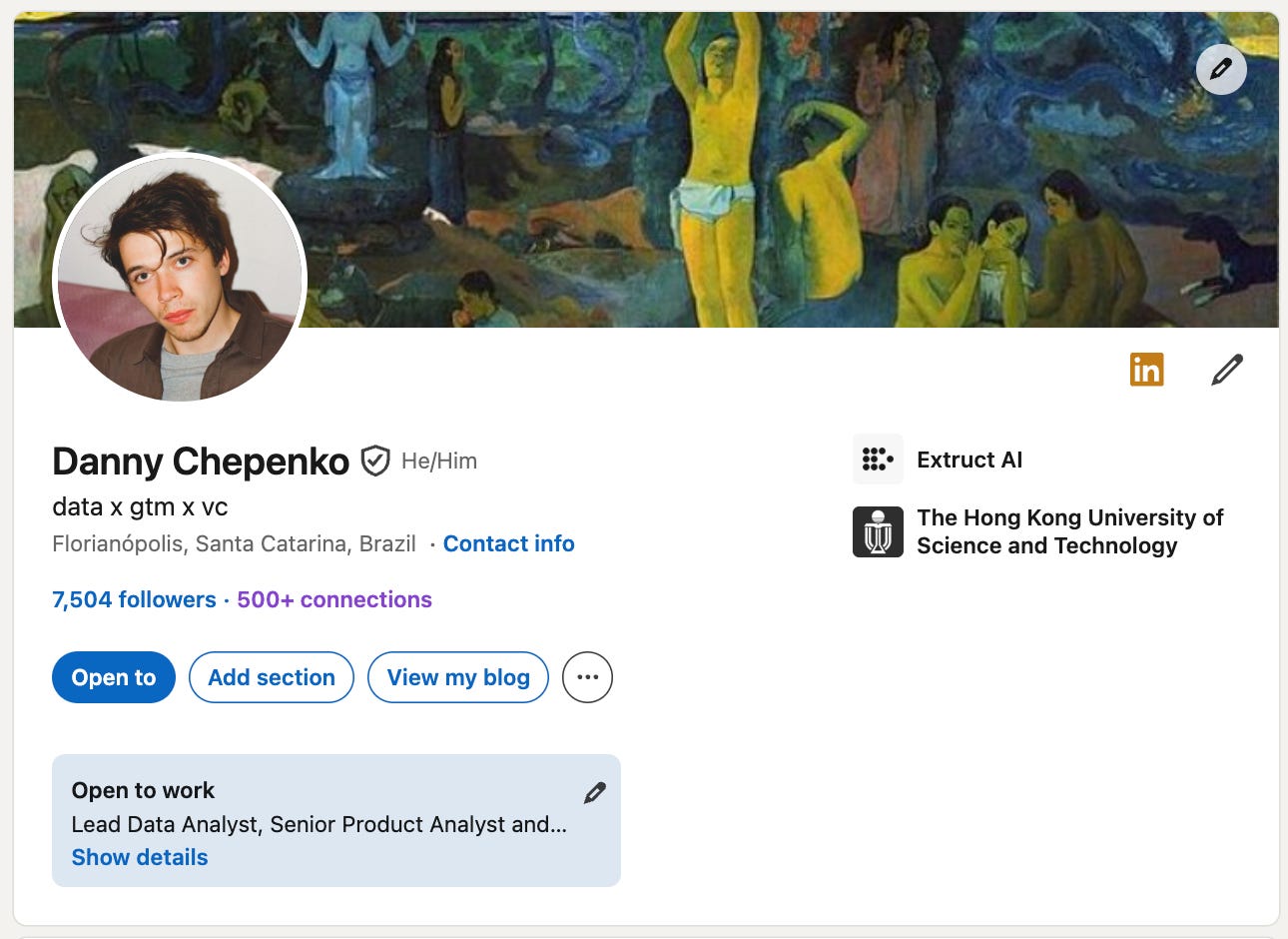
As you can see, the positioning isn’t ideal yet. It’s the problem I wake up to every Monday.
The harsh reality is that it’s easy to confuse fuzzy positioning with a lack of PMF. Often, the product works, but the market just doesn’t understand what you are. I’ve learned that clear positioning is just a mirror of your own certainty.
I don’t think there’s a silver bullet to nail positioning. All the advice you read elsewhere is legit and makes sense here: talk with customers, iterate, etc.
But in my opinion, in the pre-PMF stage, your pricing page is the truest mirror of your positioning. Pricing strategy forces you to choose a lane, and I like to design the copy and other assets from that.
I look at two things at product x ICP: capacity to pay and willingness to pay.
The multiplication of these two parameters should be adjusted based on the product, distribution, and GTM motion. We have a set of hypotheses ranging from prosumers all the way up to large enterprises.
So I’m trying to be a little opportunistic with pricing. Sometimes I have to name a price that feels slightly uncomfortable to you.
But it’s super appealing to name a low price because you don’t think you’re good enough yet. I don’t want to sound like your biz coach from Instagram, but my main learning is that pricing arguments are the best instrument to test demand and nail focus.
Writing about channels is hard because if you spend a decent amount of time on LinkedIn (like me), you may see that all channels are either dead or they’re just the only one that’s performing.
So our goal is to find 10–100 customers for every hypothesis. You need to do anything that helps land those first deals. No channel is sacred.
In the GTM hustle mode, I focus on 3–4 channels simultaneously and try to learn what sticks better with the audience—how I can combine them together.
Experimentation is also about navigating the edges of tech. We’re in the middle of a distribution shift. New windows keep opening and closing. I don’t think we need to be deep in sand with one channel here.
What I’m running now
Trusted content (like this): long-form, opinionated, and specific enough to be useful.
Founder brand on LinkedIn: direct communication beats polished corporate.
AI SEO: structured content that answers real questions and refreshes automatically.
Cold outreach: still the fastest way to test positioning with real buyers.
Yes, you’re reading it here, so it probably works.
And it works because I somehow make you trust that it’s not the lame stuff you’d easily write with ChatGPT. It takes time to write. It’s the place where I share my experiences.
Attention is getting harder. It’s never been harder to get someone’s attention.
I realized that the skill I’ve been honing over the last year is basically copywriting. I’ve realized how foolish we were to choose claims like “LLM killed copywriting as a profession.”
As the tech person, I’ve never understood the art of good copy and text narrative. Yes, LLM helps a lot, but taste and skill are super subjective and unique, the last skills a human being needs to develop.
So my ideas are what make me authentically human in all this flood of AI-generated BS. I write every word myself. AI helps me do research and edit, especially since English is not my mother tongue.
Honestly, I’m a bit afraid to put any tangible metric here. I like the newsletter as it gives me more options on distribution, but the core idea is nothing new. I plan to use algorithm feeds for distribution, especially along with other channels.
But your content is only as good as your distribution. It would be tempting to say that I know the answer. What works today? Sharing articles across customers in DMs, niche communities, and algorithmic feeds (YouTube, Twitter, LinkedIn).
Roughly 1 in 5 prospects who get on a call with me reference something I’ve posted. That’s the true ROI; it’s about reputation and trust. An authentic voice can now drive reach at a scale PR never could - direct communication from leaders outperforms polished corporate messaging.
I think the main idea here is: don’t be boring. It’s not about shitposting, but more about having a point of view and being very opinionated and direct.
My strategy:
Post 3–4 pieces a week
Repurpose existing content. I created various instructional prompts to do it faster. All my content pieces are “engineered” with Cursor. I write an md file and then ask it to polish and edit. I haven’t found a better tool that can give me flexibility over the post.
Engage with the posts of 5-10 thought leaders in the space
Don’t steal content from influencers. Try building my own counterintuitive PoV. I don’t need to chase virality for the sake of virality.
In my opinion, growing LinkedIn makes sense, and I’m quite certain that I will see positive outcomes in my vertical if I scale the account 3x.
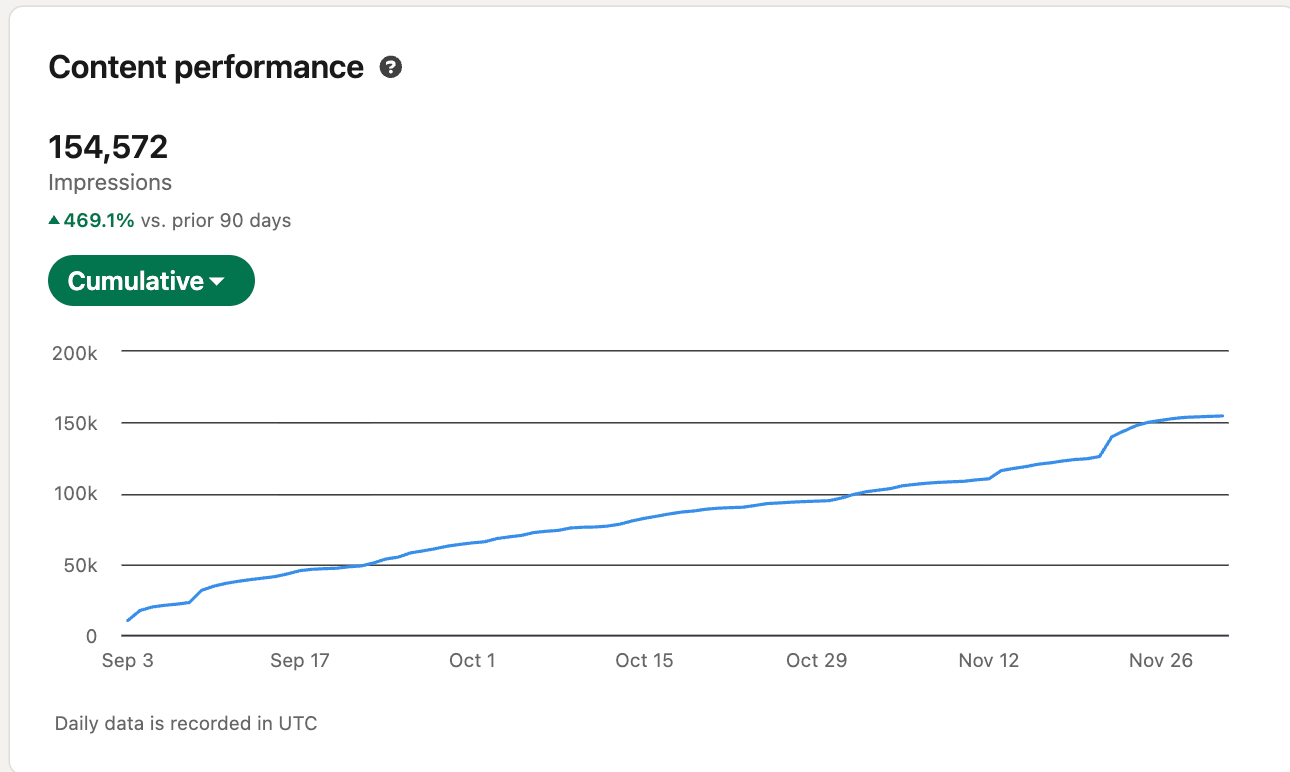
Honestly, idk if cumulative content performance is a good metric here.
Since people in our product work with company domains, the simplest thing I did was publicly publish all the data points we’ve researched for those domains. I generate all of this directly in Cursor. I connect straight to the production DB, run post-processing scripts, and mass-generate static pages.
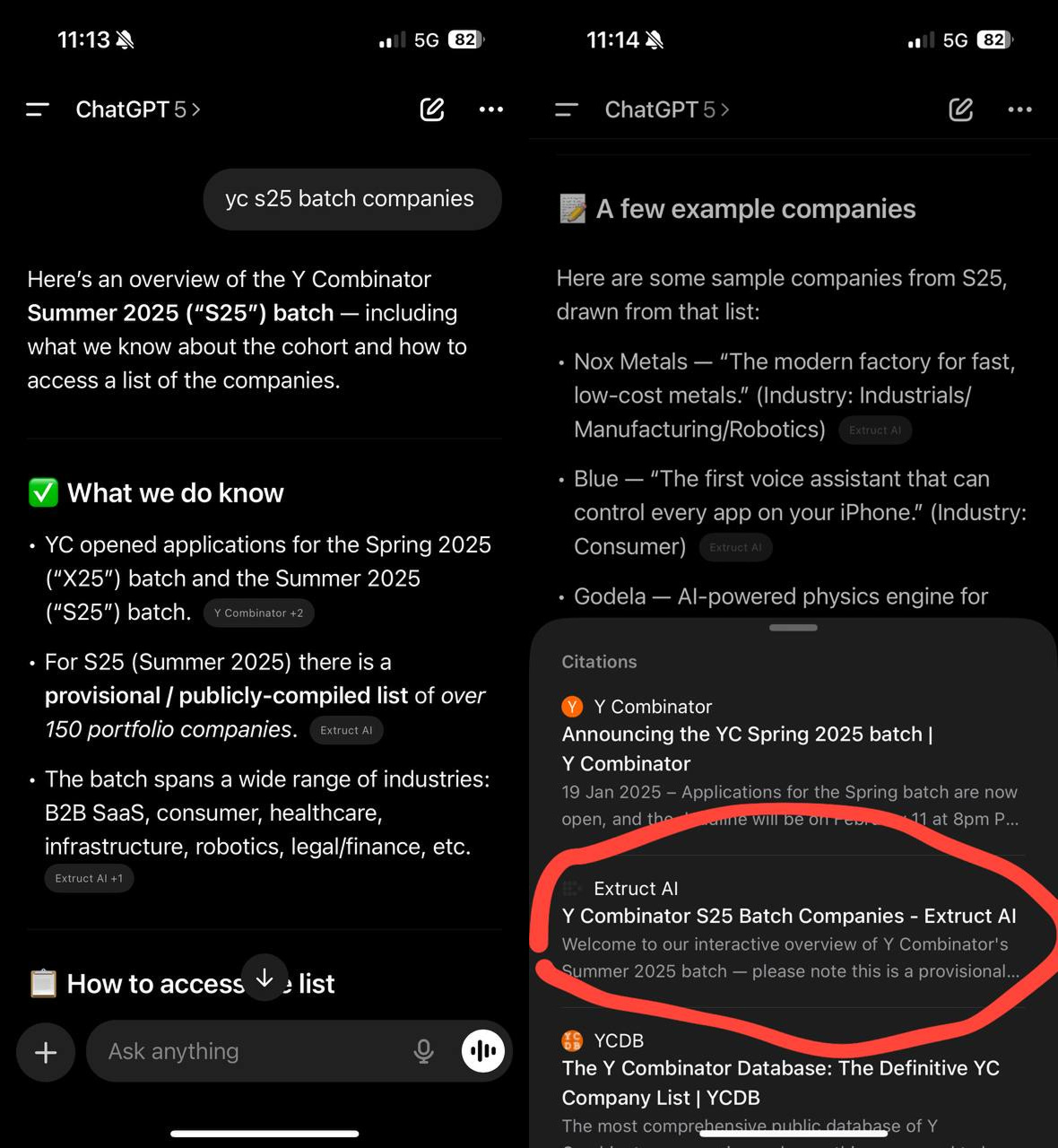
Now I’m thinking about how to amplify this. I briefly looked at 20+ tools that promise “AI visibility” or “GEO” (Generative Engine Optimization).
The pattern is usually identical: Intent modeling → generate prompts based on topics → push prompts to LLM chatbots.
Also, it feels like they’re just hitting a web search API rather than emulating real user queries, which is technically different products
I think it’s super handy to know how the intent is generated. It can be a compelling loop that spans across other assets—landing pages, copywriting, and the product itself (especially in the case of a pre-PMF startup).
But I’m not sure how AI visibility tools are helpful here. They don’t show query volume per prompt. I get that it’s hard to extract, but without it, how do I know anyone is actually using that prompt? And the long tail of intents is even more valuable.
It seems the fundamentals of SEO still apply. Readability, domain trust, author authority (E-E-A-T), and backlinks all matter for citation.
Watch what the LLM cites in its web search results. That at least tells you what content is “winning” and where you can write to fill the gaps. I think that’s why AirOps is doing better than generic AI visibility startups.
Some say that the days of cold outreach are over. I tend to think otherwise. You should keep experimenting with anything.
I don’t have a better test for positioning other than cold outreach.
The lame messaging is out. The well-researched messaging, using signals, intents, etc., is very relevant.
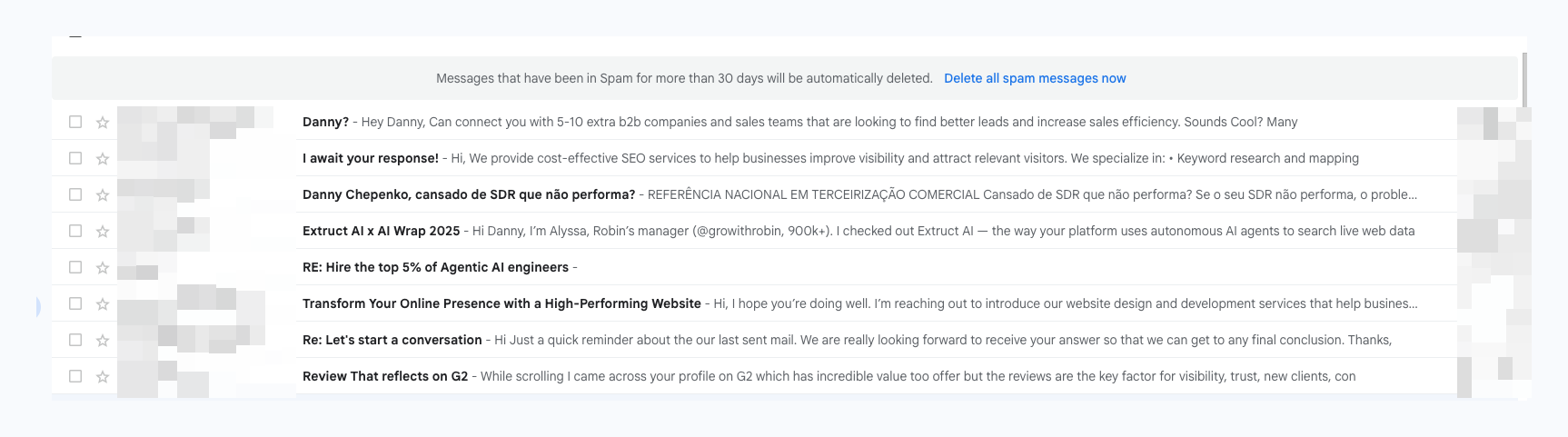
When you think that everyone is super swift on cold outreach, no, that’s the cold email I received on Dec 25.
A couple of notes on lead gen agencies:
Using an agency is fine. If someone says “a real founder should do everything themselves,” they probably never sold anything themselves outside their PS3 on eBay.
What the founder must do:
Close the deals
Find patterns
Own the GTM motion
Where an agency can help:
List building (enrichment, data prep, reporting)
Being a second brain on copy
I’m not there yet, but searching for the right combo here. I’m not trusting AI SDRs here, or put it differently, I don’t imagine they can do the work better, not in the human-in-the-loop way.
I don’t use LinkedIn DMs for outreach here. I think it’s better to either use a very targeted account-based approach or focus on inbound (see #2 above). I know people can be more responsive on LinkedIn, but it’s important to keep things controlled and not overdo it.
Additionally, most automation tools in this space are pretty sketchy, so I prefer to avoid them.
I was at some niche (up to 100 people) events this year, and they were remarkably good. I’m eyeing the trade shows, especially if selling to real sectors or something like that. For someone working from the four walls, it’s quite refreshing as well.
Reddit engagement: Direct conversations with your ICP in their natural habitat. It’s also a goldmine for AI SEO: Reddit has incredibly high domain trust and is frequently cited by LLMs as a primary source.
B2B influencers: I see that as an amplifier of personal brand on LinkedIn that can help grow an account in product branding
The funny thing about GTM hustle mode is that it’s messy by design. You’re testing positioning, pricing, and channels simultaneously. The goal isn’t to get it perfect. The goal is to learn fast enough that you can course-correct before you run out of runway.
Hope this text could be useful in a year, when I look back and see what went wrong and what didn’t.