
Last week, I was investigating a fishy phenomenon1 appearing in the research literature, which I dubbed the Mysterium verbi distorti.
In brief, weird Latin names for species, sometimes incorrect, have been popping up in papers across a variety of domains and publishers in science. Cool! Weird! Both?
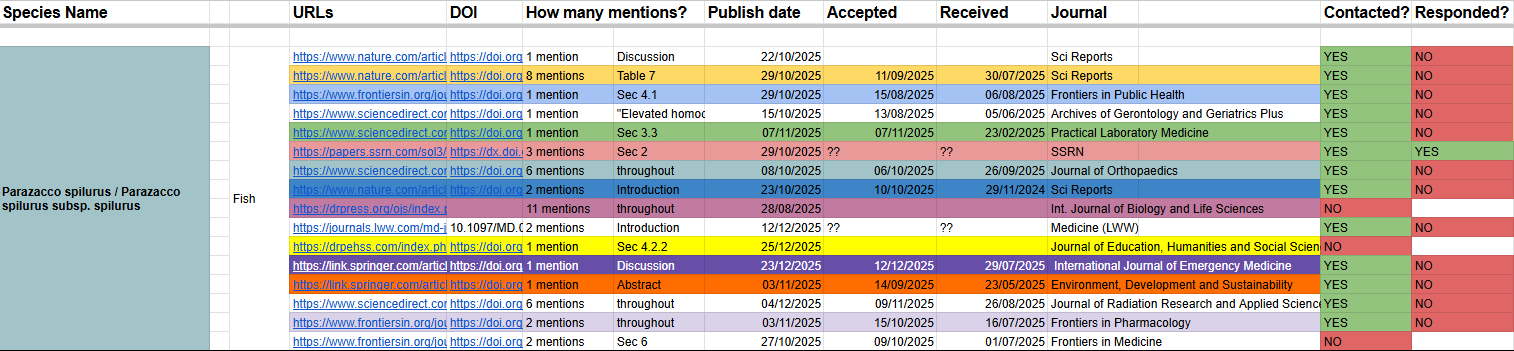
Predominantly, these come from Chinese institutions. The Latin names are not related to the content of the papers, with one — Parazacco spilurus subsp. spilurus, a slightly-incorrect species name for the fish known as a predaceous chub — being found across almost three dozen papers.
After I sent the newsletter out into the world, there were a lot of suggestions about what might have happened. One of the most reasonable takes was the species names resulted from a Chinese —> English translation tool that was going haywire.
I’d been looking into the possibility of some sort of haywire AI tool from the beginning because… well, isn’t that everything we see these days on the internet? In particular, the insertions just looked like they could be hallucinations or tortured phrases that were missed before publication. It might be especially hard to pick them up if you’re a non-native speaker.
So I dived in. Dove in? Splashed in? Whatever. The spreadsheets were out.
Over the last couple of weeks, I’ve been speaking with Wu Guangheng, founder of the 5GH Foundation, which promotes responsible research in China. They’ve provided a lot of background information and even attempted to recapitulate the errors.2 That hasn’t been successful, but a few lines of evidence seem to be converging… I’ve also had assistance from Wing Kuang, a journalist in Australia, who has been very helpful!
We haven’t come to a definitive conclusion, but we’re much closer to an answer — and yet, maybe further away, too.
Mysterium verbi distorti II

We return to the mystery. When I posted the mystery on Bluesky, there were some responses with good hypotheses for the insertions.
One, from Pekka Lund (pekka.bsky.social) via Google Gemini3, suggested this was a “Machine Translation error caused by a ‘dirty’ or ‘greedy’ autocomplete function in a specific translation software (likely an LLM-based tool or a plugin for WPS Office) widely used in China”.
It suggested that some of the Chinese characters were being filled in when translated to English. It said the Chinese Name for the predaceous chub was 異鱲 (yì liè) or 异𫚭 in Simplified — and the character yì can also mean “different”, “abnormal” or “hereto-” and so, presumably, translating those words from Chinese to English lands you in verbi distorti territory.
Similarly, Utetheisa kong — Kong (空) in Chinese, meaning “empty” or “space” or “air”. And some papers showed that Utetheisa kong appeared in places where there was discussion about space or aviation (presumably 航空 (hángkōng) - aviation) and in reference to smart air conditioners.4
This was a good hypothesis to probe! It provided a mechanism to work with. But how this actually occurred was the next thing. What was the software or tool responsible?
Of the two dozen papers I was interested in, I had contacted the authors of about 15. Only three got back to me. But two separate authors came with one explanation: WPS Office.
WPS Office is a Chinese-developed software that functions basically like Microsoft Office.5 You can do writing in its version of Word, PowerPoint stuff in Presentations and a bunch of spreadsheet stuff in Spreadsheets (that’s the W.P.S part).
An author of the preprint paper “The Impact of MMP-8 and MMP-12 on Gliosis in the Prolonged Regeneration of Optic Nerve Injury in Sprague-Dawley Rats”,6 which features both Parazacco references and a reference to Castanopsis chinensis, responded to me on January 7. This was their response:
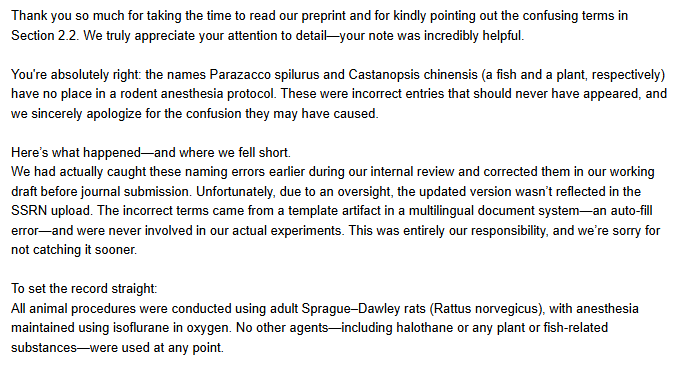
When I asked what the “template artifact” was, I got this (bolded by me):
Why this occurred—and how we can help prevent it moving forward: Many labs in our region use shared Word/WPS phrase libraries, where short text triggers are convenient but can occasionally conflict. If two entries have similar triggers—especially in multilingual environments—the most recently used one may be auto-inserted by mistake. That’s exactly what happened here.
For clarity: this was not generated by AI.
The incorrect phrases came directly from fixed AutoText snippets within our own template, and our version history confirms they were inserted manually through standard Word functions. As per our lab policy, we do not allow large language models to write or edit any procedural methods.
There it is: A WPS phrase library may be our candidate. Sold. Although I wasn’t Sold-Sold. The text here had seemingly come through a generative AI tool, which is reasonable, given the author was not conversing in their mother tongue (I presume!). But it also seemed to suggest these were AutoText insertions — which can be used in Word or WPS to quickly add in commonly used words or terms. A little different to what I expected, the researcher was essentially saying they’d typed out a shortcut, that then automatically inserted a matching entry.
In this case, the researcher provided these triggers for AutoText: One was ISO4. Another was BIO_ECO_SPECIES_SHORT. How these two could be mixed up confuses me, but maybe I am misunderstanding what this templating oversight could actually be. I would love to hear from someone familiar with Word or WPS that could explain this!
This one had a fair few insertions throughout. In total, it had six mentions of Parazacco spilurus subsp. spilurus and 11 mentions of Broussonetia papyrifera. Quite a lot. In fact, it’s the most mentions of the latter that I’ve found.
The paper is titled “Bibliometric analysis of mesenchymal stem cell-derived extracellular vesicles in the treatment of osteoarthritis” and it was published in the Journal of Orthopaedics.
In this case, Broussonetia papyrifera refers to the Paper Mulberry, a plant with the Chinese name of 構樹 (gòu shù) — or Simplified 构树. The characters here can mean something like “construct” or “build” or “outline” or “framework”. This seems to make sense in the context of the paper.
One of the authors responded to me and explained, in Chinese, via translation:
The reason for the problem you pointed out is that there was an issue with my translation software. My English is very poor, and I write my thesis in Chinese first and then translate it into English. Due to the lack of corresponding financial support, I don’t have the conditions to have experts polish it. I sincerely apologize for causing any trouble.
And when I asked about the software? WPS built-in translation software!
So: Did WPS recently update a model, change a model, sometime around August last year?
I’ve reached out to the office and hope to find out more from them soon. This is kind of the last puzzle piece: Why only since August?
And there is one extra wrinkle.
If this is a translation tool error that’s creeped in, how might we explain this paper in MDPI’s publication, Foods, which features no Chinese authors. It’s titled:
Beyond Sugar: A Holistic Review of Sweeteners and Their Role in Modern Nutrition
The paper is a review about non-nutritional sweeteners (NNS) and the three authors here all appear to be from Romania.7
This paper features just one instance of a verbi distorti — it uses Utetheisa kong, our non-existent moth species. In Section 7.5. Environmental Sustainability, the text reads:
Pollinators such as honeybees (Apis mellifera) and bumblebees (Bombus spp.) may experience altered foraging behavior [251], reduced learning and memory [252], or disruptions in gut microbiota when exposed to NNS-contaminated nectar [251], potentially affecting colony growth and pollination services. Other floral-visiting insects, including butterflies, moths like Utetheisa Kong white [253], and hoverflies, may have reduced feeding efficiency or altered visitation patterns, while sugar-feeding ants could show changes in food preference and colony development [254].
A few things here:
This has placed the word “white” in the text. That seems to align with Chinese characters around empty spaces or blanks — which Utetheisa kong has been placed in before, so makes sense.
But these references are weird.
For instance [251] links to a paper titled “What one genus of showy moths can say about migration, adaptation, and wing pattern” and it does speak about Utetheisa ornatrix! However, it mentions nothing about altered foraging behaviour in bees or “disruptions in gut microbiota when exposed to NNS-contaminated nectar”.
Reference [252] discusses air pollutants ability to affect pollination and references some papers where diesel exhaust can impair learning and memory — but this has nothing to do with NNS.
Reference [253] is a reference to “Future Market Insights” on the Global Artificial Sweeteners Market here. It does not reference any moths!
Reference [254], purportedly about sugar-feeding ants … also goes to a market intelligence assessment by “Mordor Intelligence” here. No ants were harmed in the making of that report.
SO: If the explanations provided around translating from Chinese to English with WPS make sense, stack up and are the sole reason, how can this part be explained? One theory may be that the Academic Editor, Fayin Ye, who appears to be Chinese, could have inadvertently introduced this during editing? I am not suggesting this! It would seem weird. But given this seems to have arisen from mistranslations + additions, it’s about the only link I can find right now.8
Nevertheless, the strange references suggest that the paper needs another look. MDPI’s Research Integrity team tell me this paper is now under investigation by the Editorial Office at Foods.
Signs Point to Yes.
With everything we know now, can we definitively say that these errors are not research integrity breaches? I think they are likely generated and translated innocently. However, the fact these have made it into a variety of publishers and journals and the papers are low-quality, with repeated phrases and poor formatting and sometimes very circular discussions, suggests to me that there are some fairly inefficient review processes taking place that are letting some silly science errors slip through.
In addition, in articles published in journals such as Frontiers, there is a statement that reads “The authors declare that no Gen AI was used in the creation of this manuscript.” But WPS Office sells its translation tools as AI plugins based on Google and ChatGPT.
So I do believe that the verbi distorti may still hint at some deeper problems, some messier problems — for now, it’s a scientific beige flag. Moreover, there are cases I haven’t documented in these two investigative pieces that seem to be associated with predatory journals and perhaps even paper mills. That’s taking a little longer to work through!
But I am going to keep digging all the same…
Until next week!
no bs.