I made a resolution this year to listen to less algorithmically recommended music (Spotify radios, Daily Mixes, Discover Weekly, and the like). These playlists were becoming my primary source of music discovery, and I felt like I was missing out on a world of songs or artists that could potentially be favorites, but I’d never know. I also felt that I wasn’t actually sitting with my music but cycling through it like water, not only devaluing its role in my life but, especially in the case of AI-recommended music, pushing me further away from being able to understand and describe my own taste. This promise turned into a project of tracking my music discovery – documenting the songs I save or buy, where I found them, and whether they were algorithmically or organically recommended. This is what I’ve found over the last four months.
As an elder Gen Z-er, my musical coming-of-age happened sometime between the end of the CD era and Spotify’s rise in 2013. I would spend hours curating the perfect mixtape (and meticulously decorating the CD case for it), but I was mostly exposed to whatever B96 radio was playing and my parents’ iTunes library. Enter Spotify, and I had endless, instant access to music, making me feel like I had complete control over my taste for the first time.
However, this was all before the “attention economy” was a thing, before Spotify needed ways to keep you streaming. Spotify has since inundated the app with algorithmically-driven personalization features, since personalization is what keeps you streaming – the more you engage, the more data Spotify collects, helping it build your “taste profile” and serve you something before you even ask. The whole point of this recommender system is to surface music you’ll like, which can really get it right sometimes, but what happens when you over-rely on these personalization features for your music discovery? The algorithm gets sharp enough at predicting your taste that it stops introducing anything outside of it, just reflecting your taste back at you, ever so slightly repackaged.
It’s no secret in the music industry that Spotify’s relationships with the major labels don’t help diversify its recommendations – one study from industry consultancy Music Tomorrow found that over four years (2018-2022), major labels accounted for nearly 70%-87% of the music featured in their most popular playlists like New Music Friday, Today’s Top Hits, and Pop Rising. The algorithm already favors what’s culturally dominant, so when that’s layered on top of label politics, mainstream artists get amplified while smaller ones get hidden, and users lose out even more on interesting discoveries.
There are also way more organic music discovery sources than algorithmic, which is why it’s astounding how pervasive AI-recommended music is in today’s world of music engagement.1 This suggests people want convenience, and Spotify is reinforcing this through design. Since going public in 2018, it began shifting consumption out of other places in the app and into the home page. “It was less of a focus on the library, less of a focus on search, more of a focus on getting it right when someone opens the app,” a former Spotify employee said about the initiative.2 In other words, it was less about finding something new but having it delivered to you, little to no effort required. Even if Spotify isn’t narrowing your taste, it’s not giving you a strong start to try exploring and actually understanding it yourself.
So, that’s kind of The Reason Why I’m Doing All This. As we grow accustomed to the ease of shuffling a generated playlist, we 1) forget that discovering music is a conscious – dare I say therapeutic – act and 2) remove any meaningful context behind the music. Opting for an AI-generated playlist versus one from a person (whether or not you know them) takes you another degree away from the personal or shared histories, experiences, and appreciations attached to the music. Also, personally curating or recommending songs reveal our taste, and therefore a part of ourselves, so we have a vested interest in what we put forward. The algorithm assumes no risk, simply offering what’s mathematically sound.
I’m on a mission to find and listen to music via human sources – public playlists by friends and music curators, online radio stations, YouTube DJ sets, independent blog recommendations, etc. I want to see what this would do not only to my taste but to my overall behaviors and habits around music engagement. I want to know, how do we define and evolve our own music taste when the very discovery and listening happen under the mostly quantitative rules and value metrics set up by profit-driven streaming services? I LITERALLY CAN’T HELP BUT WONDER.
You can skip this part if you don’t care how I tracked my listening and discovery, totally cool.
I have a light background in UX research, but I’m still learning – if there are better ways to do things throughout my methods, let me know! This isn’t perfect because it’s impossible to track every single song I’ve listened to, nor do I want to scrutinize my behavior that intensely because, besides that not being fun, it would be the opposite of my typical music engagement behaviors. So, this “study” is bound to have data gaps or misrememberings. All I can say is, just trust me. You know where my heart is.
works cited
“So, Nickie, HOW did you track your listening?” Thank you so much for asking.
To track my listening sources: Whenever I put on a radio show, a YouTube DJ set, or an album on Spotify or my record player, I record it in my handy dandy Oasis notebook (you should get one if you don’t have one btw). I write down the day, what I’m listening to (i.e., radio show name, mix/public playlist name, DJ set name, album name), the source (i.e., where I found it, but if I streamed it on Spotify, I made note of that because this project is so grounded in Spotify usage), and the length of the work. Yes, there have been instances when I listened to a Spotify radio or checked out my Discover Weekly, and I made sure to note that. Despite my best efforts to not listen to algorithmically recommended music, there were times when I wanted to, and I think the most important part of this “study” is to stay true to what I decided to listen to that day. What I’m not recording here:
I’m not recording times I listen to my playlists. That would be most of the time, and I don’t want to be monitoring my music consumption that hard out of fear of making this a burden.
I don’t make note of repeat listens, since the point is to see where my music was coming from. Also, for reasons above.
I sometimes just forget to write down something I listened to. Purely human error, what are ya gonna do.
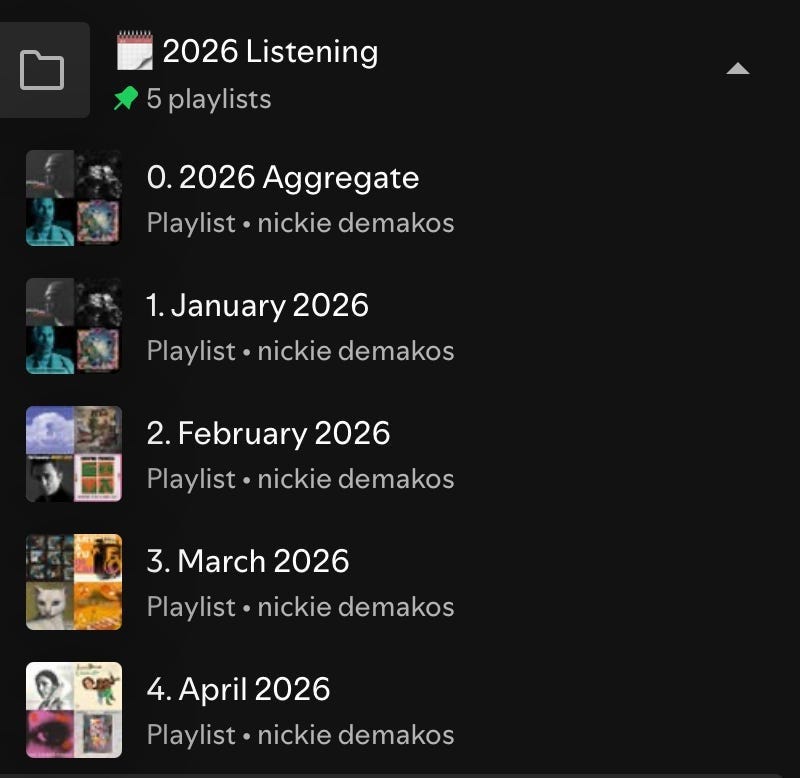
To track my music recommendations: Whenever I buy or add a song to any of my playlists, I also add it to a playlist for that month’s songs (e.g., April 2026). I can’t track my listening in terms of streams, so I’m tracking music I’m adding to my library (so, when I say “music I listened to during [month],” I mean the music I added to my library). I actually prefer this metric as opposed to streams, since streams could mean anything, whereas songs I add to my playlists are directly indicative of my taste. “Playlist additions” is also one of the most important metrics for Spotify for understanding and building users’ taste profiles – this is what informs the playlists they build. Your playlists are basically building theirs.
To track and analyze my feelings and perceptions: Each week, or whenever I have a thought, I write down reflections in a journal or my Notes app. Quantitative data alone is not going to summarize my listening behavior and any changes over time (especially when the data is already limited and incomplete). I also wanted to compare how I feel versus what the numbers are telling me.
To analyze my listening habits:
At the end of each month, I export that month’s playlist as a CSV file with Exportify. If you’re wondering why I’m still using Spotify, as someone whose #1 enemy is Spotify, this is why. Exportify is the easiest and best way to analyze my listening data, and it even has access to the metadata for each song. Some of that has been super useful, like date added, and others are just fun to factor into my analysis for that month, like song popularity or year the song was released. This lets me ask questions like: Do certain sources recommend/play older music? Which sources recommend/play more obscure music?
In this spreadsheet, I also add a few more columns to track the lifecycle of the song:
Source: Where I found the song (see the end of this section for more details on how I categorized algorithmic vs non-algorithmic)
New/Old: Whether it’s a brand new song to my ears or a song I’ve heard before
Did I Share With a Friend? Y/N: Self-explanatory, added out of curiosity
For DJ? Y/N: This was important because I began learning to DJ in the fall/winter (shoutout Superior Elevation DJ School), which meant I was finding a lot of new music. For some research questions, I wanted to separate the songs I found for class or DJ sets and the songs I found for general listening.
I import this sheet in a master Google Sheets spreadsheet, with each month having its own sheet and an aggregate sheet for all the months’ songs. Then, I do the fun part: DATA ANALYSIS!!!!!!!!
I broke down six main sources – algorithm, human-curated, personal, social, real world, and unknown – into more specific sources. I used these six broader categories in my data charts for the sake of visibility and comprehension, but I’ll call out if any subcategory had the biggest share of the source. I define them as follows:
Spotify: Algorithm - any song presented by Spotify’s music recommender system (i.e., Discover Weekly, Release Radar, mood mixes, Spotify radios, recommended tracks up next)
Social: Algorithm - any song presented on my Instagram feed/stories without me following the account and the post/store is intended to promote the song; also YouTube recommendations/up next
NOTE!! I don’t have TikTok, which I feel like might be a huge variable in algorithmically recommended music since it’s famously good at pumping music. I’m curious if TikTok would throw more music on my feed than Instagram.
Blog/Curator - anyone who organizes mixtapes/playlists/DJ sets or writes about music (new and old)
Spotify: Public Playlist - any playlist on Spotify made by a user
NOTE!!! I know that these people may be getting and saving algorithmically recommended music, there’s no way to avoid this. Regardless, saving their songs means I like their taste, and that feels organic to me.
DJ Set - someone’s digital or vinyl DJ set, mostly on YouTube
ANOTHER NOTE!!!! This category is strictly for DJ sets I search for on YouTube, searching for either a specific genre or an account I like. If I select a video that YouTube presented in my feed or “up next,” I categorize this as “Social: Algorithms” because the algorithm surfaced it without my explicit intent.
Radio - online radio station, mostly NTS Radio
Browsing - literally just poking around in artist discographies, independent record labels’ signed musicians,
Rediscovery - I remembered a song I liked and wanted it back in my life
Vinyl - a song from my vinyl collection
Live Show - a song from a concert I went to
Public Space - a song I heard in a restaurant, bar, etc.
TV/Movie - a song I heard in a TV or move soundtrack/score
Friend/Family - a song recommended to me by a family member or good pal :)
Social: Following - a song someone (not a music curator or blogger) put in their story or Instagram post (literally listen to these)
Unknown - didn’t remember :/
In my findings, I include a chart on algorithmic vs non-algorithmic sources. This is how I define the two:
Algorithmic: the platform (Spotify) decided what to show me, without me expressing specific intent
“Spotify: Algorithm” and “Social: Algorithm” qualify because in each case, a recommender system is making an unprompted judgment about what I might like based on my behavior or taste profile.
Non-algorithmic: a human decided what I’d hear, or I decided myself; I also refer to this as “organic” or “human” sources.
Every other category qualifies because there’s a clear human agent — a DJ, blogger, friend, radio host, a TV music supervisor, myself — making an intentional curatorial choice. Spotify: Public Playlist fits here because a person assembled it, regardless of how they found the songs.
JUST TO NOTE☝️, I’m very aware that non-algorithmic/organic/human sources can be influenced by music marketing and PR companies, which in turn make business decisions based on music streaming services’ metrics on streaming and engagement. Music marketing and PR have always existed, but streaming services’ monopoly on music distribution has shifted the industry in ways that have hurt the DIY and independent artist economy, so finding and supporting these artists via concerts, buying their music or merch, and sharing their songs is a huge priority in this project.
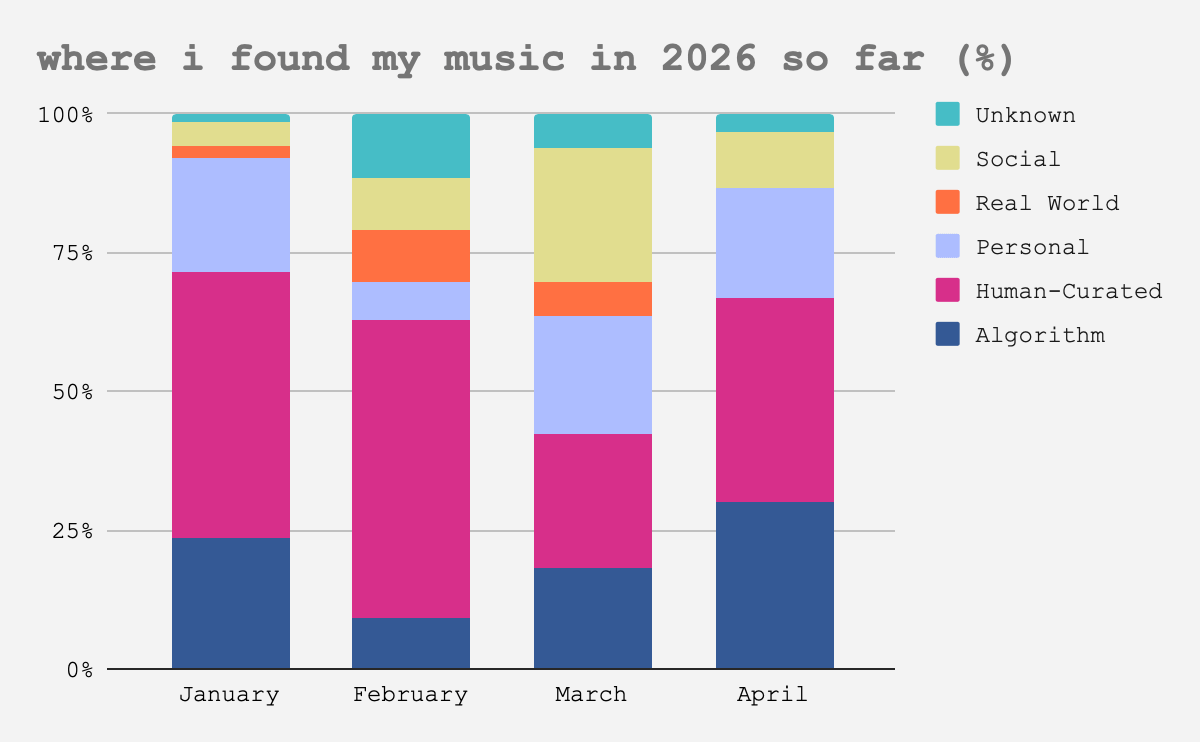
I crunched the numbers on my saved music from January-April and put them into nice charts to see the data with my own eyeballs. It’s important to note this data is coming from my saved songs, which are just one bit of all the music I listen to (for example, I also spent time off the app on YouTube or on the app listening to a Steely Dan album). So, these songs don’t represent the entirety of my listening, just the music I’ve bought or added to playlists.
There are certain curators and blogs I began to love and returned to frequently for music recommendations via Instagram or their newsletter.
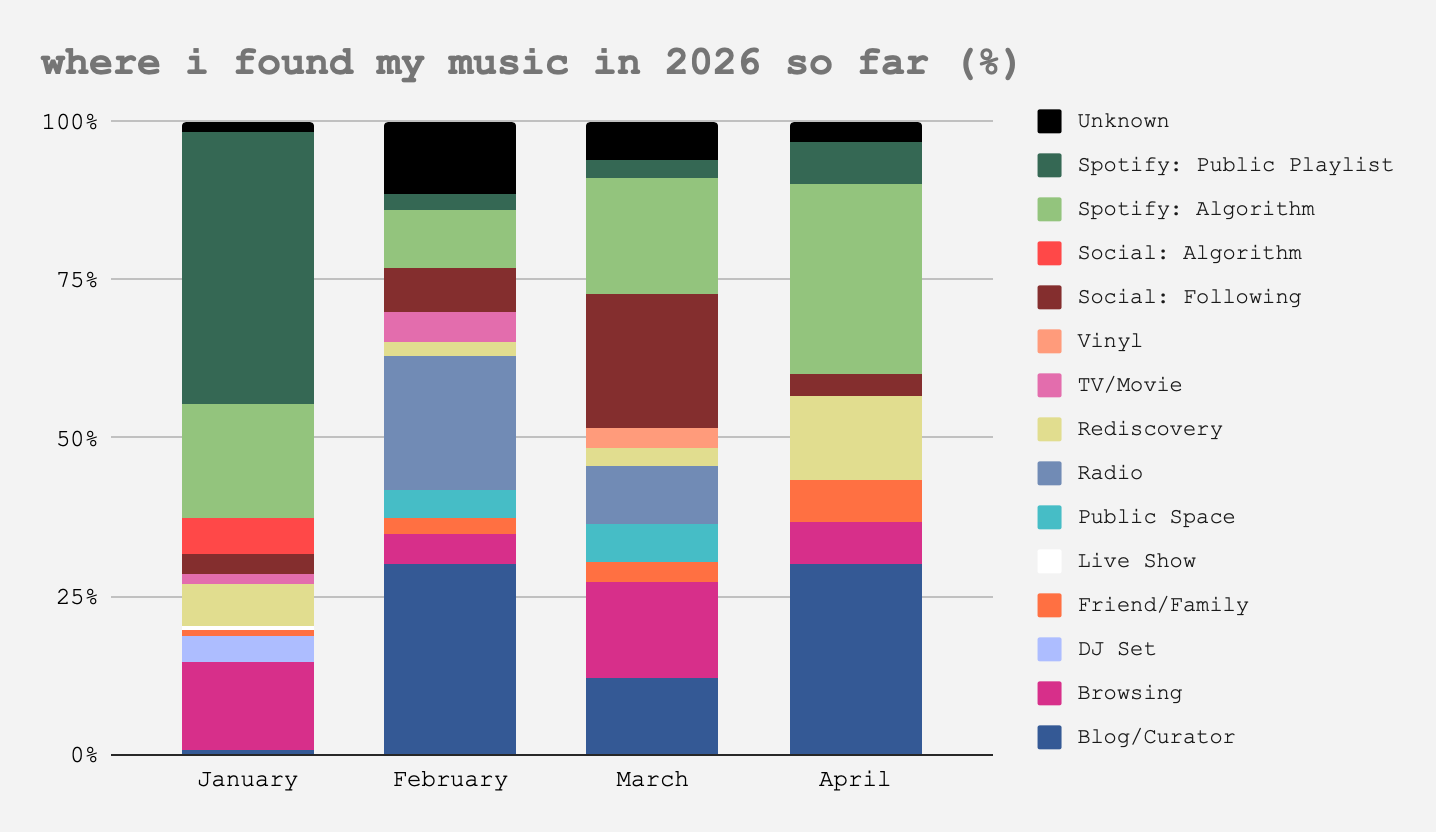
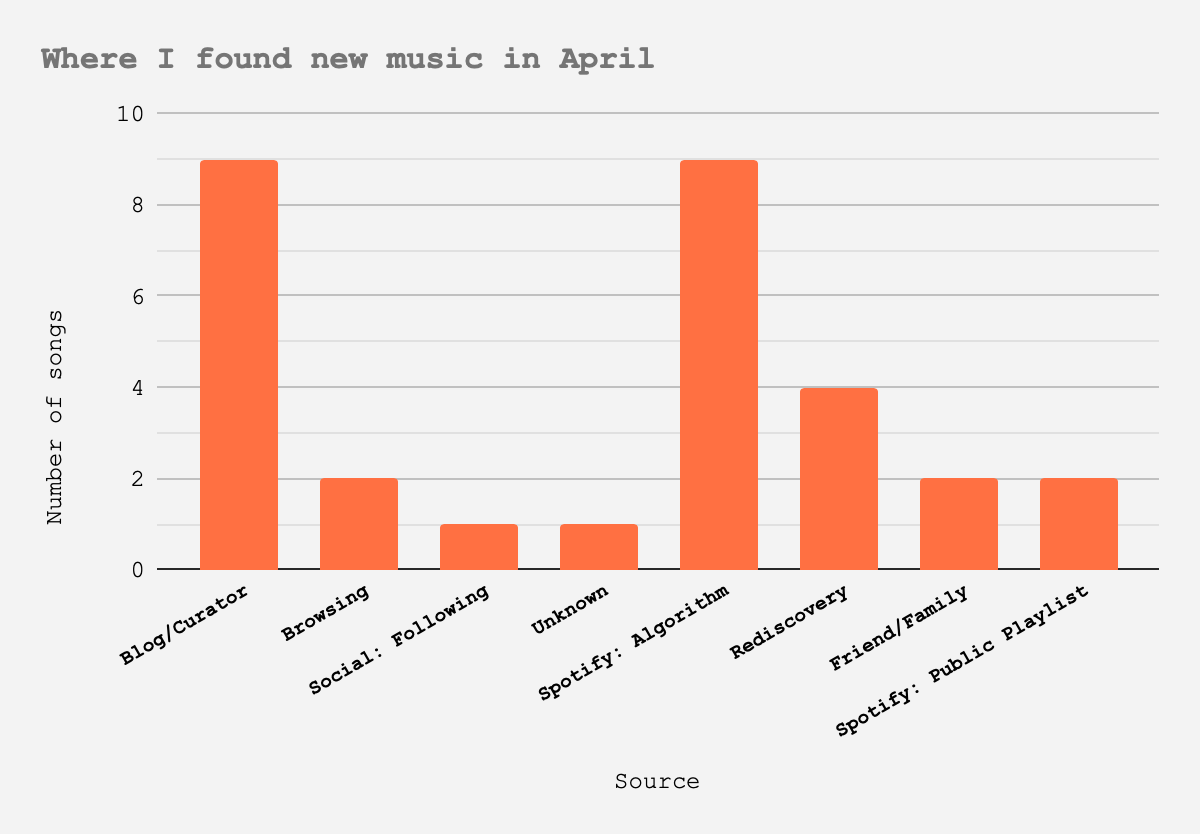
OKAY, SO I SAVED SOME SPOTIFY RECOMMENDED SONGS ✋😳🤚 In April, 26% of my saved music came from algorithmic sources. It doesn’t feel like a lot, but when you see it tower over all the other sources – all organic or human – it feels a bit daunting.
Most of these songs came from Spotify’s autoplay feature which continues to play music after you’ve finished a playlist or album, even if you didn’t ask for it. And sometimes it just really got it right. Spotify is so damn good at calculating the perfect song to play next because its music recommender system calculates everything. There are a lot of ways it provides recommendations depending on the features, but in general, it pulls from the acoustic features, mood (that it calculates using its own data on tempo, energy, and valence), listening behavior, cultural context, playlist co-occurrence (i.e., where this music appears elsewhere), editorial tagging, AND other social signals of the music you’re listening to and save to your library – especially the ones you save. So, of course it’s going to recommend pretty appropriate songs for your mood or environment.
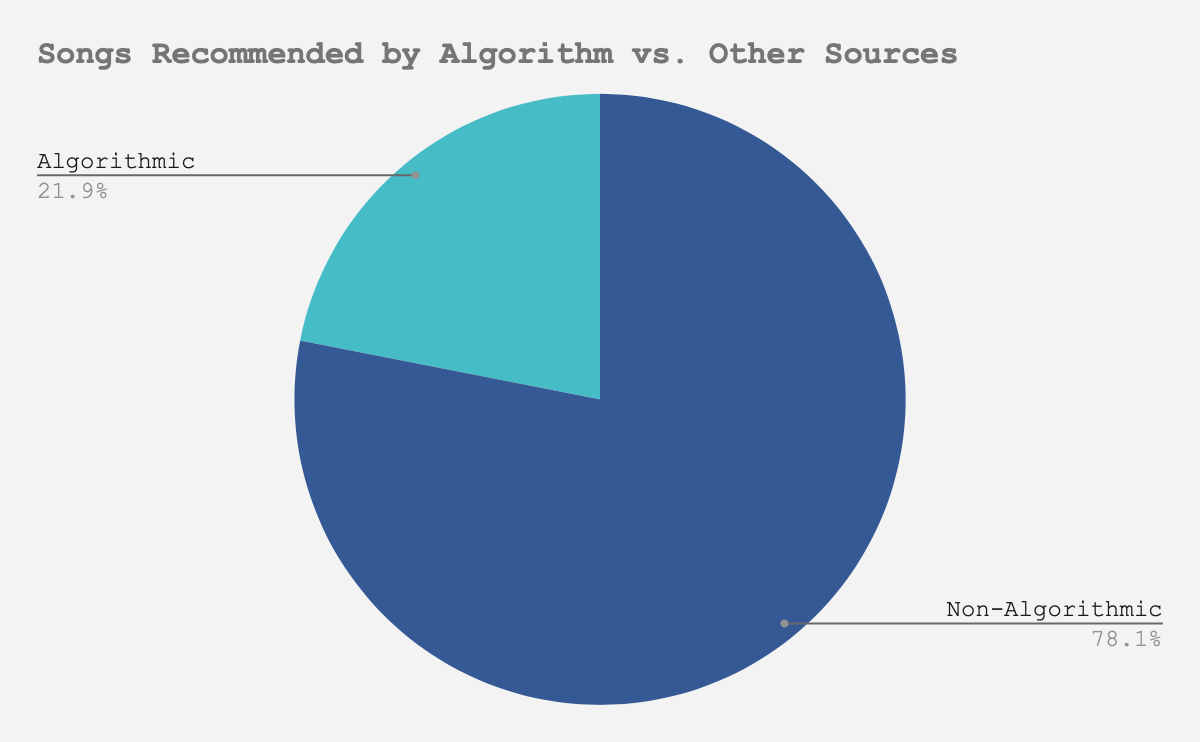
It’s expected that I found most of my music from non-algorithmic sources because I was making a concerted effort to do so. But 22% of my music still being AI-recommended felt like a high number after all this time seeking out music new and old, digging deeper, poking around, the activity of it all.
I seriously wish I knew how much of my saved music was algorithmically recommended before I started this project, but I would never even know if it were possible. The last time Spotify released information hinting at this was in 2018 when it reported that Spotify-owned playlists accounted for 31% of users’ listening. This included playlists that their editorial team curated, but most of the editorial playlists today are algorithmically personalized to your taste (also called “algotorial”). Spotify’s personalization features have also proliferated since 2018 (think of Discover Weekly, Daily Mix, recommended stations), so this number has to be enormously high. One former Spotify employee pointed to something telling here, saying that “whenever they are not releasing data that they used to release, it’s because the numbers are not looking good.”3 Spotify knows releasing this data would probably make users feel like they have no control over their music recommendations and, therefore, personal taste.
There are third-party studies that have tried to quantify the number of algorithmically-recommended streams on Spotify, ranging from 30% of a user’s songs to 41%. The remaining streams come from the user consciously selecting music from their own library or playlist. Still, what if these libraries and playlists are mostly full of algorithmically-recommended songs? This is the question worth asking but will probably never get a straight answer to.
The most noticeable change in my behavior has been my tendency to get annoyed when the AI playlists weren’t playing songs I liked or had in mind; they’re supposed to be carefully designed for my taste, so they should be catering to my current listening needs. I wonder if this reaction stems from a cognitive bias called the Barnum effect, which is when we believe generic information that could apply to anyone applies specifically to ourselves. Spotify’s hyper-personalization efforts, that extends even to its copywriting (e.g., your Daily Mix or Discover Weekly, a playlist that is “made for you”), creates the illusion of tailored listening personas, making us feel our taste is perfectly unique. This makes us more likely to listen and stay streaming, but it may also make us so attached to our “listening personas” that we feel offended when they’re misunderstood.
I never felt the same level of annoyance when a DJ or radio show host played a flop because their job is to utilize all of their knowledge, expertise, and experience to determine what music to share with us (not me alone), and how they’ll go about doing it. I think of the way the Hong Kong–based musician Cehryl structures her shows in the same way as performances because there’s an “emotional arc.” There’s also something sacred about a person playing his or her taste for a community, hoping to express a unique point of view that will bring something new to people’s ears and lives.
I never recorded listening intent (because that would be too much self-observation), but I believe this was also a factor in my reactions. The times I just wanted to put something familiar on without discovery (or otherwise “easy” listening) were when I didn’t mind or notice, but when I was seeking out new music or sounds, I was more critical.
This brings me to my sweet, beautiful Oasis journal. I used this to track what I’ve been listening to (see Gathering the Data #1 for more context), but I haven’t analyzed this yet because I’m still figuring out how and if I want to use it. It logs playlists, radio shows, albums, etc. as opposed to singular tracks on a playlist, so the data is inequivalent. I feel like it would be an inaccurate representation of my music habits to compare the time spent listening to certain albums or radio shows to the number of songs actually saved (setting the data gaps aside lol). My saved music is not the final representation of my taste or music identity, and it’s surely not a fraction of the ways I engage with my favorite music. In the same vein, time alone doesn’t define the quality or meaning or context of the music I’m listening to.
I know this all sounds like a lot of effort, but I fell in love again with the activity of listening to music after a time of being pretty dejected. I’ve been so curious and excited about all the new, different kinds of music I’ve been learning from people, so I’m not too pressed that about a fifth of my music has come from an algorithm. It’s pretty unavoidable to get something algorithmically fed to you these days, so I’m just glad I’ve made a concerted effort to expand my listening bubble and get to know the music bloggers, curators, archivists, critics, and musicians overall – especially independent and DIY musicians – keeping music lineages and culture alive. Until next month!!!!!