I saw where all my Amazon packages come from as part of an Amazon Fulfillment Center Tour.
If you’re an Amazon customer and if you’re slightly nerdy and interested in warehouse logistics, you should sign up for one of these tours near you.
Here’s what I saw, what surprised me, and whether you should take the tour yourself. (Yes.)
This is not a sponsored post. I am really just a long-time customer and shareholder of Amazon and I enjoy things like warehouse tours.
Introduction
Last week I toured the SAT2 Amazon Fulfillment Center in San Marcos, Texas.
It’s one of more than 175 fulfillment centers across America that make Amazon’s two-day shipping possible.

The tour is completely free. Amazon is spending millions of dollars to show nerds like you and me how their warehouses work.
You can sign up for one of the tours here: In-Person Amazon Fulfillment Center Tours. They have a bunch of locations available.

I assume they’re doing this because they want you to feel good about Amazon being one of America’s largest employers. And honestly it worked on me.
The push to offer more public tours is happening at an interesting time—Amazon just announced they’re cutting 14,000 corporate jobs, while also planning to automate 75% of warehouse operations over the next decade. More on that later.
Inside the Warehouse
What you will see inside the warehouse is miles and miles of conveyor belts. Seriously, probably dozens of miles of indoor tracks moving packages in every direction. It’s hypnotic to watch and yet feels exactly like what you’d sort of expect.
The building is absolutely massive—like 28 football fields massive. And this is just ONE facility that only handles standard two-day shipping. Amazon has more than 175 of these fulfillment centers across America, all running simultaneously, all processing millions of packages.
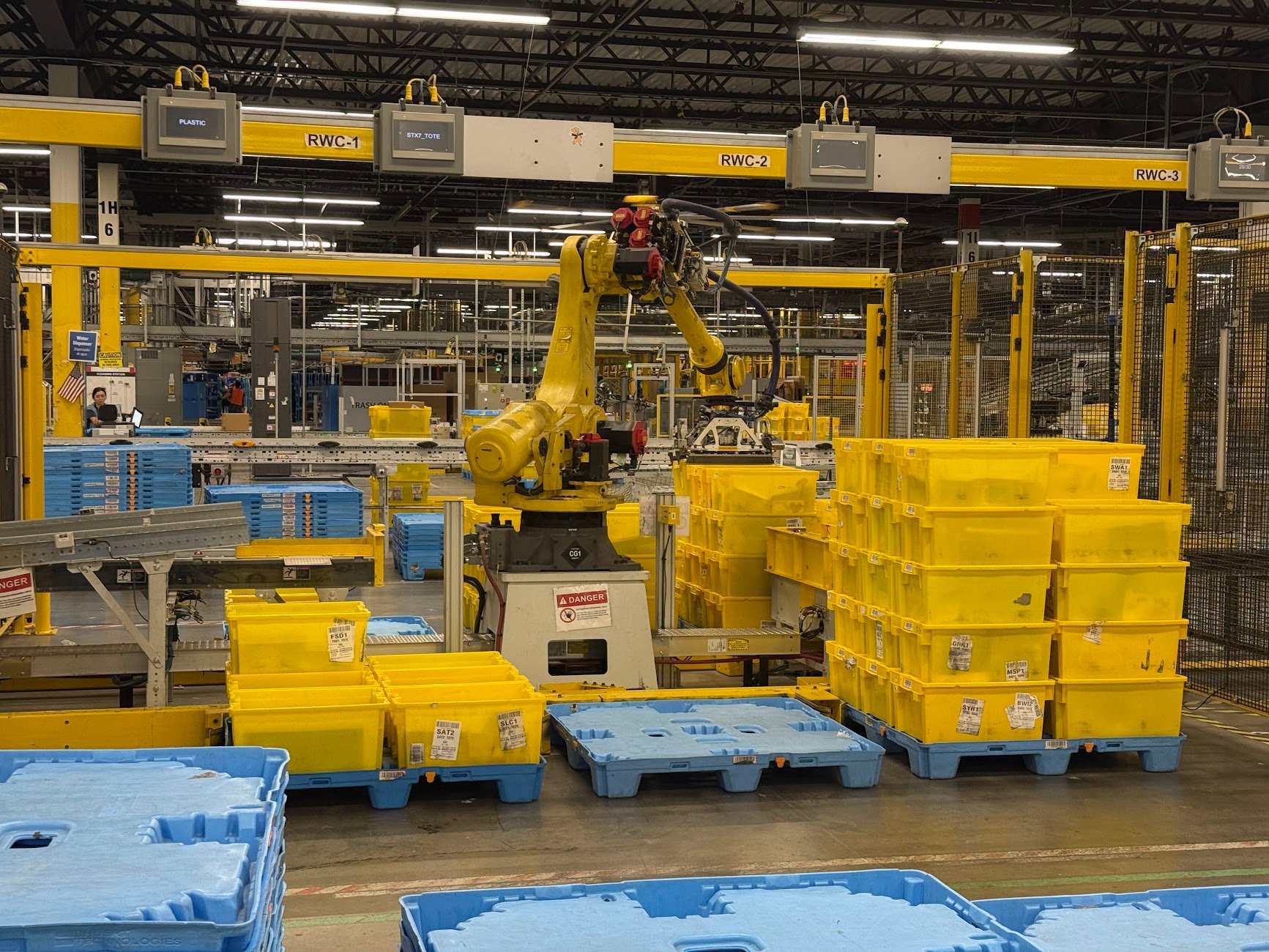
They showed us a robotic arm in one section, pictured above, but it wasn’t doing any work when we were there. I thought it was funny that this was the most technologically advanced part of the tour. A lot of the other stuff was a bit old hat.
Kiva Robots
The big stars of the tour are supposed to be the warehouse workers. But I think the coolest thing for me was seeing how the Kiva robots work. Those are the orange, Roomba-like robots you’ve probably seen in Amazon promotional videos.
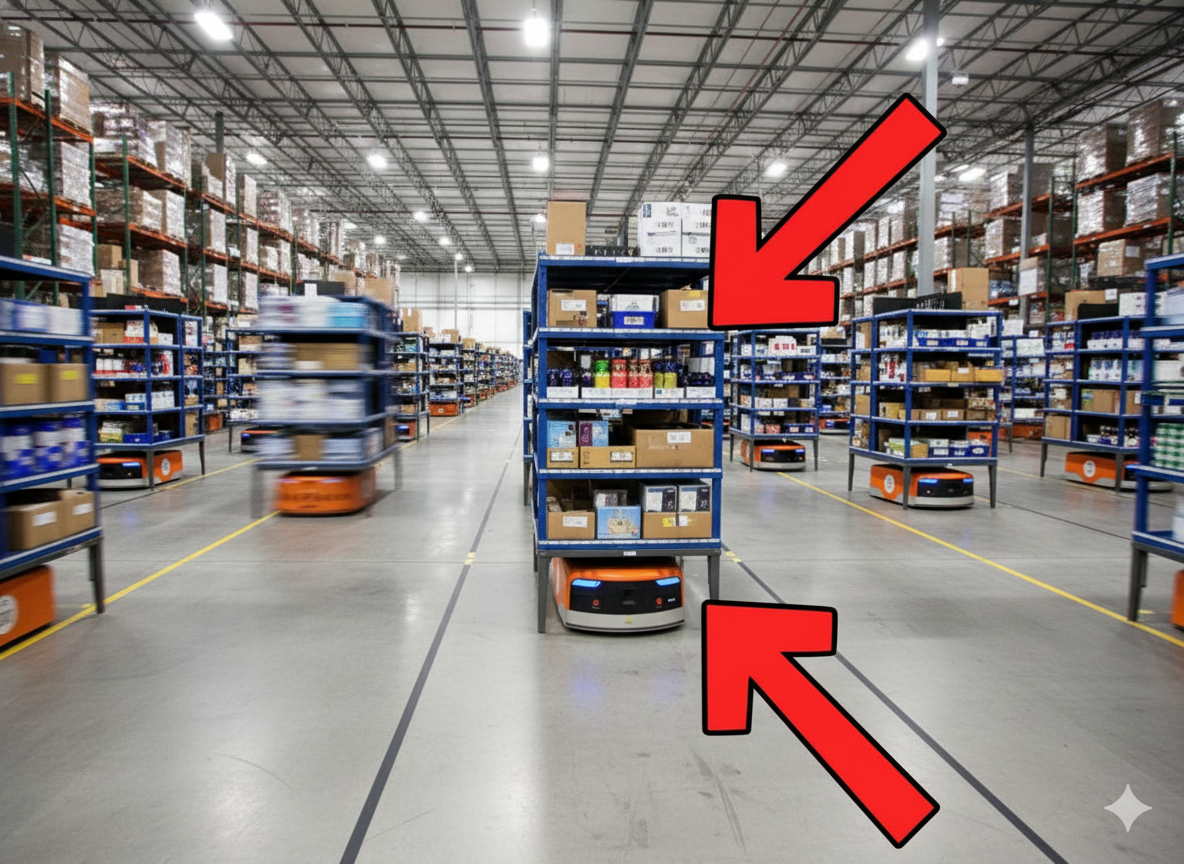
The Kiva robots don’t actually pick items. Instead, they slide under entire shelving units called “pods,” lift them up, and bring them to stationary human workers. The rep said they can lift 1,000 lbs.
The robots navigate by reading 2D barcodes on the floor. A central AI system (running on Amazon Web Services, naturally) coordinates all their movements to prevent collisions. The robot zone—this fenced-off area where the pods zip around—takes up about 65% of the facility’s square footage. Humans aren’t allowed in there while it’s operating and we sometimes had to be careful where we walked.

Human Workers
Way more humans work here than I expected. People were sorting packages, applying labels, moving items from conveyor belts, scanning barcodes, and doing quality checks.
The tour guides—all actual Amazon employees—were sharp and seemed genuinely happy. Every employee we talked to was in a good mood. Maybe they put the happy ones on the tour route, but still.
This tour gave me newfound respect for warehouse workers. The lack of windows and natural light would hurt my soul. The repetitive nature of the work, day in and day out, isn’t something I’d be good at. It reminded me of my high school apprenticeship at Siemens Energy and Automation, where I’d sometimes see the warehouse workers while setting up computers for the IT department.
For the people who choose this line of work, the benefits seemed solid and the working environment looked reasonable.
While Amazon was showing us all these human jobs, they’re simultaneously planning massive changes. According to leaked documents reported by the New York Times in October 2025, Amazon wants to automate 75% of warehouse operations by 2033, potentially avoiding 600,000 new hires. Which, you know, doesn’t mean job cuts: just avoiding new hires. They did however just cut 14,000 corporate jobs this week, citing AI efficiency gains.
How They SLAM Shipping Labels
The way they apply shipping labels is interesting. The label barely touches the box at first. It’s slightly wet with some kind of mist. Then gravity and time make it stick permanently.

I watched this happen and couldn’t believe those labels would stay on. But when Amazon is processing millions of packages weekly, they figure out what works and how to use the least amount of effort that sticks 99.999% of the time.
The way they handle labels is called the SLAM process. That stands for:
- Scan
- Label
- Apply
- Manifest
The package never stops moving on the conveyor belt. As it flies by at high speed, it gets automatically weighed (to verify it’s the right item), then a robotic arm instantly prints the shipping label and literally blasts it onto the box with a puff of air. That’s why the labels looked barely attached and slightly damp when I saw them—they’re shot onto the packages with compressed air while everything’s still moving. The whole thing happens in seconds. No human touches it.
Amazon Warehouse Tour Logistics
Here’s what to expect in a more detailed notation.
Duration: About 45-60 minutes, plus a 10-minute safety briefing.
What happens:
- You start in a classroom watching a safety video
- Two or three tour guides chaperon you at all times
- You’ll walk about a mile and climb at least one flight of stairs
- They give you a bottle of water
- There’s one bathroom break during the tour

Pro Tip: They tell you to arrive 15 minutes early. You really only need to be there 5 minutes early. Tours start exactly on time.
Bathroom Warning: I couldn’t use the bathroom after the tour ended. If you drink a lot of water or Diet Coke like me, plan accordingly.
What you can’t bring:
- No phones allowed on the tour floor (they provide lockers)
- No bags or backpacks
- Photography only allowed in designated lobby areas
What to wear:
- Closed-toe shoes (required)
- Long pants recommended
- Sleeves required (no tank tops)
Conclusion
Should you take this tour?
Yes, absolutely. I mean, it’s free. And it was cool.
You’re not seeing any proprietary secrets on this tour. Competitors aren’t going to learn anything groundbreaking. What you’re seeing is the bulk warehouse operation: lots of people, lots of conveyor belts, and those 12-year-old Kiva robots.
But still. It was neat. Most of us buy from Amazon constantly but have no idea how it actually works. This is a chance to see behind the curtain of a multi trillion-dollar operation.
You’ll see the pick, pack, sort, and ship process that gets packages to your door. You’ll meet actual Amazon warehouse workers and sort of understand the massive scale of e-commerce logistics.
The tour made me feel better as both an Amazon customer and shareholder (I’ve owned the stock since 2003!). Seeing the operation firsthand, meeting the employees, and understanding the complexity involved—yeah, I think that is worth an hour or two of your time.
Is it a PR exercise? Absolutely yes.
Did it work on me? Also yes.
Visit amazontours.com and find a fulfillment center near you. Tours are free but you must register in advance—no walk-ins allowed. Bring a friend. My buddy Sameer and I both came away impressed by the scale and complexity of the operation.
Have you taken an Amazon fulfillment center tour? What surprised you? Email me at hello@nickgray.net or leave a comment below
Thanks to my friend Jonathan Wegener who told me that I MUST take this tour. He’s always ahead of the curve and knows me well.
Bonus: Amazon’s Peculiar Ways
I took a picture of a sign they had up for their employees called “Amazon’s Peculiar Ways.”

- We earn trust with our customers by making precise, high-bar promises and then keeping them.
- We are willing to make long-term investments – sometimes at the expense of short-term gains.
- We share the good and the bad to help customers make informed buying decisions.
- We work to avoid the bland personality that customers typically associate with the big homogeneous, corporate Borg.
- We take credit for (i.e., brag about) the impressive things we do in a way that is subtle and sophisticated.
- We endeavor to speak to our customers in a tone that is neither boastful nor boring.
- We use specificity when possible and sensible.
- We prefer to title features factually with a degree of precision.
- We don’t make content look like an ad.
- We stay away from creating new icons.