Since 1965, 1 million people have been murdered in America. 300,000 remain unsolved. And homicide is simply the most visible part of millions of unsolved burglaries, assaults, robberies, and other crimes. Preventing crime and disorder is the core function of government, and we have the ability to do it better. Accordingly, this article surveys what we know about preventing crime, why it has risen and fallen in the past, and what we can do going forward.
The overarching theme of this article is that crime management is most like macroeconomics. Many things are not going to be directly testable. Things which appear to not work can sometimes work through different channels than what we can measure, and things which appear to work can sometimes only be temporarily effective. Above all, it is not desirable to rely upon simple regressions or the immediate response of a time series without reasoning through why the effect we actually want to find is identified. What people do is a function of what their expectations are, not just what the state is doing. That we must lump so much in the residual is unpleasant, but the world defies pleasant answers.
This post is brought to you by Mechanize, Inc. They are hiring for a variety of positions, including software engineers. I encourage you to apply here.
Our starting point is that of the rational agent. This does not imply that criminals are suave or cunning; most are not. It is just that rationality is the best clotheshorse on which to pin additions to reflect impatience, imperfect knowledge, or present bias. People commit crimes because they want to. They receive some payoff from a criminal act. Thus, people respond to things which change the costs and benefits of crime. This implies three roles for the criminal justice system, deterrence, incapacitation, and rehabilitation. The first two correspond to raising the cost of committing a crime, while the third corresponds to reducing the benefit from committing a crime. Deterrence can come from the severity of punishment, and from the likelihood of apprehension. Our prior should be that raising the cost of crime or reducing its payoff will reduce it, all else being equal. We should not be overly swayed by mediocre studies which find no effect, not unless we are supremely confident that the study is perfect.
These agents hold beliefs about the world, and about what other people believe. These beliefs are directly related to criminality. Why? First, crime has increasing returns. Other people also offending reduces the likelihood that you yourself will be punished. A riot is the purest example of this – people expect that if they are the only ones looting a store, they will be stopped, but if everyone is doing it, they confidently expect to get away with it. A city with exactly the same people and exactly the same enforcement might find itself with different levels of crime depending purely on its past. A long literature in macroeconomics (see Diamond 1982) shows that when you have increasing returns, the equilibrium is indeterminate, depending on the beliefs of people about others.
Second, most homicides in America are arguments between acquaintances, made lethal by the presence of weapons. Whether people carry weapons on them is determined by their beliefs about how likely violence is. A prolonged shock to violence leads to people carrying weapons as a matter of course. Now arguments that would have been settled with a punch-up end with people dead.
Third, the police are dependent on victim and witness cooperation. Most crimes get solved because someone is willing to identify the assailants. This is why many more homicides get solved than non-fatal shootings. It’s not just that there are fewer resources dispatched to non-fatal shootings – it’s that the victim knows who did it, but won’t talk. If everyone is involved in some sort of crime, they don’t want to talk to the police. This is, incidentally, the best case for drug legalization, and for police departments refusing to turn over illegal immigrants to ICE.
Finally, there is a sort of zero-lower bound on the ability to punish. If too many people are committing crimes, the criminal justice system will run out of capacity. This could be the space in prison, in jails, the number of police officers, the throughput of courts – if any part of the system is at capacity, the whole system cannot increase punishment. The job of the criminal justice system is to get us to the lowest equilibrium possible, where what crimes do inevitably arise can be solved cheaply.
We don’t really know what the rate of crime was before 1933, when the homicide statistics were first collected nationally. Anything before that time is coroner’s records, and a lot of conjecture. We don’t really know anything about non-homicide crimes before 1973, when the National Crime Survey started. Still, we know the broad shape of criminality over time. It reached a peak in the 1930s, generally understood to be connected to prohibition, then declined through the 1940s and stayed low in the 1950s. (This was likely World War II vacuuming up young men, who are particularly violent). Then crime rose, in all categories, in cities and the countryside, starting in the 1960s, and remained at a high plateau until it began falling in the 1990s. Since, we saw a substantial spike in the aftermath of the George Floyd protests, and a swift decline to the level of the mid 2010s.
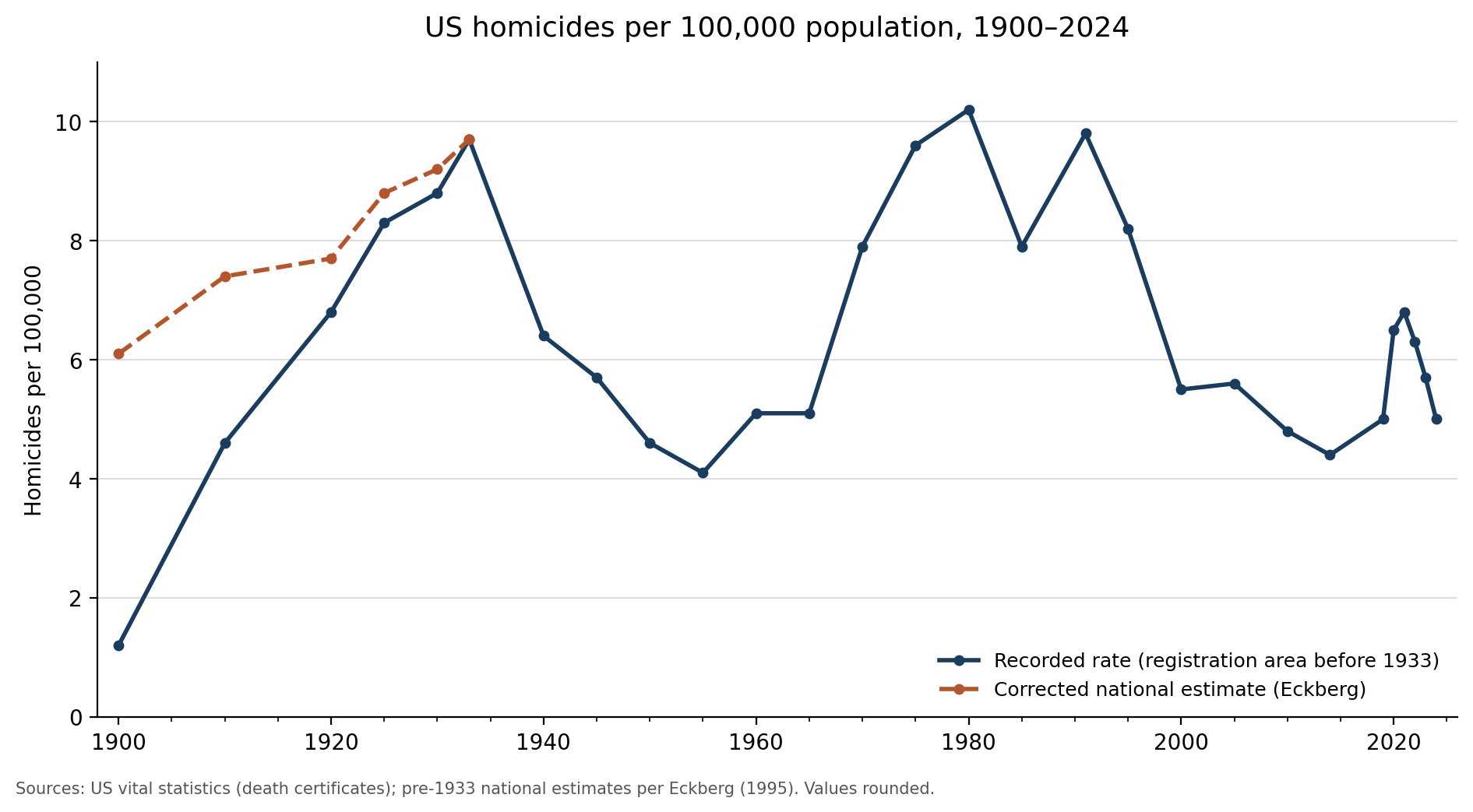
Much has been about the decline in crime in the 1990s, but we should really start with the rise in crime in the 1960s. In my opinion, it happened for roughly the same reasons as the inflation of the 1970s. There was a shock to conditions which lead to crime, which was met by a passive, accommodating government. People’s expectations about their likelihood of punishment became unanchored, and we soon found ourselves in a world where we could not raise expected punishment to bring it back down again.
My story of the 1960s runs like this. The Baby Boom matured, and there were a great many more young men relative to the rest of the population. At the same time, property became much more stealable, in particular cars and televisions, while women left the house to go to work. Guns also became much cheaper and numerous around this time. Meanwhile, the elite consensus settled on the belief that policing did not reduce crime, and what was needed instead was fixing the root causes. Reading the 1967 President’s Commission Report is really striking in just how much it focuses on reducing disparities and rehabilitation over catching criminals more effectively. We will return to this later, but there is strong evidence that poverty does not cause crime, but rather, crime causes poverty, and inner character causes both crime and poverty.
The first parts provided the shock. Crime would have risen no matter what because of that. But, because of the ideology which discouraged policing, we made it clear that if you did a crime you would get away with it often enough for it to be worthwhile. Despite crime tripling between 1961 and 1975, prison population actually fell from 1961 to 1968, from 220,149 to 187,274, with the prisoners per crime committed falling by two-thirds. When we finally did hike punishment starting in the 70s, it took a very long and painful period for it to take effect. When you adjust for punishment per crime committed, we did not reattain the expected punishment of 1960 until 1990.
That high crime correlates with high imprisonment rates, and that the hiking of punishment did not appear to have an effect, leads many people to believe that prisons are not the answer to crime. This is wrong, for precisely the same reasons that higher interest rates correlate with higher inflation, and central banks often hike interest rates without seeming effect. What matters is punishment relative to what people expect. An exogenous shock to the number of police, or the intensity with which they patrol, should reduce crime, and that is indeed what we observe.
One genre of study uses variation in police deployment from terror alert levels, which are plausibly exogenous to local crime conditions. Klick and Tabarrok (2005) use the Homeland Security Advisory System, which during periods of high alert leads to many extra patrols around the National Mall in D.C. and other government sites. Crimes committed drop by 15% around the National Mall during high alert periods, but not elsewhere. Di Tella and Schargrodsky (2004) pursue a similar strategy in Argentina. Another genre of study uses shocks to police headcount. Mello (2019), a representative example, uses grants under the COPS act which allowed for more people to be hired. The identifying variation comes from the grants being allocated through a scoring rule with sharp cutoffs, with a 3.2% increase in police causing a 3.5% decrease in crime.
A very influential study from the 1970s, the Kansas City Preventative Patrol Experiment, led many people at the time to believe that police patrols did nothing. It was covered widely (see the New York Times) and gets routinely cited as the consensus. (See, for instance, Peter Moskos’s book “Cop in the Hood” on his time as a Baltimore Police officer). They found no effect of the density of police motor patrols on crime, as reported in their summary here.
The initial interpretation was incorrect, however. The idea behind the experiment would be that a large, 35 square mile area would be divided up into 15 areas, with some assigned to proactive policing, others to reactive policing only (with cops responding only to emergencies), and others to the control group, as illustrated below.
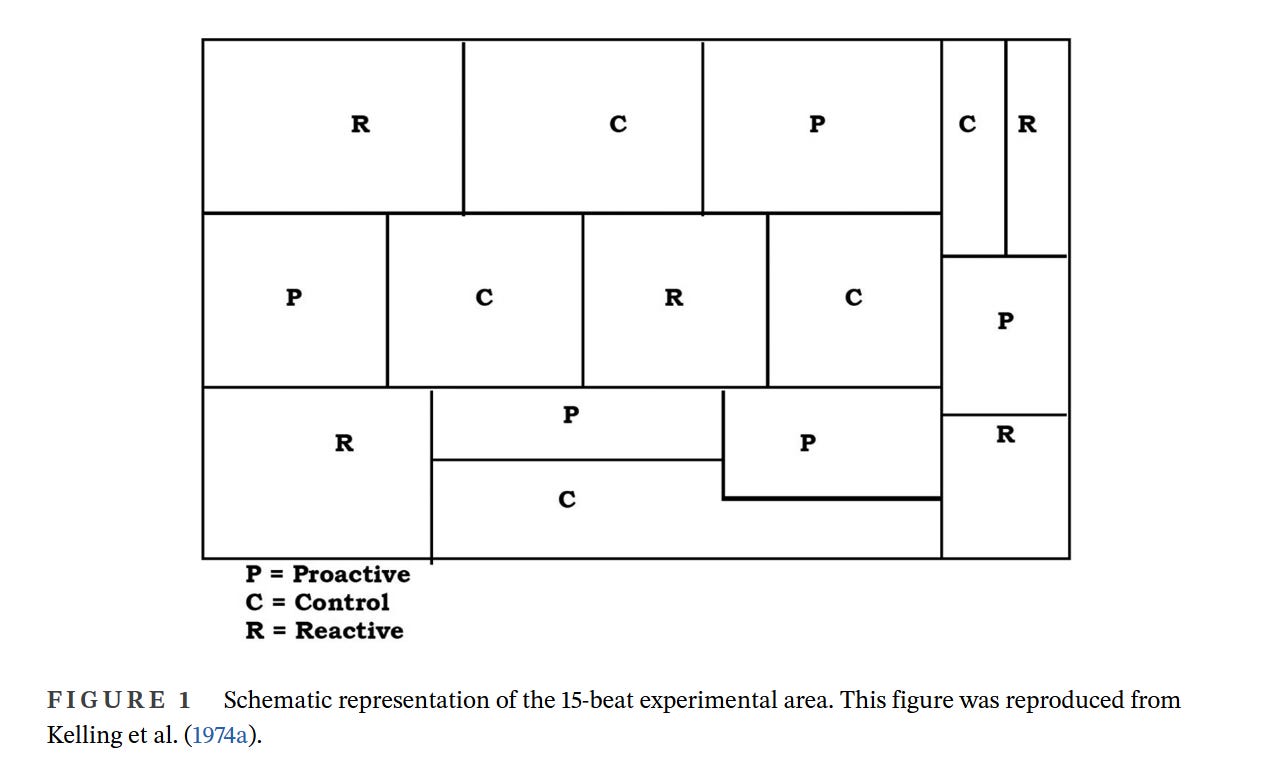
The basic problem is that there was no meaningful difference in actual patrols between the reactive and control beats. Cops would drive through and back on the way to emergencies anyway. Once you consider that, as Weisburd, Wilson, Petersen, and Telep (2023) do, and only consider the proactive patrols versus the rest, you do indeed see patrol affecting crime as expected.
Finally, the program was not announced to the public. We should expect for deterrence to be less effective when people are unaware of what their likelihood of being caught is or that it has recently changed. A program of having undercover detectives circulate among the public is likely to reduce crime if everyone is aware of the new policy, and less so if they do not.
This can go some way in explaining why increasing sentences does not seem to have much effect. When you ask people what the punishments are for various crimes, and how they vary as a function of age and prior record, people have wildly inaccurate ideas about how much punishment they face.
The very best study design, in principle, assessing the effect of sentence length is Lee and McCrary (2009), who use the fact that punishment changes discontinuously at age 18 in Florida to estimate how many people choose to not commit a crime. They find a rather small effect. However, when you survey people about how much expected punishment changes at age 18, as Hjalmarsson (2009) does, you find that they greatly underestimate the severity of punishment. When people unambiguously know what the punishment is, as with Helland and Tabarrok (2007)’s study of California’s three strikes laws, sentence length does have a substantial effect. What’s more, Lee and McCrary were simply the first. Lovett and Xue (2018) run the same design in California, and do find substantial and significant effects.
In any case, the severity of punishment also expresses moral norms which will affect both treated and untreated groups. Our estimate is always going to be biased down because expectations matter. And more mechanically, if youths commit crimes because they are in a gang, and prison sentences reduce the willingness for adults to be in the gang, then the criminality of everyone is reduced in a way that cannot be measured directly.
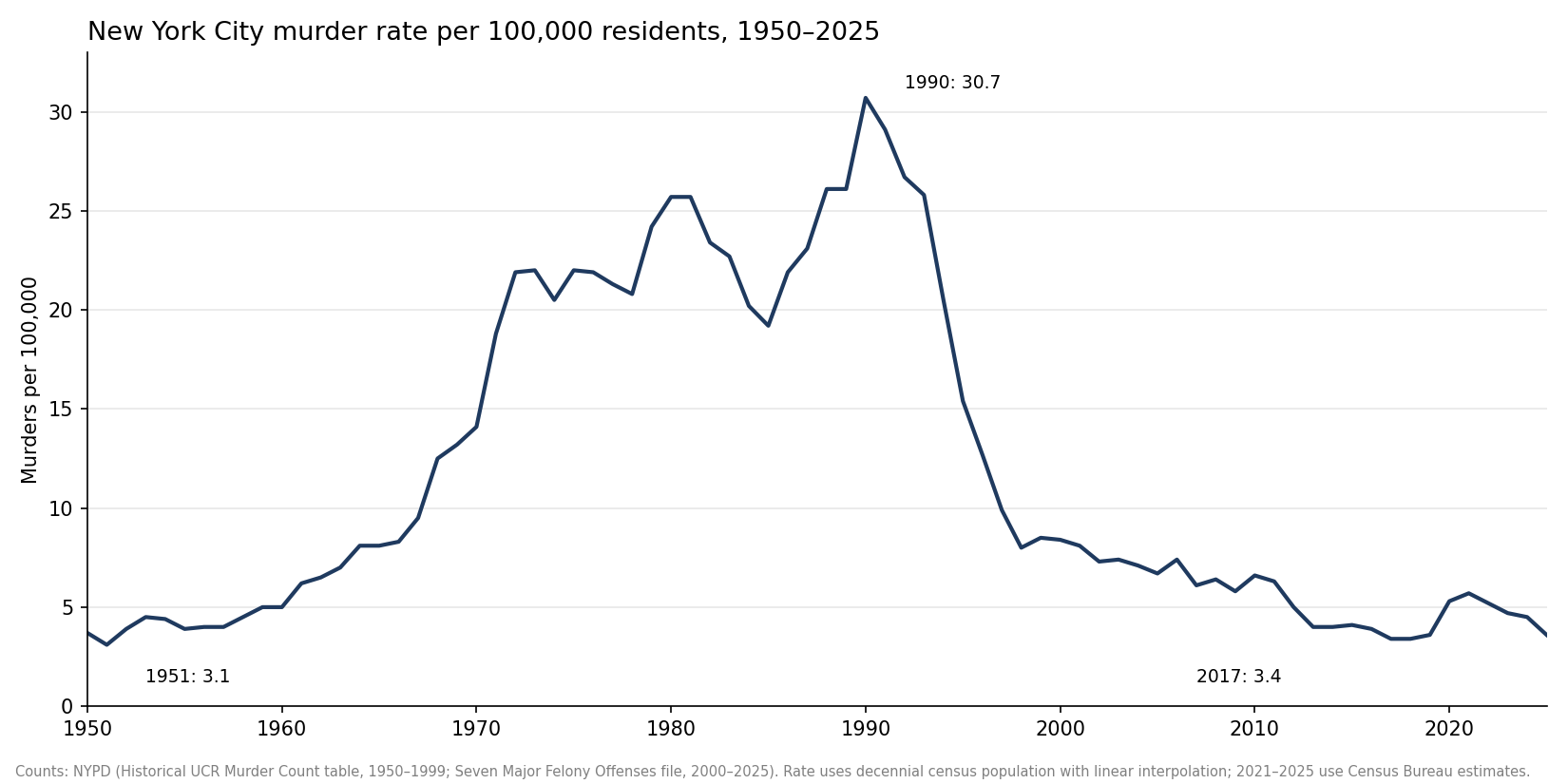
New York City from the 1950s to today is an instructive example of both what can go wrong, and what can go right, in crime management. Below is the homicide rate since 1950. Murders increased ten times over between 1950 and 1990, then fell back to just about where they were. What happened? Why?
Until the early 1970s, the New York Police Department was ludicrously corrupt. Essentially everyone was “on the pad”, which meant taking formalized payments from gambling operations in lieu of enforcement. Patrick Murphy, later to be police commissioner, describes the system in his memoir as one where everyone was doing their utmost to avoid their duty. Police callboxes were not about calling the police, they were about making sure the patrol officer was not sleeping on duty.
When the crime increase of the 1960s came, as it did everywhere – some combination of baby boomers and stealable property – total imprisonment actually fell, from 19,000 statewide in 1963, to 12,500. This was ideological, the result of state laws. I quote from the Assembly’s Ways and Means Committee: “First, the Conditional Release program, created in 1965, provided for mandatory early release to parole based on the amount of incident-free time served in prison, better known as accrued “good time”. Second, a 1966 federal court decision known as the Baxstrom decision limited the state’s use of prisons as de facto residences for mentally ill or handicapped offenders who had already completed their sentences. Finally, several revisions to the Penal Law were enacted in 1967, including both a redefinition of what constituted a drug offense and the establishment of certain authorized dispositions, such as those for narcotics addicts.” At the same time, the Warren Court progressively raised the standards needed in order to make an arrest. People in jail fell, too, because the system hit capacity. From a peak of 14,000 in 1970 (in a space built for 8,000), people in jail fell to 5,310 by 1975.Since punishment was falling in absolute terms, punishment per crime committed absolutely plummeted.
Meanwhile, Patrick Murphy became police commissioner, and the Knapp Commission revealed the pervasive corruption in the department. Police officers had moved on from extorting gamblers to extorting drug dealers. The response of Murphy and the city was to stop policing. It may sound unbelievable, but from the early 1970s until 1994, a patrol officer could not arrest someone for a drug deal which they observed. They were instead to report it upstairs to specialized vice squads. The theory was that if the police could not arrest people for committing crimes, they could not extort them in exchange for not arresting them. The trouble is, well, they stopped arresting them.
Reducing expected punishment naturally led to an increase in crime. Belatedly, New York tried to hike enforcement, but could not meaningfully do so. They hit the limit on officers, prisons, and courts, a situation made worse by the arcane laws surrounding booking. In a normal city, when an officer makes an arrest, they bring the perpetrator back to booking, fill out the necessary paper recording why the officer arrested him and what the officer observed, and then that’s it – they’re free to go back to work.
Not so in New York City. The officer needed to give a sworn statement to an assistant district attorney, in person. If there was no ADA available, he’d just have to wait it out. (Meanwhile, the defendant would also need to wait for the fingerprints to be sent back to Albany, matched against records, and sent back. The time from arrest to arraignment routinely exceeded 24 hours, and on some occasions lasted days). Both plaintiffs and city in Williams v Ward agreed that the whole process would routinely require 11-15 hours of police work, with the arresting officer often bound up for a whole shift. As a consequence, officers shied away from making arrests they didn’t have to make.
The number of cops also greatly decreased at this time. New York City, during the 1960s, committed itself to being a big-spending welfare state, with greatly expanded admissions to free college, a million people on welfare, an enormous payroll, 18 hospitals running a deficit of $334 million a year, and debt service on the order of $500 million a year.
They paid for this by not paying for it. All of the departments were extremely independent in their budgeting, and each tried to get by with accounting tricks – borrowing against revenue that was never going to come, rolling debt over with new debt, putting recurring expenses into the capital budget, assuming that life expectancy was the same as in 1917and other sundry acts of deception and wishful thinking. Mayor Beame, who was previously comptroller, knew that the city was hiding how much it was in debt, but neither he – nor anyone – quite understood the scale of the deception.
In February 1975, the Urban Development Corporation defaulted. This was a state entity, the result of a weird work around state laws. New York voters have to approve bonds through a referendum, they had rejected bond referendum five times, so Nelson Rockefeller figured out (with the help of John Mitchell, later famous for other things) that you didn’t have to get voter approval if you weren’t actually obligated to pay them back. Instead, they had a moral obligation to repay. When it turned out the moral obligation didn’t mean a thing, the banks in NYC refused to rollover the debt. By April, the city was out of cash. As a result, the size of the force had to be slashed. 5,000 cops were laid off in 1975. By 1980, the force had shrunk by a third, while serious crimes were up 40%.
An interesting demonstration of the power of enforcement comes from two great New York City blackouts, in July 1977 and August 2003. (The earlier great blackout of 1965 happened in November, during hours when shopkeepers were still in their stores, which means that looting just wasn’t going to happen). 1977 saw massive looting, with 1,616 stores broken into, and over a thousand fires set. 2003 saw essentially nothing. Why? In 2003, the first windows were broken with five minutes on Flatbush Avenue. The police immediately jumped into action, arresting dozens, and there was no rioting.
Yet, if you simply looked at arrests, you would think that 1977 was the one with enforcement. NYPD arrested 3,776 people that night. But it was all so late – they let it grow out of hand, and only then cracked down. Like the Fed during the 1970s, they were passive as crime/inflation rose, and it took painful, costly hikes to bring it back down again.
Homicide exploded again during the crack epidemic of the 80s and early 90s. Some of this was due to the pharmacological nature of crack cocaine – not that it caused users to kill people, but that it caused dealers to contest space for selling. Crack has an extremely short-lived high. Once on a binge, someone would return to the corner to make a series of small purchases. Control of places with high foot traffic are thus extremely valuable, and people fought over them. This figure is from Levitt (2004) – you should know that the rise in homicide was essentially solely due to young Black men.
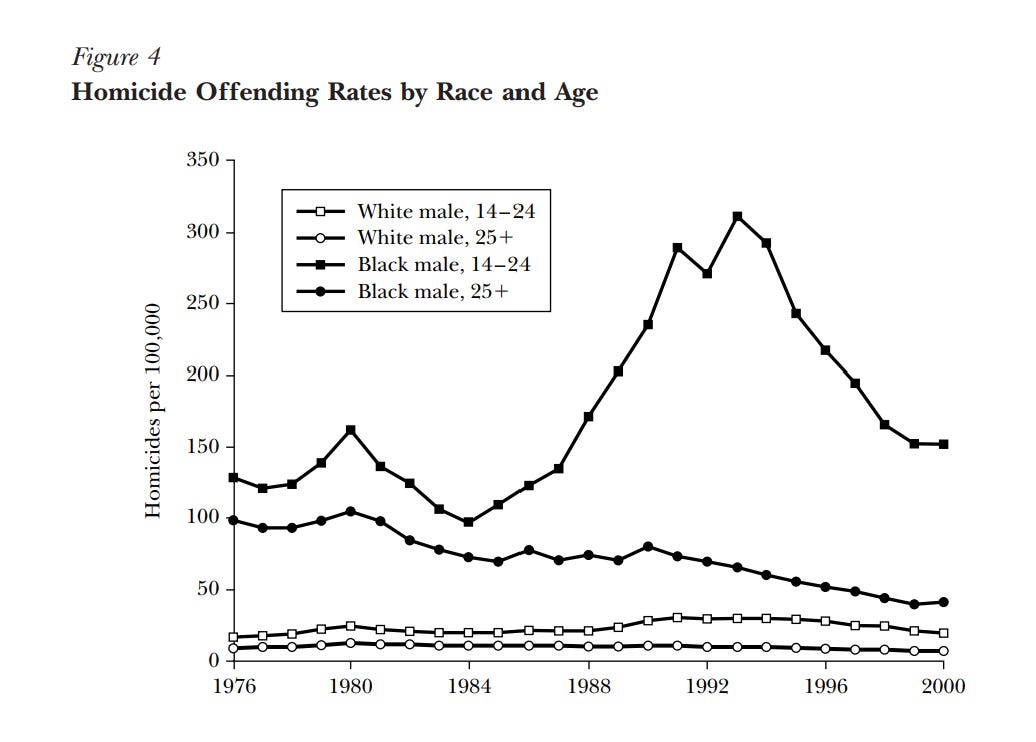
Much more important, however, was the change in norms that crack produced around weapons carrying. Where previously a dispute would be about honor, and you could preserve a norm of not using guns to settle things, now some portion of disputes are about territory. Since other people are carrying guns, you have to carry as well. The vast majority of homicides, even ones that involved the drug business, were because of personal disputes settled through violent means – not business, just strictly personal.
Some evidence. First, gun carrying greatly increased between 1983 and 1991. Borrowing from Bartley and Williams (2022), figure 6, the percentage of inmates who had never owned a gun fell from over half to just 16%. The median price paid for a handgun had fallen in half over that time.
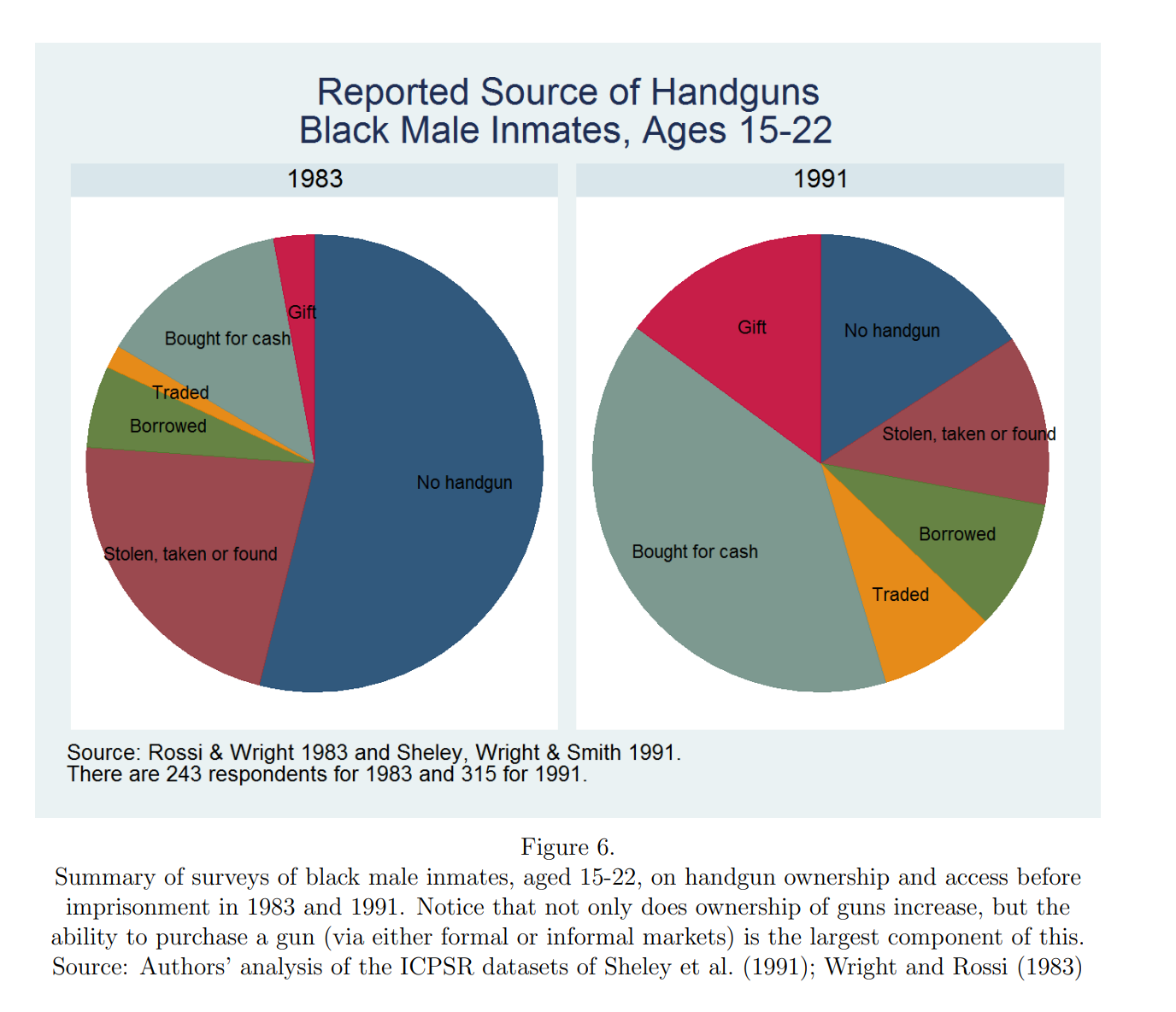
Second, when you simply asked people what they were carrying guns for, it was always protection. Everyone expected people to be violent, so they carried, and were violent in turn. In Chapter 4 of “In the Line of Fire”, Sheley and Wright show that the main reason people carried guns during crime is because they believed the victim would be carrying one too. Guns were carried for, in their view, self-defense, not status. Fagan and Wilkinson (1998), similarly, link gun ownership to an “ecology of violence”, where a gun increasingly becomes a necessity because everyone else has one. Colson Whitehead writes, of the era:
It was only a matter of time before we started posing for album covers. Not one from innocent ’85, but one from a few years later, after the music had changed from this:
Rhymes so def
Rhymes rhymes galore
Rhymes that you’ve never even heard before
Now if you say you heard my rhyme
We gonna have to fight
’ Cause I just made the motherfuckers up last night
to this:
“Hey yo, Cube, there go that motherfucker right there.”
“No shit. Watch this . . . Hey, what’s up, man?”
“Not too much.”
“You know you won, G.”
“Won what?”
“The wet T-shirt contest, motherfucker!”
[sounds of gunfire]
Lyrics from the aforementioned “Here We Go” and “Now I Gotta Wet ’Cha,” copyright 1992, by Ice Cube, born the same year as me, who grew up on Run-D.M.C. just like we all did. “Wet ’cha,” as in “wet your shirt with blood.” Something happened in those nine years. Something happened that changed the terms, and we went from fighting ( I’ll knock that grin off your face) to annihilation ( I will wipe you from this earth). How we got from here to there is a key passage in the history of young black men that no one cares to write.
- Colson Whitehead, “The Gangsters”
Once violence is allowed to fester, it becomes endemic, and take a long time to get out.
Starting in the very last years of the Dinkins mayoralty, but beginning in earnest under Giuliani and Police Commissioner Bratton, crime in New York City went down. In my view, it’s because the police started actually policing. The Bratton reforms were a combination of computerized command and control with Compstat, making precinct commanders personally responsible for crime under their watch, and freeing the police to actually enforce the law, combined with a large increase in headcount.
It’s important to note, though, that the point of Compstat is not really about the stats. It’s about accountability. Municipalities which adopted Compstat in order to look modern, but without any of the good management it enabled, were nowhere near as successful as New York City was.
Shootings remained steady through the 2000s, then slumped through the 2010s. Nobody really knows why. The best explanation I have is targeted enforcement. For most violence, we know more or less who is going to do it. Gang members are not exactly shy in proclaiming that they are members of gangs. What is much harder is pinning any particular act on a particular person. Instead, NYC simply arrests the whole gang, and charges them as a criminal conspiracy. They do this way more than anyone else. New York City is also notoriously tough on carrying firearms.
Then, in the aftermath of the George Floyd protests, crime increased, as it did nationally. Shootings doubled. To my mind, the cause of the crime increase was an enormous common knowledge shock, like the looting of 1977 (or the Montreal police strike of 1969). The police pulled back from policing, people stopped cooperating and were less willing to report crime, and importantly, everyone knew this to be the case. At the same time, the courts stopped functioning at all because Covid
Of note, the NYPD had had a de facto police strike before, after the death of Eric Garner. The police unions (there is a different union for each rank in New York City) are insanely prickly about respect, and disliked the de Blasio administration. For seven weeks, officers refused to do anything that wasn’t required. The difference from 2020 is that there was a police strike going on that was not common knowledge. It was noticed, but the period on which it was being reported on was very brief.
However, as with the rest of the country, long-run beliefs stayed anchored. The Adams administration hiked enforcement substantially, and shooting returned to just about where they were in 2019.
Many people believe that crime is the result of socioeconomic conditions, and that we need to fix the root causes. I think that this is a bad thing to focus on. Simply giving people money does not reduce crime, except for some categories of property crime. (In which case, we are simply substituting for irregular theft by criminals by regularized theft by the tax authority). Cesarini, Lindqvist, Oestling, and Schroeder (2023) is the best study on this, using widely played lotteries in Sweden to trace out the effect on crime. Criminality actually slightly increased after winning the lottery, though this was insignificant; neither did winning the lottery reduce the delinquency of their children.
What does work, in terms of soft interventions, are things which keep people busy. Summer jobs programs for teens do reduce conviction rates, and we have extremely good identification for this. Gelber, Isen, and Kessler (2016) estimate that the Summer Youth Employment Program in NYC reduced the likelihood of incarceration by 10%, using the fact that receiving a job was randomized. The case for summer job programs is especially strong since the effects are persistent.
While reducing poverty per se does not meaningfully reduce crime, disrupting locuses of crime like “the projects” does reduce it. I see this as evidence for my story of crime having multiple equilibrium. When cities demolish public housing projects, crime drops without displacing into where the people went. Most of the evidence is from Chicago – Danielle Sandler (2017) finds that demolitions of projects like Cabrini-Green caused crime committed in the nearby neighborhoods to drop by 8.8%. Chyn (2018) finds that these effects lasted, and the children who were pushed out did better. (A lot better, with violent crimes reduced by 14%). The main reason Cabrini-Green was so violent is that each of the buildings were controlled by gangs, and they’d fight each other. Demolishing the project is a big shock that gets us out of the bad equilibrium, and pushes the people into places where we are in a low equilibrium of crime.
I think the lead-crime hypothesis is both true, not as substantial a contributor to the fall in crime as people think it is, and also of complete irrelevance to society today. Its prominence in discourse is because people would really like a solution for crime which is one clever fix, and does not necessitate anything unpleasant. Basically when you take the estimates across the good studies, correct for publication bias (where significant results are more likely to be published), and multiply the implied elasticity by the observed change in crime, you can explain 7-28% of the fall in crime. (This is borrowing from Higney, Hanley, and Moro). And of course, this is holding the police response constant. It’s totally possible that crime would have fallen by just as much because we would have hiked policing to match, much as how a worse supply shock can still be outdone by the Federal Reserve.
Likewise, I also believe that the legalization of abortion reduced crime, but that this is more or less irrelevant. The causal channel – that mothers were more likely to abort the babies they could not take very good care of – is so obvious that I would struggle to believe it isn’t true. However, trying to actually show how large the effect is is next to impossible. I simply do not believe that you can construct meaningful state-level differences in differences from whether or not abortion was legal before Roe v Wade – and in any case, when we did try it, the significant results of Donahue and Levitt (2001) were inflated by a coding error.
Cognitive behavioral therapy is something which seems to me promising, but unlikely to scale up being a substantial intervention. The core is the “Becoming A Man” experiments in Chicago, as well as an implementation in Liberia. Both of these had positive effects, with the Liberia intervention unexpectedly producing effects ten years later on.
However, when the Becoming A Man program was scaled up in READI Chicago, we found no changes in primary outcomes to speak of. All they got were some positive secondary outcomes on subgroups. But that’s how it goes with programs like these. They are extremely vulnerable to being implemented by charismatic figures who are likely to have an effect, regardless of what they do, through simple motivation. It tracks that the Becoming A Man program saw an effect during the program, but none afterwards, suggesting that what matters is being attached to a structure.
One strategy which consistently works to defeat crime is targeted deterrence, which is essentially divide and conquer. The thing about gang violence is that you know more or less who’s going to do it. It’s the people in the gangs. Now, you don’t have anything to charge them with, but you can go talk to them, and say, “We are going to help you. We are willing to spend resources, get you guys a job, all that. But if you or your crew shoot anyone, we are going to come down on you like a ton of bricks”. New York City did something like this by sweeping up everyone in a gang on criminal conspiracy charges, but a lighter approach is possible.
Boston was the first city to implement this program, in the 1990s. Youth homicides fell by 63% afterwards. Now, time series evidence is nowhere near sufficient to prove the case. But what we can show is the effect across gangs. Braga, Hureau, and Papachristos (2014) find that the gangs subjected to the treatment reduced their shootings by 31% compared to similar gangs which were not treated. More recently, the surprising fall in Baltimore homicides – 60% between 2022 and 2025 – is likely due to targeted deterrence. The argument for it is that they looked at where the program was first rolled out within the city, and that the people treated saw larger reductions in crime.
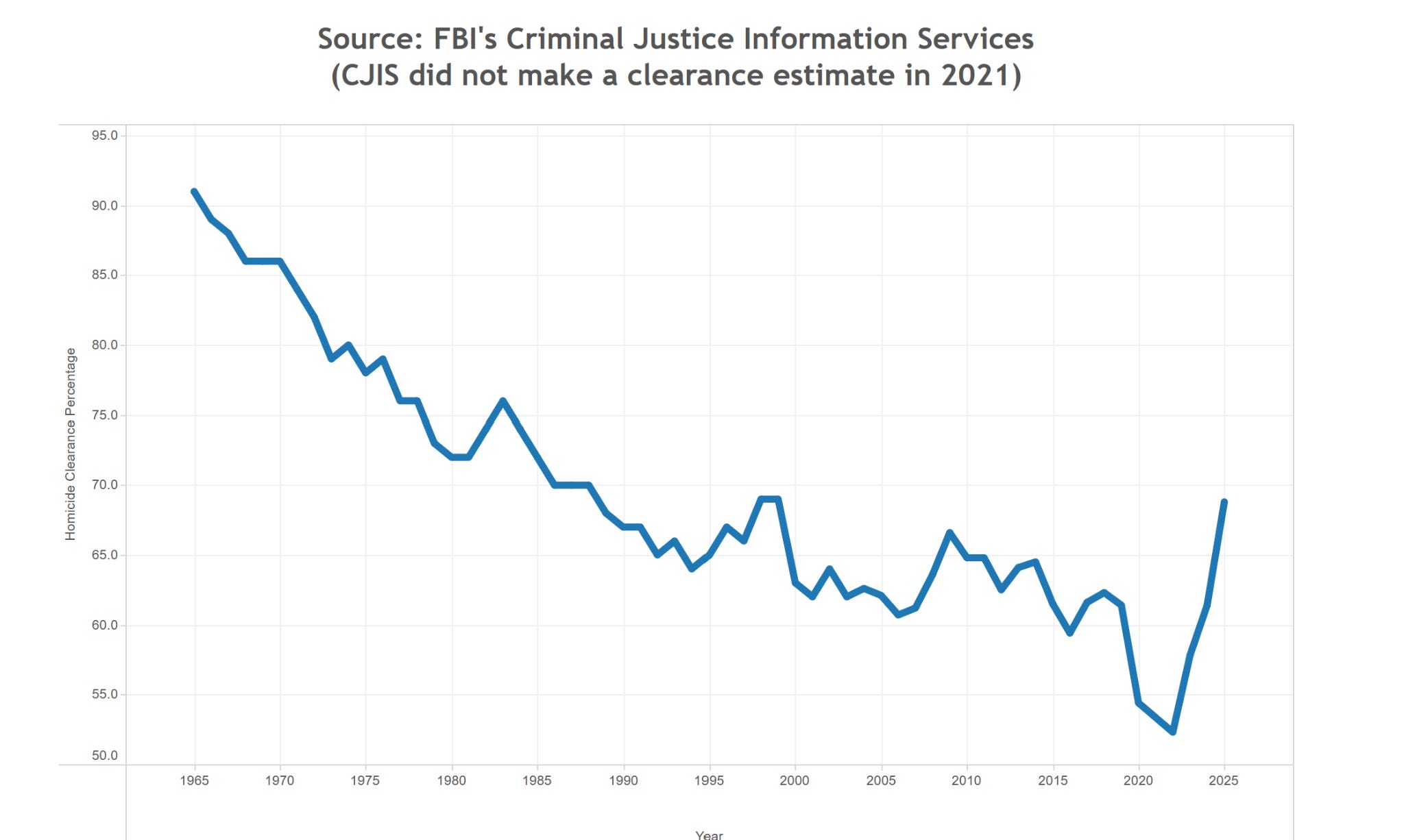
In a similar vein, divide and conquer can be used within police departments. Homicides have clearance rates well above all other crimes. Partly, this is because murderers are easier to catch (people talk when they wouldn’t have otherwise, and it always gets reported as quick as possible). But this is also because police take it more seriously, and invest more resources into finding killers. Homicide squads work differently from the rest of the department. Squads assign cases to one detective who is in charge of leading the investigative effort, and professional success is tied to how you do at resolving cases. Rather than treat property crime as something to be recorded and perfunctorily investigated, the police should make specific people responsible for solving a manageable portfolio of crimes.
Going forward, I expect crime to continue falling in the categories of the law the police choose to enforce. In particular, ubiquitous surveillance is making it much easier for the police to solve the crimes that they choose to solve. Homicide clearance has substantially risen in the past few years, and the best explanation is that you can now do things like request whose phone records were observed at the scene of the crime. But this is a subject for another article.
My story of crime is that there is no determinate equilibrium. Both high and low crime states, and many in between, are possible, given the same observables and level of enforcement. This greatly complicates evaluating the effects of policies. As such, we need more theory and less empirics in police practice. The thing that works for reducing crime is finding the people doing it, and stopping them. There is no alternative.