Economics nowadays is very slow, careful, and methodical. Because professors have limited time to read, we reward one’s greatest, most pain-staking single work. The institution of the job market paper is a reasonable response to this – you will spend perhaps seven years, start to finish, working on one single paper, adding bells and whistles to show one’s ability. You start it in your second year, have a six year phd, and have it eventually publish two years into your first job. By the time it comes out, it will be thoroughly out-of-date, though of course immaculate.
The world for economists is changing. The development of generative artificial intelligence will, in my view, completely shake up how economists conduct their research. I do not think the old way will be best, although I am not sanguine to say that it cannot last. (Many bad equilibrium have lasted far beyond their proper time!). Economists are going to be able to move much faster when it comes time to actually write the paper. We are going to exhaust what can be done with the data we already have – it will not be that hard to sic an AI agent on a dataset to tell you everything you might possibly be interested in.
I would like to propose a vision of what that future may be. You may have already heard of the economist as engineer and the economist as plumber; I would like the economist as reporter. The economist should be someone who goes out into the world, gets the facts on what we can and should change to make the world better, and then builds a case for why we should do this.
Think about what the bottlenecks will be after AI automates stuff. AI can implement code faster than you can dream – the cost of running statistical analyses is lower than it has ever been. What AI cannot do is go out in the field, testing something. It cannot uncover graft, corruption, and fraud. The economist’s expertise will be in knowing what stones to overturn, like an investigative reporter, and in getting it out to the public in such a way that it can actually change the world for the better. They can be like an investigative reporter in the times when newspapers were profitable enough for that.
The jobs can be similar because there is a fundamental similarity in the way all good arguments are made. Suppose we want to make the case that we should do X. We have ideals, broader goals which we wish to meet but have some flexibility in how we reach them. Presumably, we should do X because it is in service of these greater goals — doing X will cause improvement Y. The space of possibilities is massive, so we must simplify the world down to as few assumptions as possible, then state what must be for those assumptions to hold. Although we cannot test everything, given limitations of data, everything we claim must have a conceivable test which can be falsified. A lawyer does this when building an argument; an economist does this when writing a paper; a crack journalist does this when investigating the efficiency of a government program.
What I find, however, is that journalists as a class are largely not capable of answering many important questions. They have not been trained in the skills which would be necessary to actually find out anything for themselves. They are forced to rely upon asking experts who, often not having the time to study the topic themselves, are going to give them generalities. To simply collate the opinions of others is not and cannot be journalism. It is punditry, suited for the op-ed sections. Heck, often journalists cannot even do that. Having no deep understanding of the methods, they cannot differentiate good from mediocre or even bad studies, and generally do not read much beyond the abstract.1 Knowing economics lets you pick out what matters.
There is value in writing columns. It is what I do – I try to collate the things which are valuable for others to know, and present them. People have limited time, and must rely upon others to tell them about what is important out there in the world. I hope that I do this well, and further hope that you can forgive my endless chatter about methods in industrial organization. But, it cannot exist without people actually doing the work to find things out about the world.
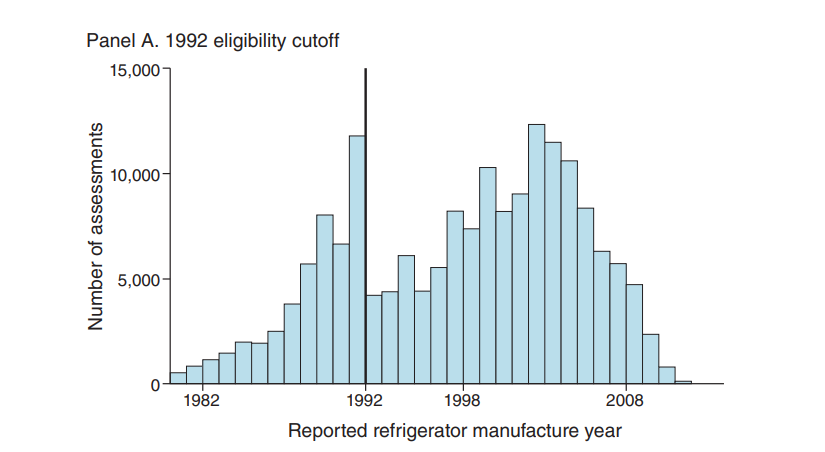
I should give some examples of what would be excellent work under this new paradigm. Joshua Blonz has an excellent paper on California’s Energy Savings Assistance program, which (in the name of energy efficiency) subsidized certain upgrades to homes for low-income households. The most important part of this were the refrigerator replacements, which constituted the bulk of the program. If the fridge was built before 1993, when the Clinton administration changed the energy efficiency standards, they would replace it for free, for a projected reduction in electricity costs of $326.
The only trouble was, the program was riddled with fraud. The contractors were paid per action performed. If they reported a fridge built in 1993 as being built in 1992 (and they were the contractor who would do the replacement) they would be paid $222 more. So what do you know – there’s a great heaping of refrigerators built just before 1993.
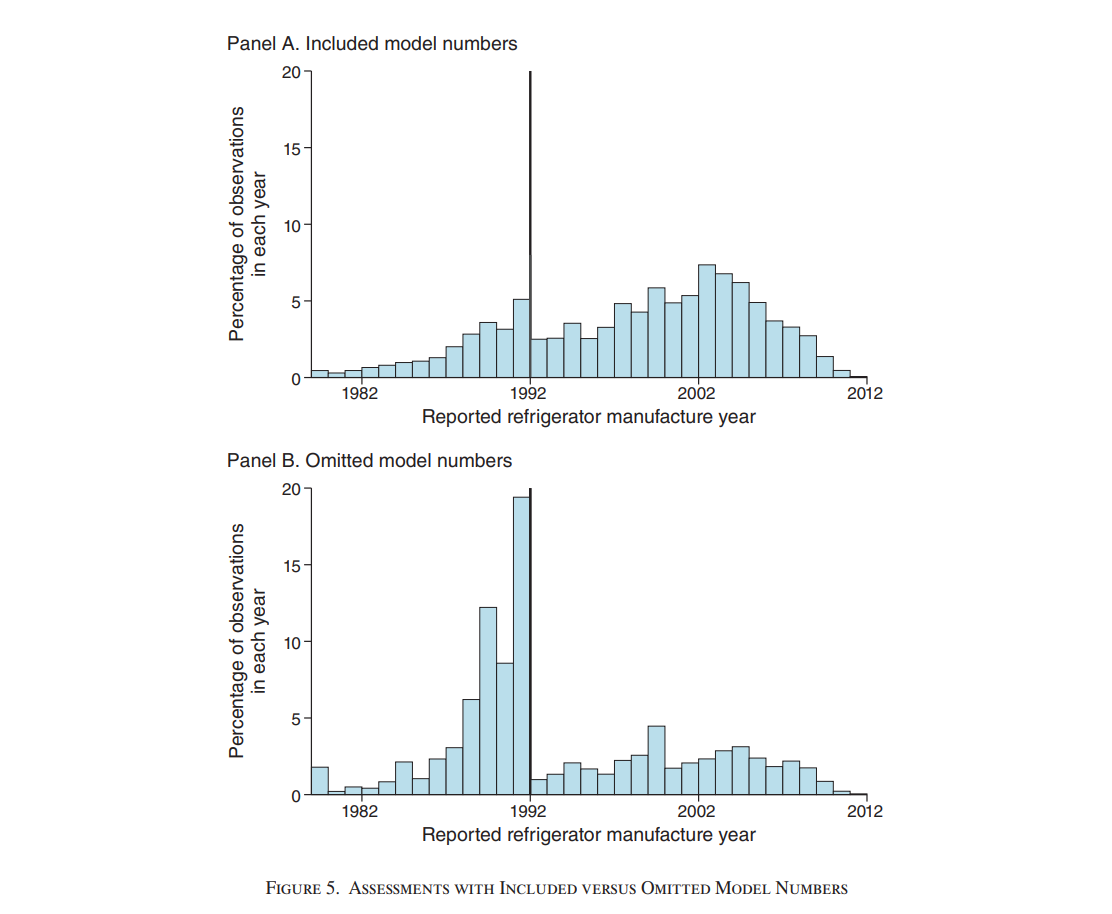
These results were driven by refrigerators with missing model numbers, with contractors misreporting about half of the fridges without one.
In 2012, California changed the eligibility year to 1998 and – isn’t this remarkable – there stopped being a heap at 1992, and started being a heap at 1997.
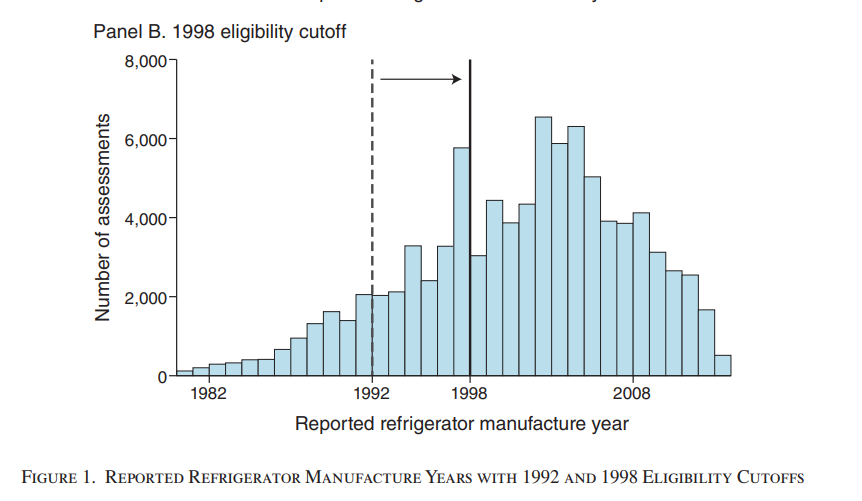
The change took place within the month that it happened, immediately dropping the number of “1992” refrigerators in half. Why didn’t they catch it? Because the government agency in charge only audited after the fridge was removed, caring only about whether the job was done rather than if it should have been done. Oddly, it would have been better for society had all of the fraud been purely for things which never happened – at least they wouldn’t have had to have wasted real resources. San Diego administered it separately, with more serious guards against fraud, and found no such heaping. The costs of this were large. Using a reasonable cost of ten cents for every kilowatt-hour of electricity, the fraud was sufficient to flip the net benefits from $61 per household to negative $106.
To my mind, this is precisely what economists should be doing. Blonz identifies a problem, then builds an unimpeachable case that it is actually happening, and it actually matters. He uses reasonably sophisticated tools, not to show that he can use them, but because they are essential to building the case. It is a shame that publication timelines are such that it could only come out long after the horse had left the barn – the period studied was 2009-2012, but the working paper was only out in 2019, and the
A journalist reporting on the same story would be forced to simply interview people about how they’re misreporting, with no idea how big it would be. That is not to say that there is not good reporting out there. I lack the knowledge of journalism that I have for economics, so there will be fewer examples, but I thought the Washington Post’s piece on fraud in veterans’ benefits was excellent. Here, though, the tools of economists would be excellent. The piece can’t say anything about the social costs of it, or what would happen with different rules, or how much of it is fraud. They’re stuck with “everyone knows what’s going on, let me tell you about it”, which is surely so much less than we’re capable of.
I would highlight modern healthcare economics as doing much of what I think we should be doing. They take on one particular facet of the industry, whether it’s a current practice or a proposed policy, and evaluate it. Thus you see excellent work on the kidney dialysis industry, on risk-adjustment in MedicareAdvantage, on pharmaceutical reference pricing, on the effects of reducing funding for drugs, assessing the quality of nursing homes and improving inspection schedules, correctly weighting consumer preferences for MedicareAdvantage, assessing optimal merger policies, assessing the impacts of past mergers, showing the effects of Medicaid on health, finding the causes of opioid abuse, and – I’ve got to stop, there’s just so much. This stuff is incredibly important, and we need more of it. Also important is work in antitrust. The FTC is badly understaffed, and we should be running far, far more merger reviews.
Economics has changed before. For years and years, economics was essentially not an empirical science. We lacked sufficient data and computing power to truly be empirical. It progressed via theoretical refinements, qualitative observations, the cataloging of facts about particular industries, squinting at time series, broad reasoning about aggregates, and some basic econometrics on paltry datasets. Can you really say that there are any truly great empirical papers by the standards we would have today? Stigler on the economics of information has the prices of 27 car dealers and 14 anthracite shipments, and then on information in the labor market has the wage offers to 44 graduates of Chicago’s business school, some surveys of companies as to their hiring rates, and aggregate census statistics by industry; Jerry Hausman’s paper on how to isolate discount rates from choice of air conditioning unit has a sample of 46 households; Jacob Mincer’s paper which introduced the Mincer regression is based off of averages from the census per unit of age and some aggregate statistics on income by industry; Solow’s 1957 follow-up to the paper which introduced his famous growth model is based upon data that he himself described as “ad-hoc” and “will really drive a purist mad”; and on and on and on. Going through old issues of the Journal of Political Economy, you see essays which would seem bizarre now – behold a 12 page essay with essentially no data whatsoever, verbally expositing a model of heroin distribution – or simply bad. They are certainly trying, and there are many papers which take on important questions – see, for instance, a paper on the determinants of firm R&D investments, which is just reg(y, x) on the Fortune 500.
Of course all the prestige was with the theorists. All we could do was accumulate more and more beautiful tools. We don’t really need any more tools. Instead, we need to answer the questions the public needs, and deserves, to know.
What we as economists need to do is reward other economists for doing so. We are well aware of the power of incentives, so let’s change them. We should reward the creation of new datasets highly, and penalize academics for them not becoming public quickly. There should be a substantially larger budget for economists at the CMS and FTC, and plausibly other places too. Admittedly, this will have to wait for the next administration. I know (from talking with economists at the FTC) that they are badly understaffed, and have to let many problematic mergers go without any scrutiny simply for want of stuff. Writing many good analyses of particular industries and questions should be seen as important as one really great paper. Journals should strongly weight policy relevance. This can be retrospective, so if it was relevant at the time the working paper came out, but it should matter. We actually need fewer NBER working papers. Can we kick some of the old people off? It just clogs things up. I absolutely refuse to name names, but there are a lot of meh papers that get released.
Lastly, a cultural change. Economists need to conceptualize themselves as salesmen to the public, not just other economists. If you are a talented researcher who hates talking to the public, that’s fine – hire people to do this! (DMs open). Your audience should not just be other academics, but the world. You’re going to have to be on twitter, sorry. You’re going to have to be on substack. You’re going to have to reach people. Maybe, if you don’t need to spend on RAs to do tedious coding tasks, you can spend on them accumulating data and popularizing your work.
Remember this always: the point of economics is to improve the world. As the world changes, we must change with it.
P.s. It strikes me that I should include some economists who are facing the public, especially ones you might not have heard of. Omissions should not be taken as a slight. List is partial and to be expanded. These include Alex Imas; Jesus Fernandez-Villaverde; Hanno Lustig and Romain Wacziarg; Brian Albrecht and Josh Hendrickson; Basil Halperin; Daron Acemoglu; Ashvin Gandhi; Peter Hull; Mean Field Zane; Scott Sumner; David Deming; Chad Jones — fill in more!