I think economics has little to say about the polar extremes of AI. If we are dead, then alas, we economists will have no data to analyze; and if we are in the midst of unimaginable plenitude, we will hardly care about small optimizations. So let us instead discuss what happens in the middle – AI is powerful, useful, but not all-encompassing.
In particular, it seems likely we will handle much shopping through the use of artificial agents, instructed to make purchases on our behalf. Such an agent would have the ability to search for deals, to compare alternatives, to commit to prices, and perhaps to anticipate what we would want before we do.
On the other hand, sellers would have exactly the same technology as the buyers would. They would have artificial agents doing nothing but observing the prices which other firms set, gathering information about the underlying demand for their own products, and adjusting accordingly.
Who wins? Do markups go up or down? It is my belief that this will lead to markups going up, by a lot, for a very simple reason: sellers list what they are selling and at what price, while buyers do not express what they are willing to buy until they do. Consequently, while AI will almost certainly improve the real efficiency of the economy, I expect it to greatly increase misallocation. Which will be more important remains to be seen (although I expect the real efficiency gains to outweigh the increase in misallocation).
This post is brought to you by Mechanize, Inc. They are hiring for a variety of positions, including software engineers. I encourage you to apply here.
Suppose that there are two companies selling an identical product, which is produced at a constant marginal cost. They are facing a downward sloping demand curve for their product. Thus, there is an optimal price, where they both produce where price equals marginal cost, that would be reached under conditions of perfect competition. There is also a monopoly price, one which maximizes their joint profits, and would be chosen if the two companies were to merge. Normalize the perfect competition price to 0, and the profit maximizing price to 1. This monopoly price is inefficient because they must restrain themselves from selling to people who would be willing to pay what it costs to produce. For the time being, we will say that no other companies can enter.
What would happen if both companies set their price simultaneously, and the game lasts for only one period? Each company can reason that if its opponent were to set their price at p, then they can profit by taking price p minus epsilon. Knowing this, the opponent will set their price just a little bit lower, and we end up with the only Nash equilibrium being the price at marginal cost. (Or if the prices that people can charge are discrete, the price will be the smallest increment above zero possible).
This is not preferable for the firms. Ideally, they would like to merge; failing that, they would like to price as though they were. That last is collusion. You don’t need for there to be any actual communication for firms to act as though they were colluding. Indeed, it is possible to sustain collusive pricing using just the prices chosen over time. A few things help with this: patient players, players with the ability to commit to things, observable prices, limitations on entry, limited payoffs for breaking the collusive equilibrium, and a lack of countervailing market power.
Consider what happens when firms no longer have to stick with one price forever. Instead, prices are sticky. They can change them, but only every once in a while. Maskin and Tirole (1988) formalized what was posited by Edgeworth long ago – prices will drift between 0 and 1, with the firms collecting supracompetitive profits. Suppose that both companies are selling at marginal cost. One firm decides it does not care for this, and it would be indifferent between selling nothing at the monopoly cost and any amount at zero. They raise their prices to the monopoly cost and keep them there. Their competitor observes them do this, and chooses to raise its price to just undercut the monopoly price. Now the firms can go back and forth undercutting each other,
We can see this most clearly in the market for gasoline. Byrne and de Roos (2019) trace out these exact cycles in Perth, Australia. There, four major companies own the majority of gas stations. In 2001, they required that all gas stations put their prices up on a public website, in the name of price transparency. Within a few years, the gas stations settled on a routine – the biggest network would move first, and everyone else would follow. I think a picture says more here than I could – underneath every sawtooth is excess profit collected.
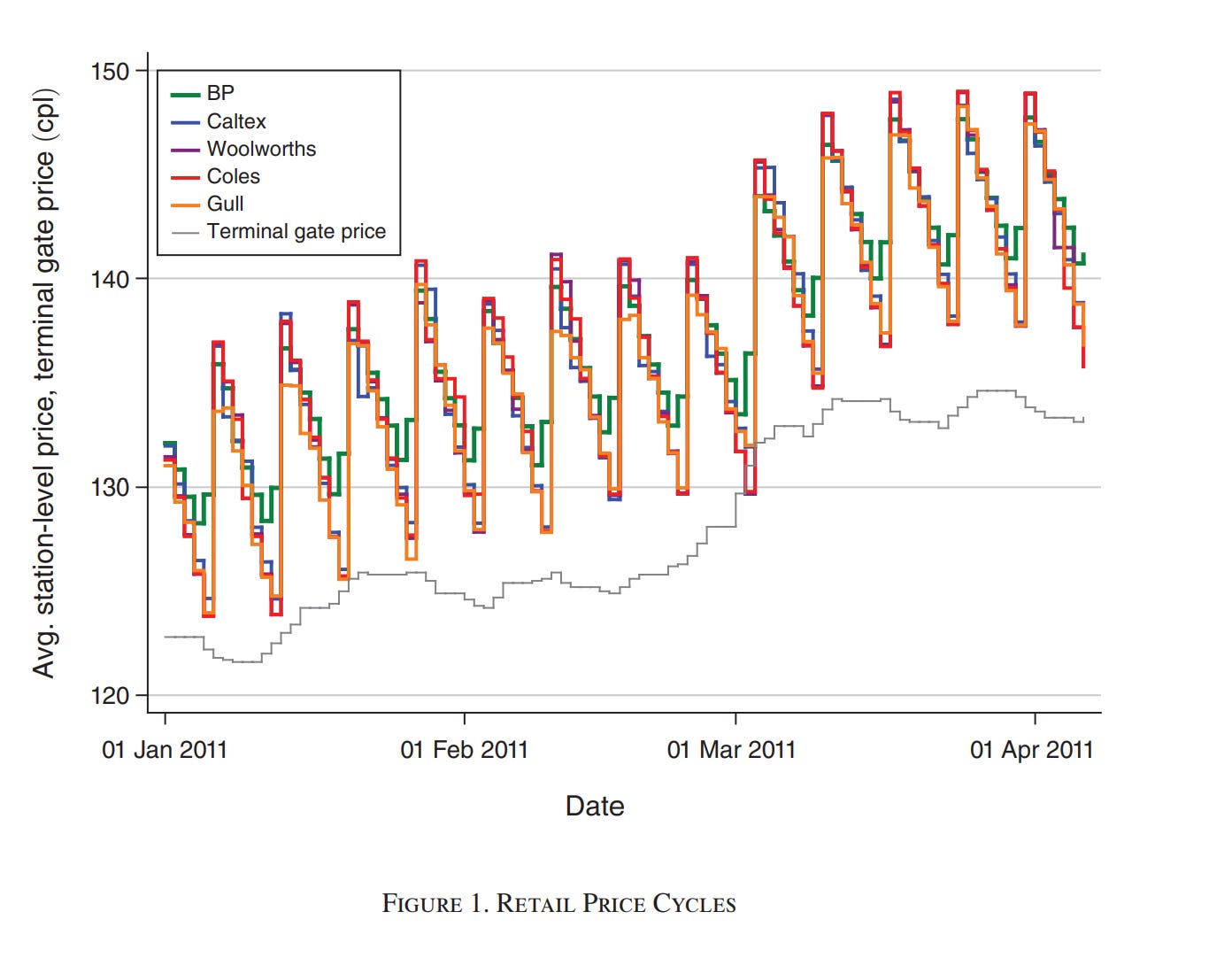
Now suppose that firms can change their prices instantaneously, with full knowledge of everyone else’s price. The situation gets even worse. The consumer will have to pay the monopoly price at all times, regardless of how many companies there are. Suppose we are at the monopoly price. If anyone lowered their price, they would be immediately matched by another firm selling for the same price. There is never any gain to undercutting.
Worse still, this does not mean that these profits go to anyone. Get rid of the no entry assumption. Competitors pay some fixed cost in order to enter. In that case, the fast pricing algorithms will keep the high markups, but firms will enter until those high markups are simply to recoup the costs of entry. (Mankiw and Whinston (1986) is the classic reference here).
How large could this distortion be? Some sense of the size can be given from looking at the common ownership literature. Many publicly traded companies are partially owned by index funds. One might reasonably be concerned that these partial owners of many companies place a weight on the profits of other companies, leading them to compete less strongly. These numbers are back of the envelope, because they must make many strong assumptions about the distribution of demand; nevertheless, full collusion among publicly traded companies would reduce consumer surplus by 30%, according to Ederer and Pellegrino (2024). I am not going to defend the specific number, except to say that it is extremely large.
It’s clear that, in a static world of homogenous goods and many possible buyers, AI agents lead to complete collusion, and the extraction of surplus from buyers. Of course, the world is complicated. We do not see collusion everywhere now. I am concerned, however, that AI agents will remove many of the offramps that usually disrupt collusive behavior now.
One way that collusion breaks down is that firms are uncertain about what prices are. AI agents autonomously trawling the internet for prices means that the conventional source of not knowing what prices are is gone, but we can still have uncertainty over prices due to secret price quotes, due to changes in demand, or due to the variety of products available.
Secret price quotes is something which seems promising, but won’t work out. Buyers will also be using AI agents to shop, of course. This should lower the cost of negotiating, and we might expect defectors to give secret price offers. However, sellers can use the same bots as the buyers. We should not expect prices to ever be secret, so long as there is any difficulty in telling who is a bona fide buyer.
We might also be uncertain over what the right prices are. So far, we have been assuming a known demand curve, but this might be something which we need to infer over time. However, I would expect cheap intelligence to be very, very good at forecasting what demand is. This will lead to a large gain in productivity, but will also make it easier to collude.
Similarly, a confusion of goods with different characteristics makes it hard to tell what the price of a new good is in relation to yours. You don’t know for sure whether they are offering a product which is below the collusive price, or at it. This makes collusion substantially easier in homogenous good industries like concrete. However, if cheap intelligence is allowing us to understand the world better, complexity will matter less and less.
Buyers using AI agents need not undo collusion by searching for the best deals. In the extreme, better deals simply do not exist. There is nothing to find. Even if we suppose that searching was costless (from the point of view of inference), and agents could sample every available price, declining to buy in this period to wait till the next is still costly. So long as sellers are more patient than buyers (which seems plausible), the sellers win.
What AI agents do is raise the payoff to successfully cutting one’s price lower than your competitors. If everyone’s agent waited for the price to fall, and jumped at the first opportunity to buy, then the payoff to cutting your prices is enormous. However, we assumed that other sellers can change their prices just as fast as you, and can detect secret plans to lower prices. Buyers could plan to reward the first firm to defect by using moving first as a tiebreaker in who to buy from; however, competing sellers could simply cut by more. I am going to assert as a theorem, but decline to prove, that there is some size of cut sufficient to rule out any gain from cutting prices by getting buying agents to buy from the responding parties.
Second, even if buyers could collude as well as the sellers can, we would still expect the sellers to win. If two agents are bargaining, and make offers back and forth subject to a cost of continuing the negotiation to the next period, then how much surplus each party gets is determined by the relative patience of the parties. I expect for buyers to be less patient than sellers, because people’s need for a product arises somewhat unexpectedly over time. Even if AI could anticipate what you will want before you want it, your ability to buy in advance is determined by how much inventory you can hold. If, as seems likely, there are increasing returns to holding inventory (you do not possess a warehouse, the sellers do), then sellers will again be more patient.
So far we have been assuming a passive intermediary. Firms post prices somewhere, all buyers can observe them, and transactions happen. But right now, shopping occurs through intermediaries like Amazon which take an active interest in which sellers are listed, whose prices are promoted, and whether they offer their own products. In the future, I believe that the advantage of Amazon in being a central clearinghouse is lessened. Hosting a web domain is cheap, and AI agents will be much more able to handle searching widely. However, Amazon (or an Amazon like company) should be able to claim a substantial portion of rents through their logistics. Delivery has increasing returns to scale. More packages along a route, and more packages per stop, make the cost per unit shipped cheap. However, I would expect the intermediary to have less of an advantage than they do now.
This suggests a possible path for AI companies to make money. Sellers would like to sell at high prices to those with a high willingness to pay, and at low prices for those with a low willingness to pay, but are unable to do so without other companies getting into a ruinous price war. Your AI company possesses an astonishing amount of data on you as a person. I expect they will be able to predict what you are actually willing to pay for a good, better than anyone else could.
The buyers and sellers could commit in advance to have the buyer’s agent reveal their type, and charge the corresponding price, with the buyer’s agent collecting a fee. Sellers have some information of their own on what the likely price people are willing to pay is; in large volumes, AI companies would build a reputation for honesty, and we would increase efficiency. Conceivably, they could extract the entire surplus (gestures vaguely at Bergemann, Brooks, and Morris (2015)).
Not everything about cheap information is negative. This whole article has assumed that demand conditions are known, and all we need is to optimize in that known environment. Obviously this is not the case. Companies have to learn about how to produce and what to produce, and their errors are costly. Cheap intelligence will greatly increase the accuracy of firm predictions. I expect this gain to be very large, and I will explore how large in a future article. However, with cheap intelligence comes cheap collusion, and the losses from that are likely to be very large.