I believe that we should imprison people who commit their first crime at a young age longer than those who commit it later on. The reason is that age at first crime reveals information about what sort of person you are.
Consider this simple model of crime. It is possible for any person to commit a crime, but each person has a different hazard rate for a crime committed in a period. This hazard rate increases rapidly beginning in early teenage years, and then declines to zero as people get older and eventually die. I assume that people have hazard rates which are multiples of each other, rather than additive – the practical implication is that crime rates of higher types converge at the end of their life to the lower types, rather than being permanently higher. A stylized example is shown below.
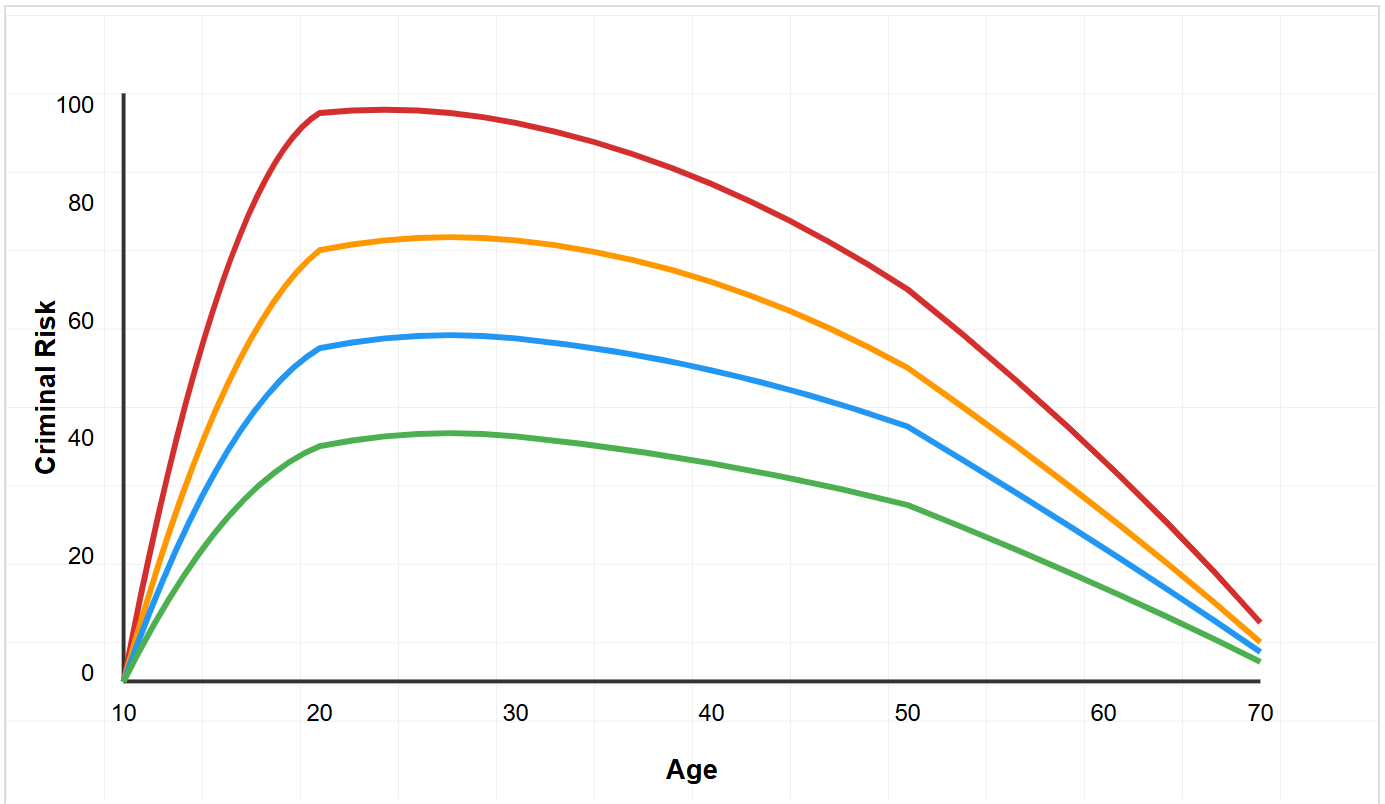
We are trying to figure out how long sentences should be. There are multiple stories of why prison reduces crime, but we are going to focus only on incapacitation. I am sure that both deterrence and rehabilitation play some role, but since any attempt to find the optimal sentence length would involve identifying each separately, we can go one at a time. The reason we imprison people, under incapacitation, is that their likelihood of committing a crime is too high. We want to hold people until their propensity for criminality drops below a certain threshold, and thus we want to hold violent types longer. Adding in deterrence will tend to increase sentence length, because one person’s imprisonment has a positive externality onto others; while rehabilitation will tend to decrease the optimal sentence length, as it turns people into lower types.
We can’t observe people’s type directly, but we can infer it from the age at which they commit their first crime. We start with some prior about the proportion of each type in the population and their hazard rates, and then adjust our belief about their type. The optimal sentence is therefore higher the younger the first crime committed is, and increasing in the number of crimes a person commits.
What is striking is that our justice system does the exact opposite. We give juvenile offenders a pass, and punish severely those who have crossed the age of majority for a first time offense. The effect of this is to systematically punish less violent people more, in absolute terms, than more violent younger offenders. This is totally backwards!
Our justice system does, however, do the right thing in being more lenient to first offenses. Repeated crimes draw us more and more to the belief that they are a high crime type who should be locked up. It gives a grounding for three strikes laws, which I (in essence) support. (I think the jump from second to third strike often involves too large a punishment).
This is the first sketch of a larger project. Having written down a model (I am omitting the equations for the sake of popular appeal) I will then have to estimate it. I expect to use NLSY data, and possibly administrative data from elsewhere. I have not yet done so, however, and do not expect to complete this for at least a month. Some points of interest that I want to cover are what the implied hazard rate for crime we tolerate is, what the length of sentences would be if we tried to match that, how much crime would fall by, the costs and benefits of doing so, and solving for optimal sentence if someone was removed from society for earlier (thus preventing us from seeing more information about their type).
I do have some predictions though. The effect of deterrence likely exists on the margin, but weakly. Nobody thinks seriously that simply removing all punishment for crimes would have no effect on crime, but at the same time we don’t have much evidence for it one way or the other. It’s hard to estimate, because much of it happens in the long run, and marginal changes are unlikely to have an immediate impact. Cross-sectional studies are not credible, as prison sentences chosen will be confounded with so much (not least legislatures perceptions of what future crime will be and the likelihood that offenders will be caught). The consensus seems to be that deterrence can be reasonably ignored. Rehabilitation seems like it works more, though there is such heterogeneity between prison systems that it is difficult to say that we could extract externally valid.
Regardless of how deterrence and rehabilitation modify the optimal sentence length, so long as the effects don’t vary based on how old people are, we should still be biased against young people, not the old.