Did you know that your blood passes through your kidneys roughly 300 times per day? I didn’t, but when I learned this, I had little reason to doubt it. I don’t feel how blood moves around my body—I have no awareness of how much of it is leaving my heart and flowing through my kidneys—so I’m happy to accept statements from reputable sources as fact.
The mind is different. Unlike our kidneys, our thoughts, memories and emotions are part of our everyday subjective experience. This can give us the misleading impression that we understand how these processes work, perhaps making us less willing to defer to evidence that contradicts our intuitions.
At the same time, psychology is the science that most easily escapes the ivory tower and finds its way into bestselling books, LinkedIn posts, podcasts, and dinnertime conversations. This is hardly surprising. Research on the mind promise answers to some of our most pressing questions, from how much sleep we need to whether social media is rotting our brains. But such questions are easier to ask than to answer. While brain scientists hem and haw and hedge their bets, many people gravitate towards those who sound more certain—those who offer tidy explanations and definitive answers, whether or not they are true.
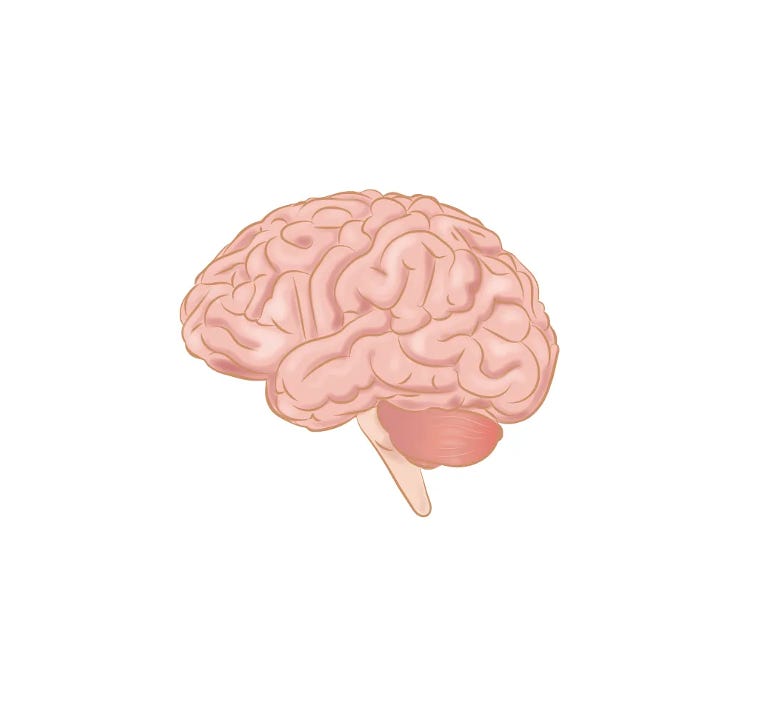
The result is that psychology has become home to an unusually persistent collection of zombie myths: ideas that have been debunked repeatedly but which refuse to die. Some of the most tenacious concern the structure and function of the brain itself, including whether we use just 10% of it, whether bigger brains are always better, and whether we harbour remnants of earlier brains within our own, from a reptilian “lizard brain” to the popular idea of an “inner chimp”. These ideas endure because they are neat and memorable, and perhaps because they place humans where we like to think we belong: at the pinnacle of evolution.
But these simple stories about the brain and its evolution are wrong. And, it turns out, the reality is far more interesting.
© Wikimedia Commons
Myth 1: You only ever use 10% of your brain
As a child, I remember being told that a human brain was like a 10-storey building, and that “most of the time, Man was working in the basement”.1 The implication was that the brain has vast untapped potential that most of us barely touch and that, if only we could reach the higher floors, we would discover what we are truly capable of. As an idea, it’s aspirational. It’s also utter tosh.
To see why, first consider what this would mean in evolutionary terms. Large brains are expensive. They require large skulls, which are one reason human childbirth is so unusually dangerous. They are also metabolically costly: the human brain comprises just 2% of our body weight, yet consumes about 20% of the energy we use at rest, scarfing the calorie equivalent of a can of Coke each day. The idea that evolution would build such an expensive organ for us to use just 10% of it makes no sense. It would be like buying a high-performance sports car and leaving it parked on the driveway. Natural selection does not typically pay for machinery that sits idle.
Empirical evidence bears this out. Brain imaging studies show widespread activity across many regions of the brain, even during simple tasks and while we are asleep. Though different networks are active at different times, there are no areas that remain permanently dormant. And the effects of brain injury are also revealing. Damage to even small parts of the brain can result in marked loss of function, suggesting that there is no vast reserve of unused brain tissue waiting to be recruited. We don’t seem to have a spare 90% sitting idle that can be pressed into service.
The brain, then, is not like a 10-storey building, with most floors uninhabited. Instead, a better analogy might be a bustling office block, where different rooms and floors are used for different purposes. While it’s true that all rooms are not in use all of the time, no room or floor is permanently empty. Instead, different areas are more or less active at different times of the day.
In other words, you use 100% of your brain, even if you don’t use all of it all of the time.
Myth 2: Bigger brains are always better
This is a myth that flatters our own intuitions: we have big brains and we are smart. Doesn’t it stand to reason that big brains are therefore better?
Not exactly.
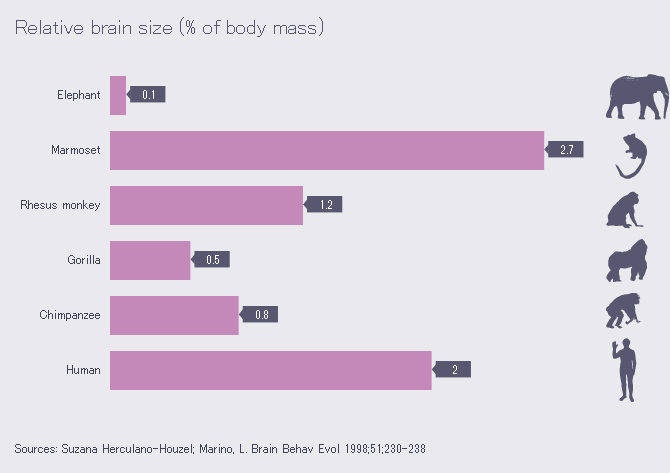
In fact, the strongest predictor of brain size is body size. Bigger animals tend to have bigger brains2 because a brain exists primarily to control a body. This means that absolute brain size is a weak proxy for mental prowess. Elephants have brains almost four times larger than ours, but here I am writing about elephants, not the other way around.
What matters more is relative brain size: whether a species has a larger brain than we’d expect based on its body size. Humans do, and so do most other primates.
© Wikimedia Commons
Relative brain size predicts some aspects of intelligence. Across birds and mammals, species with relatively larger brains perform better in experimental problem-solving tasks3 and tend to be more innovative in the wild, discovering new foods, inventing new foraging techniques and, sometimes, using tools. Animals that have large brains relative to their body size tend to be more flexible and able to think outside the box—this anatomical feature predicts ingenuity.
But whether this shows that bigger brains are better is another question entirely. Brains are expensive, requiring a steady stream of glucose to keep them running. Growing a big one uses energy that could be invested elsewhere, including on growth or reproduction. In line with this reasoning, some species have evolved relatively small brains because this better suits the demands of their lifestyle. Species that hibernate, for instance, experience long periods with no food intake, where a large brain would be a liability. Accordingly, they tend to have smaller brains than we would expect based on their body size.4 Similarly, domesticated species tend to have smaller brains than their wild counterparts, in part because being cared for by humans means an animal need not rely on its own wit to survive. Exhibit A below.

My dog. No predators. No responsibilities. No dignity.
More importantly, big brains are not needed to achieve impressive feats. Some animals have tiny brains but are capable of remarkably sophisticated behaviour. Bumblebees, for example, can learn to pull a string to get a food reward, to obtain food that is out of reach, and even to play a form of bee football. A chickadee’s brain weighs less than a gram, yet they can remember the location of thousands of stored seeds while I forget where I left my keys. This is a surprisingly common theme across the natural world: many animals excel in highly specific domains, such as learning and memory, without exhibiting the broad cognitive flexibility that characterises species with larger brains.
Rather than favouring ingenuity for the sake of it, evolution arms species with the kind of brain they need to survive in the world they inhabit. Large brains, and the flexibility they permit, tend to be most advantageous in unpredictable environments where animals need to be able to adapt to new contingencies on the fly—a good example being the urban environments that they share with us, which reward inventiveness and adaptability. In more predictable environments, large brains are not automatically better. Indeed, for many species, the benefits of a larger brain simply do not justify its substantial energetic cost.
Myth 3. You have a lizard brain or an inner chimp
Can’t resist eating sweets? Must be your lizard brain. Lost your temper? That’s your inner chimp.
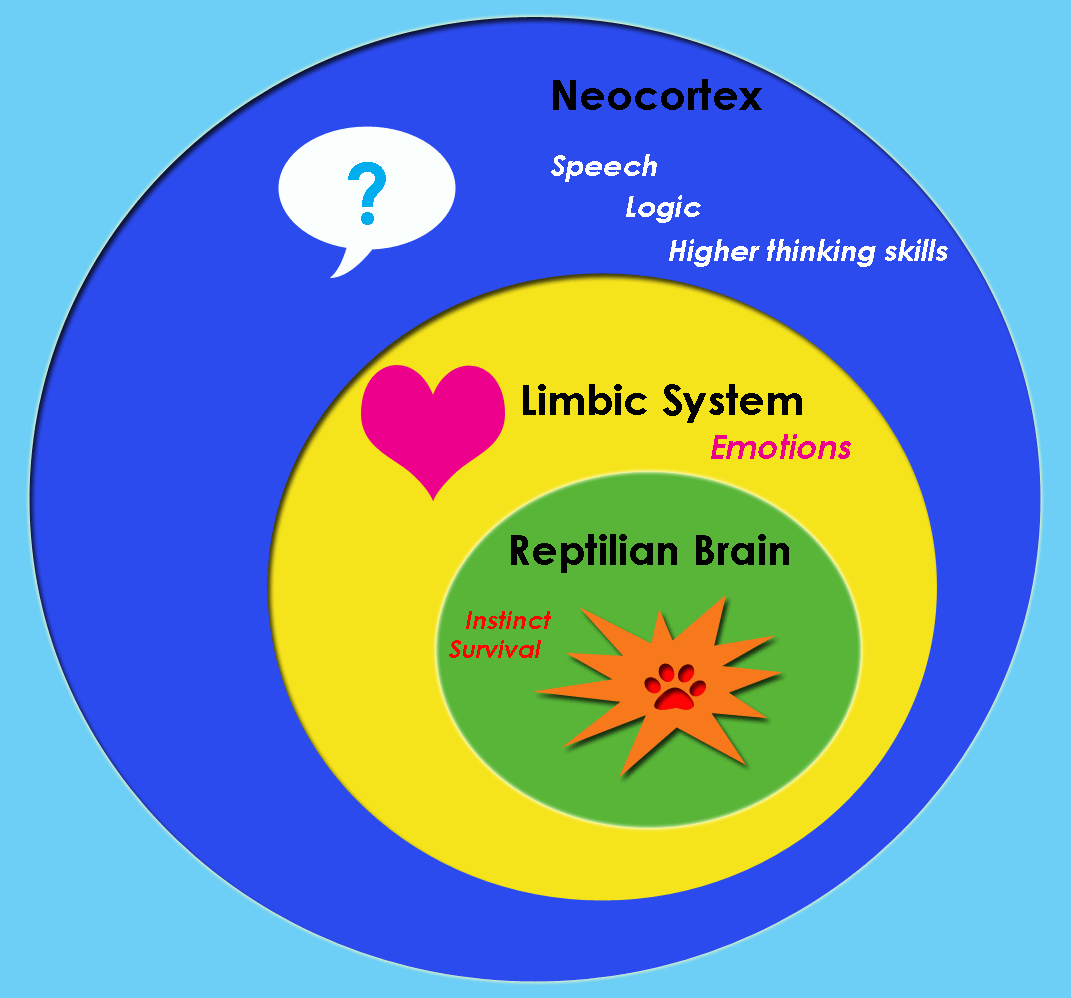
You might be familiar with this myth, which has become a fixture in the self-help aisles of the book shop. It derives from the triune brain theory, the idea that some parts of our brains have existed for millions of years, largely unchanged. According to this theory, evolution built the human brain by adding new layers onto older ones that already existed in other species. Its advocates invite us to imagine the brain as evolutionary scoops of ice cream: a vanilla scoop for the instinctive “reptilian” brain; a chocolate scoop for the emotional limbic system, and a final strawberry scoop for the human cortex, where logic and reasoning reside. Under this view, human-like intelligence is found in this newer region, while all of our shortcomings—impulsivity, fear, and anger, for example—stem from the older parts that we share with other animals.
But evolution is not an ice cream vendor, and this is not how brains evolve.
The triune brain concept © Wikimedia commons
It is true that some brain structures have deeper evolutionary origins than others, but that does not mean that evolution left the older regions untouched while adding the newer ones on top. Instead, all brain regions have evolved, and continue to do so, in all the species in which they are found. Describing some regions as ‘new’ and others as ‘old’ is therefore misleading: all parts of the human brain are as new as each other.
And brain regions do not work in isolation. Our prefrontal cortex—the area most closely associated with reasoning and planning—does not operate independently of the rest of the brain. Instead it communicates continuously with other regions, and it is this widespread connectivity which gives rise to much of what we consider uniquely human cognition. The brain operates as a whole, not a collection of parts.
With this in mind, I hope that reading statements like this will henceforth trigger your bullshit detector:
“The Human brain and Chimp brain have independent personalities with different agendas... Effectively, there are two beings in your head!”5
There are not two beings inside your head. And one of them is not a chimp.
The Social Instinct (2021) is available to buy here (US) and here (UK).
The Thinking Animal: What Other Intelligence Reveals About Our Own will be published in February 2027 and is available for pre-order now.