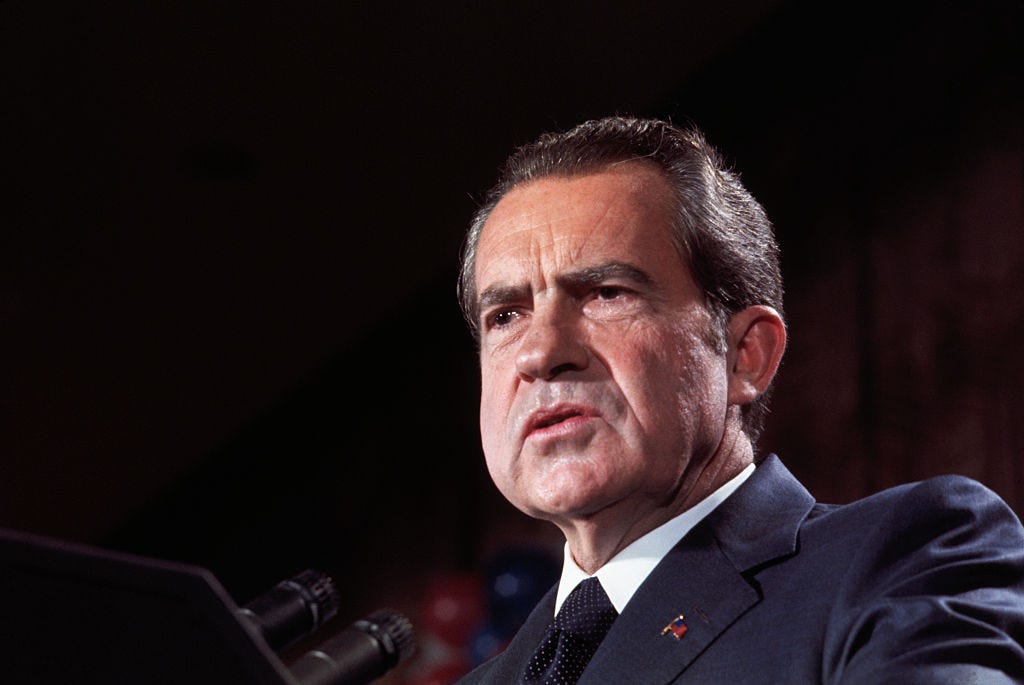
Late on the afternoon of April 19, 1971, Richard Nixon picked up the White House telephone and told his deputy attorney general, Richard Kleindienst, to kill a federal antitrust case against the International Telephone and Telegraph Corporation (ITT). “The IT&T thing,” he said, “stay the hell out of it. Is that clear? That’s an order.” When Kleindienst tried to explain the legal complexities, Nixon cut him off: “I know all the legal things, Dick. You don’t have to spell out the legal things.” Then he added a crucial detail: Unless the message got through, he said, the Justice Department’s antitrust chief—the man actually bringing the case—would have his “ass out within one hour.”
The call lasted less than two minutes. It has never before been transcribed in full, cross-referenced with related conversations. Now, thanks to a project we are launching this week with the Hoover Institution, it’s one of thousands that can be.
For more than half a century, Americans have consumed the Nixon presidency through a distilled, dramatized version of history presented by television and film. We have rarely had access to the thing itself. But for years, it has been hiding in plain sight, before our very eyes—or rather, our ears. Beginning in February 1971, Nixon installed recorders throughout the West Wing, including in the Oval Office, which activated automatically at the sound of people’s voices. Prior to the Watergate scandal, the only people who knew about these recorders were Nixon, his chief of staff H.R. “Bob” Haldeman, Haldeman’s aides, and Secret Service personnel. Nixon wanted everything taped because he believed it would be the foundation for a uniquely authoritative official history of the momentous presidency he envisioned—and he believed these recordings would remain entirely private and under his personal control. That was the idea, or at least it’s our best guess, since Nixon never definitively said why he decided to start taping. But once the tapes turned on, in the tumult of events and decisions, the fact that they were constantly running seemed to fade from his mind.
The result is approximately 3,400 hours of audio files that provide the most comprehensive, behind-the-scenes documentation of an American presidency that there has ever been, or ever will be. The problem is, for years, this raw audio has been “available” only in the most generous definition of the word. The antiquated audio files are incredibly difficult to listen to, are accompanied by a subject log that itself contains errors, and, for those reasons, have remained largely untouched. The most the public has learned about the tapes over the years has generally been a selection of cherry-picked, sensational snippets that have become famous—above all, the famous “smoking gun,” which conclusively implicated Nixon in the Watergate cover-up. Aside from those, less than 10 percent of the audio archive has been transcribed or published, much less carefully studied.
Until now.
The Hoover Institution’s Applied History Working Group is starting a new initiative to produce a complete, verified transcription of the Nixon White House tapes. This is the closest thing we shall ever have to eavesdropping on the presidency itself. And it is only now possible because of the revolutionary technology of artificial intelligence, which is capable of deciphering indistinct exchanges that are often beyond the human ear.
Let’s backtrack. While there have been several major releases of Nixon’s meetings and calls by the National Archives between 2007 and 2013, each of them went roughly the same way: A quantity of audio, ranging from 200 to 400 hours, was suddenly dumped online. As I (Luke) have been studying these files for years, a reporter would call me for a story he was writing that afternoon and ask what was noteworthy about the new audio. I would quickly listen to as much as I could, come up with some colorful examples to be cited in the story, and that’s all we digested until the next dump of audio. Indeed, in the years since 2013, the National Archives has been quietly releasing additional audio without public fanfare. Even the hefty, nearly 1,600-page book series, The Nixon Tapes, which I published a little over a decade ago with Douglas Brinkley, represents no more than 2 percent of the whole. To transcribe the full tapes by hand would have taken 200,000 pages, and many times that number of hours.
But now AI can do the initial work of processing the audio, which is the most tedious step; humans are only needed for verification. As a result, the length of the transcription process has declined from between eight and 25 hours for an hour of audio to about four. Early results have held to a sustained accuracy rate above 98 percent on clean audio, with each transcript checked twice: once against the tape itself, and once against the National Archives and Records Administration’s own official subject logs—a system of organizing the data that, this project has already discovered, is itself not free of error.
What was once a painstaking ordeal has been transformed into something manageable, and something that allows us to take you back to the 20th century and lift the veil on one of the most controversial and consequential presidencies in American history—all through the lens of audio files of conversations that President Nixon never expected would reach the public eye.

Every White House, of every party, in every era, has operated behind a curtain that even its own supporters cannot see through. Lyndon Johnson’s aides wrote of a president who bullied and charmed in the same sentence; we take their word for it because we largely have no choice. Ronald Reagan’s diary entries are a marvel of restraint, precisely because he knew, or suspected, that someone would eventually read them. Even the most candid memoirs are acts of self-authorship, composed by people who know how the story ends and have every incentive to make sure they come out of it looking like they knew it all along.
Nixon’s tapes, by contrast, capture a president who did not know he was writing his own history—who was, in fact, actively trying not to. “I will not be transcribed,” Nixon says in one of the earliest tapes, oblivious to the irony that it was his own ill-fated decision to tape everything that makes transcription possible.
Already, in just the earliest weeks of this work, previously undisclosed material has surfaced: real-time evidence of White House interest in the surveillance of a sitting member of Congress; a direct, unguarded conversation about a Wall Street messaging operation conducted at the president’s personal direction; a fleeting but unmistakable early mention of a young antiwar veteran, John Kerry, barely out of the Navy, who would spend the next four decades in American public life.
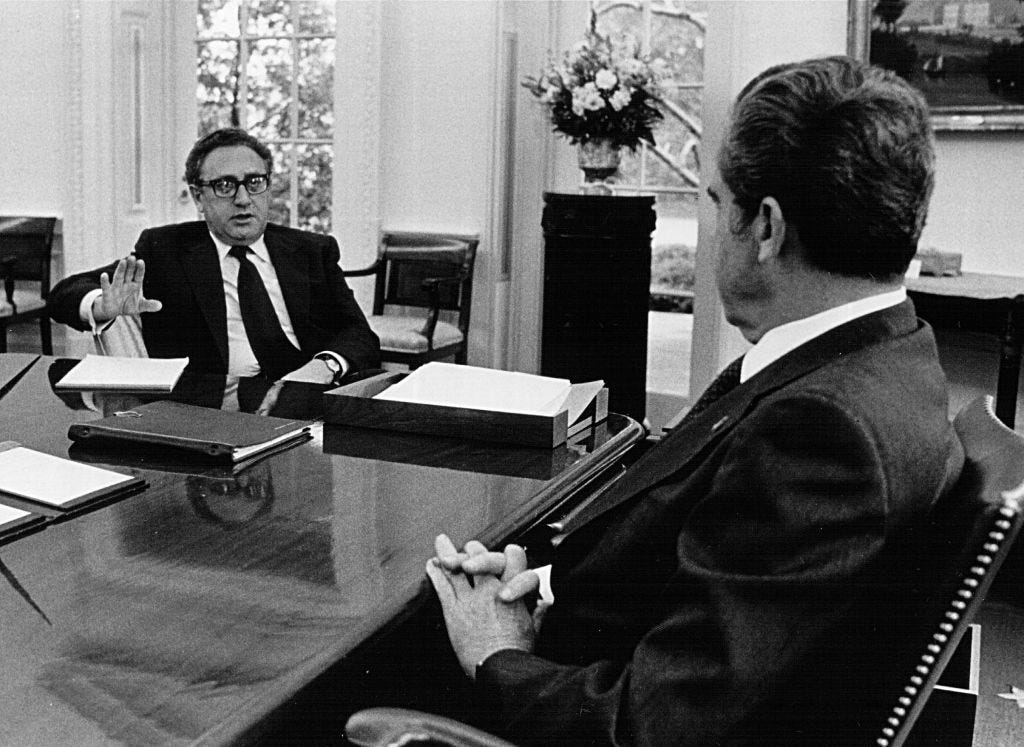
In one April 1971 call, which has never before been transcribed in full, Nixon and Henry Kissinger can be heard calibrating the exact sequence in which to approach the Soviet ambassador and a Romanian back-channel intermediary as they plan Nixon’s bombshell TV announcement that he would be the first president to visit the People’s Republic of China. Nixon tells Kissinger flatly that “we’re playing for very high stakes,” and that the timing of their China move will depend partly on what Moscow signals. (They ultimately got the timing exquisitely right, but it took the utmost secretiveness and finesse.)
In another conversation, the president is walking through exactly which senators up for re-election have been loyal to make sure they “hold firm” before a floor vote, and exactly what will happen to any of them who don’t come around.
In a third, after delighting in a market rally with a stockbroker friend, Nixon instructs an aide to make sure a particular Cabinet secretary—not the most credible one, but the most telegenic one—is the face of the administration’s economic optimism the next morning.
Within the same 24-hour stretch, sometimes within the same hour, the same man is a global strategist reordering the Cold War, a machine politician counting votes, and a message-manager stage-directing his own government’s economic narrative for the evening news. No memoir captures that simultaneity, because hindsight always sorts the strategic from the tactical, the historic from the merely expedient.
Nor does any memoir capture the tapes’ other register. Nixon’s insecurities have been explored at length by his biographers. But the tapes reveal the peculiar intimacy, even tenderness, of a president who needed his allies as much as they needed him. Two days after the ITT call, Nixon is on the phone with Herbert Rainwater, national commander of the Veterans of Foreign Wars, thanking him for a television appearance defending the administration against antiwar demonstrators camped on the National Mall. The conversation drifts, unexpectedly, into real diplomacy. Rainwater, entirely unprompted, lays out a detailed proposal for linking American troop withdrawals to the release of prisoners of war, number for number, and Nixon listens carefully enough to say he has made a note of it. A veterans’ leader with no formal role in foreign policy is workshopping an exit strategy from Vietnam with the commander in chief—and the commander in chief is listening.
And that is the strength of the recordings: They include all of these registers, often within minutes of each other, which is something no strategy manual—and no memoir written to make its author look consistent—has ever managed to do. In other words, they capture Richard Nixon the human—not just Richard Nixon the president.
That brings us to the second thing these tapes offer, which is harder to see and more important to say. We treat certain texts as permanent instruction manuals for the exercise of power. Sun Tzu’s The Art of War has survived 25 centuries because it distills the logic of conflict into principles abstract enough to apply anywhere: Know your enemy, strike where he is unprepared, and win before the battle is joined. Carl von Clausewitz gave us the concept of the fog of war and the notion that war is policy continued by other means. Niccolò Machiavelli told us, more bluntly than anyone before or since, that the prince who wishes to keep his state must sometimes act against faith, against charity, against humanity itself, and that the appearance of virtue matters more to most observers than its substance.
These books endure because they are abstractions—and abstractions, by design, leave out the messy details. The Nixon tapes are, it might be said, the audiobook edition of those texts—not because Nixon was reciting Machiavelli, but because he was applying, in ordinary American English, the same principles set down in The Prince 460 years before. When Nixon tells Kissinger to hold back a diplomatic overture to China until he sees what the Soviets do first, that is Sun Tzu’s dictum about striking where the enemy is unprepared, translated into the argot of a Southern California Republican. When he orders the Christmas bombing of North Vietnam in 1972, with the intent of forcing Hanoi back to the negotiating table in Paris, he is channeling his inner Clausewitz. When he orders a subordinate to drop a legal case rather than let it complicate a larger relationship, that is Machiavelli’s prince deciding that the state’s interest outranks the letter of the law.
This is why the transcription we are embarking upon matters as scholarship. As we have found, the National Archives and Records Administration’s own official finding aids are riddled with errors: Names are frequently misattributed, dates transposed, and participant lists full of inaccuracies. They are as good as they could be for something prepared in an analog age. The discipline of building a complete, independently verified transcript—checked against the original audio, checked against the documentary record, corrected where the official summary is wrong, and yes, occasionally revealing something nobody was looking for—is what turns 3,000 hours of magnetic tape into a source historians can actually cite, sentence by sentence.
There is a reason this work feels newly urgent. We live again in an era anxious about the presidency’s hidden machinery, and about what gets decided behind closed doors. The Nixon tapes will not settle that anxiety. On the contrary, rather than reaffirming the old narrative, now half a century old, that there was something uniquely wicked about Richard Nixon’s administration, they make the listener suspect that most of what went on in Nixon’s Oval Office was probably not very different from what has gone on, before and since, when other presidents sat in the same place.
The room where it happens is a very different place from the presidency as depicted in civics textbooks. The men who run this country’s executive branch have always been doing something closer to what we can now hear Nixon doing—spitballing statesmanship, low politics, and media stagecraft in the same breath, out of public view, and rarely in the tidy, sequential way the historians later present it. As biographers of Nixon and Kissinger, we are constantly struck by how much of the historiography of the 1970s remains trapped in a narrative framework forged by the leading journalists at that time. Yet the tapes, like the vast quantity of subsequently declassified documents, capture precisely what the journalists could not know.
In the coming months, we will focus our work on transcribing conversations between Nixon and Kissinger. This might be the most valuable subset of the entire project, given Nixon’s focus on foreign policy and both men’s reputations and actions as global strategists. We can hardly predict what the files might unearth.
What we do know is that, 50 years on, as flies on the Oval Office wall, we can finally hear the Nixon presidency—as Kissinger might have said—wie es eigentlich gewesen, as it actually was.
This essay first appeared in The Free Press on September 30