This essay is the first in a new NVR series on narrative poetry. It was originally presented at Ashland University’s 2026 MFA summer residency.
Narrative poetry shouldn’t need justification. Its roots are as deep as literature itself. The Epic of Gilgamesh is a poem, as are the Iliad and Odyssey, the Ramayana and Mahabharata. The great works of tragic and comic drama in both antiquity and the Renaissance, as well as Japanese Noh drama, are written in verse. For much of human history, storytelling was a poetic art. Rhapsode, bard, skald, griot, and balladeer all told stories via song, chant, refrain, rhyme, and meter.
A skeptic might remain unconvinced. A proud lineage does not guarantee present viability. Dead trees can have deep roots. Prose fiction, to such a skeptic, has replaced narrative verse with little remainder. Poets, even very good poets, might continue to write narrative poems, but only as an antiquarian or boutique exercise. The living sap flows through prose.
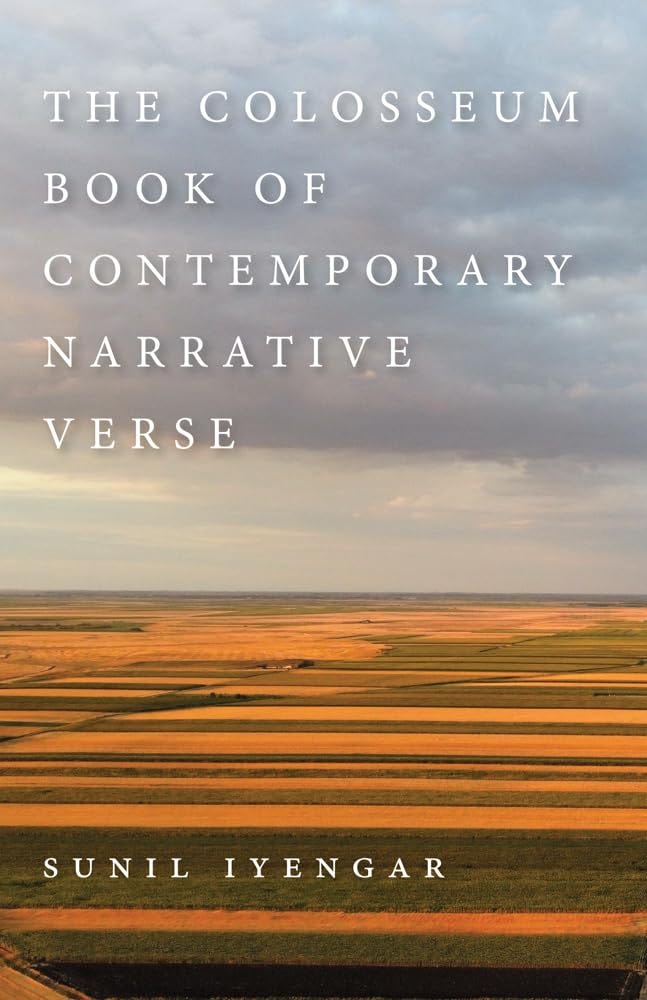
This argument doesn’t hold up, though. As Sunil Iyengar points out in his introduction to the recently published Colosseum Book of Contemporary Narrative Verse,[1] the short to mid-length narrative poem comes into its own after the rise of the novel. It reaches a high point in Victorian poets such as Robert and Elizabeth Barrett Browning, Christina Rossetti, Henry Wadsworth Longfellow, and Alfred, Lord Tennyson.[2] Iyengar sees Thomas Hardy as an important figure whose poems “resolv[ing] in irresolution” clear the way for much twentieth-century narrative verse. E.A. Robinson, Robert Frost, and Robinson Jeffers establish a distinctive narrative verse tradition in early twentieth-century American poetry. This tradition sees a minor renaissance at century’s end in the poetry of Dana Gioia, Rita Dove, Jared Carter, Marilyn Nelson, Herbert Morris, and others. The late twentieth century even sees a spate of acclaimed verse novels, including Vikram Seth’s Golden Gate and Les Murray’s Fredy Neptune, as well as Derek Walcott’s contemporary verse epic Omeros.[3]
Nonetheless, the general, if jagged, trend has been toward the eclipse of narrative verse by lyric verse. The trend seems to be sharper in the early decades of the twenty-first century. Full-fledged narrative poems rarely appear in journals and rarely win prizes. Many journals set a maximum line length on submissions, pre-emptively excluding narrative verse that runs over a page. Courses in narrative verse do not show up in many MFA programs. Indeed, narrative is often assumed to be a prose art. Sometimes editors and workshop participants even make the questions explicit: Why not write a short story? Why not prose instead of poetry?[4]
Given the widespread equation of narrative and prose, it’s worth noting some distinctive virtues of narrative verse. But first, a quick nod to a possible counterargument. In one sense, most poetry has a narrative dimension. We live in place and time, after all. Humans constantly sequence actions and trace cause and effect. Narrative is a fundamental way in which we find patterns within the flux of existence. We understand ourselves and our world in large part through stories. It is unsurprising, then, that even imagist poems as spare as Ezra Pound’s “In a Station of the Metro” or H.D.’s “The Pool” have a dramatic situation. In the classroom, students often try to extrapolate stories from them. Furthermore, poems that offer a vivid scene or a brief character sketch, especially poems that convey the author’s first-person experience, are common enough. Much less common is narrative verse with sustained plot progression, with developed characterization, with fictional or historical events and characters. This is the kind of narrative poetry about which one might ask: why isn’t this a short story instead?
Some poems have a ready answer. Their form has an evident, even necessary, relationship to the narrative being told. Dana Gioia’s “The Ballad of Jesus Ortiz” is about the shooting of his great-grandfather, who had given up cattle drives to tend bar in Wyoming. The poem begins,
Jake’s family were vaqueros.
They worked the cattle drives
Down from Montana to market.
They did what it took to survive.

Jake’s real name was Jesus,
Which the Anglos found hard to take,
So after a couple of days,
The cowboys called him Jake.
The throwback form befits the poem’s themes of place and ancestry. In a brief essay on the poem, Gioia notes that he struggled to write about this family tragedy until he found the right form: the roughed-up meter and strong rhymes of “the cowboy ballad.” The ballad form situates the story squarely in the Western genre, but it also fits because “the ballad has traditionally been the form to document the stories of the poor, particularly in the Old West.” Gioia adds: “The people I wanted to remember sang and recited ballads.” All of these formal associations, the history that the very form evokes, would be lost if this poem were written in a different form or if its story were told in prose.
There are similar instances where a narrative poem’s form has a particularly apt relationship with its content. Amit Majmudar’s “In the House of the Frost Giant” tells the story of a young Indian college student whose girlfriend takes him to meet her disapproving father in Minnesota.[5] It becomes a mock-epic quest to defeat the “Frost Giant” in his lair, full of allusions to Norse mythology and written in an alliterative verse that evokes Norse poetry:
Portly, Nordic,          his cinderblock boots
with crystals stuck          in their tire treads,
shovel shouldered          he eyed my Audi
as I drove gingerly          up his driveway. Just
done salting it          (for his daughter’s sake,
not her brown boyfriend’s)          he stomped and harrumphed
harshly enough          to shiver Yggdrasil.
Note here how the caesura divides boyfriend and daughter, formally establishing the father’s imposed divide, an icy crevasse, that runs throughout the poem.
Another example is Marly Youmans’s uncanny book-length fairytale-in-verse Seren of the Wildwood, which is written in blank verse sections that conclude, as in Sir Gawain and the Green Knight, with a rhyming bob and wheel. One section ends with this meditation on fairy tales,
             Regret
And gladness blend as one
At times—who can forget,
When fairy tales are done,
Their magic alphabet?
The bob and wheel endings allow for such thematic commentary. They also bring Seren into conversation with the Gawain poem and medieval poetry in general.
Form is never simply a shipping container for the story, but its exclusive fittingness is rarely as evident as in these poems by Gioia, Majmudar, and Youmans. But they, like all good narrative poems, answer the question “Why not prose?” in other ways as well. Critics and poets often point to the compression of narrative poems. Poems tend to use fewer words, often far fewer words, than short stories. When handled well, this gives narrative poems concentrated power. It puts their contents under pressure. It can also heighten these poems’ rhetorical effects. It can strengthen their emotional punch, especially when narrative poems are read in one sitting.
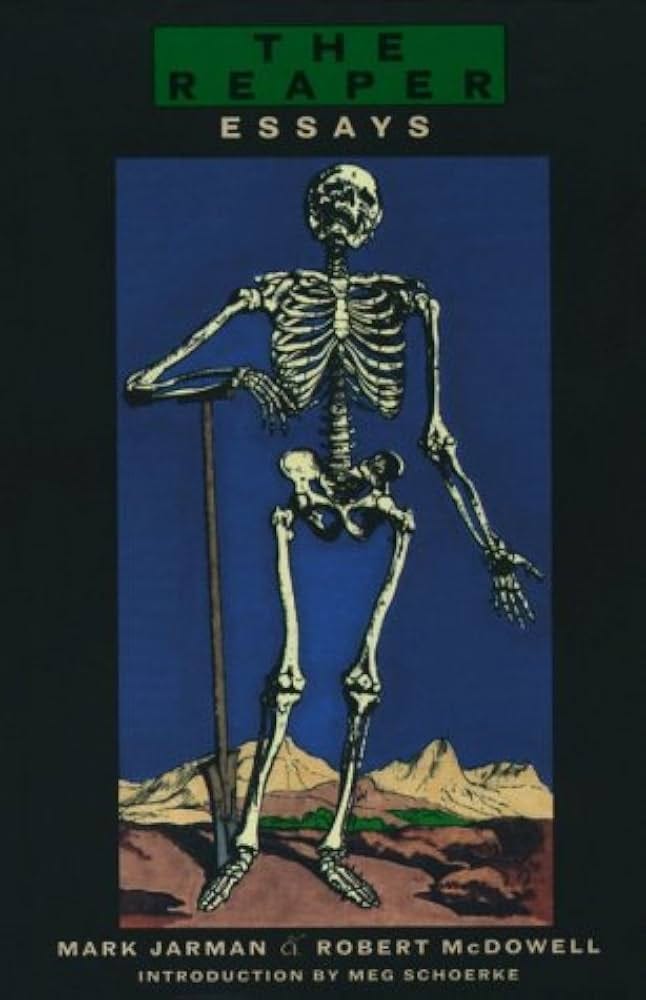
Mark Jarman and Robert McDowell, whose journal The Reaper helped launch the narrative poetry revival of the 1980s, write in an editorial essay that “narrative poetry can tell a story in less space than prose and more immediately. It gives more the sense of living the story, than standing outside of it, but only if the story is as unpredictable as life.”[6] Jarman and McDowell claim in another essay that if a narrative poem captures enough of life and isn’t heavy-handed, “the story as a whole becomes a metaphor,” one which repays contemplation. It takes us deeper into the complexities, the mysteries, of human existence. Jared Carter, whose verse appeared several times in The Reaper, has a poem about an old Indiana farmer whose property is claimed by eminent domain and who is supposed to move to his daughter’s home in Florida. He instead kills himself and his beloved cattle dogs during his last night on the farm. Here are the closing lines:
He had only known dirt under his fingernails
and trips to town on Saturday mornings
since he was a boy. Always he had been around
cattle, and trees, and land near the river.
Evenings by the barn he could hear the dogs
talking to each other as they brought in
the herd; and the cows answering them.
It was the clearest thing he knew. That night
he shot both dogs and then himself.
The purpose of poetry is to tell us about life.
This poem, titled “The Purpose of Poetry,” shows us the tragic side of life (and also the small satisfactions that can hold a life together), but what exactly are we supposed to think about this story, or about life? The poem’s story is deeply meaningful, but it evades any simple univocal meaning. It is moral at a more fundamental level than a single, simple lesson. It asks us to pay attention to something important and complex. The final line is risky, and it could be disastrous in another poem. But it is earned by the Hemingway-esque narration up to this point, which approaches psychology and theme via externals, via fact and action. It functions as a call for poetry to be unflinching, but it also suddenly pans back from this individual farmer’s story, offering it as broadly exemplary of life and poetry, and thus establishing it, a la Jarman and McDowell, as a metaphor for meditating on life.
Narrative verse is an art of elision and excision as well as of compression. This, too, is part of its intrigue. In Carter’s poem, we might wonder about the daughter’s mother, about the farmer’s relationship with his daughter, about her attitudes toward the farm. Had he visited her in Florida before? Why does he shoot the dogs? Was the “man from the courthouse” who informs him about the eminent domain order kind or callous? Did he get right to business or did he delay the hard news with chummy small talk about crops or weather? A short story would probably answer some of these questions. It would probably at least name the characters. That’s not necessarily a weakness. Elaboration and development are narrative virtues in their own right. But there is also power in leaving these questions unanswered. They make Carter’s poem more archetypal, metaphorical, symbolic.
Narrative poetry enjoys all the affordances of poetry in general—alliteration, anaphora, repetition, meter, rhyme. Meter, for instance, can contribute to the sense of taut compression. It can propel the narrative forward. It can provide a subtle music behind spare or conversational diction. Rhyme can establish narrative connections between the rhyming words. It, too, can modulate the music of the poem in more overt or subtle ways. (I remember the first time I read Robert Browning’s “My Last Duchess,” I did not even realize it was written in couplets, but I am sure that I felt the couplets.) Repetition can be used in a variety of ways. Returning to “The Ballad of Jesus Ortiz,” consider Gioia’s use of repetition in these stanzas:
Three thousand head of cattle
Grazing the prairie grass,
Three thousand head of cattle
Pushed through each mountain pass.

Three thousand head of cattle
Fording the muddy streams,
And then three thousand phantoms
Bellowing in your dreams.
The repetition of “three thousand head of cattle” emphasizes the size of the herd, the epic scale of the cattle drives, the drives’ grueling repeat crossings of mountains and rivers. The first three repetitions also set up the evocative variation, “And then three thousand phantoms / Bellowing in your dreams.”
The line offers many narrative affordances. David Mason makes this point in his essay “Other Lives: On Shorter Narrative Poems”: “The line as a unit of sound is tremendously important, but the line is also a unit of thought and feeling; it can contribute to dramatic dynamism and plot in particular ways, adding another dimension to the process of storytelling.”[7] Brian Brodeur makes a similar point in “‘To Crawl Under the Earth’: The Persistence of Expansive Poetry,” where he stresses “the expediency that the poetic line affords each story [in verse]—the quickness of leaps in thought, the ready access to the imagination, the cinematic jump-cut movement of action, and the efficiency with which the poetic line deepens emotional and psychological intensity.” In many narrative poems, a line or two or three can evoke a whole scene. In Paul Lake’s “Inspectors,” for instance, a survivor of the Bataan Death March recalls his near starvation: “I’d save kernels from their horses’ shit / Until I’d filled a can, boil it, and eat.” Two lines evoke a visceral, harrowing scene of sustained desperation and stubborn survival. Prose fiction can achieve similar effects of economy. This is often the case in short stories or taut novellas. In Jim Harrison’s Legends of the Fall, for instance, we are introduced to a seafaring grandfather through the stories that loomed large in his son’s mind: “His own tamer wanderings had been engendered by his father’s tales of seeing giant squid fighting in the moonlight in the Humboldt swells off Peru…” Here, too, there is a concentrated evocative power that might well be lost if those squid fights were described across a paragraph or chapter. (Harrison, poet as well as fiction writer, is a master of the lyric touch in prose narrative.) In narrative verse, though, such compression is underscored by the integrity of the line. In the example from Lake’s “Inspectors,” the two lines suggest narrative development. The first line evokes gathering the corn, the second cooking and eating it.
In Patricia Smith’s “Siblings,” the line is used for characterization. Each line of the poem is a personified hurricane.
Arelene learned to dance backwards in heels that were too high.
Bret prayed for a shaggy mustache made of mud and hair.
Cindy just couldn’t keep her windy legs together.
Dennis never learned to swim.
This is not a conventional narrative poem. It reads more like a list poem at first, but it unfolds over time toward Katrina, who is separated from the others by a space and who receives three lines rather than one:
None of them talked about Katrina.
She was their odd sister,
the blood dazzler.
Katrina becomes the rupture, the cataclysm, in this story of hurricanes, with the suggestion that she is at least three times as powerful as the others.
In a brief essay titled “Thirteen Ways of Thinking About the Poetic Line,” Gioia notes that the final word of each line is in a position of emphasis. “The word at the end of a poetic line,” Gioia writes, “should bear the weight of imaginative or musical scrutiny. The end word of a line is highly visible and audible.” This is another narrative affordance of the poetic line. The final three lines of Patricia Smith’s “Siblings” end with the significant words “Katrina,” “sister,” “dazzler.” In David Yezzi’s “Dirty Dan,” a poem of remembered late-night trips to a diner, a hungry crowd shows up after dancing in a club: “…The counter’s jammed with kids / who’ve come from Luna, dancing, high and freeze-framed / in strobe flashes and ethereal black light.” There is a poetic touch in “freeze-framed” receiving the inevitable, however brief, pause at the end of the line, but there is also something “freeze-framed” about the memories that make up the poem in general. They are vivid, frozen vignettes, and the narrator is in a way still frozen himself, struggling in life, wishing that he could go back to those more vital days of youth. Returning to the first stanza of Gioia’s “The Ballad of Jesus Ortiz,” quoted above, its lines end with the words “vaqueros,” “drives,” “market,” “survive.” Together, these words are a key to the ballad’s opening stanzas, while “survive,” which receives special emphasis as the final word in the stanza, is appropriate to this whole poem of danger and hardscrabble existence. A line’s final word rarely does this much work, but every good narrative poem will have some line-ending words that are significant to the story or thematically resonant in addition to being poetically satisfying.
The line break affords many narrative possibilities. Ron Rash’s “Wolf Laurel” is about a father and three sons in the North Carolina Appalachians. They brave fierce cold on the winter solstice to track down a predator that has been killing their sheep. Rash writes in a seven-syllable line, so his poems, usually less than a page in length, are exemplary in terms of narrative compression. Yet they often feel as expansive as one of Rash’s short stories or novels. “Wolf Laurel” is a single long sentence. Rash is especially skilled at breaking his seven-syllable lines in interesting ways. The poem opens:
Tree branches ice-shackled, ground
Hard as an anvil, they leave
The hearth’s huddling heat, three sons
And a father…
Note how the line break separates the sons from the father. Later in the poem, the father dies from a heart attack during the hunt. With night falling, the sons decide to bury him beneath the river ice so that the predator does not eat his body. They plan to return for his body in the morning. In short, “they leave” together, but only the “three sons” will return to “The hearth’s huddling heat.” They are next to that heat in the line. Their father is separated from them and from it by the line break, a separation that foreshadows his death and icy internment.
Sydney Lea’s “The Feud” offers another study in the narrative affordances of the line break. As the title suggests, it is the story of a feud between the narrator and his neighbors, the Walker family. It begins with the Walkers dumping deer guts on the narrator’s property, which sets off a series of ever-more extreme retaliations over the course of the poem. The narrator’s refrain, even as he escalates the feud, is “nothing good will ever grow from feuds.” The refrain appears for the third time in the poem right before the narrator takes the feud to a violent new low by feeding the Walkers’ pig an apple stuffed with rat poison. Here, the refrain is broken across both line and stanza: “…Nothing // any good from any feud…” The break gives “Nothing” emphasis. It becomes the abyss into which the narrator descends, the black hole of his vengeance. This emphasized “Nothing,” alongside the poisoned apple, becomes a theological key to the poem. It suggests what St. Augustine calls the privation of evil, how evil is a betrayal of the promise of being, a nihilation of it. (Earlier in the poem, the Walkers’ dog is described as “thin as Satan.”) The feud becomes a descent into the Nothing.
Of course, most line breaks are not as thematically dramatic as these examples from Rash and Lea. But any well-written narrative poem is attuned to the narrative coherence of the line, to the emphasis on a line’s final words, to the line’s alignment or tension with sentence syntax, to the dramatic possibilities of enjambment. The line’s narrative possibilities are perhaps the first answer to the “Why Not Prose?” question, since in prose the right margin, rather than the writer’s judgment, determines line length.
There are other distinctive virtues of narrative verse, including its memorability and how it can house passages of lyric description. This essay aims to be suggestive rather than exhaustive. And while criticism has its place, certain virtues of narrative verse can only be experienced. So I’ll end by urging you to pick up The Colosseum Book of Contemporary Narrative Verse or to read some of the other accomplished narrative poems published in recent years, such as Paisley Rekdal’s “Whistle Jacket,” Matthew Buckley Smith’s “Ankou,” Maryann Corbett’s “Emergency, New Year’s Eve,” J.C. Scharl’s “Ponds,” Forester McClatchey’s “Smokejumper,” T.O. Brandon’s “The Bell Witch,” or Mary R. Finnegan’s “Out of the Mouth of God.”[8]
[1] Several of the poems collected in this essay can be found in The Colosseum Book of Contemporary Narrative Verse: Dana Gioia’s “The Ballad of Jesus Ortiz,” Jared Carter’s “The Purpose of Poetry,” Paul Lake’s “Inspectors,” Patricia Smith’s “Siblings,” David Yezzi’s “Dirty Dan,” and Sydney Lea’s “The Feud.” Where possible, I have linked to online versions of the poems.
[2] Victoria Moul discusses the formative influence of George Crabbe in the essay “The freckled flower upon the flinty base: whither the narrative poem?”
[3] On this renaissance and its legacy, see Brian Brodeur’s Hopkins Review essay “‘To Crawl Under the Earth’: The Persistence of Expansive Poetry.”
[4] This essay is partly inspired by a conversation with Mary R. Finnegan, who recalls a classmate asking such questions of her narrative poetry during a workshop.
[5] This poem is included in Majmudar’s 2026 collection Things My Grandmother Said.
[6] These editorial essays are collected in Jarman and McDowell, The Reaper Essays.
[7] Mason’s essay is collected in New Expansive Poetry: Theory, Criticism, History, edited by R.S. Gwynn.
[8] One should also keep an eye on the online journal Talk to Me in Long Lines, which features new mid-length narrative verse each month. Several excellent verse novels have been published in recent years as well, including Aaron Poochigian’s Mr. Either/Or, Jason Guriel’s Forgotten Work, and Daniel Cowper’s Kingdom of the Clock.
Steven Knepper is editor-in-chief of New Verse Review: A Journal of Lyric and Narrative Poetry. He teaches at Virginia Military Institute and in the low-residency MFA program at Ashland University.