Independence Day, 2025, I was browsing LinkedIn in what was probably a lame way to spend my evening, when I noticed a profile view:

The name sounded big, but I couldn’t figure out where I saw it before. Maybe I had read of something by her. What started out as a “how did you find me/what brought you to my profile?” turned into one of one of my newest correspondences. While we still both can’t figure out how she stumbled upon my profile, I believe it was either LinkedIn’s algorithm, or possibly clicking on the profile of a commenter or reaction to a post that she viewed. What followed was a series of e-mails from one the most inquisitive 71 year olds I’ve ever met, let alone 71 year olds.
After realizing she used to freelance for Wired in the 90s, one thing started to make sense. Few journalists in Silicon Valley today have this kind of drive for questions the way Paulina asks. She doesn’t just surf the web, she steers a speedboat as if it could hold a supply of gasoline that could sail the Pacific and back, and uses it to question everything in and around the Bay Area. I started to think, why has tech journalism gotten so bland? Why are so many tech news sites merely news about “social media” products, and not interesting hardware? Why do so many tech articles chase stories that are basically a retweet in sentence format? And why is it, that whenever a tech site does interview or report on a company spokesperson about a new product launch, it sounds little more than a colorful bird parroting a press release that can easily be found on the company’s own website?
As I have discovered in recent years, the answer can be found by the decline of critics in both literary and industrial trade journals over the past two decades. Ross Barkan pointed to a renaissance of literary critics in his April 2024 article “The Death (and Life) of Takedown Culture.” Gabe Bullard in his August 2026 post recalls his first bad film experience, writing:
“Learning that art can be bad is an essential step in understanding the world. The best efforts of even the most experienced, knowledgeable, and successful people can fall short. Professionals can cut corners. Advertisements can intentionally mislead us. Adults can be wrong. They can make mistakes. They can lie.”
Silicon Valley is not the only sector guilty of this. Hollywood in recent years has been trending with Celeb-on-Celeb interviews and podcasts such as Armchair Expert with Dax Shepard and Good Hang with Amy Poehler, to curate a social media presence and to limit unpleasant or awkward interviews. I admittedly watch these podcasts too, and don’t mind them as much as most tech interviews, and have come to the conclusion that actors have excelled in their interview skills so well that they do some interviews better than the ones who should be doing the role, kind of like this Wayne’s World 2 “audition”:
Of course, I am aware of the dwindling press access pool at the White House..
What I think has changed in Silicon Valley is that in the past, the leading edge was comprehensible improvements in telecommunications- digital typewriters or desktop publishing, faster news, internet replacing fax machines, but not fundamentally agentic the way artificial intelligence is being augmented or even substituted for epistemic knowledge. Being close to the machine is useless if it is an opaque box or a closed source HAL 9000 and its CEO can’t even figure out where the power switch is. Eliezer Yudkowsky wrote that AI needs an off switch, but any AI system/network anywhere near that level of danger should never even be built.
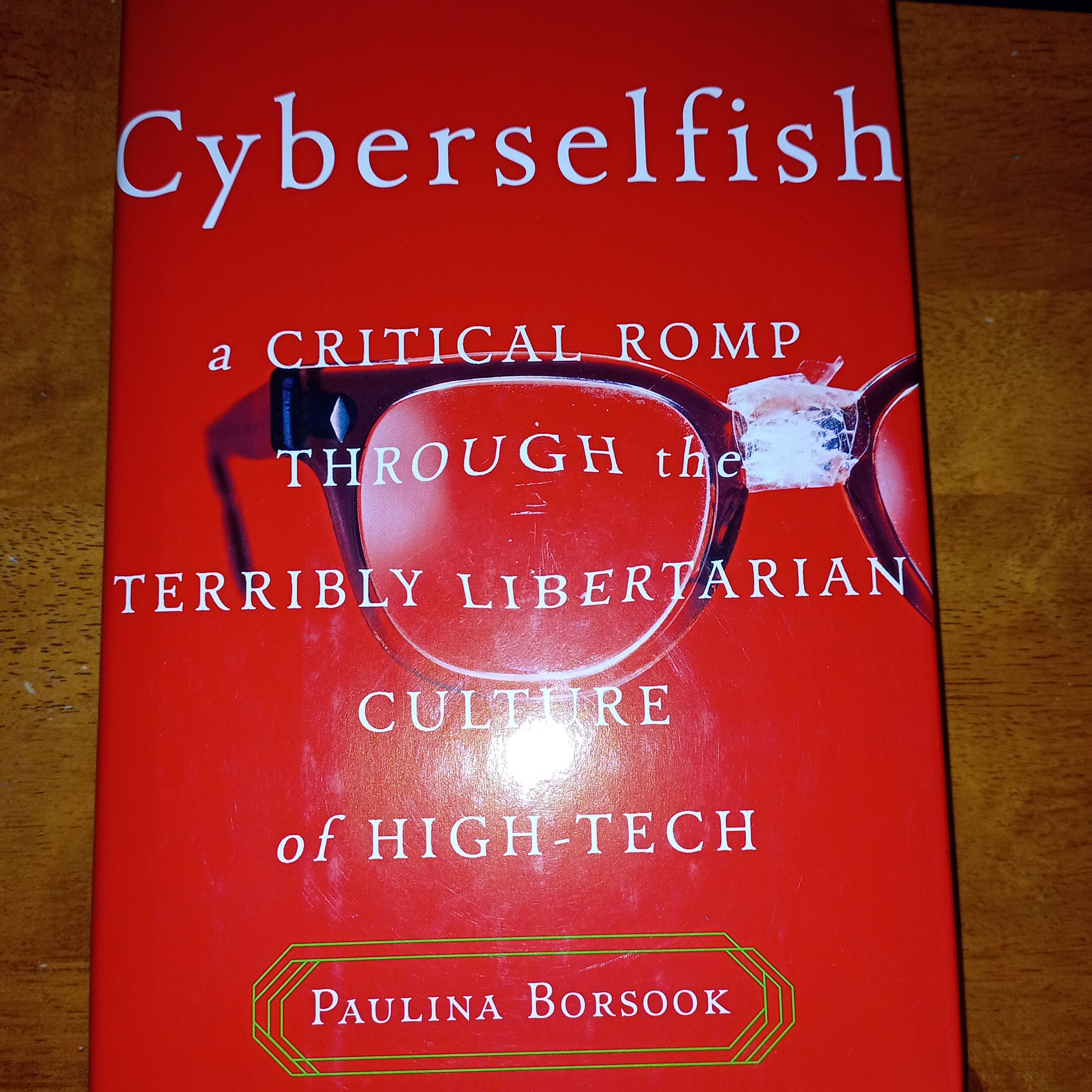
In July of last year, before one of the few remaining copies of the first edition of Paulina Borsook’s 2000 book, Cyberselfish: A critical Romp Through the Terribly Libertarian Culture of High Tech went out of stock or was shipped to OpenAI’s book shredding machines, I managed to snag a very clean and Like New-ish copy (slightly better than its “Very Good” so as not to oversell itself). When it arrived, a cutout of a newspaper mention of the book was carefully folded inside:
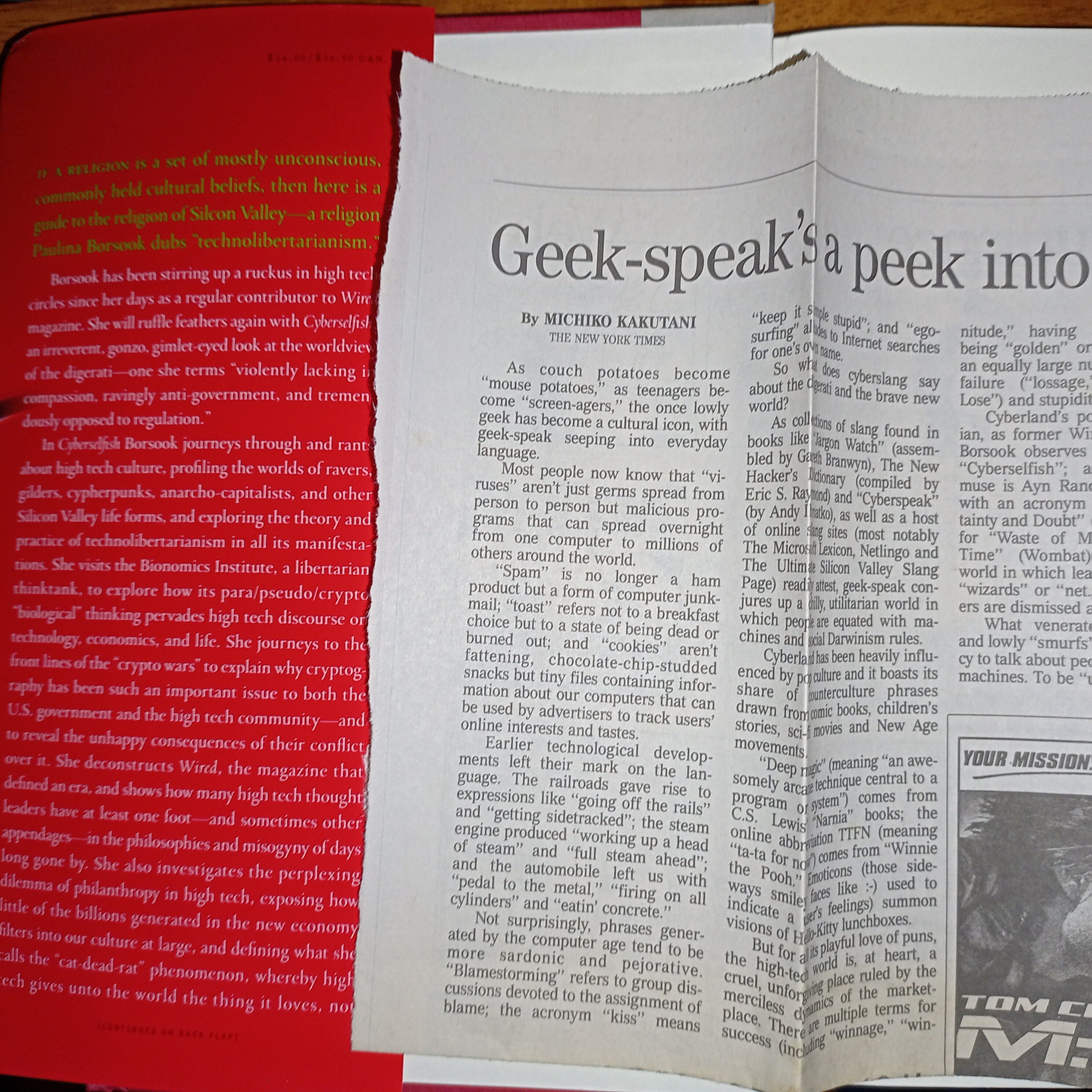
I figured that whoever was reading the book probably was researching some of the slang of the dot-com era, as a lot of new vocabulary entered the lexicon. I also also had a curiosity about the book store that sold it. After it shipped, I Googled the seller’s name as it was printed on the return address, and found that the proprietor of the book store had passed away just three months before my purchase, and possibly his family or estate was selling the book. Admittedly, I don’t always have zero curiosity about the people who sell used books or products. One time, in 2010, I bought a textbook on nanotechnology and semiconductors, and the seller (likely a Goodwill or used bookstore that bought and sold academic books) left or forgot a business card inside that appeared to match the original book owner- a researcher in the field, who left that industry. He appeared to go “crazy” and had posted a number of paranoid articles online warning about the carcinogenic dangers of carbon nanotubes. But just a few years later, an eerie character in FX’s The Americans echoed some of the same perils.
Anyways, just a few days ago, I asked Paulina if she happened to know the former owner of the small time bookstore in the Pacific Northwest who shipped me the book (he was a West Coast native) and she said no. I occasionally think in the subjunctive, and wondered still whether this owner had already marked the book for sale before his passing (if his illness was known and terminal), or if it was one of his personal favorites in his collection (a “reserve” if you will). After all, if the owner was married, the wife might not have been too happy to discover his “secret stash”. These are booksellers, but it’s not appropriate to speculate more.
Interestingly enough, a woman on social media revealed a guy she knew had a mad crush on her decades ago. Tiny world it would be if they were the same person. Miniscule world it would be if empirical knowledge is accepted.
The most interesting comment I saw was one who compared her to the Rachel Carson of Tech: “POLLUTION of the mind and society.” In my sophomore year of college (Integrative Biology 150, 2003), I learned about Carson’s Silent Spring and how DDT was still used in poorer, less developed non-Western countries.
Borsook’s writing style is truly geeky. She writes about a Diconix 150 inkjet printer, made by Kodak in the late 80s/early 90s, with the same enthusiasm about specifications that I had when my family purchased our first HP Deskjet 600C in 1996. Up until that day, our family had only a Smith Corona electronic typewriter:
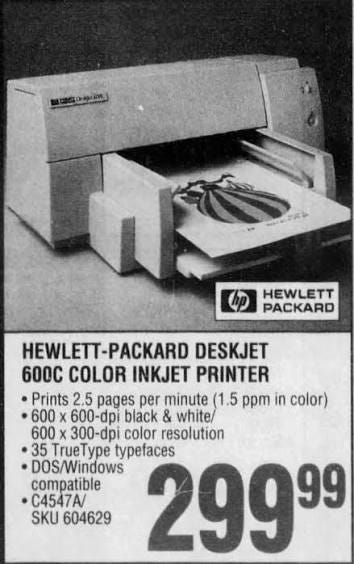
The amount of drafting, formatting, and editing I could do on a school paper with MS Works 3.0 before turning in the final draft saved a lot of lift-off correction ribbon tape which was used to erase the typos on the Smith Corona. Years later I would switch to laser printers because the dry toner lasts longer or forever (models where ink/toner expiration dates were not programmed into the bios). But printing paper had started to fall out of fashion:
Cyberselfish: A Critical Romp Through the Terribly Libertarian Culture of High Tech was re-released last month on September 15th in the U.S. and yesterday in the U.K. It also will be released in France, Belgium and Switzerland on October 29th. A brief disclaimer: Borsook mentions me in the Afterword, which is to my knowledge the first time my name appears in a commercial book, so I now feel obligated to live up to at least the worth of the paper that it is printed on. A tall order, to say the least. Ok, maybe a Grande order, or a Venti order.
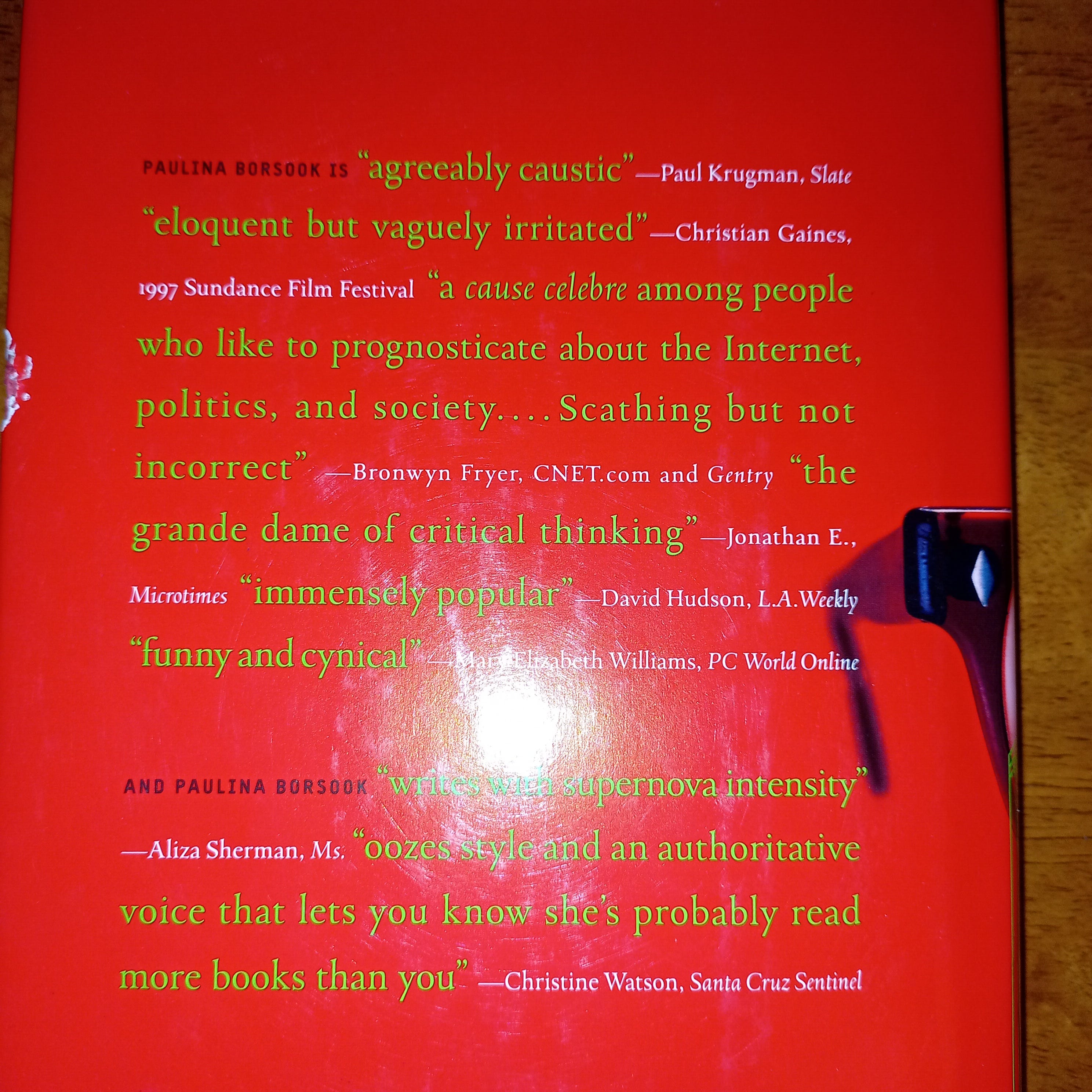
While I have tried to keep my self-promotion to a minimum, the thing is about getting to know Paulina through e-mail correspondences for the past 14 months is that she is an absolutely a delightful thinker to chat with, and I felt I should at least share that. I can’t think of many other writers in this era who can both criticize and cauterize a subject with balanced precision. She also writes extensively on other topics too, maintains a long list of essays on her archived page (one of my favorite is Raise high the yellow flag of quarantine: prophylaxis against the software way of knowledge, published in 2002), was never fixated on the technology field as a writing specialty, and merely covered it as a cultural phenomena during her time at Wired. Centuries-old novels and writers is more her thing. I asked her if anyone has compared her to Alice Roosevelt Longsworth and she says “no, but I love it. an ex once compared me to dorothy parker, which i quite liked.”