By age 2, Terence Tao had learned to read. Also at 2, he was using toy blocks to show older children how to count. He started learning calculus at 7; by age 9 he was already university-level in the subject. By 11, he was thriving in international mathematics competitions. At 20, he earned his Ph.D. from Princeton University. When Tao joined UCLA’s faculty that year, in 1996, he was younger than some of his undergraduate students. UCLA promoted him to full professor at age 24, and he remains the youngest person ever to become a full professor here.
He has won nearly every award a mathematician can win, including the Fields Medal in 2006, widely considered the Nobel Prize for mathematicians. National Geographic’s cover story about geniuses in May 2017 included Albert Einstein, Leonardo da Vinci, Charles Darwin, Thomas Edison, Wolfgang Amadeus Mozart, Michelangelo — and Tao.
Tao has been referred to as the “Mozart of Math” since 2006, when a UCLA mathematics colleague, John Garnett, said of him, “Terry is like Mozart; mathematics just flows out of him, except without Mozart’s personality problems.” Tao, who holds UCLA’s James and Carol Collins Chair and is director of special projects at UCLA’s Institute for Pure and Applied Mathematics, declines most interview requests. But in this critical moment for science, academia and the world, he talks about how artificial intelligence is reshaping mathematics, about threats to the U.S. science “ecosystem” and the value of doormen.
Many sciences have changed dramatically in the last century. Has mathematics?
You can pick up a mathematics textbook from 200 years ago, and it looks a little different from new textbooks, but not incredibly so. Mathematics has lagged behind the other sciences in embracing the 20th and 21st centuries. We still work in very small groups — two or three people. We haven’t mastered big science, splitting up a big task into many subprojects. Challenging problems require people from different fields of mathematics to work together, or people from mathematics and other sciences, industry and the general public.
You’re in favor of that.
Yes. Mathematicians have a reputation for being esoteric and abstruse, for doing some sort of magic wizardry that no one else can understand. That is harmful. Now that we have all these funding uncertainties, we’ve had to build a case for why it’s important to fund the basic sciences, mathematics in particular. Many sciences have figured out ways to get the public involved and to crowdsource research. Astronomers accept reports from amateurs about, say, comets. Biologists accept reports on California’s biodiversity, with volunteers collecting thousands of samples of soil and aquatic sediment. We are just now beginning to see citizen science happen in math.
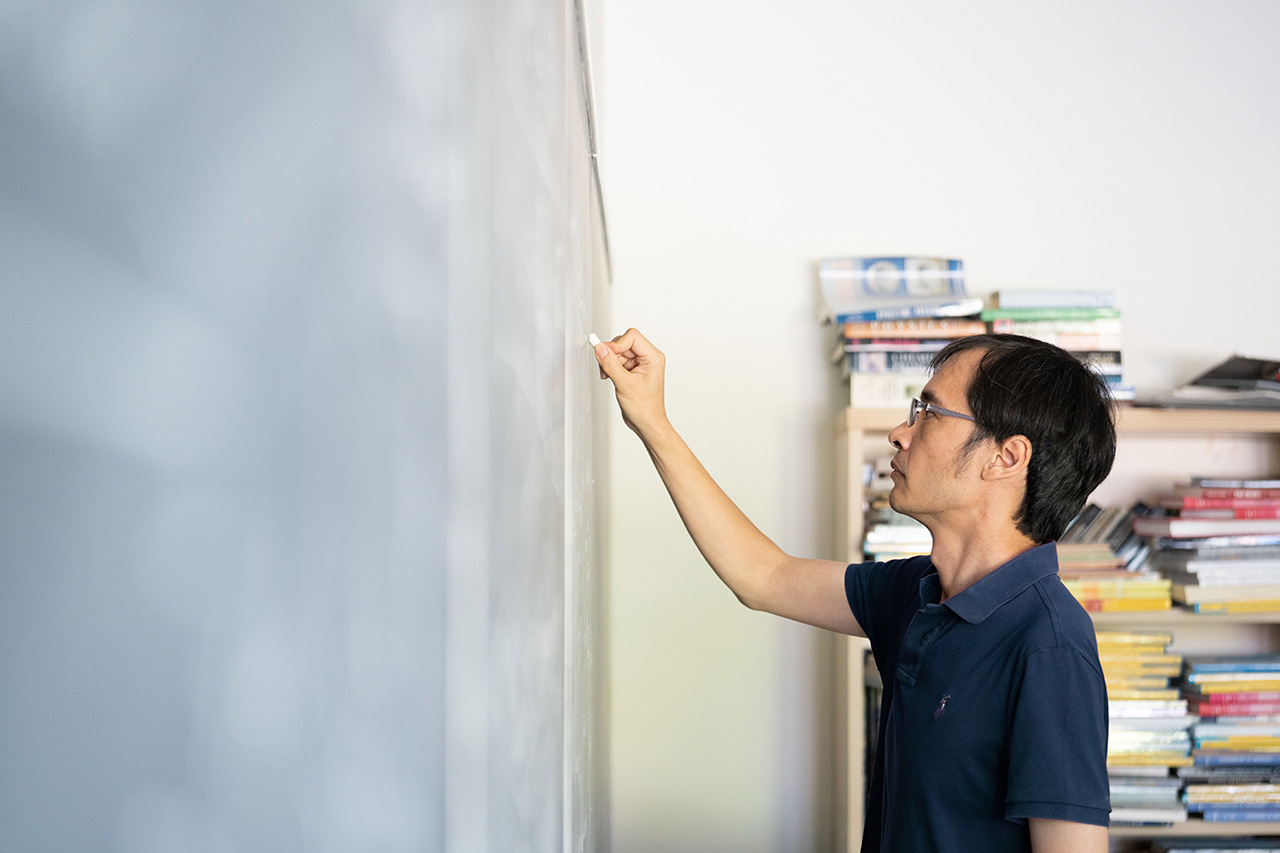
David Esquivel
Tao in his Mathematical Sciences Building office. "It is especially risky for students to ask an AI to solve a problem assigned to them to help train them," he says. "It’s analogous to when calculators came out; you don’t give it to students who are learning how to add."
What role does AI play in this?
AI can raise the quality of amateur contributions. We have formal verification software that can take a math proof and check whether it is correct. You can use it as a filter and accept only contributions that have been verified to be correct. I’m very excited about what we can do with these.
Before the Industrial Revolution, if you wanted to make a wooden doll, you would need a wood-carver to carve one doll by hand over weeks or months. Mathematicians are kind of like this. We spend weeks working on one problem — maybe two or three if we’re feeling ambitious. But we don’t take a dataset of 10,000 or more problems and use a technique that we believe can solve some of these problems. What percentage of the problems can we solve with this technique? Until recently, we didn’t have the manpower to have 100 graduate students work away on these problems and see which technique works well. In a clinical trial, doctors can administer a drug to 10,000 people and see how many get cured. We couldn’t do things like that in mathematics, but now we can start doing clinical trials of mathematical techniques that were pure fantasy until very recently. This excites me the most about AI. It allows us to do completely new things.
What is the value of mathematics in the AI age?
There’s a fallacy in business management called the doorman fallacy. The fallacy is: A fancy hotel is trying to cut costs and hires a consultant. The consultant observes the hotel has a doorman and says to install an automatic door opener. You can fire this person and save money. The company does this, but six, 12 months later, the reviews of the hotel go down; customers are not as happy. The hotel feels more impersonal; there’s no one to help guests get a taxi. They don’t feel as safe. The doorman was doing a lot more than just opening and closing doors — things that weren’t reflected in the official job description.
This is a danger of AI. If we say mathematicians prove theorems and solve difficult math problems, we can get AI to solve difficult math problems and replace mathematicians with AIs, but we’ll lose all the other things mathematicians do. Mathematicians explain things, connect things, train the next generation and train nonmathematicians how to think quantitatively and problem-solve — things that we never really needed to specify before. We took for granted that mathematics was valuable. We have to become philosophical about why we are here, what our aims are, what value we add. We have to advocate for ourselves. I wish it wasn’t under such stressful circumstances. But it’s something we should have done decades ago.
How will mathematics be transformed by AI?
There are a lot of good, useful ways in which we can use it already. There are also dangerous ways. For students, we have to be very wary. It is especially risky for students to ask an AI to solve a problem assigned to them to help train them. It’s analogous to when calculators came out; you don’t give it to students who are learning how to add.
You don’t want AI to think for you.
No. We use calculators, we use GPS. But there’s always a trade-off when you use a technology; you give up some of your physical or mental muscles. I use GPS all the time when I drive, and I feel I’m giving up some of my geography sense. Before GPS, I had a very good knowledge of my neighborhood; I knew what streets were next to what streets, and I feel that fading. It’s a trade-off that I’ve chosen to make. I’m willing to give up some geographic knowledge so I can free up mental space for other things. We have to decide on our AI diet, so to speak. We can cheaply solve all kinds of mental problems, but it can degrade our mental fitness, just like eating too much junk food can degrade our health.
How much are you using AI and other modern computer technologies in your work, and how helpful are you finding them?
There are some places where they’re incredibly useful, and some where I barely use them at all. When I was a graduate student, I used to walk to the library, pick up books and read them. Even before AI, I’ve been doing my searches on the internet without leaving my chair. I can ask AI to collect all the references on a subject and give me a report.
"There's a lot less serendipity when you work with AI tools. They give you exactly what you ask for and nothing else. People select their communities, meet only the people they want to meet and complain about being lonely. They've optimized out all the random interactions with people. Technology is all about trade-offs."
Is that better than when you walked to the library?
It’s different. It’s more thorough for the specific task I ask but has less serendipity. Going to the library, sometimes I would find another interesting article that I wouldn’t have known to find. There’s a lot less serendipity when you work with AI tools. They give you exactly what you ask for and nothing else. People select their communities, meet only the people they want to meet and complain about being so lonely and never meeting anybody. They’ve optimized out all the random interactions with people. Technology is all about trade-offs.
It’s safe to use AI up to the point where you can verify the outputs. Traditional ways of doing mathematics are like a water tap you turn on and a trickle of drinking water comes out. AIs are like a firehose of low-quality water, not drinkable, in huge amounts. AI formal verifications are like water filters that filter out undrinkable water. It’s the bare minimum of what you need, and we have those now. But if students don’t understand the subject, they cannot check whether an answer is correct. That’s the danger.
There are still mistakes with AI?
Oh, yes. It’s not grounded in any actual understanding. They make very clever guesses about answers.
Maybe you can talk a bit about ALPHA — Accelerated Formal Proof Synthesis with Neuro-Symbolic Automation — the new project where you and a team of UCLA computer scientists and mathematicians have received a three-year, $5 million grant from the Defense Advanced Research Projects Agency [DARPA] to develop artificial intelligence tools aimed at transforming how mathematical discoveries are made, formalized and verified.
We responded to a DARPA challenge. A very tiny percentage of mathematical results have been written formally. DARPA realizes formalization makes AI use safe and can massively accelerate mathematics and any discipline that requires lots of math. The challenge was to create an AI system that could take a massive amount of data and out come perfectly verified proofs.
Will ALPHA reduce errors?
That will be a by-product of this. We hope to massively expand the library of formalized mathematics and produce large numbers of verified proofs. ALPHA will provide a framework for turning assumptions into formal proofs. The more formalized proofs you have, the more formalized proofs you can make. This will allow AIs to be more safely used.
You've said the U.S. science ecosystem is under threat. Can you say more about this?
We live in unprecedented times, in many ways. We had a stable funding ecosystem since the 1950s. After World War II, there was a very strong bipartisan consensus that scientific excellence was a strategic asset. All the amazing technology we have today, including the internet, requires an ecosystem of all of STEM: industry, engineers, scientists and people who do basic research. If you want to build a better jet engine, for example, you don’t want to invest in that until you first have some theoretical basis.
Twenty years ago, at UCLA’s Institute for Pure and Applied Mathematics, I worked with a statistician and an electrical engineer on the mathematics of compressed sensing — a technique for extracting more high-quality resolution images out of a small amount of data. The application we had in mind was medical imaging — MRI scans, in particular. If you are scanning the human body and get only 30 seconds of scanning time, the traditional scanning methods provide images that are too blurry to diagnose a tumor. We found, theoretically, a way to improve the resolution of these images. My colleagues did numerical simulations that worked very well. I worked with them and found a satisfying mathematical explanation for why this technique was outperforming the previous one by a large amount.
By a factor of about 10, I think.
Yes. Then big MRI manufacturers saw it and were willing to invest millions of dollars of their R&D. Their latest models have sped up MRI scans quite a lot.
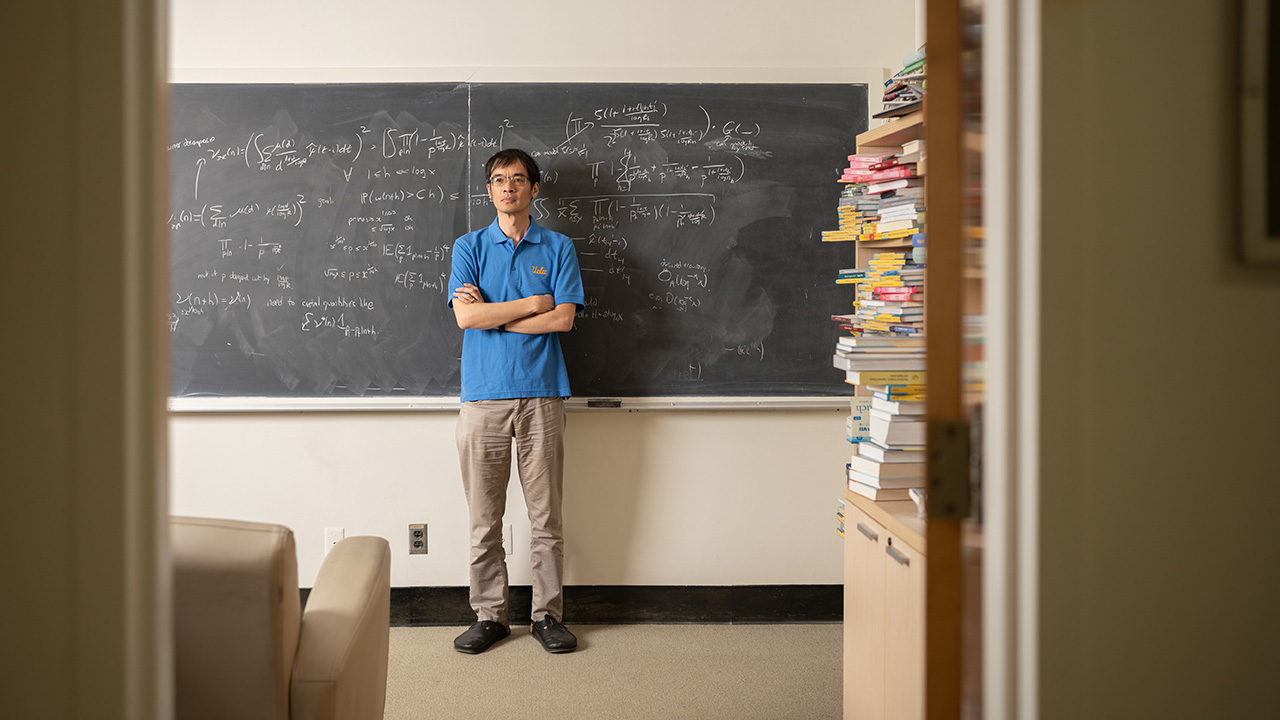
David Esquivel
"I worry there are not enough scientifically literate people in important policy positions," says Tao, winner of the 2006 Fields Medal. "Mathematicians can make connections between fields that others may not see."
Basic research often leads to useful applications. Wasn’t there a connection between Einstein’s theory of relativity and a mathematics theory devised decades earlier?
That’s a similar story. Euclid set out laws of geometry, but people started suspecting in the 15th and 16th centuries that there were other geometries. Eventually they discovered non-Euclidean geometries. Riemannian geometry is positively curved in some places and negatively curved in others. Mathematicians developed these for the sake of curiosity — not to solve problems outside of mathematics. Einstein, in trying to understand what gravity was really doing to the universe, eventually came to the conclusion that gravity distorted the geometry of space and time. Einstein didn’t have the language to describe this properly. He needed equations that require a lot of mathematical machinery. It turns out that 20 years prior, Bernhard Riemann had developed almost exactly the theory that Einstein needed; Einstein tweaked it a little.
It seems like the history of science is filled with accidental discoveries.
This is the power of curiosity-driven research. This happens over and over again.
You said mathematicians have to answer what value they add. What would you say taxpayers receive in return for the investment in mathematics research?
We do many things. We give guidance to the rest of STEM. We can give boundaries for what is possible in science and engineering. We give people scientific literacy. We need people who can explain difficult concepts and keep the population scientifically literate. I worry there are not enough scientifically literate people in important policy positions. Mathematicians can make connections between fields that others may not see.
Math can seem remote for a lot of people. What mathematics should everyone know when deciding what kind of mortgage to take on their home, or whether to take Social Security as soon as they are eligible?
Basic algebra, probability, statistics — a good high school education. There’s no specific magic formula that helps you run your life. Humans are very bad at risk analysis. They can be terrified of a very low-risk event, but then do something very risky, such as eat an unhealthy diet. People don’t measure things quantitatively nearly enough. They don’t estimate, What is my risk? Knowledge is power. Including knowledge of numbers.
When you won the Fields Medal, you were asked about your legacy. You said, “Maybe when I’m in my 60s, I’ll look back at what I’ve done, but now I would rather work on the problems.”
[Laughs]
Twenty years later, you’re 51. Have you given any more thought to your legacy?
Not legacy, but service, definitely. Increasingly, I’m more interested in how to shape the field broadly. I try to be involved in debates on where mathematics is going. I feel like I can make a difference. It helps me sleep better at night.
Stuart Wolpert is director of UCLA Conversations and serves on the UCLA Emeriti Association’s board of directors.
Read more from UCLA Magazine’s Fall 2026 issue.