The story in 15 seconds
- Madrid’s Robledo de Chavela DSN complex evacuated as wildfires advance.
- Fire over Sierra Oeste de Madrid threatens NASA antenna complex near Robledo de Chavela.
- Evacuation completed; security personnel remain on site.
The divide · 1 of 3
Xataka claims penetration; WIRED says the equipment impact is unclear.
Who skipped what
Blind spots
If you only read Western Mainstream outlets, you would not know:
- Fire risk also threatened ESA’s Cebreros tracking station.
Skipped by RTVE.es, WIRED
How each outlet frames it
Every outlet we compared, the headline it ran, and a link to the original article.
Western Mainstream
ABC
El fuego amenaza las instalaciones de la NASA en Robledo de Chavela y obliga a desalojar a todo su personal
24 July, 2026
Ars Technica
Wildfire forces evacuation of NASA’s Deep Space Network complex in Spain
24 July, 2026
RTVE.es
El avance del incendio de la Sierra Oeste de Madrid obliga a evacuar la base de la NASA en Robledo de Chavela
24 July, 2026
WIRED
One of NASA’s Most Important Deep Space Observatories Hit by Spanish Wildfires
24 July, 2026
Other
Cadena SER
The flames of the Madrid fire threaten NASA's station in Robledo de Chavela: "The situation is critical"
24 July, 2026
Leganés Activo
Los incendios forestales de Madrid dejan en jaque las antenas de la NASA en Robledo de Chavela
24 July, 2026
New Scientist
One of NASA’s crucial links to deep space is at risk of burning down
24 July, 2026
Onda Cero
NASA's Robledo de Chavela antennas, in a 'critical situation' due to the advance of the fires
24 July, 2026
Spaceflight Now
Critical NASA Deep Space ground station in Spain evacuated due to wildfires
24 July, 2026
The Objective
The fire in Madrid puts NASA's Robledo de Chavela station in a 'critical situation'.
24 July, 2026
Xataka
In a critical situation: the Madrid fire forces evacuation of an installation indispensable to NASA
24 July, 2026
Western Tabloid
Daily Star
NASA station in Spain evacuated due to 'critical' wildfires as Europe burns as 40,000 flee
24 July, 2026
Latin American
Europa Press
Madrid fire leaves NASA's antenna complex at Robledo de Chavela in critical condition.
24 July, 2026
Full story
Wildfires threaten NASA link
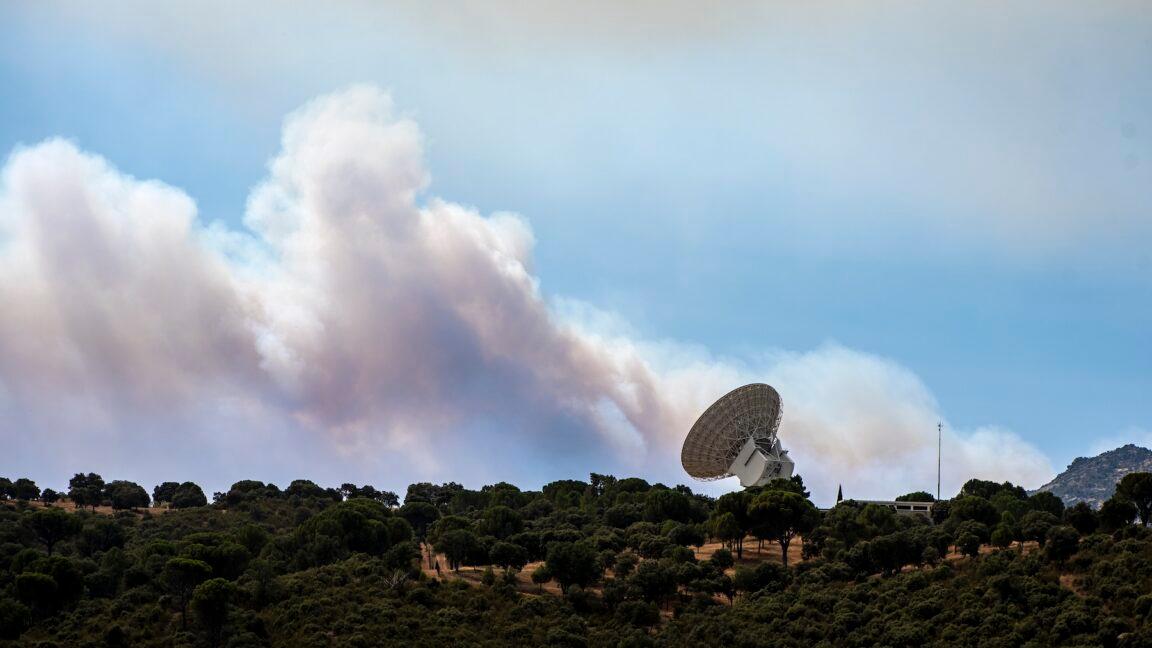
Wildfires in Spain overran one of three observatories the US National Aeronautics and Space Administration uses to connect with spacecraft, including Voyager 1, the James Webb Space Telescope, and the Artemis mission around the Moon.
“evacuation orders in place for 60,000 people”
WIRED
Spain declared a wildfire emergency as multiple blazes burned out of control near Madrid, with evacuation orders in place for 60,000 people, and the affected area included Robledo de Chavela, a municipality near the Deep Space Communications Complex run by NASA.
ABC
WIRED reported that a NASA spokesperson said the agency successfully evacuated all personnel, and that while the fire had passed through the observatory complex, it remained unclear what impact the flames may have had on sensitive equipment inside.
New Scientist said a fire near Madrid intensified on 24 July and burned through the Madrid Deep Space Communications Complex (MDSCC) in Robledo de Chavela, where Robledo and surrounding areas were evacuated.
The New Scientist report added that NASA said it had “seamlessly transitioned support for mission operations to the Goldstone Deep Space Communications Complex in California, ensuring continuity of service and uninterrupted support for spacecraft communications.”
Evacuation and uncertainty
New Scientist said NASA’s statement reported that all employees at MDSCC were able to evacuate safely, but that the antennae themselves had not been evaluated yet.
WIRED quoted a NASA spokesperson saying, “Any potential damage will be assessed when it is safe to do so,” and added that if conditions allow, a site assessment could happen as soon as Saturday.
Ars Technica
The BBC reported that as of Friday, more than 25,000 people had been evacuated in Spain and more than 20,000 were in lockdown, while emergency crews fought to shield NASA’s Madrid Deep Space Communications Complex from wildfires.
In Spain, the government delegate in Madrid, Francisco Martín, said the installation was in a “critical situation,” and RTVE.es reported that Lola Cadierno confirmed the evacuation of 90 workers in total in several stages.
RTVE.es also said Cadierno told Canal 24 Horas that “No podemos confirmar que las llamas lo hayan alcanzado, porque no tenemos a nadie dentro,” and that the complex’s perimeter status was unknown because no one remained inside.
What’s at stake next
New Scientist warned that NASA’s Deep Space Network (DSN) is “already drastically oversubscribed,” and that with one dish out of commission the process of getting commands and receiving data could slow further.
“Sería una catástrofe para la NASA”
RTVE.es
It added that DSN’s three stations are designed to cover about a third of the sky, so “there will now be times of the day when certain spacecraft are out of touch when they otherwise wouldn’t have been,” a risk it said is particularly problematic for extremely distant spacecraft such as Voyager 1 and 2.
WIRED described the DSN network as “the largest and most sensitive scientific telecommunications system in the world,” used to transmit information from Earth to spacecraft and to transfer data from the James Webb Space Telescope.
RTVE.es said Cadierno warned that if one of the DSN complexes fails, “Sería una catástrofe para la NASA,” because a portion of deep-space mission tracking would not be performed from that part of the world.
The Objective reported that the Robledo de Chavela complex began operations in 1965 and that, if one station fails, “there would be NASA's deep-space missions that would not be tracked from this part of the world,” leaving only Goldstone, California, and Canberra, Australia, operational.
The deep audit
How victims, perpetrators and terms are handled across outlets.