- Community forests across Nepal produce large volumes of timber that remain unsold due to high government taxes, collection costs and competition from private and imported wood, leaving user groups without revenue for sustainable forest management and conservation, officials admit.
- While Nepal’s community forestry program has successfully increased forest cover to 44%, government royalty rates make legally harvested timber expensive, pushing consumers toward cheaper private or imported options like aluminum and UPVC.
- Unsold timber undermines forest management programs (planting, thinning, fire prevention), encourages illegal logging and creates storage and decay problems, affecting both environmental conservation and local livelihoods.
KATHMANDU — The Khorthali Community Forest User Group in Dolakha, central Nepal, produced 1,189 cubic meters (42,000 cubic feet) of timber in 2025 — roughly 18 standard 40-foot shipping containers in volume. However, the group could not sell all of it. About 340 m3 (12,000 ft3) of wood still lies on the roadside. “Community members have asked us to help sell the timber, but potential buyers are not interested,” said Anil Regmi, an official at the district forest office in Dolakha.
Across Nepal, other districts face similar challenges. In Bara, the district forest office has 2,605 m3 (92,000 ft3) of unsold timber, while in Nawalpur, the figure reaches 1,100 m3 (40,000 ft3), despite repeated attempts to sell it. According to ForestAction Nepal, 60,000 m3 (2.1 million ft3) of timber remains unsold in Lumbini province alone. The estimate represents timber accumulated across multiple storage locations and years, rather than unsold stock from a single harvesting season.
Nepal’s community forests are producing large volumes of timber that remain unsold due to high government taxes and competition from private and imported wood, leaving local user groups without funds to implement sustainable forest management while politicians blame strict conservation laws for not facilitating large-scale infrastructure development. “The government set tax rate for timber is very high compared to the prevailing market rate,” said Nabaraj Pudasaini, joint secretary at the Ministry of Forests and Environment. “When you add collection costs and other charges, the prices get further inflated,” he told Mongabay.
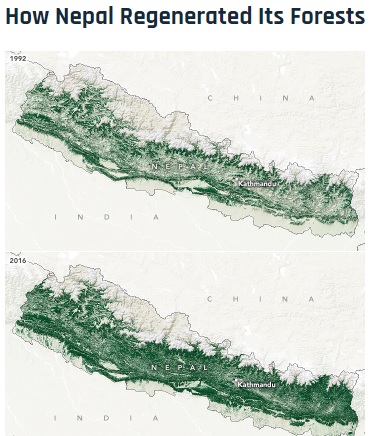
Nepal is considered a success story in community-based forestry, having increased its forest cover to around 44% of the land from approximately 23% in the past. In 1979, a World Bank report had warned, forests in the country’s hills would be largely gone by 1990.

Under the community forestry model, the government hands over management of local forests to community groups under their periodic operation plans to sustainably harvest wood from their forests and sell it with the support of the district forest office and earn a revenue to carry out forest management by paying a certain amount in taxes set by the government. Forestry management is largely focused on timber, as revenue from wood sales provides a critical source of funding for conservation and other forest management activities.
The introduction of community forest programs was accompanied by stringent deforestation laws that impose heavy fines or even jail time for violations. These laws are often unpopular with infrastructure developers, as legally clearing forested land requires extensive documentation, compensatory replantation and payment of fees, which can significantly slow down projects leading to calls for their relaxation. This is portrayed as ‘over conservation’.
Kulman Ghising, outgoing minister for energy, water resources and irrigation, said, “In the name of saving ecology, forests have been left to rot while the country continues to import expensive wood-based products from China and Malaysia.” According to the Department of Customs, Nepal imported wood, articles of wood and wood charcoal worth approximately $35.4 million from July 2023 to July 2024.
However, several experts say the issue often stems less from ecological protection itself and more from how timber pricing and regulatory structures are implemented.
They also caution that relaxing harvesting restrictions in the name of boosting wood production without strong monitoring systems could reverse Nepal’s forest recovery gains, which are widely regarded as one of the country’s major environmental successes. They also argue that the problem is less about overprotection and more about economics and policy. Government royalty rates make legally harvested wood too expensive and low value for money compared with private timber and imported or aluminum alternatives. Industry experts say this comparison is also influenced by Nepal’s limited domestic wood-processing capacity, meaning consumers often compare finished imported products with locally available raw or minimally processed timber.
Pudasaini said, “The government’s rate is very high. When wood collection costs and other charges are added, the price becomes expensive. As a result, aluminum and imported furniture are cheaper than Nepali wood.”
Domestic timber from community-managed forests now costs nearly double that of private forest wood and four times as much as finished aluminum alternatives. According to the Forest Regulations 2021, timber is divided into A, B and C grades, including trees like alder (Alnus nepalensis), chir pine (Pinus roxburghii), sal (Shorea robusta) and rosewood (Dalbergia sissoo). For example, A-grade A. nepalensis costs the government 300 rupees ($2) per ft3. Cutting and collecting the wood adds about 200 rupees ($1.40) per ft3, and including transportation and taxes, the total price reaches 600 rupees ($4) per ft3. Meanwhile, the same wood from private forests sells for only 300 rupees per ft3.
Most of the domestic wood sold in Nepal comes from private forests even as they constitute only a fraction of the forest cover. National timber production figures refer to total harvested wood, while market sales reflect only timber that successfully enters formal trading channels, meaning a portion of harvested wood may remain unsold.
Out of approximately 850,000 m3 (30 million ft3) of timber sold in Nepal every year, 650,000 m3 (23 million ft3) comes from private forests, even though the government controls more than 98% of the forest. However, timber harvesting and sales from government and community-managed forests are subject to stricter regulatory procedures and higher royalty rates than those from private land, where extraction and marketing processes are often simpler.
Because government timber (including the ones from community forests) is so expensive, buyers often avoid it, leaving community forest groups without enough revenue to fund conservation and sustainable forest management programs.
Manjil Babu Maskey, former chair of the Federation of Forest-Based Industry and Trade Nepal, said Nepali timber’s price needs to be halved at least from the current rate to become competitive in the market. As a result, consumers prefer imported aluminum or unplasticized polyvinyl chloride (UPVC), which are cheaper and finish faster.
Even wood coming from clearing of forests for infrastructure projects couldn’t be sold, officials say. They say similar market and pricing barriers also affect timber generated during forest clearance for development projects. “We have wooden logs produced during various development projects, such as the Terai–Madhesh Fast Track Road project and the 132-kilovolt electricity transmission line,” Birendra Yadav, information officer at the sub-division forest office in Bara, said. “We have had this wood for eight years. We have tried many times, but it has not been sold. What can we do?”
In addition to this are concerns of quality and consumer preference. “There is no production based on consumer preferences. Consumers want better quality for furniture and housing,” Pudasaini said.
This failure to sell has many repercussions. Because the wood could not be sold, many community forest user groups now lack money to implement sustainable forest management programs outlined in their annual work plans. These programs include planting and thinning trees, maintaining trails, preventing soil erosion and conducting fire prevention measures.
Researchers say that economically unviable legal timber markets may create conditions that favor informal or illegal supply chains. Rajesh Kumar Rai, forestry professor at Tribhuvan University, said, “Where forest resources are restricted, illegal logging increases.” Although there’s a paucity of illegal logging data in the country, reports of illegal loggers and smugglers resorting to violence, especially in areas bordering India, have become common in the media. In January, a forest guard working for the Sagarnath forest project was found killed, allegedly by wood smugglers.
The other issue is with the storage of unsold wood. “If the wood is not sold, we can’t store it properly, and it will become unusable after the rainy season,” Regmi said.
All this leads to a pertinent systemic question related to the people’s ownership of forests. Naya Sharma Paudel added, “If people do not benefit from forests, why would they conserve them? Proper use does not harm conservation. “If timber prices are too restrictive, illegal harvesting rises.”
Nabaraj Pudasaini emphasized that all the debate over economic use of wood undermines the reality that forests are not only economic resources but also environmental and cultural assets.
“Each tree is an ecosystem in its own self, even when it has fallen or is naturally decaying,” he said. “If forests are managed well, they provide many benefits, from soil conservation and water retention to supporting livelihoods. He noted that naturally fallen timber contributes to forest biodiversity and nutrient cycling, but harvested wood left exposed in storage yards typically loses both ecological function and economic value.
“We have a good example in Lumbini province, where effective forest management has significantly increased timber production and helped reduce timber imports,” he said. “However, we have been unable to produce finished wood products. This is an area we should focus on.”
Pudasaini told Mongabay that while there is a growing lobby for making it easier to cut down trees, history shows that all the gains in forestation in Nepal are fragile and could be potentially reversed in a short period.
According to the Ministry of Finance (2023-24), a total of roughly 1 million m3 (35.3 million ft3) of round timber was produced from both private and national forests, generating 6.9 billion rupees (about $47.5 million) in government revenue. Likewise, in FY 2022-23, timber production stood at 900,000 m3 (31.8 million ft3). By mid-March FY 2024-25, about 623,000 m3 (22 million ft3) of timber had been produced, from which the government collected 1.7 billion rupees (about $11.6 million) in revenue. This revenue could be maximized if legal arrangements are made to reduce taxes, said natural resources lawyer Dil Raj Khanal.
But the government is yet to work on it. Bhupal Baral, revenue secretary at the Finance Ministry, said that proposals to increase or decrease the price of timber are made by the concerned ministry itself, while the Finance Ministry only provides advice on the matter. “Regarding timber pricing, the Ministry of Forests and Environment specifies the price in the regulations. The Ministry of Finance only gives its recommendations. So far, no such proposal has come from the ministry,” he said. “They initially set a price. If it is later felt to be too high, the ministry can submit a proposal, and the Council of Ministers can make a decision on it.”
Bannner image: A village in Dolakha. Image by Global Environment Facility via Flickr (CC BY-NC-SA 2.0).
Credits
