This article is part of the Artnet Intelligence Report, Mid-Year Review 2025. Our analysis of the first half of the year’s market trends provides a data-driven overview of the current state of the art world, highlighting auction results and trends, and how industry leaders plan to move ahead.

In early June, a week before the Art Basel fair was about to open in the Swiss city on the Rhine, New York-based Clearing gallery announced that it would take over a four-story, five-bedroom villa as an alternative to having a booth in the giant convention center on the Messeplatz.
It was a surprising move by the emerging-art space, which had participated in the esteemed art fair since 2022. Being accepted into “Basel Basel” is like summiting Mount Everest for art dealers. Opting out isn’t something you do once you get in. And yet, there was Clearing, placing works by 46 artists in an attic, a basement, and most of the rooms in between. Every night, a hip crowd stayed late in the garden, where long tables were set up for BBQ dinners.

Installation view of Jean-Marie Appriou, The Birth of Venus (2022) at Maison Clearing in Basel, Switzerland. Courtesy of Clearing.
Few knew at the time that “Maison Clearing” was the gallery’s last-ditch attempt to keep going. It had been bleeding cash for two years as demand for art fell off a cliff, while its costs (for operating two spaces, in New York and Los Angeles) remained unchanged, about $150,000 a month. Owner Olivier Babin knew that participating in Art Basel offered more risk than reward if buyers failed to materialize. “We figured that more of the same wasn’t going to move the needle for us,” he said in August. So, he dropped out of the fair, despite the prospect of being blacklisted by its famously strict organizers. “We didn’t care,” he said. “It was all about survival.”
His reasoning was straightforward. Rather than pay $100,000 for a tiny booth on the periphery at Art Basel, Clearing would spend less and get more. The stately home, an 11-minute walk from the fair, had 10 times more space for art, plus accommodations for staff and plenty of room to entertain clients.
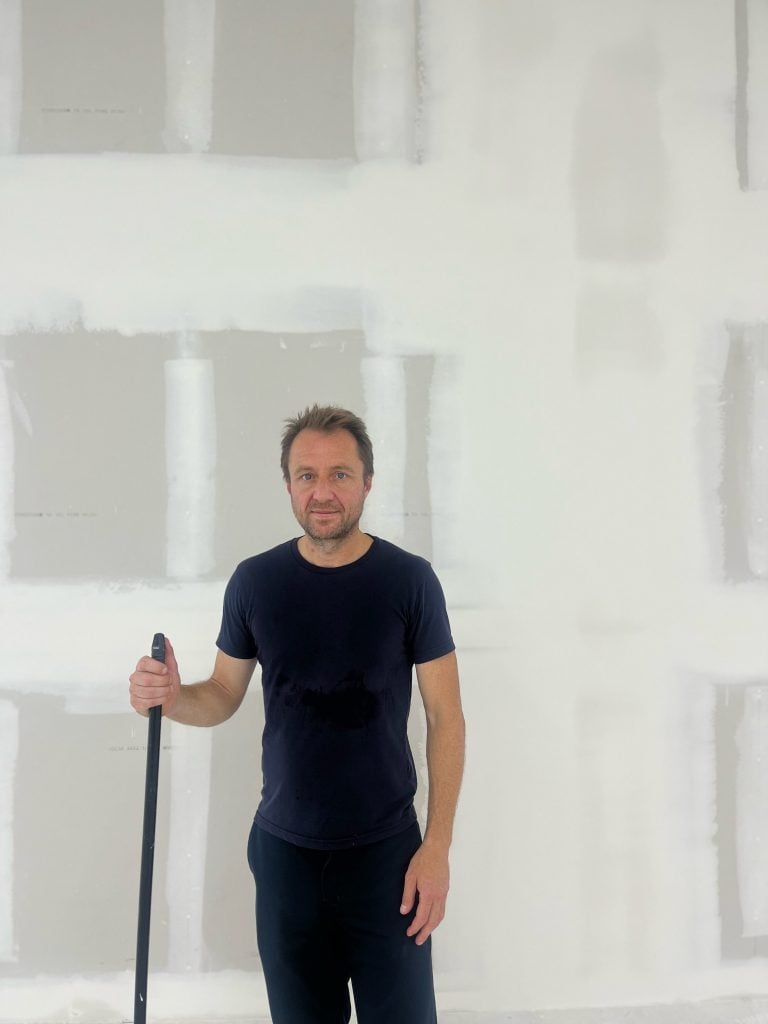
Olivier Babin of Clearing. Photo courtesy of Clearing.
Unfortunately, his plan didn’t work.
“There was a beautiful exhibition, amazing dinners, a lot of attention and press, and good sales, but the hole at the bottom of which we were standing was too deep,” said Babin, an artist turned dealer, who started Clearing in his studio in Bushwick, Brooklyn, in 2011. The gallery had made international stars of artists like Harold Ancart, Korakrit Arunanondchai, and, more recently, Marguerite Humeau, but the math was no longer working. On August 7, the gallery announced that it was closing.
“We gave it our best shot, and we missed,” Babin, 50, told me the day after he went public with the news. The gallery is headed into bankruptcy and is being sued by its New York landlord.
An Industry in Freefall
Babin is far from the only dealer on the way out. The art world is in a precarious state as it heads into the second half of 2025. Not a week goes by, it seems, without a major gallery closing: Blum, Venus Over Manhattan, and Kasmin are other prominent summer casualties. Smaller galleries are exiting and downsizing discreetly. Each case is different, but many voice the same laments: Overheads are killing businesses. Sales are down. It’s no longer fun. Primary pricing is untenable. Major collectors have stopped buying art or significantly reduced their spending. The next generation isn’t there to take over from the old guard. The art world has become bloated, and there isn’t an easy way to cure the malaise.
“I don’t believe for one second that it’s cyclical,” Belgian collector and art market commentator Alain Servais told me. “It’s structural. The infrastructure is too big. There are too many advisors, too many galleries, too many artists, too many fairs. Everything will need to downsize. In my blunt opinion, blood will flow in the streets before the art market finds a new balance.”
The contraction started quietly after Art Basel in 2022, but the disastrous results for Gerald Fineberg’s collection at Christie’s the following May brought it into the open. Fine-art auction sales during the first half of 2025 totaled $4.72 billion, down 8.8 percent from the same period a year ago and down 40.9 percent from 2022’s first half, according to the Artnet Price Database.
The Art Dealers Association of America decided to cancel its popular Art Show this year.
The decline in primary market sales has been brutal as well, based on interviews with dealers, collectors, and advisors. But the full picture is hard to gauge because of the lack of public data about gallery sales. According to the latest art market report produced by Art Basel and UBS, annual sales in the dealer sector declined by 6 percent, to $34.1 billion, in 2024.

ADAA’s The Art Show 2024. Scott Rudd/Courtesy of ADAA.
Another revealing indicator: Soho Art Materials, a popular art-supplies company in New York that works with artists and galleries, traces the sector’s decline to the summer of 2022. The firm’s sales began falling gradually and then in June 2023 dropped 20 percent from the previous month, according to Jonathan Siegel, a co-owner. The company was stretching 700 to 1,000 canvases annually for three years, starting in 2020; it now does about 200 a year, he said.
“The industry is in a free fall,” Siegel said. “Galleries are closing left and right. They have overextended. Everyone thought the light would never stop shining. The ramifications of the past two years have been dramatic. It’s been a disaster, basically.”
In the U.K., firms must file financial disclosures, which reveal razor-thin profit margins for galleries big and small, as falling turnover collides with stubbornly high fixed costs.
Sadie Coles HQ, a respected London gallery that represents almost 60 artists (including blue-chip and young stars), saw sales drop to £28.6 million ($38.6 million) in 2024 from £59 million ($79.6 million) in 2023, according to regulatory filings. Its after-tax profit for 2024 was just £206,493 ($279,000), a 0.7 percent margin, down dramatically from £4.27 million, with a 7.2 percent margin, in 2023.
A Malaise
I have covered the art market since 2006, and I have never heard people as down as they have been this summer. Suddenly, they are openly talking doom and gloom, instead of fighting against that narrative.
“It would be naive of us to expect endless growth without some retraction,” über-art advisor Allan Schwartzman said. “And it’s not entirely unwelcome. We’ve produced more artists than are worthy of the attention of a thoughtful collecting population.”
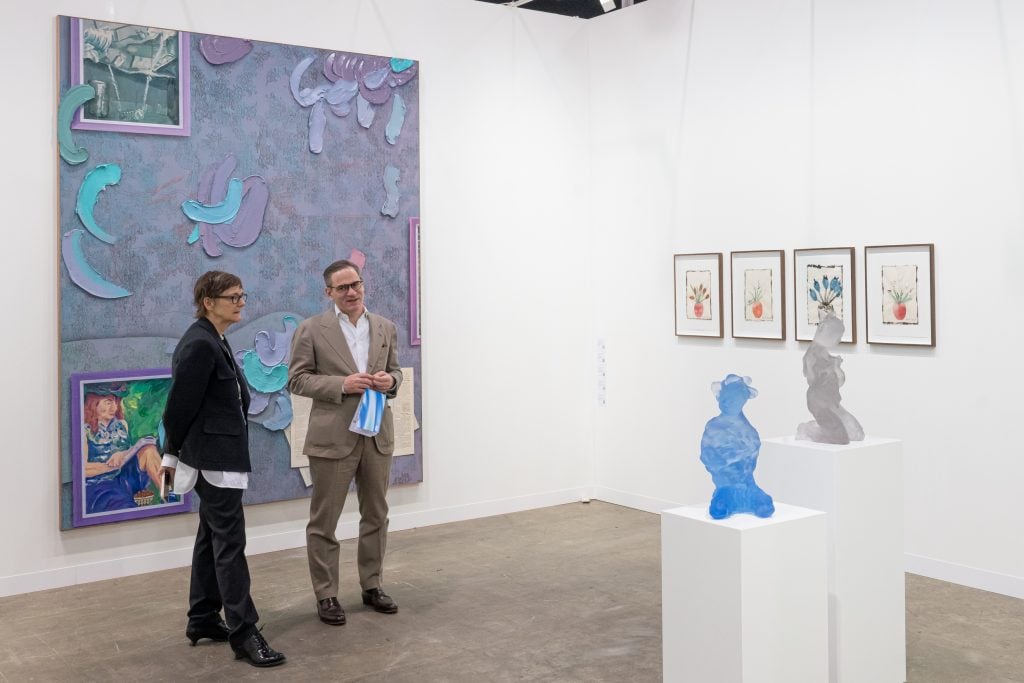
Dealer Sadie Cole and Philip Tinari, the director of the UCCA Center for Contemporary Art in China, stand inside Coles’s booth at Art Basel Hong Kong.
As Schwartzman sees it, the magnitude of current troubles became evident at this year’s Art Basel. Many galleries dealing in the secondary market had difficulty sourcing fresh material; upstairs, in sectors for smaller and younger galleries, few did any business, he said.
A gallery in the main section can afford to have a lackluster Basel and still stay afloat, he said. “Galleries upstairs, if they have a slow Basel, it starts to really have an impact on them. They have to start making serious decisions about their businesses.”
Dealers and advisors said they expect to see dozens more galleries close in the coming months.
“The energy is not positive,” said a dealer with spaces in New York and Los Angeles. “There are fewer and fewer collectors who are actively buying.”
Many investment-focused art buyers got burned and got out. Their disillusionment then spilled into the broader collecting world, the dealer said, creating “a kind of malaise.”
The question is how to “get people to understand that art isn’t an asset class,” he added.
“That’s not how you should be collecting,” he continued. “And if you have been, sorry, you’ve done something that’s not productive. Read the fine print. The reality is, no one ever said you are going to make money if you buy my artists.”
Except, of course, many dealers have suggested that.
Now that the bubble has burst, the speculators are out of the picture, off flipping meme coins, where no one makes them feel inadequate or insists that they buy three things they don’t want to get the one thing they do.
“The juice has got to be worth the squeeze,” one collector-trader said. “And there’s no juice in the art market. It’s just squeeze, squeeze, squeeze. Rude, rude, rude.”
On the Sidelines
Major collectors standing on the sidelines include Beth Rudin DeWoody, who lives in New York and Palm Beach, Florida, and Los Angeles-based Dean Valentine.
“I always look at art, but I am holding back on my collecting,” DeWoody told me in August. “I’ve gotten a few things by young artists, but I’m not at my total zeal. I didn’t go to Art Basel. I love the art world, artists, and dealers, but right now I just have to be a bit more cautious in my activities.”
Other collectors are also being more prudent, she said, given the uncertainty around the economy and tariffs, as well as sociopolitical upheavals.

Beth Rudin DeWoody at the 2024 American Federation of Arts Gala & Cultural Leadership Awards in New York City. Photo by Udo Salters/Patrick McMullan via Getty Images.
“The market got a little crazy with prices,” DeWoody said. “Maybe this will put us all back in a more normal area with less speculation, which hurt the market as well.”
DeWoody’s break from buying is “a very big deal psychologically and fiscally” for the art world, said dealer Franklin Parrasch, who has sold many works to her over the years.
“It shakes up people’s sense of confidence, but it also shakes up the sense of direction,” Parrasch said. “And that is where we are—rudderless—at the moment.”
Collectors have a herd mentality. They follow tastemaking individuals like DeWoody to determine who’s hot and what’s important. Then there’s a stampede, shows sell out, and secondary prices surge.
DeWoody was born into one of New York’s biggest real estate families, with an estimated net worth of $5.1 billion, according to Forbes. Her collection comprises 10,000 works of art, and her private exhibition space in Palm Beach, called the Bunker, has become a key destination for art-world insiders.
“People know she is a bellwether,” Parrasch said. “They know that she’s the first person to buy so many different artists that are now household names, before they even got out of grad school or had their first shows.”
Valentine, a cofounder of the Felix art fair in L.A., isn’t optimistic about the art market. Aggressive prices discourage collectors like him from participating. Asking $20,000 for a work in an artist’s first show is unsustainable, he said. “People can’t afford a house let alone a painting. The market has become separated from the fundamentals. It needs to reform.”
Why Pay Retail?
Buying the work of fast-rising artists and quickly reselling them for higher prices became rampant during the pandemic. Demand got so intense that auction houses created new sales just for ultra-contemporary art by 20- and 30-somethings. Faced with a surge of investors from around the globe, galleries raised primary prices, aiming to capitalize on red-hot demand and dissuade speculators from reselling quickly.
But the strategy backfired. “And now they are $500,000 primary, but they’re $250,000 at auction,” the collector-trader said.
Market star Shara Hughes generated $30 million at auction in 2022, when 75 of her works came on the block and a painting fetched $2.9 million, according to the Artnet Price Database. But demand has cooled significantly since then. The highest price for Hughes at auction so far this year is $310,158. Meanwhile, David Kordansky Gallery sold her painting Protection Reflection (2024) at Art Basel for $450,000 to $500,000.

Shara Hughes’s 2023 painting Some Flowers Get Trampled on view at David Kordansky Gallery’s booth at Art Basel in 2023. Photo by Harold Cunningham/Getty Images.
Lisson Gallery has sold pieces by Anish Kapoor for between $800,000 and $900,000 a pop at art fairs over the past two years. At auction, just a single work has fetched more than that since 2023, according to Artnet data.
David Zwirner charged $400,000 to $1.2 million for Dana Schutz’s new works during her solo show in Paris last October. At auction, only one painting has sold for more than $250,000 since 2023.
There are numerous other examples.
“Wait a few weeks. Wait a few months,” said the collector-trader of hot artists. “You can get great things at auction.”
Signs of Life
To be sure, the primary market is not totally dead, although deals take more time and effort to close.
Clearing’s Babin said that selling 60 percent of a show is now a great success. The rate used to be 100 percent, with empty-handed collectors added to waiting lists.
“What took two hours now takes two days, what took two days now takes two weeks,” said Mathieu Templon, CEO of Templon’s New York operations.

Will Cotton’s The Wave (2024–25), which was on view in his recent solo show at Templon New York. Courtesy of the artist and Templon.
The gallery found success with its two recent shows. In New York, it presented the acclaimed figurative painter Will Cotton’s first solo exhibition since 2018. All but two paintings sold, with prices ranging from $80,000 to $250,000, according to Templon. At its Paris location, the emerging artist Jeanne Vicerial showed large fiber sculptures, a fashionable medium, at prices ranging from €22,000 to €40,000 ($25,600 to $46,600), and almost all found buyers.
“Things are not the same, and every gallery has been feeling it, but the market is not dead,” Templon said. “When you have the right artist, the right works, there’s a market for it.”
Some younger galleries, unburdened by massive overheads, are surging forward. Sebastian Gladstone, 36, is moving into a new space in Los Angeles in September and expanded to New York in January. He keeps his costs low and employs only two staffers. His upcoming show of overlooked Abstract Expressionist Herman Cherry is sold out at prices ranging from $35,000 to $80,000.

Herman Cherry’s Bird of Paradise (Clown), (1963), will be on
view at Sebastian Gladstone’s Los Angeles gallery.
“More than anything, you are seeing a massive shift in the players,” Gladstone said, discussing the galleries that shuttered. “It’s really easy to be at a beach house in Malibu and not be in touch with what’s happening.”
Younger dealers, those in their late 20s to mid 40s, are “able to respond to the world in a way the older guard isn’t able to,” he continued. These include Matthew Brown; Tara Downs; Brendan Dugan, of Karma; and Alec Petty, of King’s Leap, according to advisors and collectors.
Robbie Fitzpatrick, who adopted a nomadic business model after operating spaces in Paris and Los Angeles, believes that the best thing younger galleries can do is stay small for as long as they can. “Don’t buy into the growth model,” he said on The Art Angle podcast, produced by Artnet. “Because it can get very tricky very fast.”
It’s not just emerging-art galleries that are struggling with huge expenditures. There are persistent rumors in the market about troubles at Pace, a mega gallery with massive fixed costs.
In 2019, Pace moved into a new 75,000-square-foot building on West 25th Street in Chelsea owned by Weinberg Properties. It is locked into a 20-year lease, with 3 percent annual rent increases, according to the Kroll Bond Rating Agency. My former Artnet colleague Tim Schneider’s analysis at the time of the deal revealed that the gallery was on the hook for $704,000 in monthly rent, or $8.5 million a year—$220 million over the course of the lease. That’s before payroll and other business expenses. Pace declined to comment.
New Models
Some dealers are trying out new models to navigate the uncertain times.
“There’s a strange insecurity in the market,” said Leo Koenig, who has reconceptualized his New York gallery several times since opening it, in 1999, when he was 21 years old.
“I used to know when to push forward and when to pull back, when it was time to close a deal and how to close a deal,” Koenig said. “And I tell you, my wisdom of 30 years in this business is kind of at odds right now with what’s going on.”
He’s currently testing a three-pronged approach. First, he has a small gallery on the Upper East Side. Second, he does seasonal business, starting in November, in Palm Beach, where he generates the most revenue. And third: In May, Koenig opened a gallery in Andes, a small village in New York’s Catskills (population: 1,114), which has a vibrant creative community. The space will remain open until October. Koenig invites collectors to visit for a weekend, creating an experience that may include a trip to Dia Beacon, dinners, hiking, fishing, and hanging out with artists.

Leo Koenig’s gallery in Upstate New York. Courtesy of Leo Koenig.
“We generate excitement and hence business through that,” Koenig said by phone from Andes. “Our dollars go a lot farther here, and people are more excited to explore a different landscape.”
The bucolic setting and low overhead are a far cry from New York, where anxieties and costs run high.
“Some of my colleagues have $50,000-to-$60,000 rent payments every month,” Koenig said. “They have the equivalent amount in staffing payments. Then there are all the ins and outs of running a business in New York. It’s insane.”
Babin, who had to pay $53,560 a month for his space on the Bowery, said he saw no choice but to close. Clearing was on top for five years, he figures, and now the math just doesn’t work.
His landlord alleges in its lawsuit that Clearing owes several months of back rent, totaling $420,016 with late fees and interest.
“In the end, it’s not a good business,” Babin said of operating a gallery. “I am not a good businessman. It takes so much drive, it takes so much energy, it takes so much everything, and I don’t have this anymore. I leave it to Karma, to Matthew Brown, to Sebastian Gladstone.”
But there’s reason for hope, in his view. The downsizing that’s underway could be the beginning of something new and great.
“Dinosaurs were wiped out,” Babin said. “That was the rise of the mammals.”