On September 9th, news broke that Jacob Coxon, an Anthropic employee, had resigned from the company with a warning to the public that the technology could “kill us all by the end of the decade.” Jacob’s tweets broke through to the public when previous similar warnings did not, and have been viewed more than 173 million times by the writing of this newsletter.
The next day, our survey went into the field, revealing two big shifts in how Americans feel about AI:
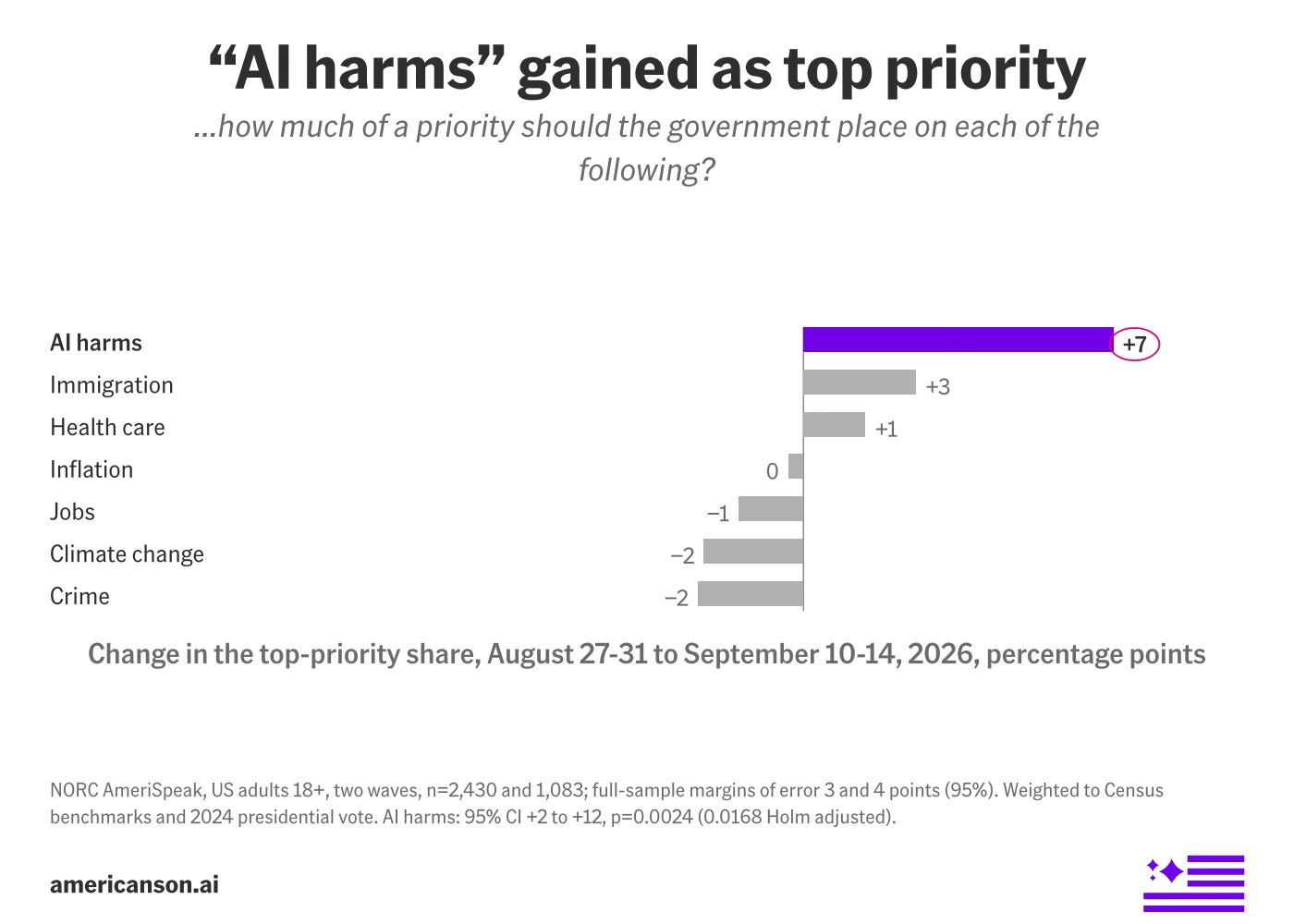
1/ More Americans than ever are prioritizing AI harms
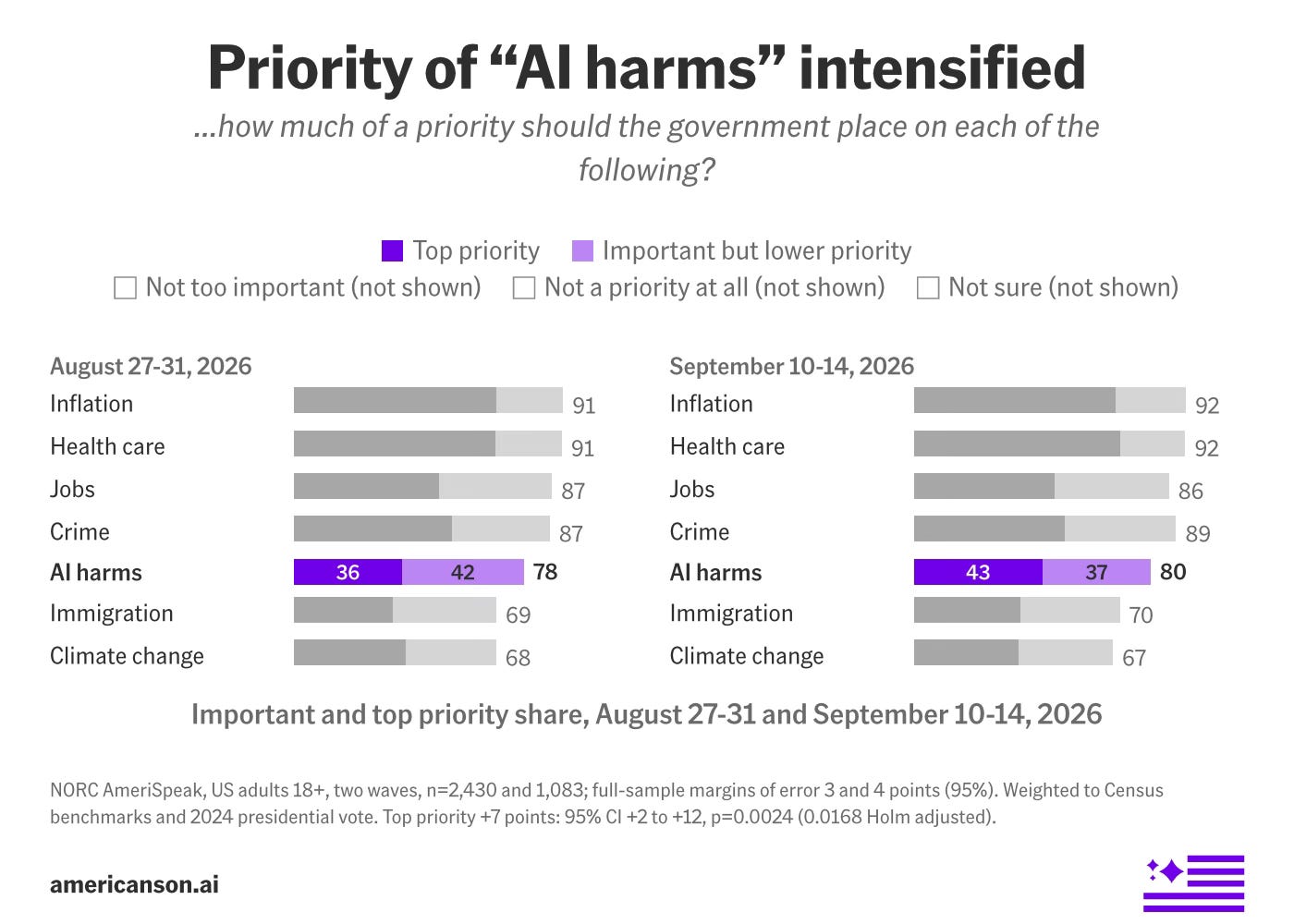
Compared to our survey just two weeks earlier, there was a significant jump in the number of Americans saying “AI harms” should be a top priority for government: AI harms as a top priority increased from 36% to 43% (+7 points). Overall, 80% of Americans now say “AI harms” should be a priority (top or important) for the government.
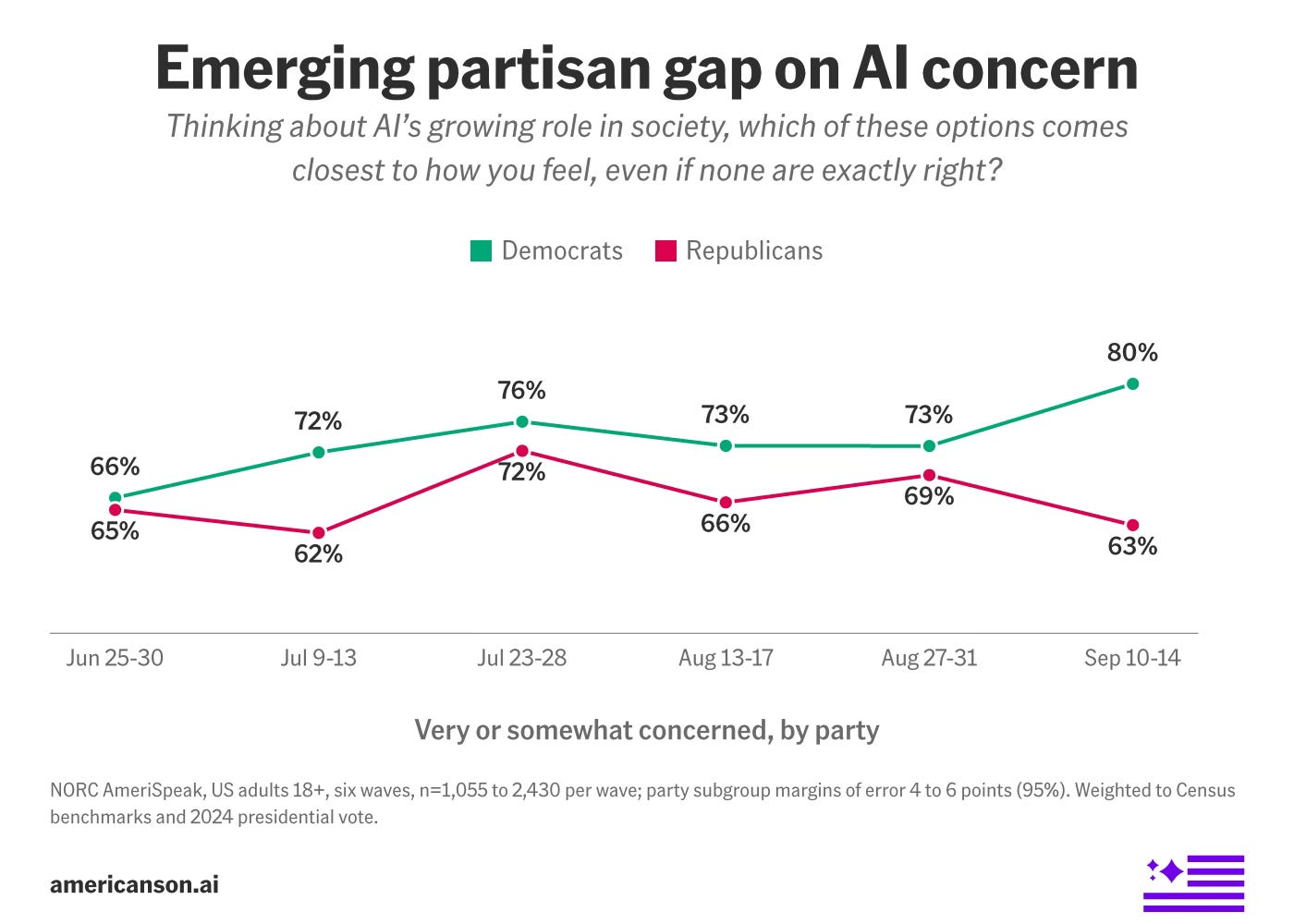
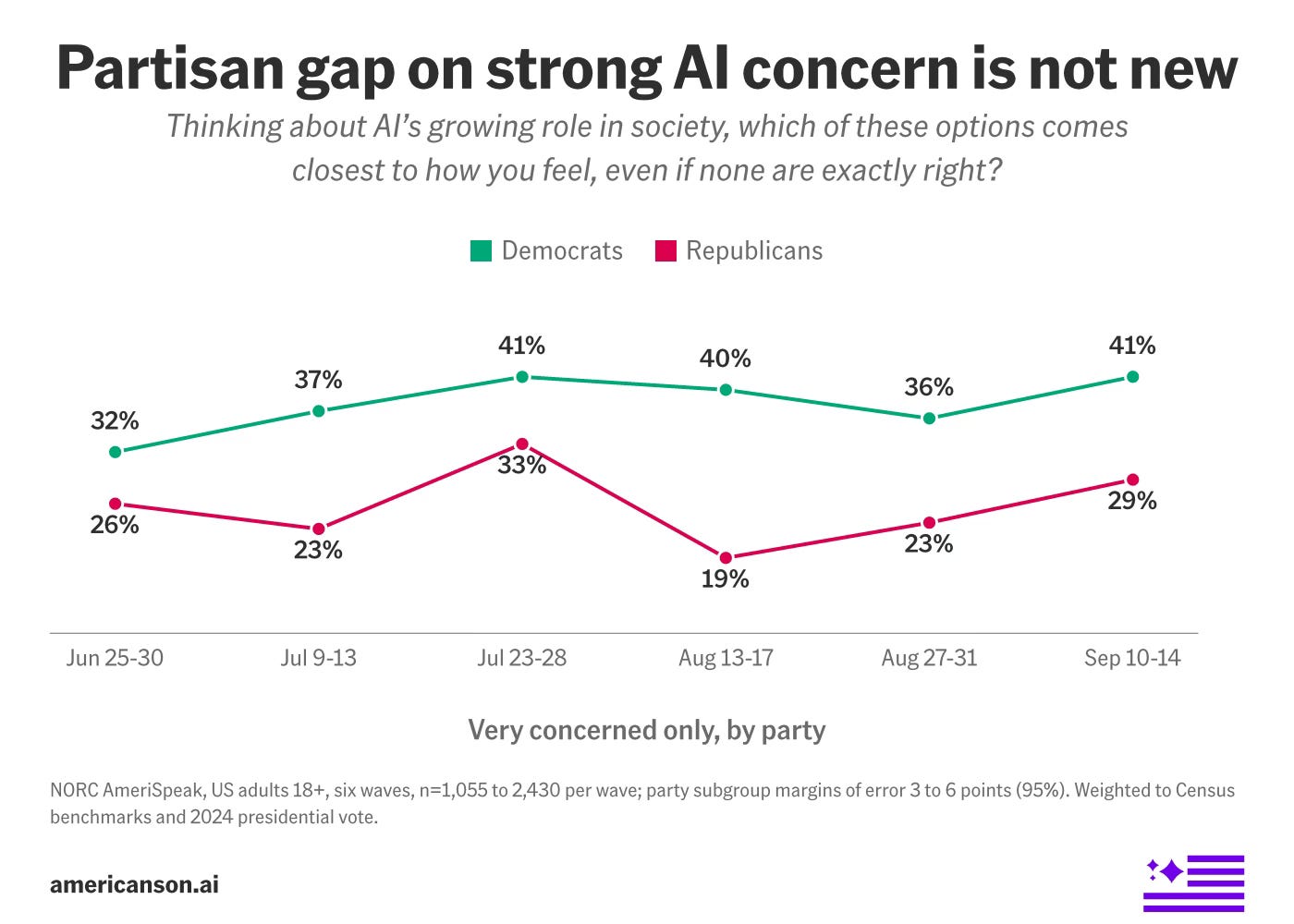
2/ There’s an emerging partisan gap in concern about AI, though a gap is not new among “very concerned” Americans
For the first time since June, there’s a significant partisan gap in concern about AI, with 80% of Democrats saying they’re concerned and 63% of Republicans. The gap is driven largely by Democrats becoming more concerned, while Republicans’ concern remains high (63%) and relatively unchanged.
However, among those saying they’re “very concerned” about AI, Democrats have long reported higher levels of concern than Republicans. Some part of this gap may stem from trust in government and could reverse if there were a change in control of government.
A few observations that our team has been discussing the past few days:
Given that now 8-in-10 Americans believe AI harms should be a top or important government priority, an increasing number of politicians, activists, and industry groups are likely to be wading into this issue. It’s difficult to predict the net effect of this, but the future of the AI policy debate is unlikely to resemble the relatively marginal and technocratic debate of the past several years. (This is a trajectory we have seen in other domains, including climate change and social media.)
It seems like concern among Republicans shifted more after the Hugging Face hack than after the Jacob Coxon tweet. To the extent that’s a real effect, we’re wondering: how much of it is due to the nature of the news (disclosure of a concrete event vs. warnings from a specific messenger) and how much is due to the Trump administration visibly dismissing concerns about AI?
Additionally, on messengers, we discussed in our last newsletter how elites have differing views on AI and AI harms than the rest of America. We have interpreted that as a bellwether for potential partisan polarization, which we’ve seen further signs of in our most recent survey. We’re wondering who the broad majority of Americans trust on AI issues, and what they are hearing from them. That’s been a topic of some of our recent focus groups, and we’ll be publishing more on that later this year.
A few important or overlooked stories from the last two weeks:
Researchers breach OpenAI using Claude. Three researchers disclosed last week that in July they used Anthropic’s Claude to hijack employee ChatGPT and Codex accounts and reach the company’s private GitHub repository. The attack took lest than 72 hours and under $3,000 in model usage. The hack raises concerns about security at frontier AI labs.
Three Senate Republicans push leadership on AI safety. Politico reports that Sens. John Curtis, Josh Hawley, and John Kennedy have each, independently, urged Republican leaders to respond to rising voter concern about AI, warning the issue could affect the midterm and 2028 elections. Curtis and Hawley have partnered with Democrats on legislation; Kennedy’s “kill switch” bill was blocked by Sen. Rand Paul.
Sanders and Bannon featured at “Pro Human” AI event. The Future of Life Institute convened a Sept. 15 assembly featuring Sen. Bernie Sanders, Steve Bannon, Sen Marsha Blackburn, Rep. Greg Casar, labor leaders and faith figures behind a declaration calling for human agency, limits on concentrated power and corporate accountability.