This week writer and editor Alexandra Ciufudean takes us on a tour of the underrated, imaginative, and inspiring indie web. Let’s get right to it!
–Josh Kramer, Head of Editorial, New_ Public
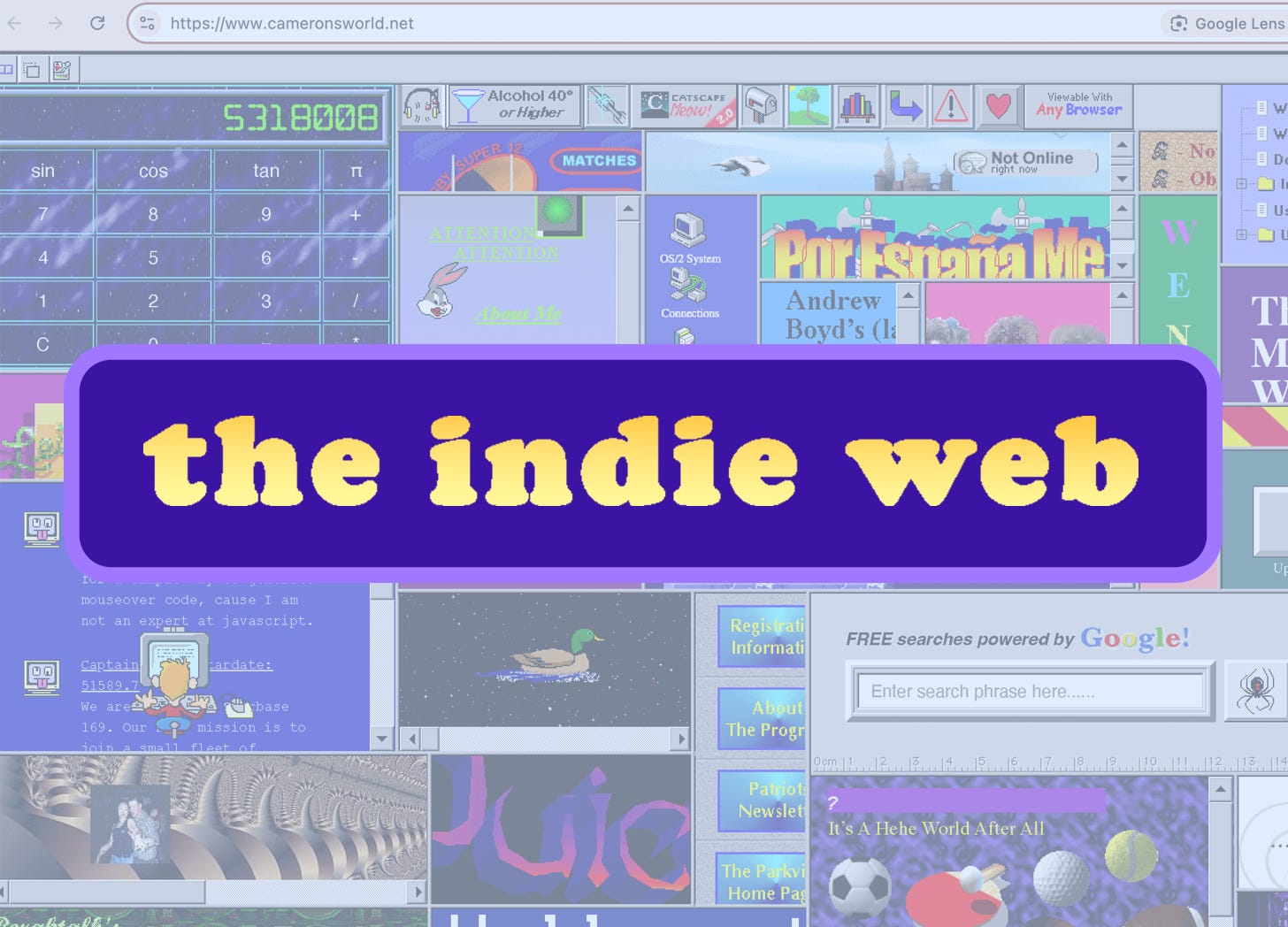
Have you ever wished there were more to the internet than the same handful of apps and sites you toggle between every day? Then you’re in for a treat.
Welcome to the indie web, a vibrant and underrated part of the internet, aesthetically evocative of the late 1990s and early 2000s. Here, the focus is on personal websites, authentic self-expression, and slow, intentional exploration driven by curiosity and interest.
These kinds of sites took a backseat to the mainstream web around the advent of big social media platforms, but recently the indie web has been experiencing a revival, as more netizens look for connection outside the walled gardens created by tech giants. And with renewed interest comes a new generation of website owner-operators, intent on reclaiming their online experience from mainstream social media imperatives of growth and profit.
To learn more about all this, I interviewed nearly a dozen website owners about the part of the internet they proudly call home, whether an indie web revival is imminent, and where they recommend you start exploring.
The indie web, the small web, the web revival, personal web, and wild web are all often used interchangeably to refer to the same digital movement — I’ll be using several of them in this article. Some terms are more descriptive, like “small web”, which includes the 1mb cafe — a list of ultralight, performance-oriented sites — along with other, less techy passion projects. Meanwhile others, like “personal web”, often point more to sites that are like public digital diaries.
They mostly refer to the same overarching concept: websites coded from scratch by their owners, about personal or niche topics and projects, best enjoyed by exploring from link to link. Many site owners compare this to gardening in your own back yard.
Maxwell Forbes is a developer whose fun, nerdy projects include a conversation-driven puzzle game and a historically-informed weather app. “You have so much control over the look and feel,” developer Forbes told me. “You can create a unique vibe that’s instantly felt and totally different from a platform’s. This space and atmosphere can be crafted to be uniquely ‘you.’”
This is a theme across the indie web. The kinds of posts and projects you’ll find are creative, personal, experimental, and sometimes so intimate you feel like you’re intruding. However, they’re not the kind of content that usually goes viral on TikTok. That’s beside the point. The focus isn’t on personal branding, growth or monetization, or “content” creation, but on freedom from those things. Instead of polished, 10-second snippets optimized for mass-appeal, engagement, and profit, these are largely slow-cooked projects made just for fun.
Creating websites can be a political act, too. Some users relish the ability to express themselves and communicate online without corporate platforms as a middleman, in the spirit of the early internet. For others, it’s a form of digital folk art.
“[The web revival] is a riff on the 20th century American folk music revival, and it implies that early personal sites, like those hosted on GeoCities, were culturally significant as digital folk art,” Daniel Murray, who runs Melonking, told me. Melonking is part digital ethnographic project, part personal site evoking the look and feel of Web1.0.
Aesthetically, the indie web definitely leans toward the chaotic late 1990s-early 2000s, with homespun code, animations, gifs, bright colors, and funky cursors. However, contemporary web design is no longer limited by the same technical constraints that originally inspired these choices. Such punchy color palettes are nearly obsolete on the mainstream web, replaced by what Kicks Condor calls “white and grey with a little blue.”
But I believe this is part of a broader, nostalgic design trend, related to a resurgence of early-2000s aesthetic in pop culture, which nowadays is inseparable from online culture. Some small web creators came of age during the Web1.0 era and love the look.
For example, Murray says this is why Melonking.net looks the way it does: “I wanted to code it badly and I wanted it to be crammed with low quality images. I wanted it to be unexplained and inaccessible because the world desperately wants to explain and define everything, and you must not let it!”
To the artists, developers, designers, and other users who populate the indie web, this aesthetic is synonymous with freedom of expression. Xanthe Tynehorne, the pseudonymous owner of Satyrs’ Forest, a site that pays visual tribute to late-1990s web design, contrasted this with social media platforms: “It’s nice to tend to a single spot over time, slowly, surely building it up into a cosy little expression of yourself — one that’s probably more representative than just firing off every random thought into the abyss every few minutes.”
Against a backdrop of accelerating enshittification and living chronically online — especially since the COVID pandemic — there’s growing interest in the slower, more intentional and connected experience the indie web promises. Don’t get me wrong, it’s still very far from becoming mainstream (and if it ever did, it wouldn’t be small or indie anymore). But I’ve noticed an uptick in content across platforms like YouTube and TikTok gently signposting users in this direction.
There are videos about how and why you should create your own digital garden (a form of microblogging similar to keeping a commonplace book) and recently, alternatives to big social media have grown in popularity. There is for example, Sublime and Are.na, which are kind of like indie Pinterest for ideas. I think this is more than early-2000s nostalgia.
In different corners of the mainstream internet, younger users are talking about reclaiming their attention spans, trading in their smartphones, writing essays for fun, journaling, discovering long reads, reading fiction, and picking up hobbies like crocheting or scrapbooking. Some influential YouTubers, like Hank Green, compare it to consuming a healthy and diverse media diet vs. the cognitive equivalent of junk food.
While none of the site owners I interviewed were confident that the indie web resurgence is actually a thing, nearly all of them said they wanted it to grow and reach more people.
Developers Barry Hess and Shawn Liu co-founded Good Enough, an independent platform that builds small-scale projects. Hess told me: “I would love my mom to have a blog. And my sisters. And my dad. And my brother. And my kids.” He also added: “Of course, if there is momentum building, the money will follow and inevitably the software will be corrupted to some degree.”
Despite the indie web’s inclusivity and celebration of marginalized identities, participation does have a bit of a barrier of entry: you may need to learn some HTML basics. It’s not an absolute requirement and nowadays there are sites that make it a lot easier, like Neocities. Hess and Liu from Good Enough have a new project called Pika, which is a microblogging site builder that can be used without any coding knowledge.
While code-free website builders like Squarespace and Wix are easier to use (I count myself among their fans), their polished, mass-produced templates are mainly intended for businesses or as professional portfolios — the opposite of what the small web stands for.
However, HTML is relatively easy to pick up and the process can be very rewarding, even addictive. AI Large Language Models like Chat GPT can guide you through learning to code, or even write your site for you. However, vibe-coding your own site with generative AI isn’t really in the spirit of the indie web, and you may end up with something you don’t know how to fix or adjust yourself. But if that’s what helps you get started on this journey, it could be worth it.
If you prefer expressing yourself in writing, there are a number of indie microblogging sites you can use, such as Bear Blog and Micro.blog.
Discoverability can be a challenge. Most indie websites are not optimized for search engines, and, due to the way site-ranking algorithms are set up, indie websites might only appear for very specific queries. You might struggle to find, say, Satyrs’ Forest, unless you type it into the search bar.
Hess told me he hopes for the development of new popular and capable discovery tools so more people can easily navigate the small web. “Connecting in this way, human-to-human, is vital to building a future filled with more connection, understanding, and empathy,” he says.
But what seems like a bug can really be a feature of the small web experience: the point is to explore. (See below for the best ways to do that.)
In the greater context of the global internet, the small web will never completely replace big platforms or serve every need, nor should it. Social media is still the main source of news in many parts of the world, offering valuable tools for community-building, commerce, even activism. For their part, most indie web creators are happy to exist outside of the mainstream.
If you’d like to explore the indie web but aren’t sure where to begin, here are a few personal sites, fun projects, and community resources to help guide you.
A few of my favorite personal sites include Ava’s Space (where you’ll find an excellent explainer guide to the indie web), Melonking, Cameron’s World (a digital art project dedicated to preserving the aesthetic of the early internet), and ANHVN (a beautifully designed site that reads like a noir comic).
For playful, interactive projects, I recommend Sonnet (I’m the editor of Untested, Sonnet’s blog and newsletter), GReg TeChnoLogY, Corru Observer, EIEIO Games, and Brian Moore’s site.
If you’re looking for community-building and navigation tools, there is an indie web wiki and there are webrings galore — collections of similarly-themed personal websites, all connected in a “ring,” with one site linking to the next and so on. There are also small browsers, search engines, discussion spaces, directories, RSS feeds, and blogrolls, as well as a monthly digital carnival (hosted by a different site every time; a theme is set and different sites are tagged to respond). And for in-person events, there is a camp and the homebrew website club, which happens monthly in a few different locations around the world.
Finally, do check out this year’s Tiny Awards — a celebration of creative, handmade sites and projects from across the web.
If you only want to click on one link then let it be this: The 32-Bit Cafe is an online community of website hobbyists full of site-building resources, discussion spaces, project sharing, and a newsletter, all aimed at supporting and growing the indie web.
Possibly breaking our record for number of links in a newsletter,
–Josh