Update 10.05.2026: Because we have been told now by a few people who don't seem to read the post till the end, that this is not "real “ and just "fake”. We put the important part here: Yes, this dashboard is NOT an official project and lacks attribution. It is most likely just a student's project, a Proof-of-Concept or some "inspirational work”. A doodle on a napkin. It could have been made by anyone. We are just commenting on the context, not the intentions.
For a few years now, big data and the accommodating dashboards are a thing in China. Every student and IT major at least at some point seems to be programming one. Mainly just mock-ups for showcasing, college assignments, hobby projects and prototyping. Popular frameworks like ‘vue’ make it pretty easy to quickly spin up a presentable result.
Afterwards, those projects often just end up forgotten and abandoned on the internet; without authentication, accessible to anyone who searches.
Usually it is just pretty mundane stuff. But sometimes you find little gems that betray where the journey of big data is going in China. Especially if it is in connection with public security issues.
We have written about some examples before but as we keep on finding more while we are looking, this will be a reoccurring topic.
One of the big challenges of China's police and surveillance system has always been to keep track of individuals. In the past (and still today) in person surveillance is used quite often when targeting people of ‘special concern’.
But in the past few years, digital means have been increasingly utilized to gain a more sweeping overview of the population. Alerting authorities to certain social developments, easier identification after mass events like the ‘white paper protests’ or to keep track of special interest groups like foreign journalists, activists or members of ethnic minorities like the Uighur.
Big-data analysis is coming in quite handy and national projects like Xueliang ( ) are providing the necessary sensors and input.
To make all this work for the regional and national security forces, it needs software to present it to them. And here we enter the realm of the data dashboard to visualize it for potential users. Meet 省厅级全息档案系统 (Provincial-level holographic archive system):
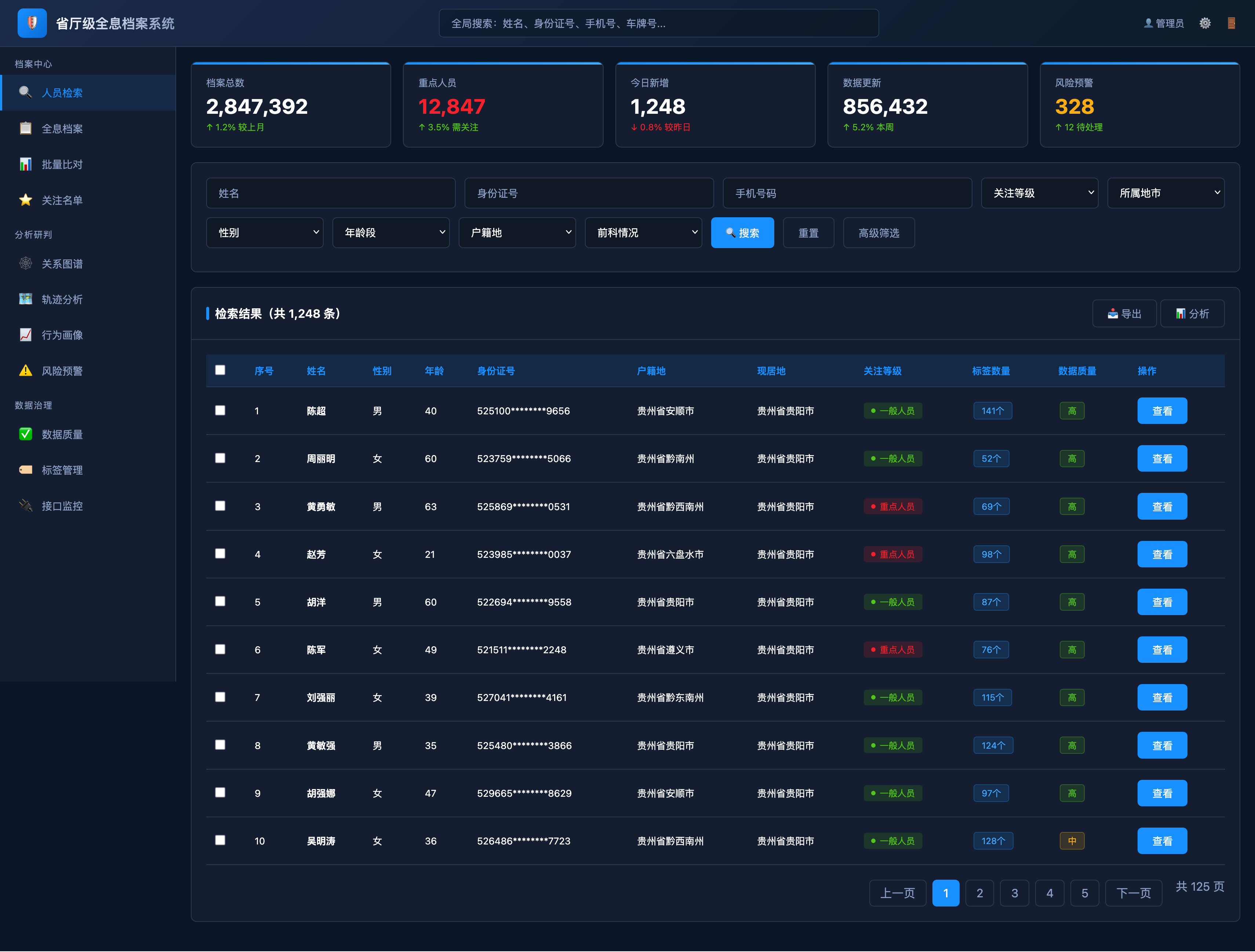
Here we have a vue based data dashboard, using very basic design elements, not relying on any tailor made logos or UI elements. Not sure if the basic nature was deliberate or if it was just what the designer had access to. It is filled with randomly generated data of potential subjects of surveillance and it shows names, phone numbers, locations and special tags:
重点人员 (Key Personnel) –
.tag-red有前科 (Criminal Record) –
.tag-orange涉毒 (Drug-Related) –
.tag-red重点关注 (Key Focus) –
.tag-orange已布控 (Under Surveillance) –
.tag-gray
Or Risk Level:
一般人员 (General Personnel) –
.risk-low关注人员 (Attention Personnel) –
.risk-medium重点人员 (Key Personnel) –
.risk-high高危人员 (High-Risk Personnel) –
.risk-high
It also let's the user inspect a specific profile. In this case ‘Zhang Wei’ (like John Smith). According to the profile and the tags, he is a drug-user, has a criminal record and is under surveillance. Here are a few examples of the dashboard's UI:
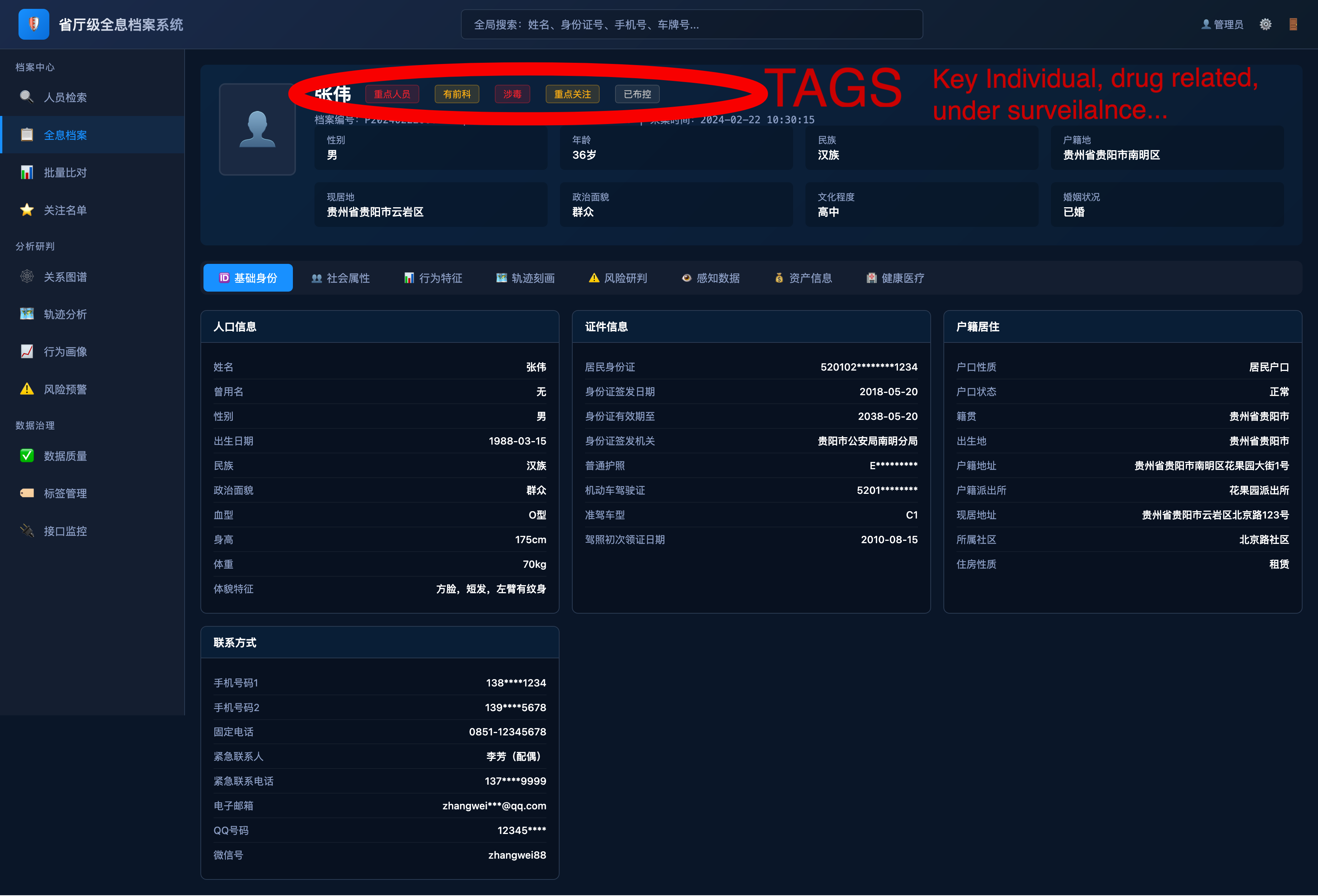
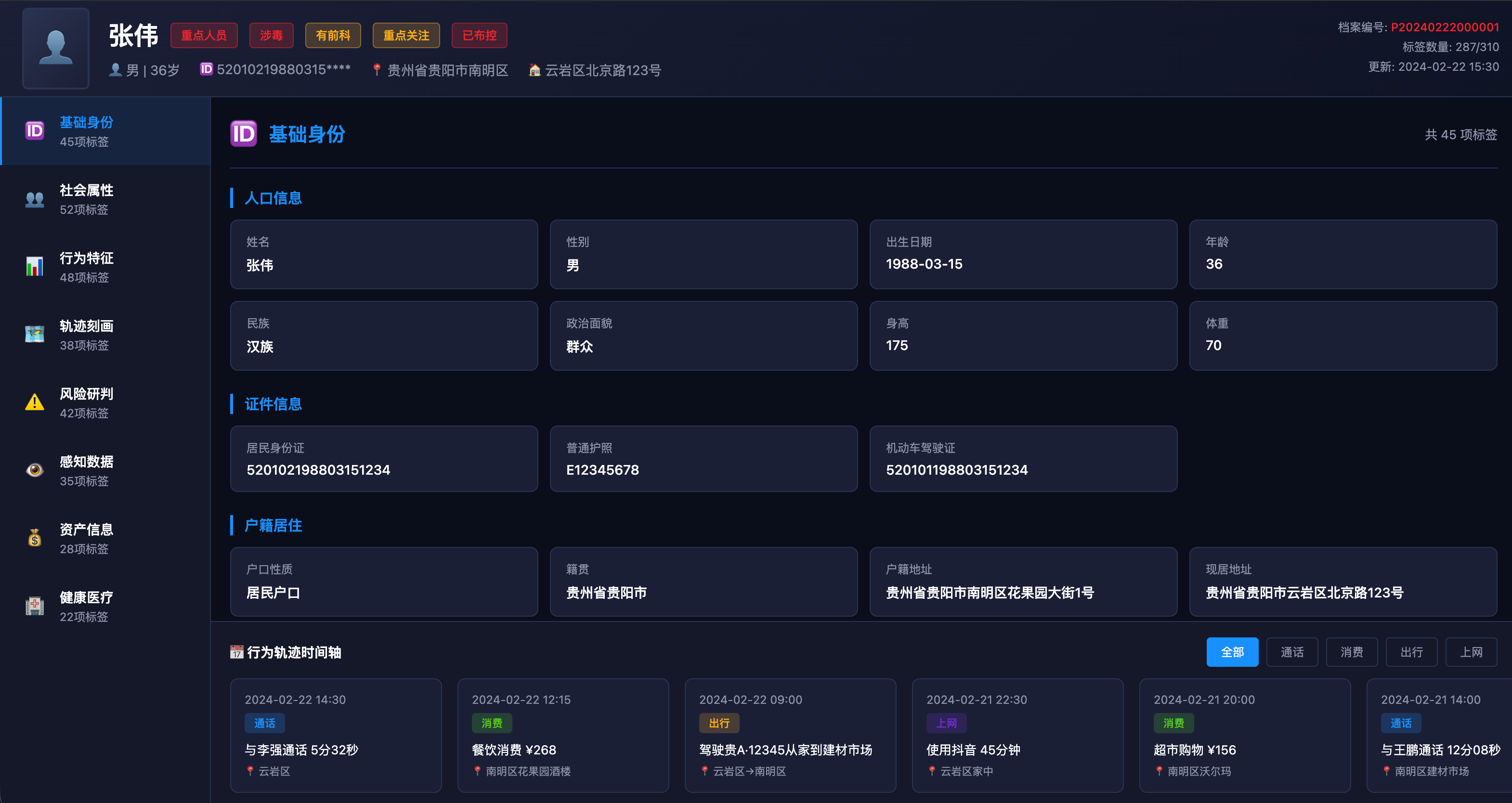
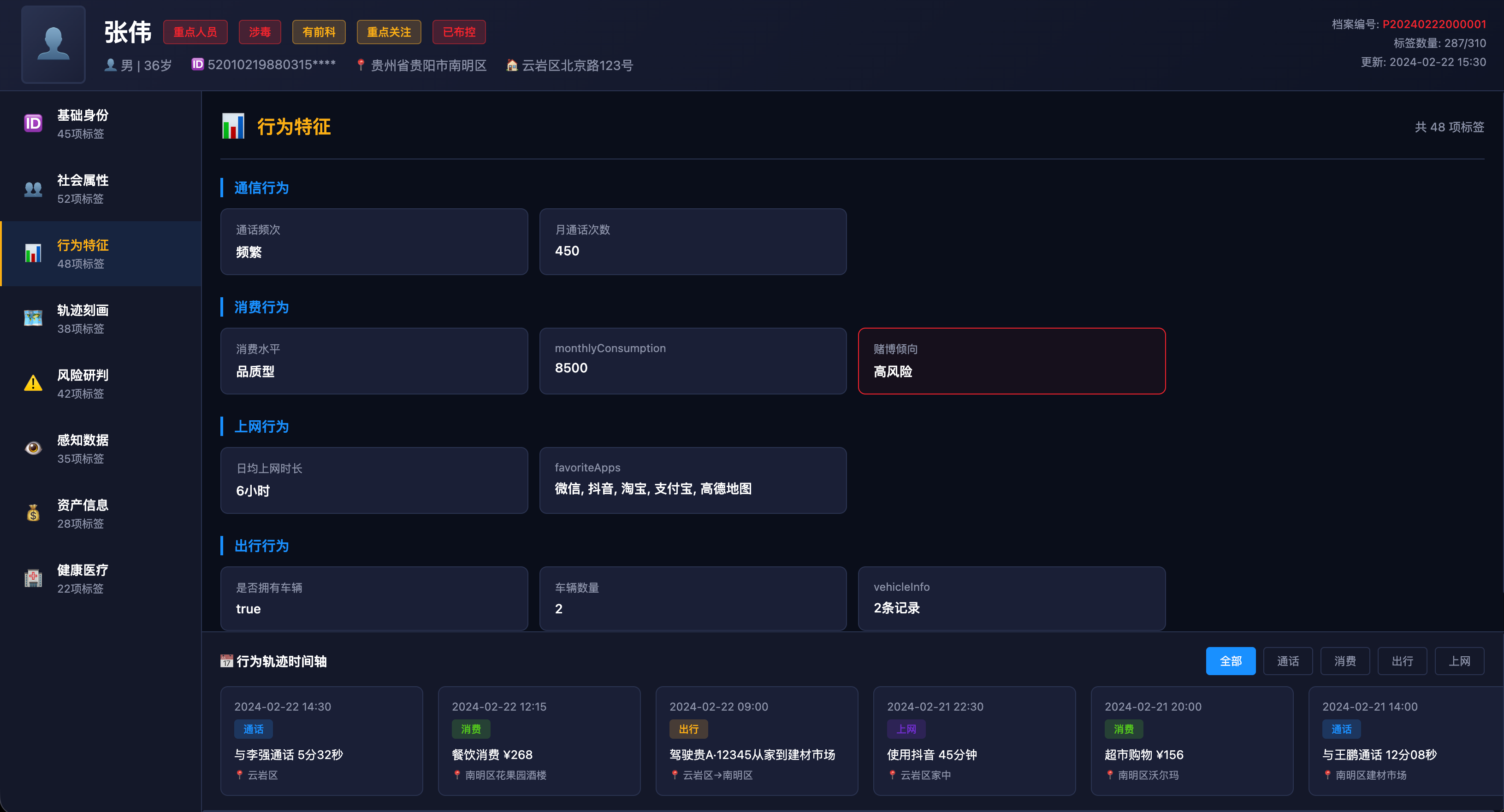
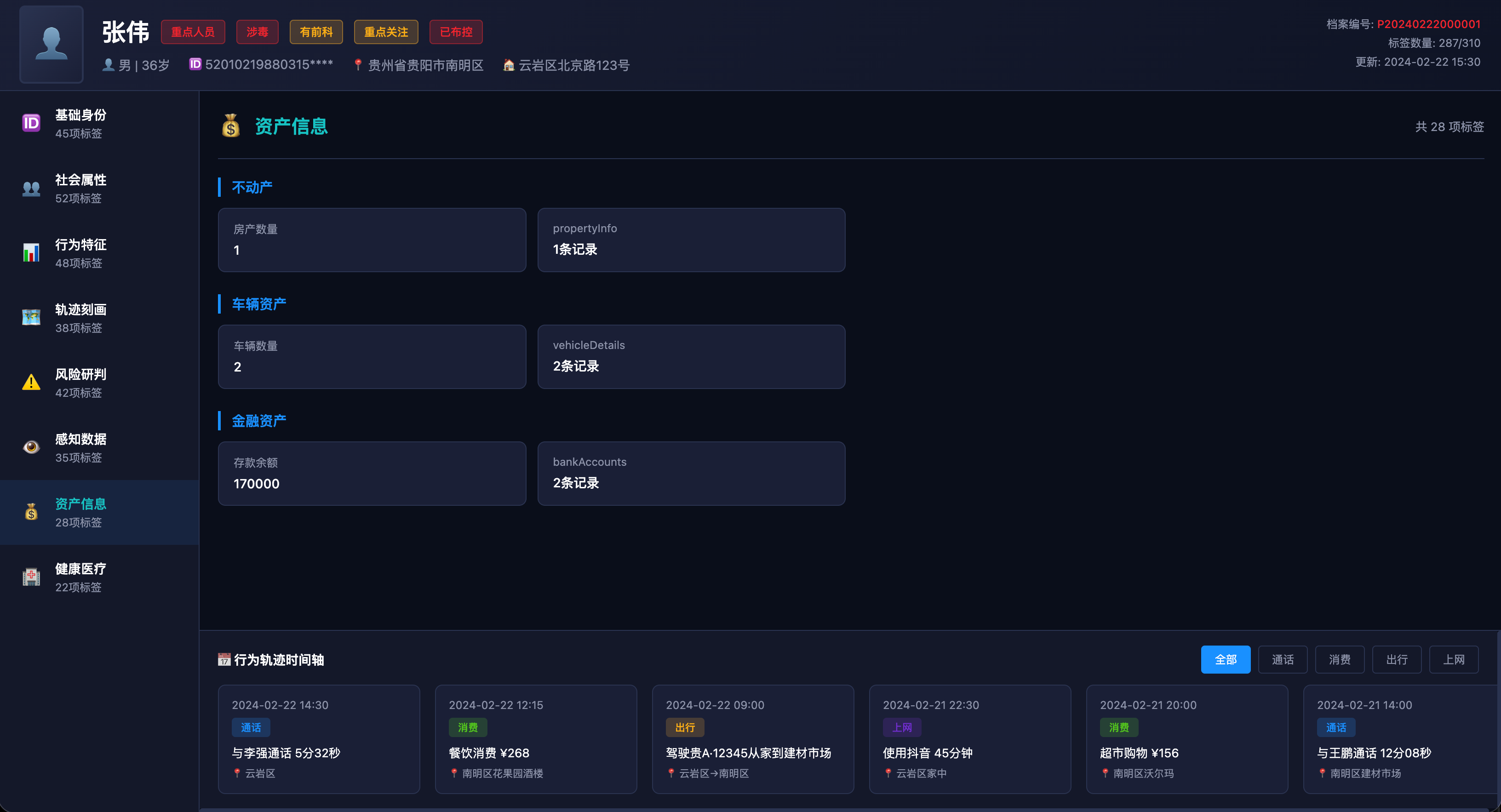
Inspecting the source file that is used to fill this profile, we can see what kind of data the system's designer expects to have access to. And that is where it gets really interesting. The list of information is rather detailed and it reflects the true state of what data gets stored on individuals. For example lets take a section called ‘bio-metrics’:
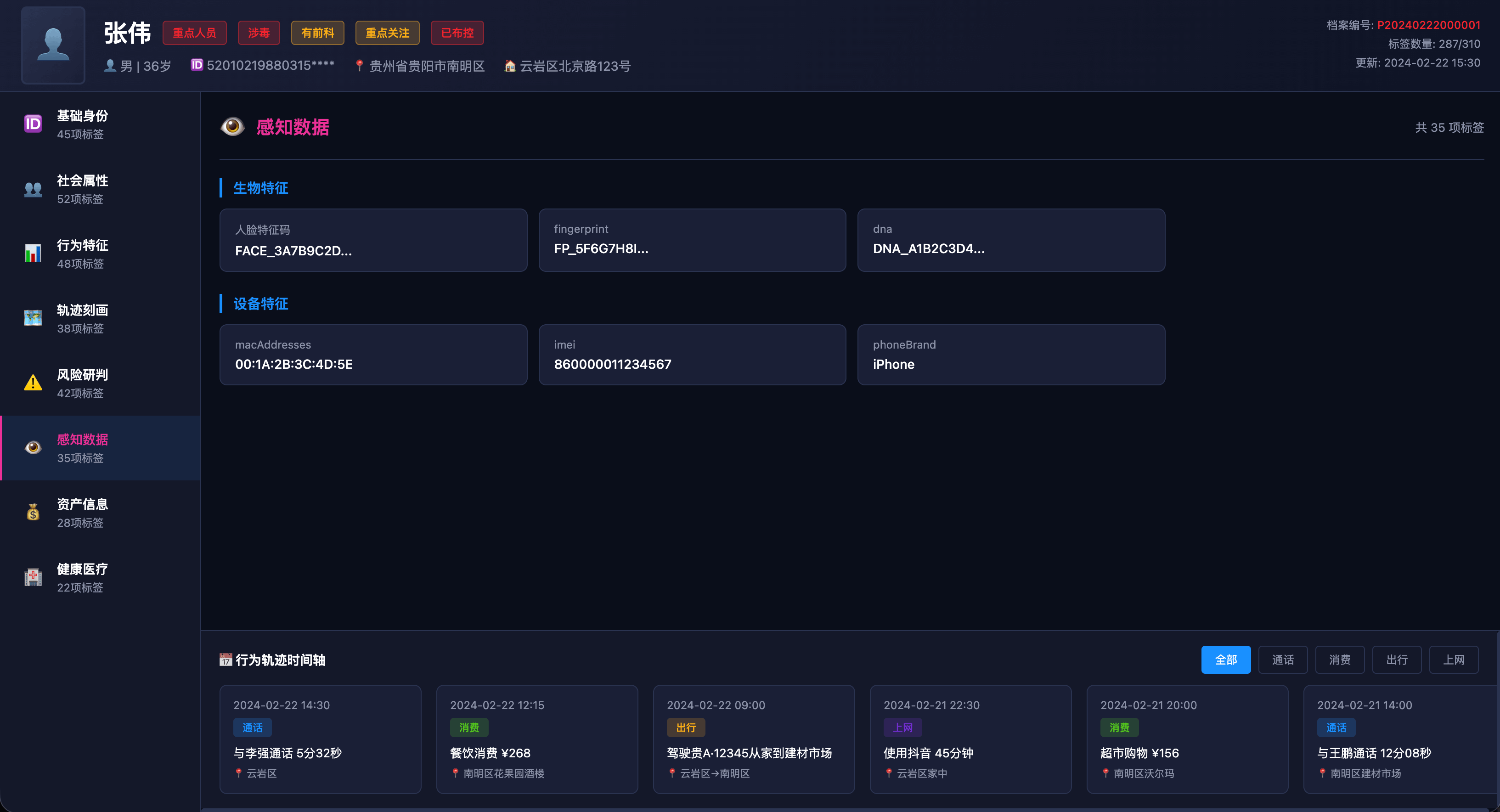
The tool just takes in a very simple Data.js file with all the necessary information, hard coded. No frills but also a clear sign, that it is just a mock up.
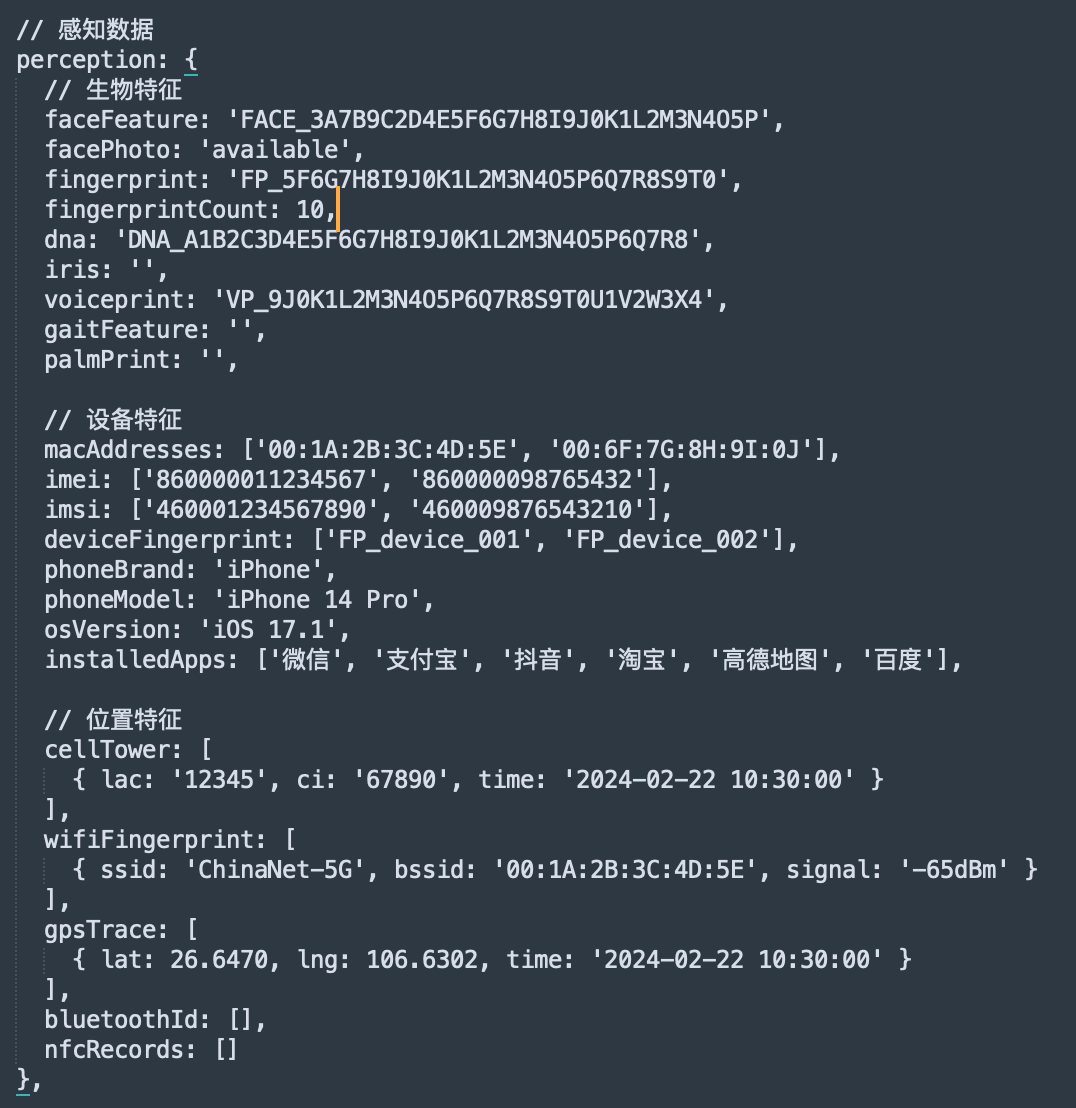
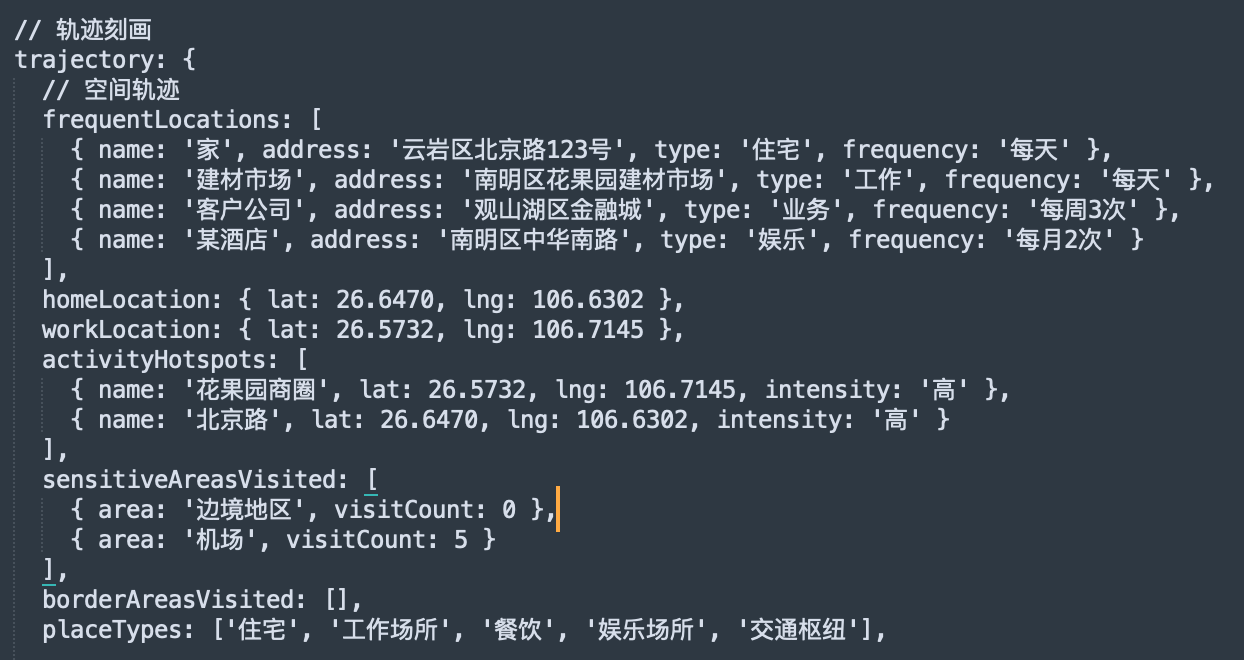
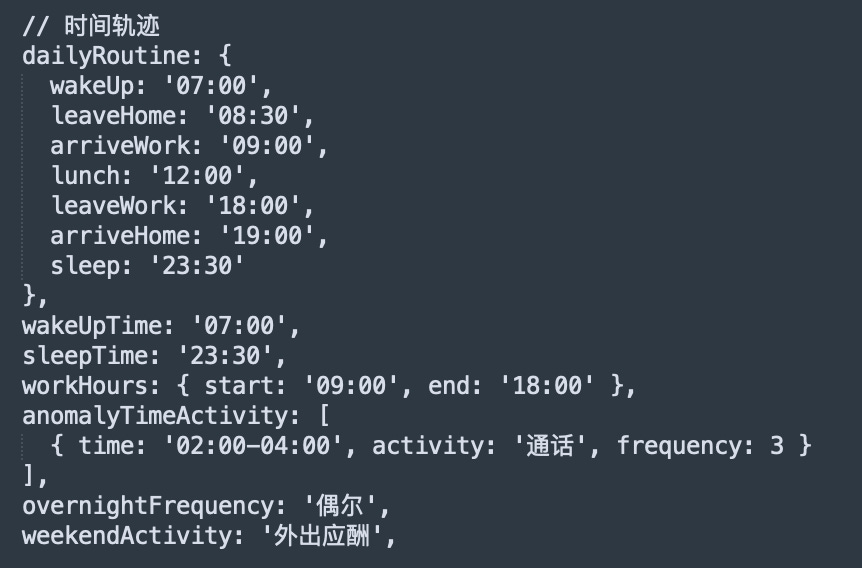
Despite all this data being fake (according to the code), the detail and granularity of the personal data, inclusive a very detailed fingerprint of the targets mobile device, is quite remarkable (GPS data, carrier information etc.).
// 行为特征
behavior: {
// 通信行为
callFrequency: ‘频繁’,
callDurationAvg: ‘3.5分钟’,
monthlyCallCount: 450,
monthlyCallDuration: 1575,
contactCount: 186,
frequentContacts: [’李强(建材商)’, ‘王鹏(客户)’, ‘赵明(老乡)’],
nightCallRatio: ‘15%’,
roamingFrequency: ‘偶尔’,
internationalCall: false,
smsFrequency: ‘较少’,
But there is more…
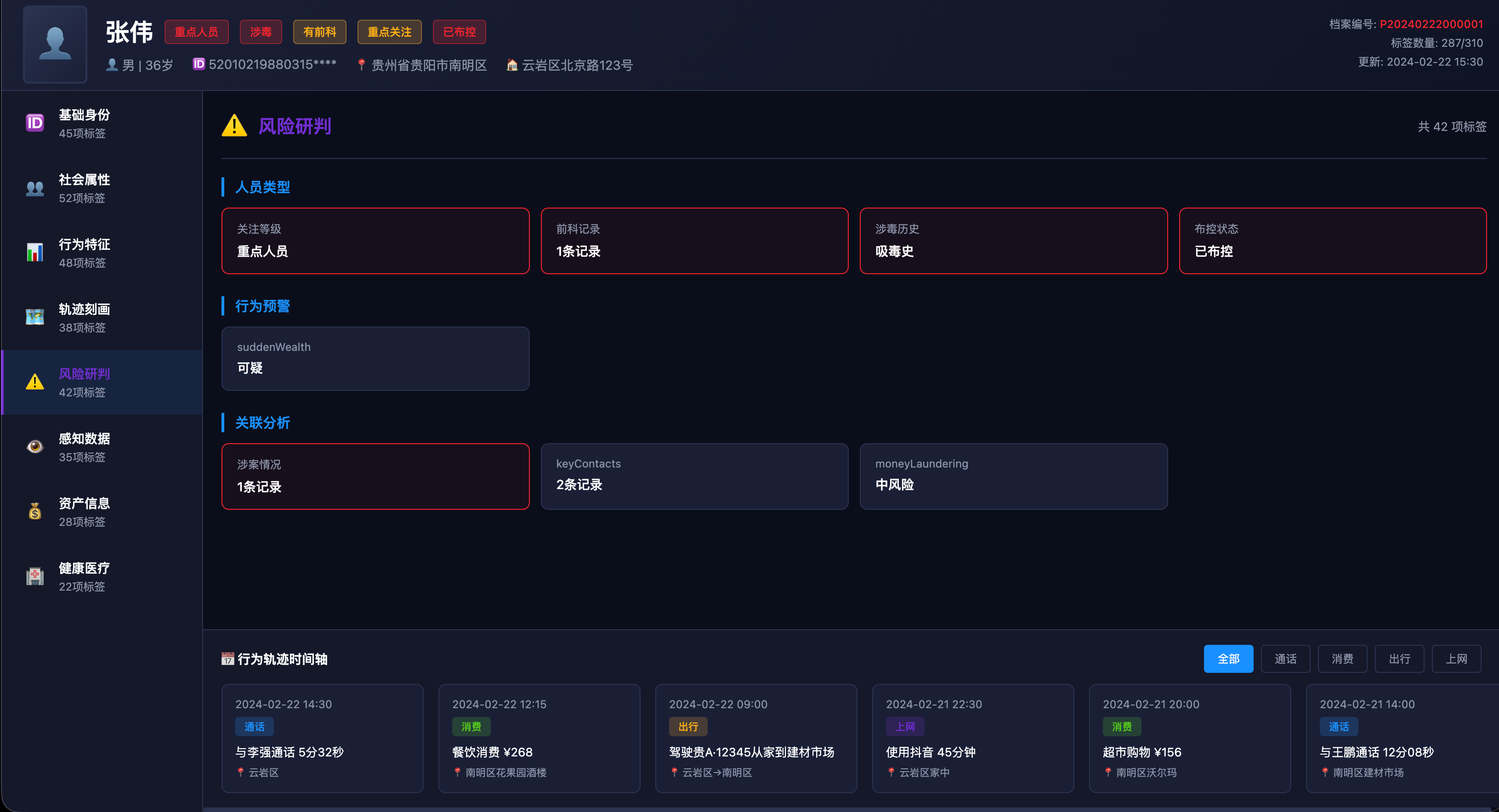
Other tabs show hospital visits, criminal records, travel behavior and persons the target has interacted with the most over a period of time. The ‘collected data points’ are so diverse and detailed that it, even considering what we know about Chinese data collection, seems rather thorough, if not excessive.
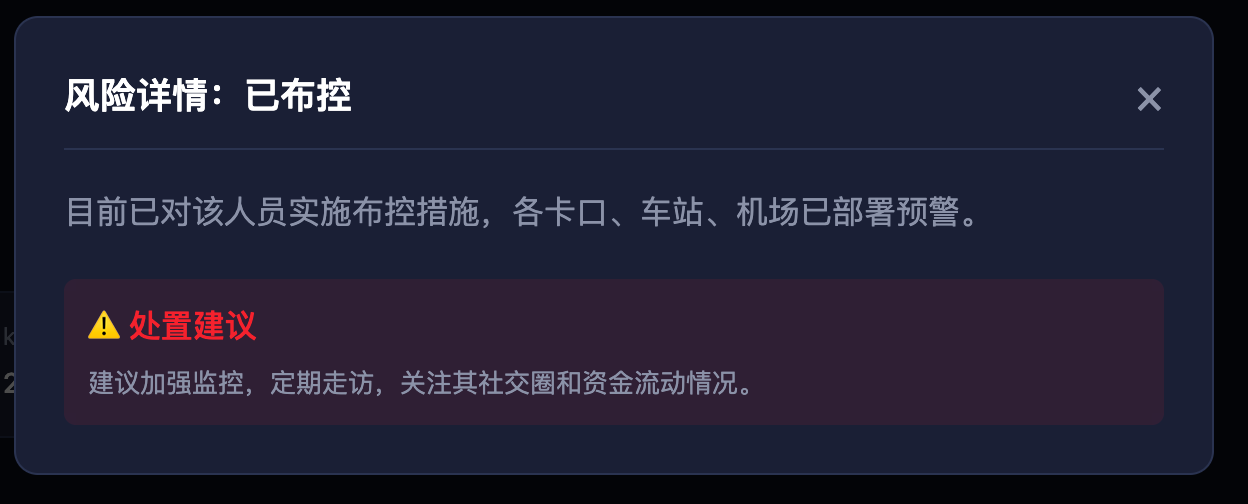
For each ‘tag’ the operator is given a quick summary and potential recommendation how to continue the case of the target.
Returning to the recording of who the targets interacts with ( and how long ) from above, the system is supposed to provide a relationship model between the target and other persons he/she interacts with. Building over time a comprehensive network of suspects/collaborators and further targets.
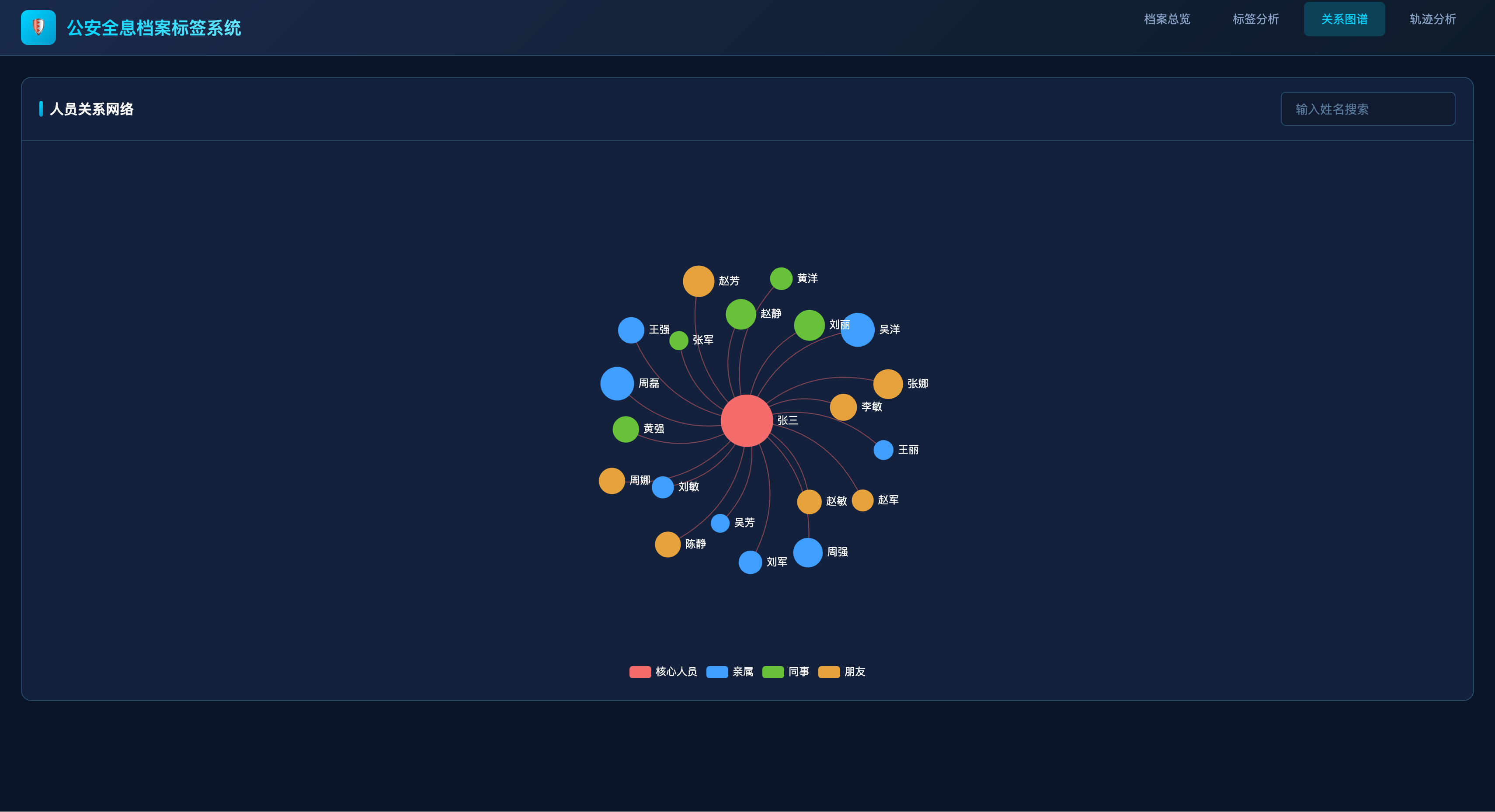
In the spirit of big-data, the design included is more a holistic analysis of the data. Though in this case the demonstration seems to be rather lackluster. I guess just having something ‘to show’ was eventually good enough.
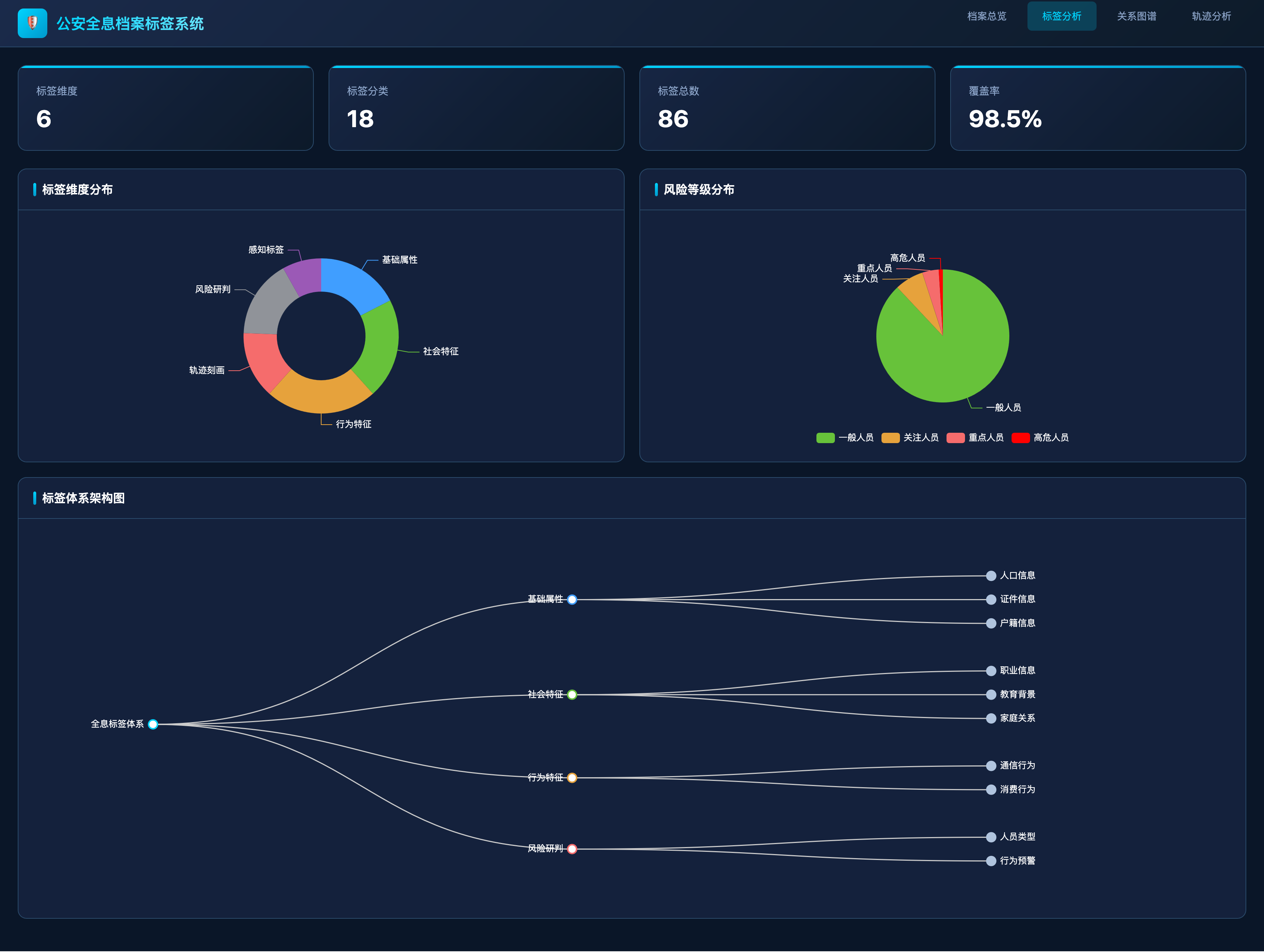
We have several good resources that actually talk about the focus of the Chinese Ministry of Public Security on creating this complex and sweeping relationship models for its population. As technology enables the ability to use more and more ‘sensors’ to pick and feed data points of citizens into mass storage and analysis systems, often enhanced with AI now, security institutions demand better and more complete systems.
In 2019 a patent was filed with the number CN201911033306, by Hisense Transtech, that presented a more powerful way to establish “holistic relationship models for people involved in cases”.
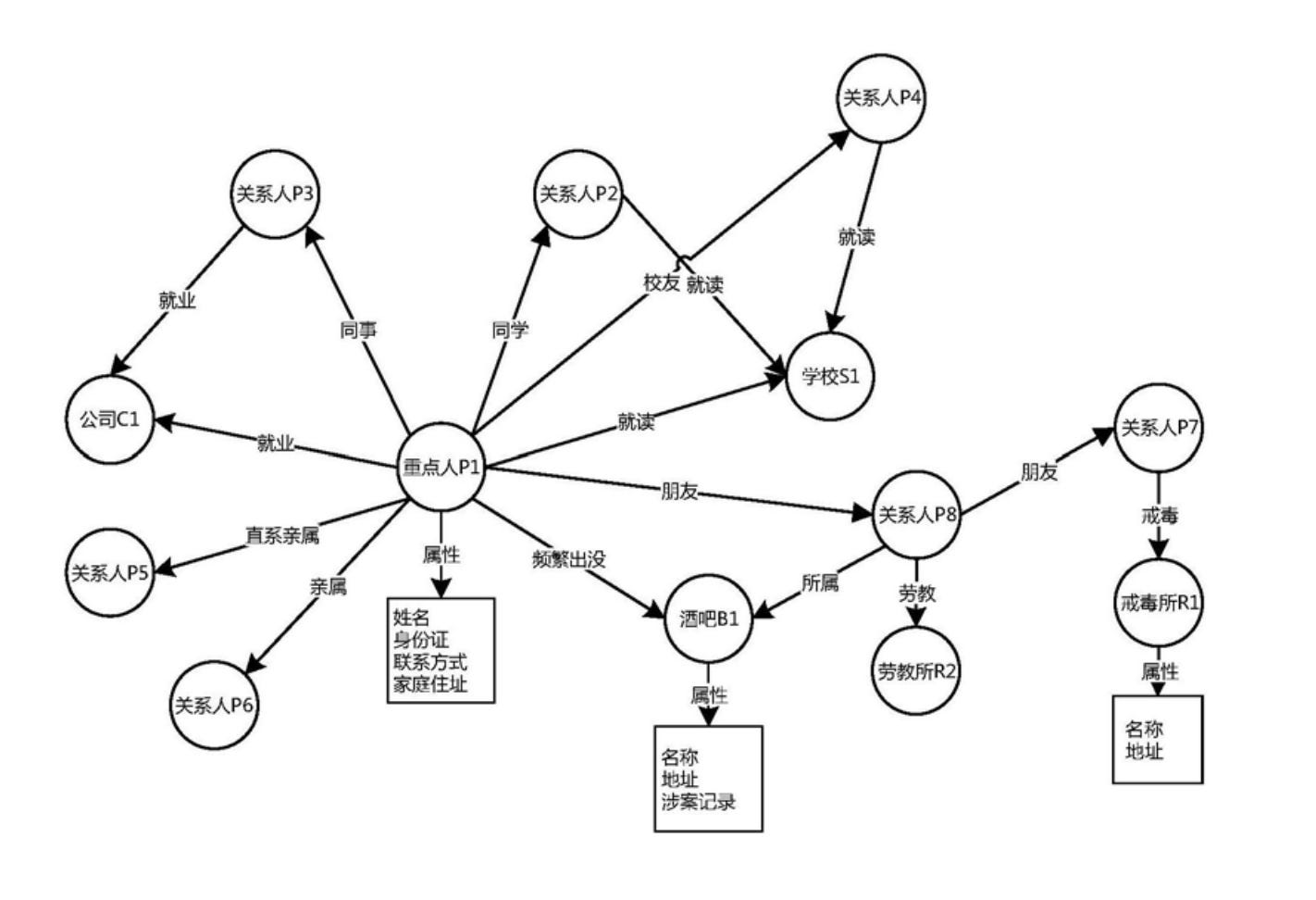
The patent tried to solve the problem of keeping a model updated despite high mobility or lack of oversight on a target by using more real time data, combining a wide range of data sources to complex knowledge graphs. This new system employs advanced reasoning techniques to analyze relationships such as: co-residence and co-travel with companions, social (media) connections, criminal case involvement, call records, and vehicle usage. This multi-dimensional approach ensures a holistic understanding of key personnel, all elements we are seeing in the dashboard above.
Just in 2025 the Shanghai Putao Public Security Bureau had a tender for such a “Holistic Personnel Archive System”. The project had a value of about 200.000 U$ and was given to Wansi Information Technology.

Wansi is a regular provider on the project-circuit for the Ministry of Public Security.
On another port, a ‘scaled down’ version of the dashboard is presented with the name “公安全息档案标签系统 - 预览版” (Public Security Information File Tagging System) - mentioning DEMO (预览版) in the HTML title-tag. That clears things up a little bit more.
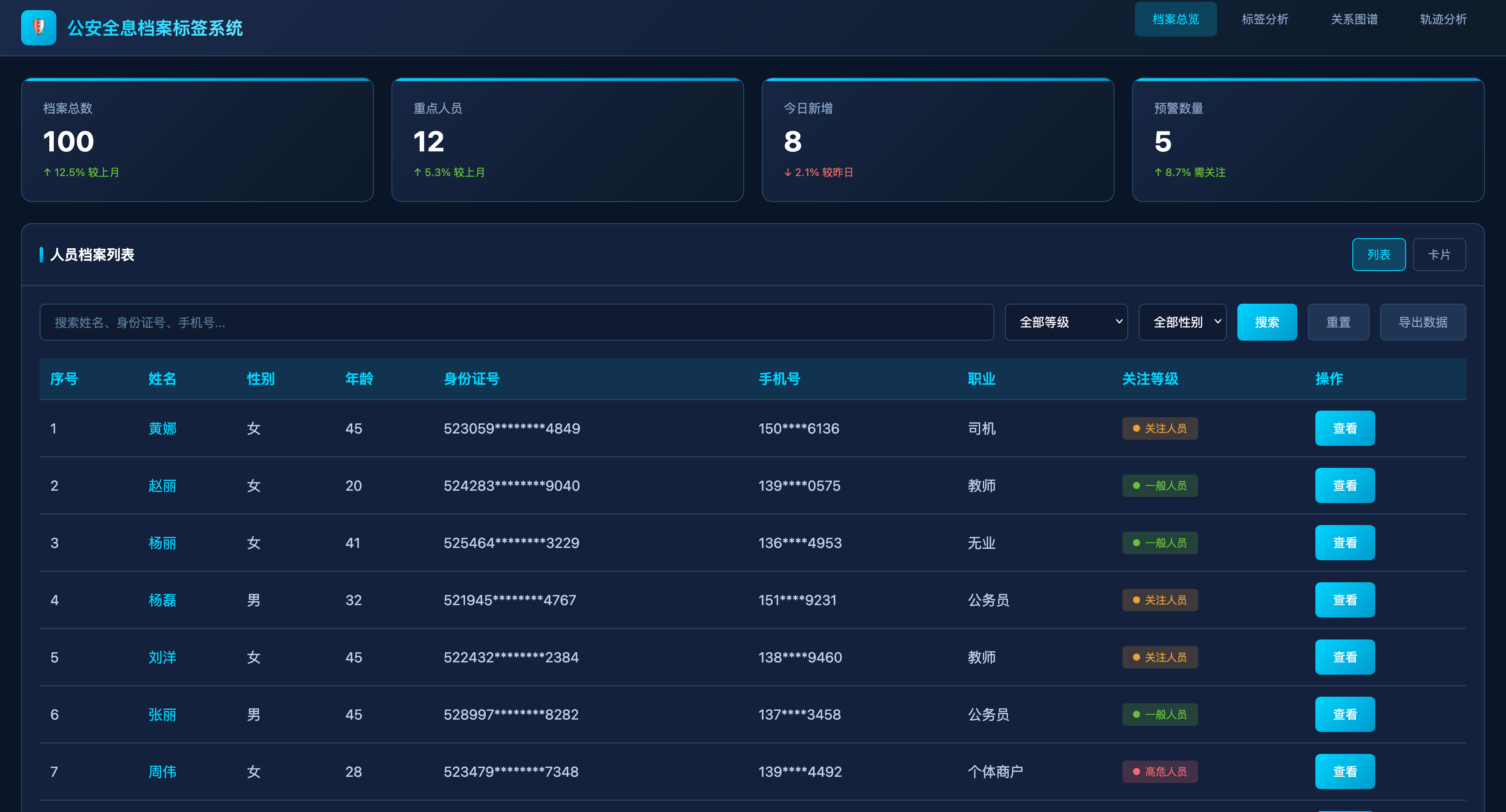
All of this, on paper at least, is a surveillance officer's wet dream. Tons of granular data on a target, at times broken down to the second of a time frame for a certain activity plus comprehensive personal data and relationship modelling. It looks impressive but will also need a tons of sensors to collect all this data, close to real time.
This might be a realistic scenario for some person-specific surveillance, but making it work for a larger group or even the population of an entire city or even province in China, might be a real challenge. Judging by the time stamps in the data, it looks like the dashboard was set up in 2024. Regional it seems to be for the region of Guizhou.
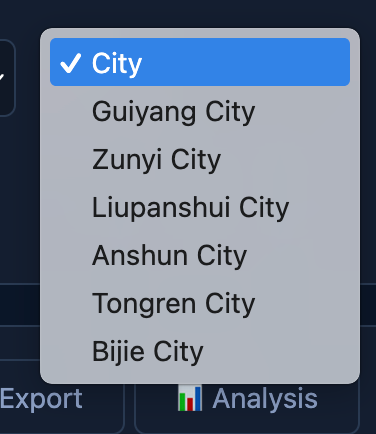
It is very basic HTML and JS code, using SimpleHTTPServer (a python based bare-bones web server framework) as to supply the dashboard. It is really just a quickly set up test with no access authorization, that was eventually forgotten. Like a whiteboard full of brainstorming ideas that at some point never got erased. So, it feels more like a fantasy than a realistic representation. But as the saying goes: aim for the stars…
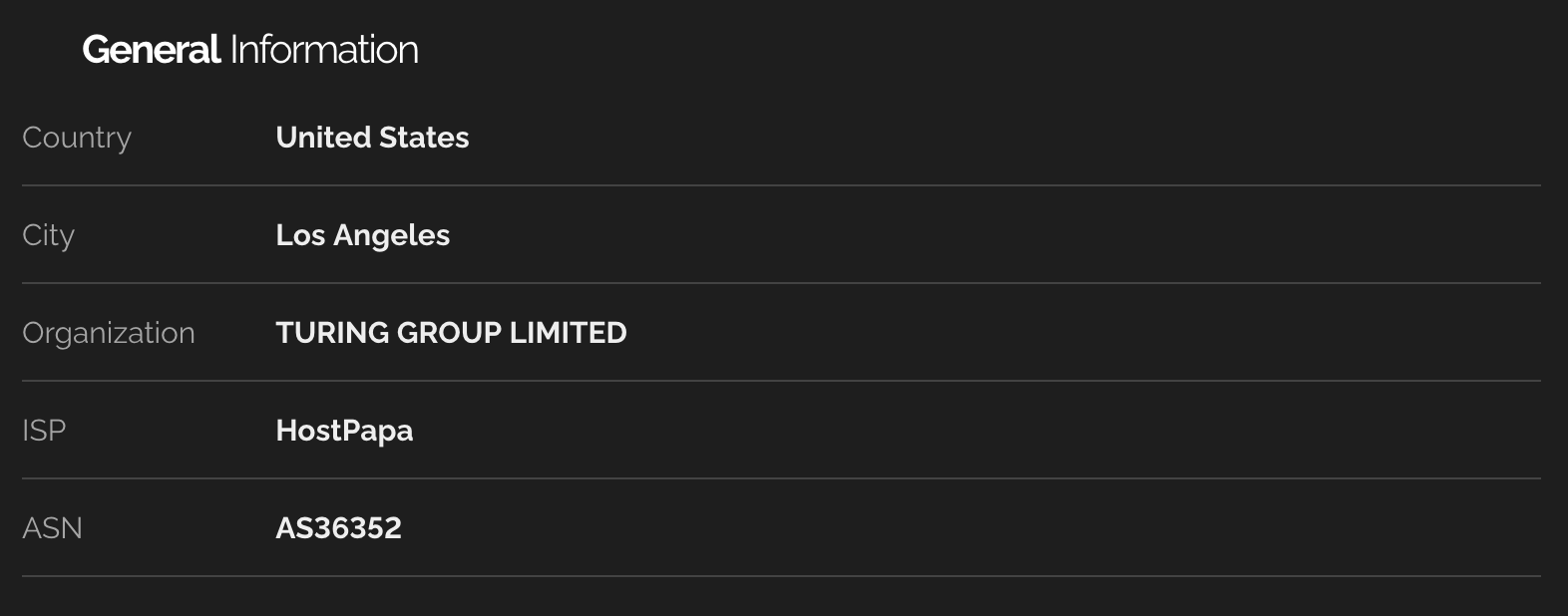
As a little bonus, the server is hosted in the United States. Could this system have been designed by a person based in the US? A Chinese student maybe? Most China based developers would probably rather just rent a VPS on Alibaba Cloud, I would assume. So, setting up such a dashboard on a US based host, even if it is just a mock-up, seems slightly unusual or at least strange.
Now, right off the bat, this thing is not some professional product and its implementation is very basic. More of a case study or a personal project than even a “working prototype”. It is just a doodle on a napkin so to speak. It can be anything, from a very motivated student’s homework, to a quickly plugged together basic demo for showcasing to a customer.
What does this whole thing all tell us? Probably not that much without clear attribution.
But we feel it gives us a little glimpse into what a system like this, operated by the Ministry of Public Security, looks like. Smart policing documents, or 智慧警务, have emphasized often that the outlook was to collect as much data on as many targets as possible (also see above the ‘holistic’ topic). Overall, this is just speculation, as there are no clear official or company links to this particular dashboard.
That said, it is always fascinating to go hunting for open dashboards with “Chinese characteristics”. You never know what you're gonna get.