Last week, The Information published its 2026 predictions and predicted that OpenAI will acquire Pinterest. Pinterest stock jumped 3% on the news. While this is still speculative, analyzing the commerce angle here can reveal a lot - both about the challenges ChatGPT is facing and about what agentic commerce might look like. Let's dig in.
Pinterest is basically a visual search app disguised as a social platform. Users create “boards” where they save images (”pins”) - recipes they want to cook, outfits they like, furniture for a room they’re renovating. It combines social elements: you can look at other users’ boards, take inspiration, share yours on a mutual feed, etc. Some pins are presented by verified merchants with links to product pages or checkout (these are “product pins”), and some are just plain images.
The highlight of Pinterest is visual search. Users can upload photos and get results almost instantly. After getting used to LLM response times, Pinterest's visual search feels like the speed of light. That's because it's traditional ML under the hood, not LLMs.
The user data Pinterest has is extremely valuable because Pinterest has strong conversion metrics compared to other social networks. When a user saves a New Balance shoe under their “shoes” board, there’s a good chance it will eventually convert to a purchase.
This journey - user uploads a shoe they like → Pinterest shows lots of shoe pins → user saves them → later comes back and buys - is a powerful funnel. The better Pinterest does this, the stronger the relationship between what users are looking for and the products that will eventually convert. This is an intent → relevant products graph. Pinterest has mastered this flywheel of vibe-searching to purchase. But it’s obviously skewed toward visual items.
On top of this, Pinterest’s primary business is an ad network that presents ads to users while they scroll and browse boards. Key numbers: ~600M MAU (half of them Gen Z), $3B+ in revenues (mostly ads), and ~$18B market cap.
This visual efficiency is really missing with ChatGPT, because it’s not a core LLM capability. If you take a photo of a shoe you like and ask for it, you’ll get a long verbose response (sort of an analysis), and if you’re lucky, you get a link. That’s the deterministic case - not “inspiration” (i.e., “bring me something like this”). The ability to go from intent → product, or from inspiration → intent → product, and completing that funnel, will be very important for ChatGPT commerce aspirations.
Look at this experiment I did - I asked ChatGPT to help me buy this exact shoe:
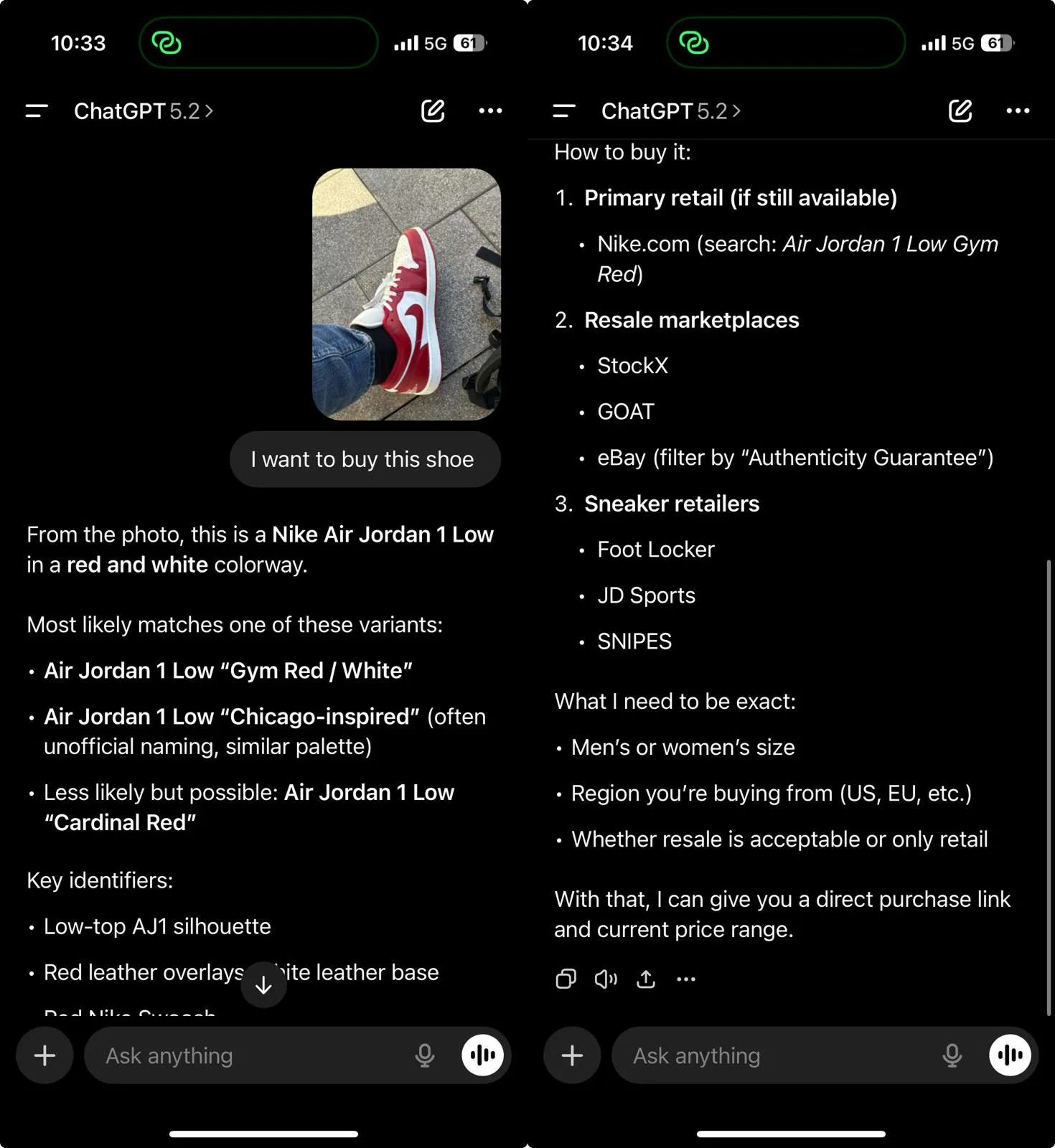
What I got was a very lengthy verbose response with no links. Now I need to burn 2 minutes reading this, then copy-paste the links. In terms of consumer land this is what you would call LOTS of friction. Slow, many-clicks, requires a lot of effort.
Compare that to the Pinterest experience:
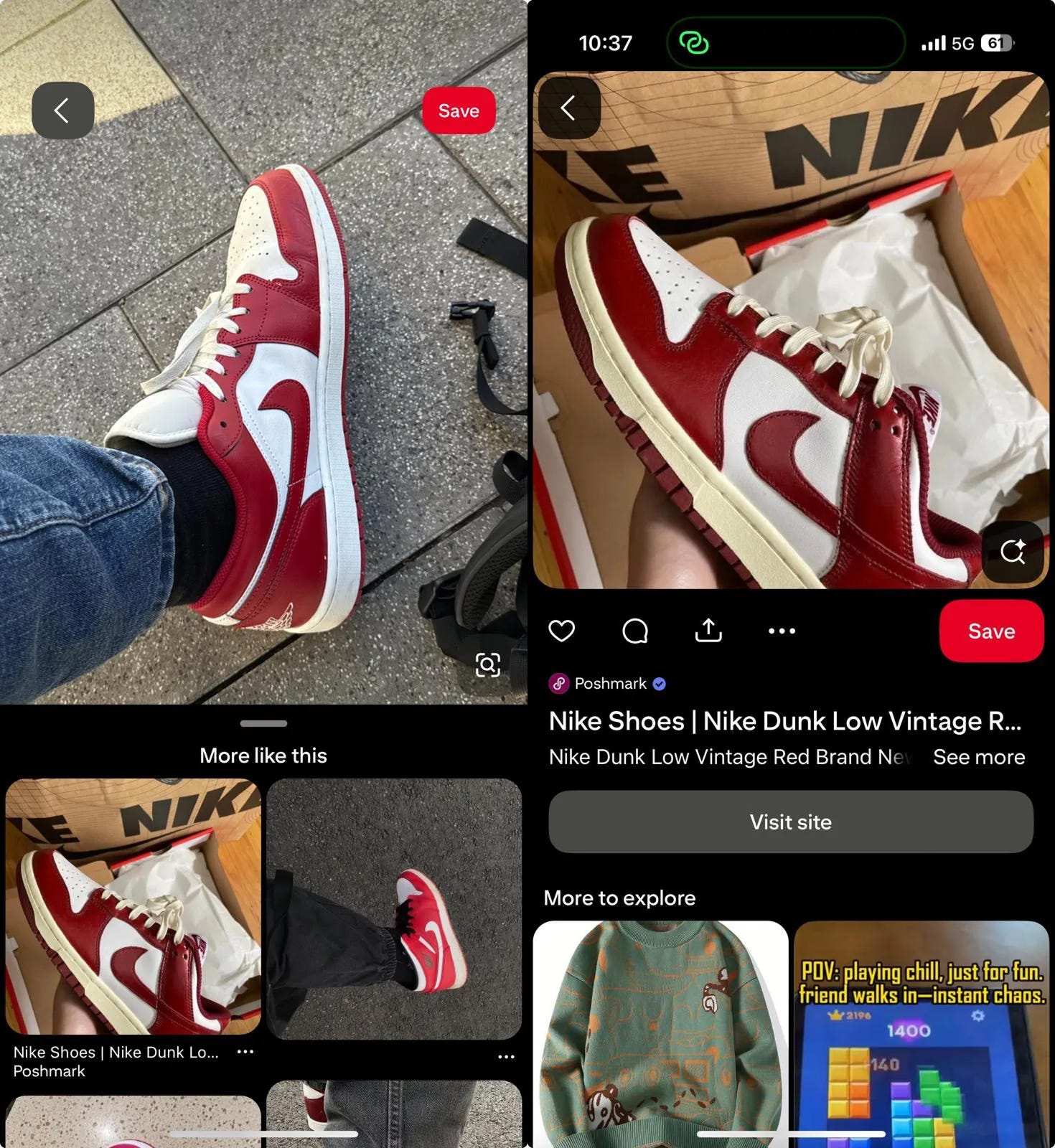
Pinterest was very different:
Much faster (1-2 seconds from query to images in front of me)
Visual results I could scan instantly
To be fair, Pinterest wasn’t perfect either- we expected to find the Nike link at the top since this is such a high-intent search, but it brought up a Poshmark (secondhand) link first. So Pinterest didn’t work perfectly, but it was much, much better than ChatGPT for this use case.
Pinterest has a few highly valuable assets for ChatGPT:
600M monthly users, half Gen Z - high-intent shoppers who spend 2x more and buy 30% larger baskets than other platforms (that’s the conversion premium that Pinterest has and we mentioned earlier).
“Taste graph” that can’t be replicated - a database connecting visual images to related images and products, all with embeddings for ML models. Billions of saves organized by style, visual embeddings for every image, cross-category preference data (”people who like X kitchens also like Y furniture”).
Verified Merchant Program - Pinterest has a merchant program where sellers get verified (the blue checkmark) and upload their catalogs to Pinterest to appear as product pins. While the infrastructure for catalogs isn’t that advanced (closer to Google Shopping feed than Amazon’s advanced seller APIs), it’s a ready out-of-the-box catalog with millions of SKUs plus established merchant relationships.
$3B+ ad revenue with working ads network - that ChatGPT can leverage to shorten their time-to-market with ads.
This visual commerce gap is something OpenAI itself is now prioritizing. Fidji Simo - OpenAI’s CEO of Applications, formerly CEO of Instacart and head of the Facebook app at Meta - recently wrote about the shift from text to more dynamic AI experiences.
“The chat interface wasn’t originally designed for this...creating and editing images is a different kind of task and deserves a space built for visuals...When visuals tell a story better than words alone, ChatGPT should include them.”
OpenAI is also embracing MCP-UI, letting developers build custom visual components directly into ChatGPT. Fidji knows this playbook well - she managed Instacart into profitability and scaled Facebook’s commerce features. The pattern repeats: visual platforms become commerce platforms. Pinterest already completed that journey. The question is whether OpenAI wants to build this capability from scratch or buy it.
If OpenAI acquires Pinterest, there are a few ways this could play out:
Pinterest into ChatGPT - Pinterest becomes a native app or branded experience inside ChatGPT. Existing Pinterest users authenticate and get visual search within the chat interface. The challenge: preserving Pinterest’s smooth UX. If ChatGPT also wants to enable in-app purchases via OpenAI’s Agentic Commerce Protocol (ACP) - the open standard for completing purchases directly in ChatGPT - Pinterest’s merchant infrastructure would need a major overhaul. Its current catalog system isn’t built for ACP’s checkout flows and product feed specs.
We played with Nano Banana to imagine how it could look like:
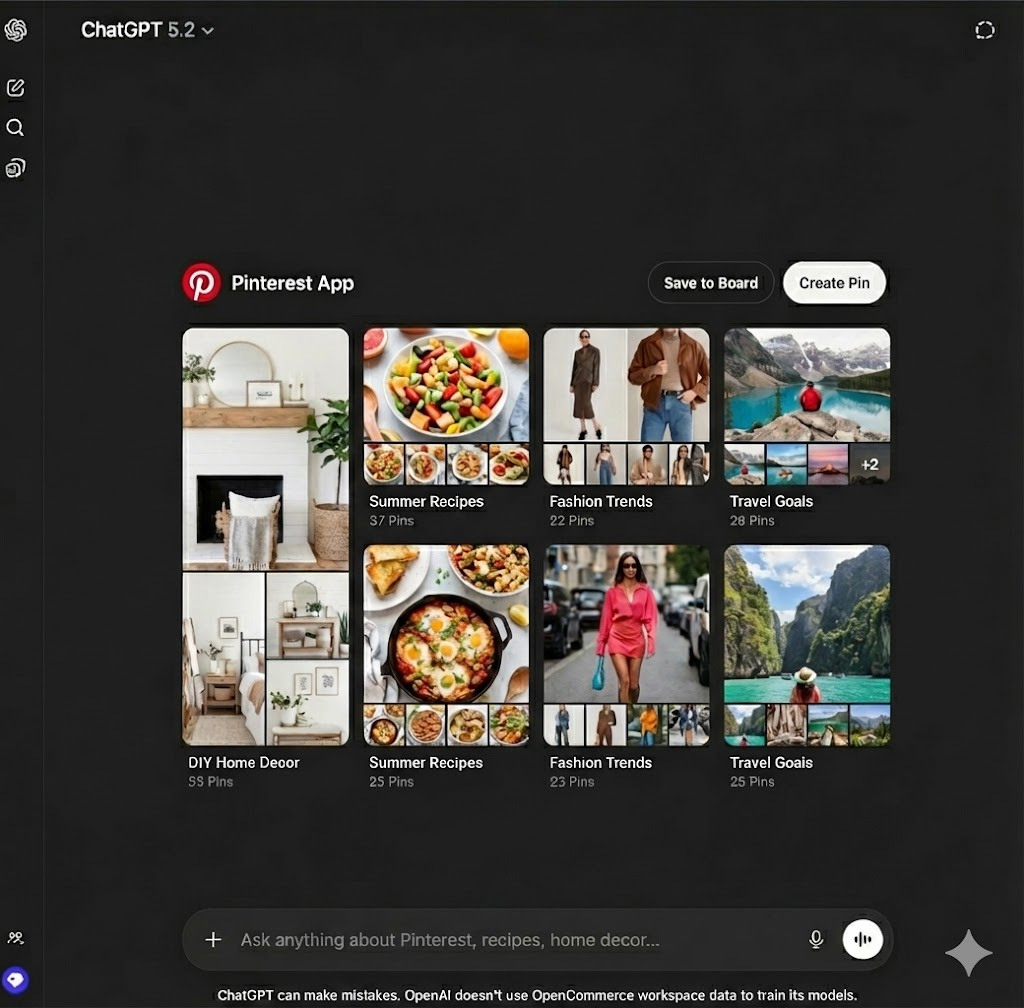
ChatGPT into Pinterest - Bolt ChatGPT capabilities onto the Pinterest app. Add conversational search that combines text and image understanding, letting users refine and iterate instead of just searching.
Technology absorption - ChatGPT swallows Pinterest’s stack (visual search, taste graph, ML models) under the hood. When users input images or visual discovery queries, ChatGPT routes to Pinterest’s engine - but it still feels like ChatGPT. Downside: harder to migrate Pinterest’s existing user base since the brand disappears.
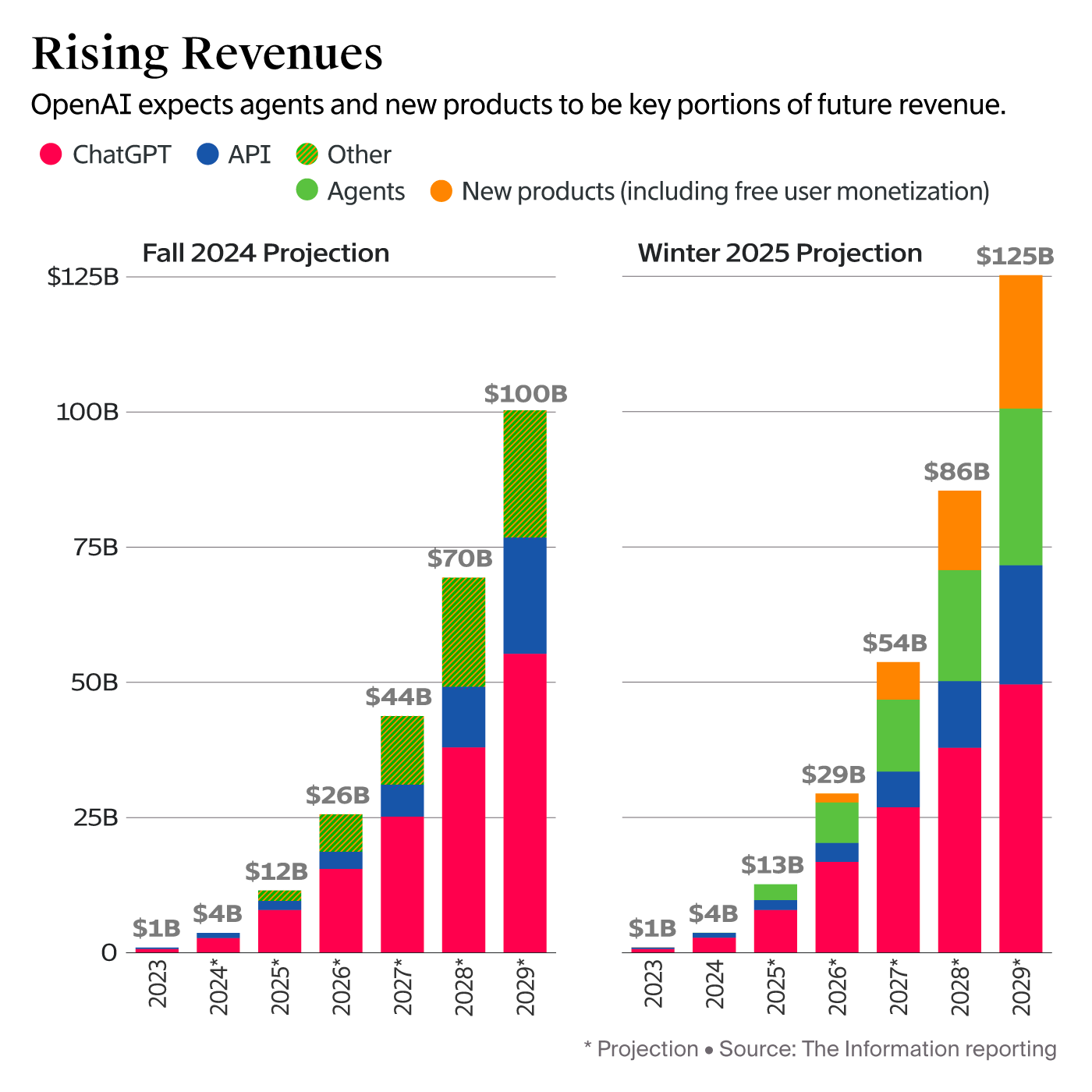
Ad network integration - Pinterest has a mature $3B+ ads business with strong attribution and established advertiser relationships. OpenAI is exploring ads but building from scratch is hard. Pinterest offers a ready-made monetization engine that could accelerate ChatGPT's path to revenues (internal OpenAI documents reportedly show plans for $25 billion in "free user monetization" by 2029. That’s only 4 years from now).
In reality, an acquisition would likely combine all four to some extent: leverage the taste graph for recommendations, migrate Pinterest’s Gen Z user base into ChatGPT, keep the Pinterest app alive but supercharged with conversational AI and bolt on the ad network for monetization.
People dine, buy, and pick with their eyes. To go from ChatGPT helping you with work to helping you with purchases, ChatGPT must go visual. That’s why we’ve seen recent emphasis on the importance of UI, plus the adoption of MCP-UI which we’ve written about in previous posts.
A picture is worth a thousand words (literally), and the human brain can process much more information with images. It’s an elevated commerce experience, and ChatGPT is not remotely close right now to being delightful for shopping.
Pinterest or not, the importance of UX and delightful user experience is going to be a major theme in the future of AI - and agentic commerce specifically. ChatGPT must go visual.
If you want to follow along as we break down more of agentic commer trends, subscribe below.