In April 2026, a 58-year-old mathematical puzzle known as Erdős Problem #1196 was solved by a 23-year-old amateur prompting GPT-5.4 Pro. It took the AI a single prompt and roughly 80 minutes of processing time to crack a problem that had stumped the world’s best mathematicians for nearly six decades (BuildFastWithAI).
Erdős Problem #1196 is a complex conjecture involving primitive sets which are sets of integers where no number divides any other number in the set (Terry Tao, arXiv). For 58 years, human mathematicians tried to solve the problem via using the traditional tools of analytic number theory. Generations of experts relied on Mertens-type estimates, "almost-primes," and Dickman distributions (Webiano). Human research communities inherited assumptions about what a "natural route" to a proof looks like, everyone kept pushing on the same locked door.
ChatGPT took an entirely different path, using Markov process theory. Instead of treating the numbers as static entities, the AI’s method viewed them as an evolving, probabilistic process where prime factors are added or removed over time (Terry Tao). It took a tool from probability and statistics and applied it to a rigid number theory puzzle.
Wandering around social media lately, you see a sharp divide regarding this news. Some call it a triumph of machine creativity. While others vehemently argues that AI is inherently not creative, claiming it merely regurgitates data or brute-forces combinations until something works (Reddit, Mathstodon).
So what actually is creativity? Is a Van Gogh painting creative? Leonardo da Vinci’s sculptures? A clever legal argument? Scientific discoveries? Life itself? And if those things are creative, is there truly any difference between human and AI creativity?
The Synthesis Engine (Its not unique to just humans)
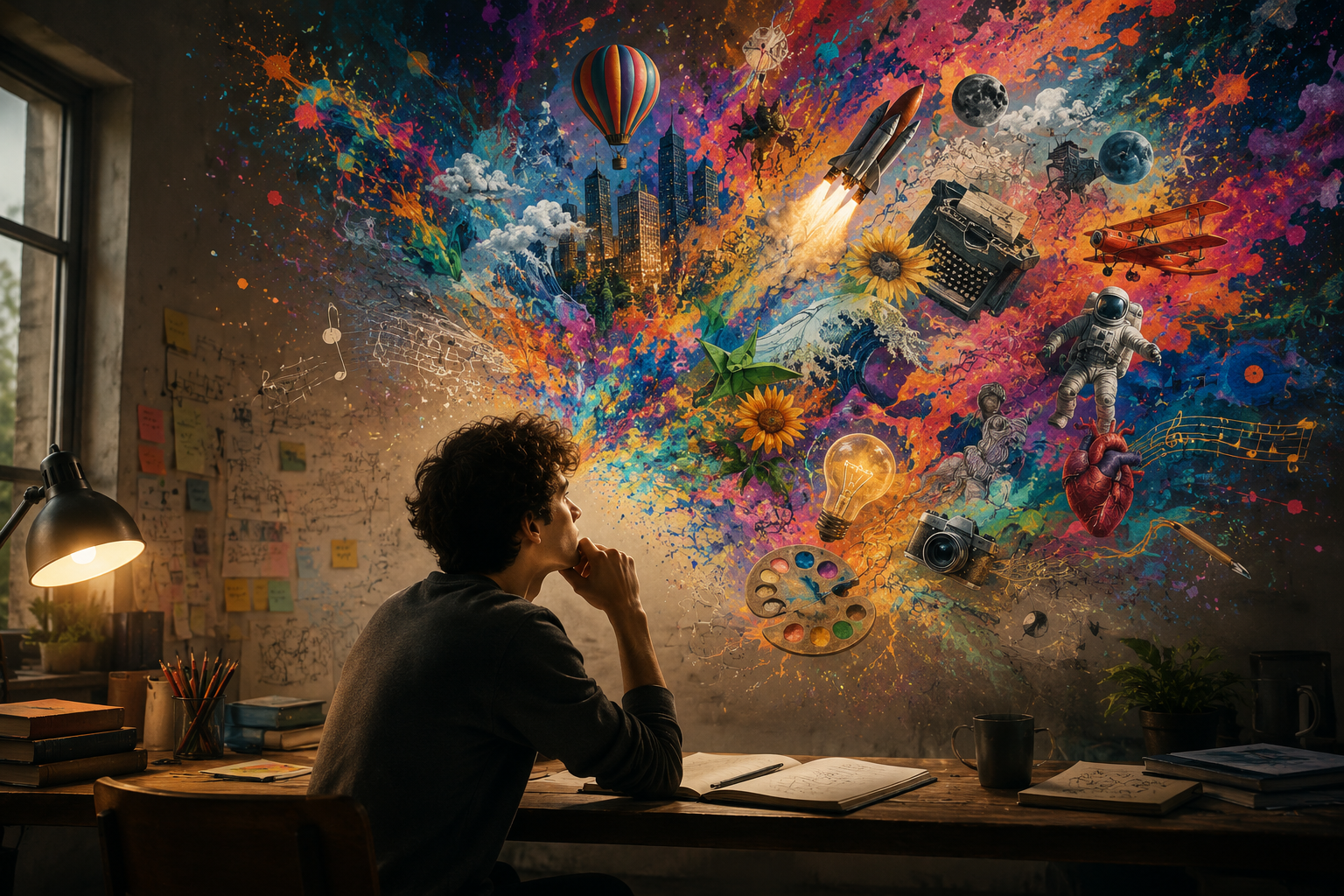
Let’s start with a formal definition. The Oxford English Dictionary defines creativity as "the use of imagination or original ideas to create something." Digging deeper into cognitive science, creativity is widely recognized as "the ability to generate novel, original, and valuable ideas, solutions, or products by connecting seemingly unrelated concepts."
By that exact definition, GPT-5.4 Pro’s solution to the Erdős problem was profoundly creative. It produced a novel, valuable idea by taking a framework from one disparate area of math (Markov chains) and applying it to another (primitive sets) (Terry Tao).
The common counterargument is that AI isn't being "inspired". It is simply brute-forcing massive amounts of data and trying different approaches until a parameter fits. But this critique misses a fundamental truth: Humans do this too. Trial, error, and mental brute-forcing are the cornerstones of the human creative process.
Consider Thomas Edison and the invention of the commercially viable incandescent light bulb. Edison famously tested thousands of different materials for the filament from cotton thread to bamboo to human hair before finding one that worked. He is widely quoted as saying, "I have not failed. I've just found 10,000 ways that won't work." This was not a sudden, divine spark of inspiration. It was an exhaustive, systematic, brute-force search through a massive dataset of physical materials until a working parameter was found. If an AI tests ten thousand material combinations in a simulation to discover a new superconductor, critics call it cold calculation. When Edison did it in a lab, we called it genius.
If we look deeply enough, we realize that absolutely everything we consider "creative" is simply a synthesis of previously existing ideas. Novelty is not about conjuring something out of a magical void. It is simply synthesizing things in a way that hasn't been done before. We truly stand on the shoulders of giants.
Consider these examples of "original" human creativity across a wide variety of fields throughout history:
- Science and Physics: Albert Einstein didn't invent Special Relativity from scratch. He synthesized Maxwell's electromagnetism with Lorentz's mathematics and classical mechanics to form Special Relativity. His "creativity" was his ability to connect existing dots in a way no one else had yet seen.
- Literature: William Shakespeare’s Romeo and Juliet was based on an Italian tale translated into verse by Arthur Brooke decades earlier. Hamlet drew heavily from the Scandinavian legend of Amleth. Shakespeare’s creativity lay in synthesizing existing stories with his masterful grasp of iambic pentameter and human psychology.
- Architecture and Engineering: The modern skyscraper was the synthesis of two entirely separate 19th-century innovations: the Bessemer process for mass-producing steel (which provided the lightweight structural frame) and Elisha Otis’s safety elevator (which made incredibly tall buildings practical to navigate).
- Art: Vincent van Gogh’s The Starry Night is a masterpiece of human expression. But Van Gogh didn't invent stars, nor did he invent the night sky. He synthesized his visual observation of the world perhaps filtered through his unique neurological state and mental struggles with paint on a canvas. Ask an LLM to generate an artwork blending the disparate styles of Van Gogh with Picasso and you replicate the same process by connecting two different styles to make a new artwork.
- Prehistory and Survival: Early humans didn't invent fire out of thin air. They observed the heat and smoke of a lightning strike. Separately, they observed that rubbing sticks together created friction and heat. Eventually, someone synthesized these disparate data points: if heat causes smoke and fire, and rubbing causes heat then you can create fire.
- Music: Michael Jackson openly stated that some of his iconic grooves were heavily inspired by the Bee Gees. The Bee Gees themselves stated that one of their songs was inspired by the rhythmic, thumping sound of their vehicle's tires crossing a bridge. Every single piece of music is a reaction to, and a remix of, previous music and the everyday sounds of the artist's environment.
- Life Itself: The very first self-replicating organisms were born when random organic molecules bounced around in a primordial soup, colliding and combining until a novel, useful synthesis occurred: life.
The Data We Ingest
The list is endless. Give us any novel thing that society deems "creative," and it is undeniably a synthesis of previous things.
Ultimately, humans learn by ingesting data. We listen to music, read books, scroll social media, observe nature, and live our everyday experiences. Our brains process this massive dataset of lived experience, pull disparate concepts together, and synthesize new creations that have value.
How are AI models any different?
They are developed and trained on this exact same data. The collective output of human history, art, literature, code, and science. They process this information so that they, too, can synthesize new creations that are valuable and productive. The underlying mechanism is identical.
Solving the Erdős theorem was novel. It had never been done before, it was highly useful, and it synthesized ideas from completely different areas of mathematics to forge a new path.
When an AI successfully combines ideas from different fields and produces a useful, novel result, it is engaging in the exact same process that gave us the lightbulb, Hamlet, and The Starry Night. It is time we drop the illusion that synthesis is only "creative" when a human brain is the one doing it.