Z. Carrière was on the faculty of the Institut Catholique de Toulouse in the 1920s. He seems to have specialized in acoustics. At some point he noticed a similarity between the sound made by a whipcrack and that made by a bullet fired from a Lebel rifle when it passes near the observer.
It is entertaining to speculate as to what had happened in Carrière’s life that caused him to be so familiar with the sound of rifle bullets passing near his head. An obvious explanation would be military service in the Great War, but I have no information about the man and so that’s only a guess.
The Lebel rifle was standard issue in the French military for decades, including the era of the Great War. At the time of its introduction it was the first military rifle to use smokeless, as opposed to black, powder. Smokeless powder, a French invention, was much more powerful than black powder and fired bullets that traveled at supersonic velocity. So when Carrière specifies that the sound of a whipcrack is similar to that of a bullet from a Lebel rifle, what he’s saying is that it sounds to him like a sonic boom.
As will shortly become obvious, Carrière was a monstrously gifted experimentalist. He decided to build an apparatus that would provide experimental proof of his hunch that whips broke the sound barrier. In this post I’ll try to explain the echt-steampunk contraption that Carrière built and documented1 in order to achieve that goal.
In order to study this phenomenon, Carrière first needed to build a machine that would reliably and repeatably crack a whip, always in the same place. His fouet de laboratoire was disarmingly straightforward, and I know it works because I once duplicated it. It’s depicted in this illustration, which is a bit confusing because it shows the same thing twice from two different angles, front and side views:
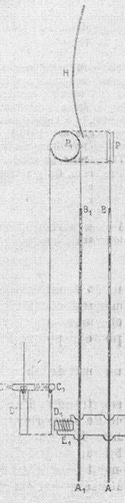
Ignore the upper part (H) for now, that’s a parabolic mirror which will be explained in due course. The device itself consists of a vertical plank. Mounted to the top of it is a lightweight pulley. Affixed to the bottom on one side is a length of rubber AB, which when stretched reaches almost up to the pulley. Fixed to the end of that is a cord BC with a knot in the end — this is the actual whip. The cord is passed over the top of the pulley, forming the U-shaped bend that Kucharski would later term a Knickstelle, and then pulled downward, stretching the rubber, until the knot can be fixed in place between the two prongs of a little fork located at C, holding the whole system under tension.
This fork is mounted on a pivot, but it’s not yet free to move because its other end is held in position by an electromagnet (D). As long as power is supplied to the electromagnet, it will hold the system in tension. But when power is switched off, the magnet releases its hold, allowing the fork to pivot around under the tension in the whip until the prongs become vertical. The knot slides free, allowing the whip to be hauled upward by the powerful contraction of the rubber on the other side of the pulley. As Carrière explains, the U-shaped bend soon lifts free of the pulley and propagates upward into the space above it, accelerating the whole way until it snaps round at the top of its trajectory and makes the claquement or whip-crack sound.
(Attentive readers of this series will recognize here Kucharski’s “Indian rope trick,” a vertically cracking whip that can lift its free end up against the force of gravity once the Knickstelle has been established—in this case, by the pulley—and gone into movement.)
Now that Carrière can make a whip crack over and over again in the same place, he’s able to set up photographic equipment, aimed at the exact spot of the whip-crack, in order to capture still images of its movement. It’s necessary to capture images at successive moments in order to perform a calculation of the whip’s speed. He’s going to do this by taking multiple exposures on the same photographic plate. He has placed a screen between the camera and the whip, and is backlighting the whip to cast a shadow on the screen. He’s using the “method of Foucault-Toepler” which clearly means schlieren photography — a way of capturing images of shock waves in the air.
Carrière actually has two different configurations of the apparatus, one for getting schlieren images of the shock waves and another for direct photography of the whip itself.
All of this is set up in a dark room. The shutter of the camera is held open, so any light entering the lens will darken the plate. Carrière now needs a way to generate a rapid series of intense, brief flashes of light during the moments that the whip is cracking. He doesn’t have access to modern strobe lamps and so instead he uses electrical sparks.
A simple spark gap in the air (two wires almost touching each other) isn’t going to work because the air in the gap is going to become ionized and won’t perform well for a rapid succession of sparks. Fortunately that’s a well-known problem that has been solved by the early Twentieth Century radio industry, which is still using spark gap transmitters. The details are a bit technical, but the bottom line is that air spark gaps can only cycle so rapidly. This placed a ceiling on how fast such transmitters could operate until the invention of the mica quenched spark gap which was widely adopted during the time (1920s) that Carrière was working on this project.

So that’s going to be his source of light. He places the spark gap at the focal point of a parabolic mirror behind the place where the whip cracks. Whenever it sparks, the mirror produces a parallel beam of light that will pass over the whip, casting its shadow onto the screen in front of the camera. The camera’s focused on the screen and so it’ll record a still image of the shadow at the moment of the spark. By triggering three or four sparks in rapid succession Carrier can get a multiple exposure showing the whip’s shape, and the associated shock waves, at different instants during the whip crack. This will give him the data he needs to calculate its velocity.
The spark gap requires 20,000 volts. Carrière produces this using a Whimshurst Machine, a classic Victorian electrical contraption that you have probably seen in the background of movie scenes set in wacky science labs.
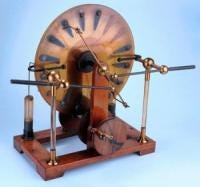
When the machine is cranked it generates high voltage but only a small amount of current—not enough to make a series of sparks. So Carrière hooks it up to an array of Leyden Jars — old school capacitors capable of storing up electricity and then discharging it suddenly. He’s got one such jar for each spark that he intends to make during the whip crack. Each jar, when switched on, will instantly discharge all of its stored energy through the mica spark gap and produce a single brief but blindingly intense spark.
Ordinary electrical switches, which use hard metal contacts, don’t perform well in such an application. Carrière instead uses mercury switches, which contain a small pool of liquid metal in a glass ampoule. When turned on, the switch’s contacts are plunged into the mercury to complete the circuit and allow the current to blast through.
The battery of Leyden jars is connected to a voltmeter enabling the operator to see how much voltage has accumulated in the system. The operator keeps turning the crank on the Whimshurst machine until the needle reaches 20,000 V and then unleashes hell by dropping the guillotine.
The whole experiment now depends on Carrière’s ability to trip a series of mercury switches in a precisely timed sequence. The first switch kills the electromagnet that has been immobilizing the fork that holds the end of the whip. This sets the whip into motion. A short time later, the mercury switches connected to the Leyden jars need to be tripped in a very rapid sequence to produce the flashes of light. Carrière handles this by building a guillotine (his term!) consisting of an 80 cm long plank that falls vertically between a pair of taut wires, which guide it with negligible friction. As it falls it strikes the mercury switches, which are mounted on an adjacent structure. By adjusting the positions of the switches up and down, Carrière can tweak the timing until the flashes are happening at exactly the moment that the whip reaches its peak velocity and snaps around in front of the camera.
In order for Carrière to calculate the whip’s velocity he has to know the time interval between successive sparks/exposures. This could perhaps be calculated by keeping a record of the positions of the mercury switches on the guillotine, but better would be actual timestamps on the photographs. And since they’re multiple exposures, each photo has to have multiple timestamps. Carrière solves this problem by mounting another electromagnet above the mirror, and using it to suspend a steel ball. It’s connected to another circuit on the guillotine. When that circuit is switched off, the ball drops from the electromagnet and plummets down across the face of the mirror at the same time as the whip is cracking next to it. The result is a series of little round shadows, one per exposure, visible in the lower right of each image. The rate at which the ball descends is easily calculated from basic physics, and so by measuring the positions of the ball’s shadows Carrière is able to get the time interval between exposures and thus calculate the whip’s velocity. To make sure he’s measuring correctly he has stretched a cord across the image plane with knots 20 cm apart, giving him a way to measure the scale.
I have two copies of Carrière’s paper, one of which I scanned twenty-five years ago from an old yellowed hard copy in the University of Washington Library, another more recent digital scan available online. In general the online version is of higher quality, but that’s not true of the images. These were originally high-resolution photos provided by Carrière to the publisher. They had to be scaled way down and converted to halftones in order to be printed. My hand-scanned grayscale versions came out better than the black-and-white images in the online copy, so I’m going to drop in a couple of those here.
Here’s a triple exposure taken relatively early in the whip cracking process:
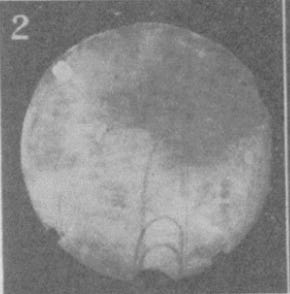
In the lower right of the disk, at approximately four o’clock, you can make out a vertical stack of three dark round spots. Those are shadows cast by the falling ball at different moments. They effectively record the time at which the three whip images were captured.
The U-shaped bend enters from the bottom, so the lowest one is the earliest and the top one comes last. The time interval between the three exposures isn’t exactly equal but you can get a sense that the U-shaped bend is accelerating—it moves a much greater distance between exposures 2 and 3 than between 1 and 2.
Here’s another triple taken later in a whip crack:
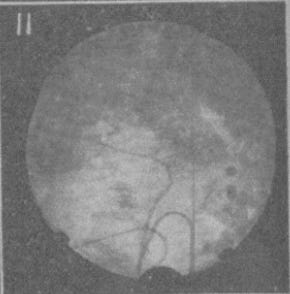
Again the falling ball is visible at about four o’clock. It tells us that there’s a longer interval between exposure 1 (the U-shaped bend entering at the bottom) and 2 than between exposures 2 and 3. (Note: the vertical line running from top to bottom between the ball shadows and the whip shadows is the cord that Carrière stretched across the image plane as an aid in calculating scale). It’s clear in this image that between exposures 1 and 2, the actual whip crack occurred: the free end of the whip, which is still rising up into the image in exposure 1, has snapped all the way around in exposure 2 and is flailing off to the left between 9 and 10 o’clock. By the time we get to exposure 3 it has whipped around even further to about 7 o’clock and is already collapsing into the bottom of the image.
I realize that it’s difficult to make out what’s going on in these images and so I made a blowup of the one above with annotations:
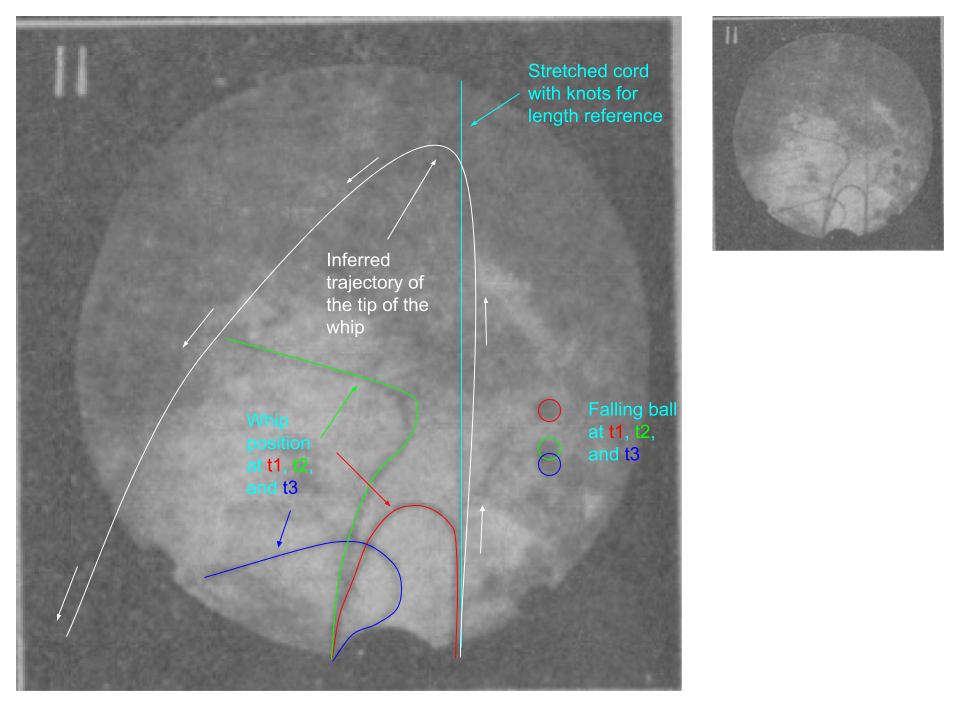
Carrière includes twelve such images in the paper, none of which captures the exact moment of maximum whip crack velocity. You can see that he’s patiently tweaking the positions of those mercury switches trying to get the timing exactly right, but chronologically he’s looking for a needle in a haystack.
The following set shows the results of his schlieren photography setup:
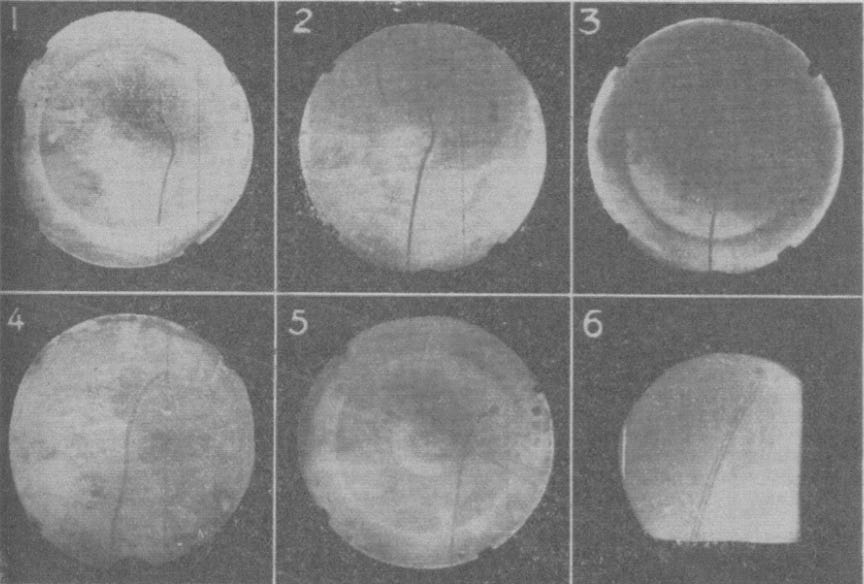
The feature to look for here, most obvious in 5 but also clear in 1 and 3, is the circular discontinuity. In 1 and 3 it only appears once, out toward the edge of the disk, but in 5 you can make out multiple concentric circles. These are the traces of the shock wave produced by the whip when it broke the sound barrier a fraction of a second earlier.
By this point Carrière has compiled an impressive amount of evidence supporting his theory that whips break the sound barrier, but he can’t clinch it using just the photographs. By measuring the photos and comparing against the ball drop speed he can show that in some cases the whip’s moving in excess of 300 m/s. But the speed of sound is 343 m/s. The whip is only moving at its peak velocity for about one ten-thousandth of a second. It’s nearly impossible for him to take two successive exposures at the exact right moments to show this happening. He has to come up with a completely different measuring scheme.
It’s shown in this cross-sectional view, which is slightly confusing since the directions are reversed compared to the photographs. In the photographs above, the whip snaps off to the left following the crack. In the diagram below it snaps to the right.
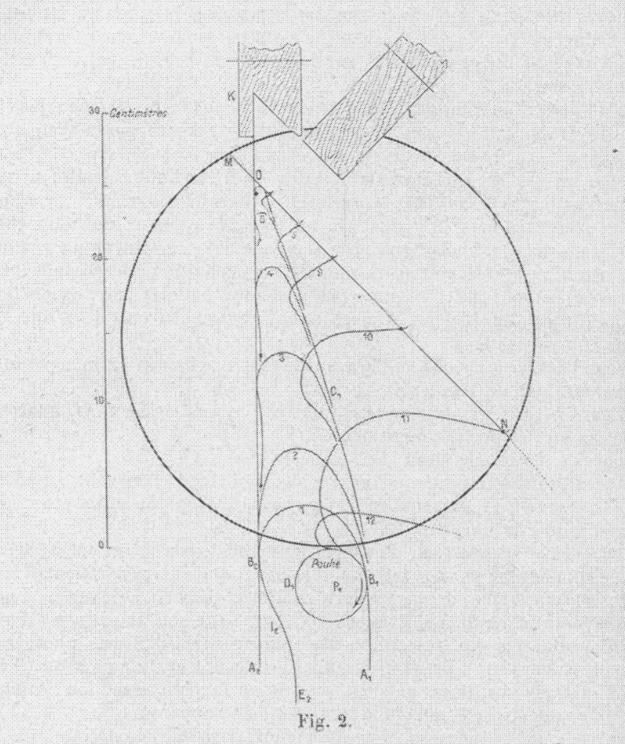
The pulley that launches the whip is the small circle at the bottom, rotating clockwise. The big circle is the mirror.
The two straight lines AO and ON show the approximate trajectory of the tip of the whip: before the crack it rises vertically up the line AO (typical positions are shown by the curves 1 through 5) and after the crack it flails around and collapses off to the right, roughly along the line ON (curves 6 through 11).
Since the whip’s movements are predictable, Carrière sets up a pair of wooden drums, shown in cross-section at the top and labeled K and L. These are shaped and arranged so that their edges are tangent to the lines AO and ON. They are just spinning disks of wood. L is a simple cylinder, K has an angled groove in its edge matching the angle between AO and ON. He’s got them hooked up to a motor so that they spin at a known speed (100 revolutions per second) around axles that are indicated by the transverse lines shown on the diagram.
Prior to each repetition of the experiment, Carrière places these drums into a smoker for a while, so that they become coated with soot. The soot isn’t bonded to the surface, it’s just a light surface layer. He mounts the sooty drums on the axles and gets them spinning. Then he performs the whip crack.
As the whip passes through the cracking zone near O, it generates a shock wave that spreads out in its wake. When the shock hits the nearby drum it blasts off the soot, leaving a visible trace along a narrow path. Because the drum is spinning, the trace doesn’t run perpendicularly up the edge of the drum; the drum’s moving laterally underneath the shock wave as the trace is laid down, and so the result is an angled trace—a helix. The angle of the helix can be measured. Since Carrière knows how fast the drums were spinning, he can use this to calculate the velocity with which the tip of the whip was moving when it produced the shock.
Based on data collected using this technique, Carrière concludes that the tip of the whip is moving at at least 350 m/s in the vicinity of point O: faster than the speed of sound. That is corroborated by the images of the shock waves on the schlieren photographs.
By the end of this thing Carrière has done what he set out to do: prove his hunch that the similarity in sound between a Lebel rifle bullet passing by your head and a whip crack is no coincidence. Both of them are sonic booms. The term “sonic boom” or bang sonique doesn’t exist yet—the OED says that it first shows up in English in the 1950s—but Carrière explains the physics of it in sufficient detail to make it clear he knows exactly what it is.
His paper includes page after page of meticulous remarks about his apparatus and about the behavior of the whip during its trajectory, which I won’t go into here. He uses a device called a Koenig Analyser, a too-steampunk-to-be-true device that uses jets of flame and a rotating stereoscopic mirror to perform frequency analysis on sounds. He cracks the whip near soap bubble membranes and analyzes the splatters. He builds a sensor into a coachman’s whip and hooks it up to the Whimshurst machine to trigger sparks when he stands in his darkroom and cracks it.
There isn’t much prior art for him to refer to, so he’s largely on his own, but he does give a callout to a Victorian physicist who will be the subject of the next post in this series.
The ingenuity of Carrière experimental setup and his meticulous attention to every possible detail has fascinated me since I first stumbled across this paper circa 2000. I enjoy reading papers about experimentalists of past eras because they combined so many qualities I find admirable: a clear understanding of the scientific principle they wished to investigate, a vast breadth of practical knowledge about how to build things, the imagination to think up such devices, and the obsessive dedication needed to keep pursuing these projects over what must have been years filled with setbacks and frustrations.