Shortly after the end of the Second World War, a German man visited his eye doctor complaining of “floaters” — little specks drifting around in his field of vision. As anyone today can verify by googling the term, it’s an extremely common condition. It’s almost always benign. Eye doctors see this all the time.
What this doctor saw, however, when he peered into the patient’s eye, was by no means ordinary. Floating within the eyeball, slowly tumbling end over end, were rods of a metallic substance — copper — each about a millimeter long.
Needless to say, it’s not normal for eyeballs to produce copper. So these objects must have entered the eyeball from outside. Yet the outer surface of the eyeball showed no signs of damage.
The doctor interrogated the patient: had he seen action during the war? Had he been near an explosion? Had he been in a crash, or suffered any kind of traumatic injury? The answers all came back in the negative. This man was a truck driver. He’d never been in an accident, never come near any kind of military action.
The way things usually work in the medical profession is that doctors treat what they can, which covers the vast majority of cases. Anything that exceeds their knowledge they refer to specialists. Consequently this truck driver got referred up the chain until he came to the attention of Dr. H. Erggelet, the Director of the Eye Clinic at the University of Göttingen—one of the most prestigious universities in the German-speaking world. Dr. Erggelet performed his exam, saw the same remarkable phenomenon, and asked the same questions of the patient, with the same result: total bewilderment. Fortunately for the truck driver, it wasn’t a serious medical problem and it didn’t significantly affect his vision. He went home with no explanation for his condition and was enrolled in the records of the university as a medical mystery.
Then another man showed up with the same symptoms. Then another.
There was an obvious common link among all of these men with copper rods in their eyes: they were all truck drivers. Further interviews began to shed some light on their histories. During the last years of the war, Germany—formerly one of the most industrialized and motorized countries in the world—had run desperately low on fuel. There were still many vehicles on the roads in good working order, but they couldn’t move, simply because there was no fuel to put in their tanks. And yet goods still had to move from place to place in order to keep the economy going and the war engine running. In desperation, truck drivers had turned the clock back a few decades and reverted to the practice of using livestock to pull their vehicles down the roads.
The only problem with this strategy was that they no longer had the harnesses, yokes, reins, and other equipment—mostly leather goods—needed to connect the animals to the vehicles. All of that stuff had rotted away during the years that Germany had become a modern motorized economy. So they had to improvise using whatever materials they could lay their hands on.
In many cases they could make do with rope or fabric webbing. Those, however, didn’t work for making whips. A whip, though it might look to the untrained eye like a simple piece of leather, is actually a finely tuned piece of engineering that won’t perform its function unless the right materials are used.
It should be mentioned here that the purpose of a whip in such contexts isn’t to inflict pain or damage on an animal. The animals are too valuable for that. Moreover, whips are delicate objects and wouldn’t last long if they were constantly being slammed into animals. The main utility of a whip is its ability to break the sound barrier and produce a loud crack. A skilled driver, seated well behind the animal, can make that crack sound in the air near the head of the animal, driving them forward or steering them one way or the other without touching them. As such, the whip is a precision instrument that can’t be replaced with any old length of rope.
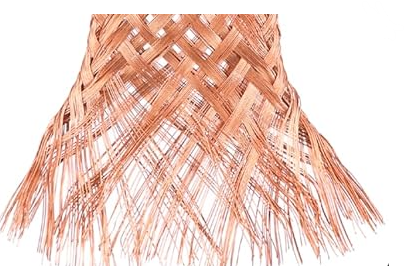
By this point in the war, Germany was littered with buildings that had been destroyed by Allied bombing campaigns. Any building that had been electrified would have a grounding cable, typically consisting of braided copper, running down its exterior to a stake driven into the ground. The cables themselves were finger-thick but the individual wires making up the braids were extremely thin, typically a fraction of a millimeter in diameter.
Some ingenious driver somewhere in Germany figured out that if you stripped a length of such copper braid from a collapsed building and cut it to length, it would work just fine as a whip. Actually getting the thing to crack required a bit of practice, of course. These guys didn’t have the benefit of professional trainers telling them how to do it right.
A common mistake among novice whip cracking practitioners is to yank the handle of the whip toward you in order to accentuate the crack. This actually works. But it’s discouraged on safety grounds. When you do it, the end of the whip tends to snap back toward you. Experienced whip crackers don’t do it that way.
Putting two and two together, Dr. Erggelet asked these drivers whether, while cracking their makeshift copper whips, they’d ever felt a sudden sharp sting in the eye. The patients answered that this was certainly the case, but that in a few minutes the pain went away and they thought nothing more of it.
At this point it seemed obvious to Dr. Erggelet that, during the whip-cracking process, from time to time a small bit of copper would break free from the end of a strand and fly back at high speed until it penetrated the driver’s eye, creating momentary pain but making only a small puncture wound that subsequently healed.
The only question remaining was whether this hypothesis was physically plausible. What exactly were the physics at work in the whip cracking process? Were the forces really sufficient to break bits off the ends of the copper strands? And were those bits moving rapidly enough that they could fly back through the air for a couple of meters and puncture the eye?
He brought these questions to a physicist in Stuttgart: one R. Grammel, who investigated the problem and, along with a collaborator K. Zoller, eventually published the findings1 in a paper entitled, roughly, “On the Mechanics of Whips and Whip-cracks.”
Grammel and Zoller’s analysis is based on that of an earlier researcher named Kucharski, the coiner of the term Kinetik der Kontinua (KdK), whose work I’ll be discussing in a later installment of this series (I’m publishing these things in reverse chronological order). I’m not going to delve into the actual mathematics here, but I’ll say that all of these guys are working from a simplified (but still informative) approach in which the whip is modeled as two straight segments joined by a U-shaped bend, which they call the Knickstelle, which means something like “bend location.”
In order to get a sense of why that makes sense, it’s worth going to YouTube and watching some high-speed videos of whips being cracked. There are a lot of these, but here is one that shows it particularly clearly. The whole video is good but there’s a particularly clear view of the moving Knickstelle at about the 6:10 mark.
When people crack whips they hold one end of the whip in their hand. This means that it, and the proximal segment of the whip, remain stationary up to the Knickstelle. Everything beyond the Knickstelle is free to move. The Knickstelle itself propagates down the length of the whip. As it does so the stationary proximal segment gets longer, and hence more massive, while the moving distal segment gets shorter, and hence less massive. Since the momentum of the whole system is conserved according to the laws of physics, this means that all of the momentum that the whip-cracker imparted to the whip at the beginning of the action gets concentrated in that distal segment, which has to move faster and faster as its mass gets smaller and smaller. As Grammel and Zoller put it, “this value [the velocity at the end of the whip] grows beyond all limits.” The breaking of the sound barrier is thereby explained.
Grammel and Zoller don’t then explicitly come out and say how the copper rods ended up in the eyes of Dr. Erggelet’s patients, leaving this to the imagination of the readership. But once they’ve worked out the basic physics of whip cracking it becomes an open and shut case. The medical mystery is solved by application of old school Newtonian physics.