Contents
In this workshop we are going to use spiking neural networks to control 2 simulated physical systems: a cartpole and a Braitenberg vehicle “mouse”. This workshop is meant to give you hands-on experience with (virtual) neurorobotics experiments, while hopefully also having a bit of fun.
Everything will be run online in Jupyter Notebooks, so no installation or setup is required. Just follow the instructions below.

Spiking neural networks and control problems
Spiking neural networks are nonlinear systems that respond to input by integrating signals over time.
Put differently, they react to signals with some delay.
As an example, the leaky integrate-and-fire (LIF) neuron model integrates some incoming current until a threshold is reached where it fires a signal (1). Until that point in time, the neuron was silent (0).
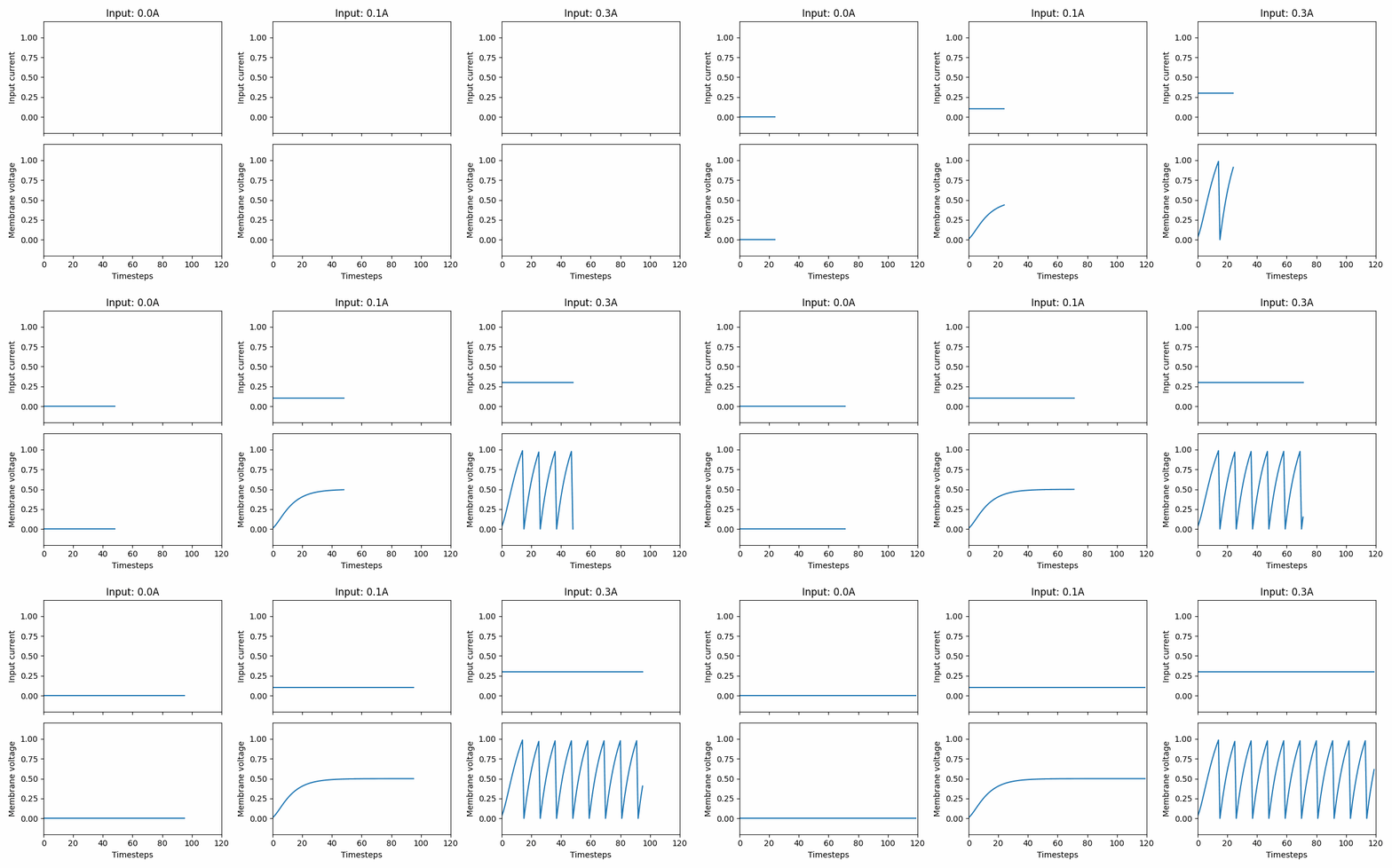
Fig. 1 Three examples of how the LIF neuron model responds to three different, but constant, input currents: 0.0, 0.1, and 0.3. At 0.3, we see that the neuron fires a series of spikes, followed by a membrane “reset”. Note that the neuron parameters are non-biological and that the memebrane voltage threshold is 1.
For control problems, this is actually useful.
We can interpret this firing/non-firing as a means to turn on and off a signal. On when the neuron is firing (1). Off when the neuron is silent (0).
In this workshop, we will be exploiting these nonlinear neurondynamics to intelligently process sensory signals to achieve specific outcomes.
About Us
Located in Stockholm and affiliated to Kungliga Tekniska Hogskolan (KTH), we are the Neurocomputing Systems Lab.
