Calling all maverick and misfit makers, creative technologists, industrial designers, artisan-engineers of Britain and beyond. It is time to come together and fuse heritage with the future to spark a new renaissance.
Today, we launch The British Cræft Prize, a new national award of £60,000 searching for creative technological and aesthetic inventions.
The twist? This is no ordinary design or innovation competition. We are seeking innovative responses to today’s biggest challenges, inviting inventors to combine the deep wisdom of crafts of the past with cutting-edge technologies of the future.
The competition is designed to inspire a wave of creativity, innovation, and aesthetic magic. It is open to all the merrie people of Britain, by birth or adoption.
The British Cræft Prize is the brainchild of Nation of Artisans — a project founded by Louis Elton in 2025 to explore Britain through the lens of the strange alchemy of heritage craft, industrial power, and cutting-edge innovation.
Britain is a land of deep craft and creative heritage. It is also a pioneer of some of the world’s most important industrial and technological innovations.
Yet these two traditions have drifted apart. Britain’s craft world is rooted but increasingly fragile, often trapped trying to conserve a way of life whose material foundations have already vanished.
Meanwhile, our techno-innovation industries are revolutionary, but lacking in soul and meaning, often dissolving the communities and traditions that once enabled harmony and flourishing.
The British Cræft Prize exists not to preserve ashes, but to light a new fire.
The prize aspires to incubate radical, practical creations — and a wider ecosystem — that proves heritage and innovation can be dynamic partners. By combining craft knowledge with emerging technology, the prize aims to address Britain’s identity and innovation crisis through a new mode of AI: artisanal intelligence.
“Craft” is a word that invites argument. Is it only handmade? Is it opposed to technology and industry? In popular usage, it often collapses into twee imagery: Etsy sellers and nostalgic handicraft. While we value human-scale making, the Cræft Prize is aimed at something more ambitious.
The name draws on the Anglo-Saxon word “cræft”. Popularised by 9th-century King Alfred, cræft is not just manual skill, but the virtuous application of knowledge and power to produce excellence in a way that binds hand, eye, heart, mind, material, place, and history into a coherent practice. The term was revived by historian Alexander Langlands in his 2018 book Cræft.
Thus, the prize is avowedly pro-technology, but against slop. At its best, technology is about doing more with less, a principle long shared by craft, engineering, and invention.
Following William Morris, we reject technology that produces ugly, soulless, and inhumane things, seeking instead the union of beauty and utility embodied in the Kelmscott Press. Following Josiah Wedgwood, we see technology not as the enemy of craft but as a means of extending it — using invention and manufacturing to unite elegance and usefulness at scale.
We are seeking ingenious applications of the fusion between heritage craft and innovative technology. We are casting our net widely because true innovation affects both the object and the method of its creation.
Britain’s heritage has always been defined by this dual ambition:
Sheffield makes cutlery and perfected the crucible steel process.
Northamptonshire mastered shoemaking and scaled Goodyear welting.
Stoke-on-Trent makes ceramics and invented the bone china process.
Entries should demonstrate this spirit of “future heritage” in one of two ways (the best will do both):
A product: An artefact that brings together craft and technology to solve a specific challenge.
A method: A deep redesign of a process or supply chain. One might design a new way of making, joining, or sourcing that combines heritage wisdom with cutting-edge tools — ideally illustrated through the creation of a physical prototype.
Ultimately, we want innovations that use advanced technology to extend deep craft traditions into practical applications such as:
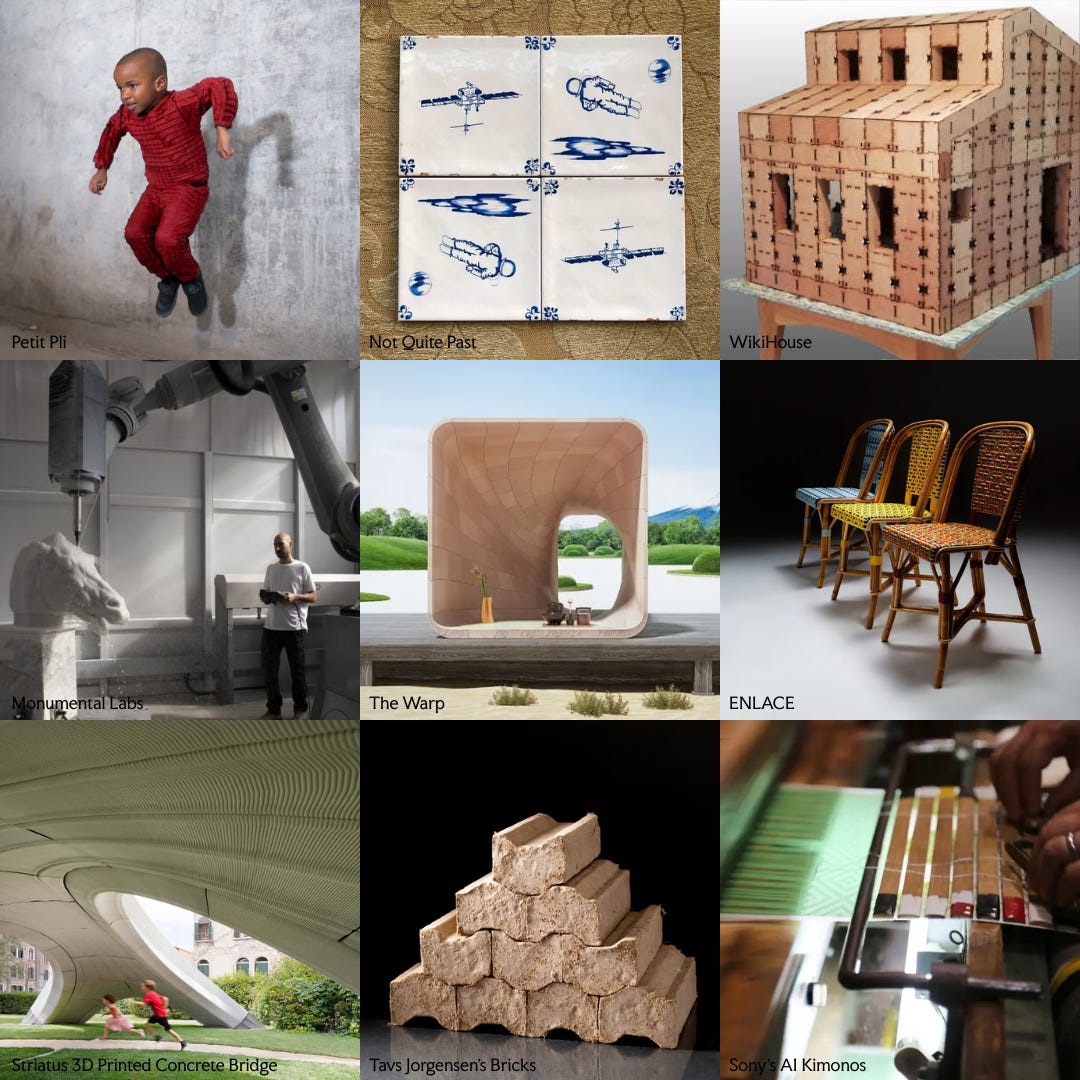
Not Quite Past applies tastefully calibrated generative AI to ceramics design and digital printing.
Petit Pli uses origami principles and advanced materials to create clothing that grows with children.
WikiHouse revives ancient Korean wedge-and-peg timber joinery through CNC-milled construction.
Monumental Labs uses CNC robots to carve stone into beautiful statues.
Zaha Hadid Architects fuses 3D printing with voussoir masonry techniques to build unreinforced bridges.
Aranda/Lasch’s ENLACE applies algorithmic design to master rattan weaving and create personalised bistro chairs rooted in traditional handicraft.
The Warp is a tea house built with 3D-printed recycled wood-sawdust panels constructed through Japanese tsugite and shiguchi joinery.
Archi-Union Architects deploys robotic bricklaying to reinterpret parametric “jali” techniques, extending masonry craft through computational precision.
Sony is integrating generative AI into the centuries-old grammar of Nishijin kimono textiles to preserve and expand endangered weaving traditions.
Tavs Jørgensen’s 3D-printed cob bricks combine vernacular earthen construction with digital extrusion moulds to create hyper-sustainable brickcraft.
For a deeper dive into these inventions, check out the deep dives on the kinds of creations we are seeking:


Entries should address challenges relevant to Britain and globally.
We are, of course, concerned with aesthetics. Yet, we are open to inventions that leverage craft and tech to respond to all sorts of economic, environmental, cultural, and infrastructural challenges — provided the scope is clearly defined.
We seek work with deep material or cultural roots in Britain, grounded in its crafts, landscapes, skills, supply chains, or infrastructure, where that rootedness is evident in the thinking and making, not just the narrative. However, projects can draw on ideas, crafts, and technologies from all over the world. For example, Petit Pli combines advanced materials with origami and pleating to make clothes that grow with children — it’s British, Japanese, and relevant to every child in the world.
We define “heritage crafts” broadly — one could take inspiration from a craft documented by Heritage Crafts. Yet these are generally limited to material crafts from arrowmaking to wainwrighting. You can go further. We are fascinated by artisanship from across the world and from different categories, from fashion and homeware to food production and housebuilding. The possibilities are endless.
The British Cræft Prize dreams of a wondrous pantheon of techno-cræft innovation spanning across categories and cultures.
The prize is open to individuals and teams over the age of 13. Anyone aged between 13 and 18 will require written consent from a parent or guardian to participate.
Entries will be judged against six criteria:
Ingenuity: invention in form, function, or method.
Cræft depth: alignment between material, place, and process.
Beauty: aesthetic excellence that endures.
Usefulness & scalability: repeatable and beneficial beyond the one-off.
Integrity: sustainability, honest sourcing, and social value.
Future heritage: contribution to Britain’s next material culture.
Judges to be selected from a breadth of worlds at the intersection of innovation, technology, design, and craft.
Model: Call for Inventions → Shortlist of 6 → Production/Scaling Phase → Final Judging → One Winner.
The Process:
Step 1: We select 6 finalists based on the potential of their invention.
Step 2: Each finalist receives a grant of approximately £5,000 immediately (depending on specific needs). They use this funding to raise the ambition of their product further before the final selection.
Step 3: The final winner is judged on the finished product and process — and awarded £30,000.
Production Funding for 6 Nominees
£30,000 total pot distributed upfront to the 6 makers.
Approximately £5,000 to each, depending on their requirements to scale and build an exhibit.
Medals & Trophy:
All finalists receive a “British Cræft Medal”.
The overall winner receives a £30,000 grant to spin out their invention (we take zero equity in any inventions, but will happily introduce you to potential investors).
Profiles:
All shortlisted finalists are to be launched into the world by Nation of Artisans through film, editorial, and an exhibition.
£60,000 is fixed. If you are a patron or sponsor who might be interested in helping to raise the scale and ambition of the prize, please do get in touch.
Individuals & Teams
Applications are open to individuals and teams.
We expect the best teams to combine knowledge of technology, design, and craft.
Existing organisations are welcome to apply, but the invention must be new e.g. it should be brought to the world through the prize.
Location
Applicants may be based in Britain or abroad, but inventions must be manufactured or demonstrable in the United Kingdom.
If selected, you must be in Britain for interviews, filming, and the exhibition.
Age
Applicants must be 13 years of age or older. Applicants under 18 must have the consent of a parent or legal guardian.
There is no upper age limit. If you have an extremely offline grandparent with the skills and creativity, share this with them. Better yet, why not submit with them?
Your submission must include:
A tweet-length description of your invention. Brand it, create a bit of razzle dazzle. A little creative magic will help your idea.
A detailed 1500-word document explaining the invention and its craft heritage, technology, and value. Check out the TechnoWithy for inspiration.
A 2–3 minute video explaining the invention.
Multimedia supporting content e.g. images, documentation, brand, website etc.
If your invention can be posted, then we would also love to see it.
Applications should present serious, developed inventions. Early sketches or speculative ideas are unlikely to be considered.
You can submit on the Nation of Artisans website:
March 2026 —Call for applications.
August 2026 — Application window closes 31st August 2026.
September 2026 — Judges filter down to a long list and a short list.
October-November 2026 — Six nominees win grants and start to scale.
December 2026 — Final judging on the six inventions.
January 2027 — Exhibition and winner announced
The purpose of this prize is to build an ecosystem of technologist-cræfters. If you have questions and ideas, please get in touch. If you meet others to work with, we will do our best to matchmake.
More importantly, this Substack (and Nation of Artisans’ Instagram page) is the primary channel we will use to communicate. Be sure to subscribe to avoid missing any updates.
This prize requires creating and catalyzing a new network and community of technologist-cræfters. If you know of any person or organisation who would be interested — as a potential applicant or partner — please share this with them. Share it far and wide.
The British Cræft Prize is currently financially supported by Tyler Cowen at Emergent Ventures. It is also partnered with the Centre for British Progress and Interlace. If you want to join that list, get in touch.