Dogs at Helsinki airport are trained to sniff out COVID-19, and they're nailing it
A smell detection agency called WiseNose claims the dogs can detect the coronavirus with near-100 per cent accuracy
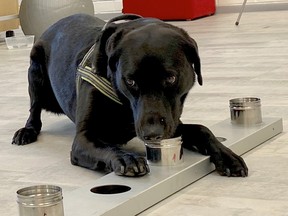
If you were getting tested for COVID-19, would you rather have your lab results determined by a highly-trained technician, or a friendly pooch?

Enjoy the latest local, national and international news.
- Exclusive articles by Conrad Black, Barbara Kay and others. Plus, special edition NP Platformed and First Reading newsletters and virtual events.
- Unlimited online access to National Post.
- National Post ePaper, an electronic replica of the print edition to view on any device, share and comment on.
- Daily puzzles including the New York Times Crossword.
- Support local journalism.
Enjoy the latest local, national and international news.
- Exclusive articles by Conrad Black, Barbara Kay and others. Plus, special edition NP Platformed and First Reading newsletters and virtual events.
- Unlimited online access to National Post.
- National Post ePaper, an electronic replica of the print edition to view on any device, share and comment on.
- Daily puzzles including the New York Times Crossword.
- Support local journalism.
Create an account or sign in to continue with your reading experience.
- Access articles from across Canada with one account.
- Share your thoughts and join the conversation in the comments.
- Enjoy additional articles per month.
- Get email updates from your favourite authors.
Create an account or sign in to continue with your reading experience.
- Access articles from across Canada with one account
- Share your thoughts and join the conversation in the comments
- Enjoy additional articles per month
- Get email updates from your favourite authors
Sign In or Create an Account
Officials at Helsinki Airport in Finland are betting on the latter, Sky News reports.
The airport is engaging in a trial that has seen 10 specially-trained sniffer dogs brought in to detect passengers sick with the coronavirus, some of whom can be asymptomatic.
Four COVID-detecting canines will be deployed each shift to screen passengers, who will also receive a standard screening to ensure the dogs’ results are correct.

Get a dash of perspective along with the trending news of the day in a very readable format.
By signing up you consent to receive the above newsletter from Postmedia Network Inc.
A welcome email is on its way. If you don't see it, please check your junk folder.
The next issue of NP Posted will soon be in your inbox.
We encountered an issue signing you up. Please try again
The pups were trained by smell detection agency Wise Nose, which works to “maintain and promote olfactory discrimination skills and organize a variety of training and performance opportunities.” Wise Nose claims the dogs can detect the coronavirus with near-100 per cent accuracy.
Aside from COVID, the agency also trains pups to sniff out certain types of cancers, rats, bed bugs, and dangerous mould via a method called “the smell of separation,” in which dogs are taught to isolate and identify a specific odour among other odours via smell samples placed in jars.
“The method is well suited for the so-called laboratory dogs who do not need to look for the source of the smell,” the agency explains on its website.
Unlike medical scientists and lab workers, who require years of training in diagnostics and biology, the dogs can rapidly be trained to identify the smell of the coronavirus. One dog, an eight-year-old greyhound mix named Kossi, was taught to detect the scent in a mere seven minutes.
The concept of using dogs to detect the virus emerged in July with the publication of a pilot study from German military researchers, in which dogs were trained to identify COVID-19 with 94 per cent accuracy.
“We think that this works because the metabolic processes in the body of a diseased patient are completely changed,” Maren von Koeckritz-Blickwede, a professor at the University of Veterinary Medicine Hannover, explained in a video posted to YouTube. “We think that the dogs are able to detect a specific smell.”

The test sees passengers issued with a small wipe with which to dab their skin. The wipe is then placed in a cup to be checked by a sniffer dog located in its own booth, a process designed to protect passengers’ medical information and privacy, as well as the dogs and their handlers.
Passengers who test positive for the virus will be dispatched to an information kiosk at the airport to determine next steps.
Finland isn’t the only country deploying sniffer dogs in the fight against the pandemic. U.K. charity Medical Detection Dogs has received government funding for its own canine coronavirus detection efforts, in partnership with the London School of Hygiene and Tropical Medicine and Durham University.
“We have started first-stage training of the dogs we have identified as having the potential for this work,” the charity says on its website.
But Finland is one of the first nations to put the dogs to work in the field.
“We are among the pioneers. As far as we know no other airport has attempted to use canine scent detection on such a large scale against COVID-19,” Finnish airport operator Finavia said in a statement.
“This might be an additional step forward on the way to beating COVID-19.”
Our website is the place for the latest breaking news, exclusive scoops, longreads and provocative commentary. Please bookmark nationalpost.com and sign up for our daily newsletter, Posted, here.