Buried pyramid in Indonesia may be older than civilization itself
New dating suggests structure at Gunung Padang was built during the last ice age, making it millennia older than the Great Pyramids
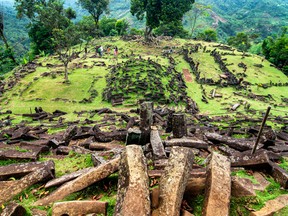
A pyramid buried in Indonesia could be the oldest such structure in the world — by many thousands of years.

Enjoy the latest local, national and international news.
- Exclusive articles by Conrad Black, Barbara Kay and others. Plus, special edition NP Platformed and First Reading newsletters and virtual events.
- Unlimited online access to National Post.
- National Post ePaper, an electronic replica of the print edition to view on any device, share and comment on.
- Daily puzzles including the New York Times Crossword.
- Support local journalism.
Enjoy the latest local, national and international news.
- Exclusive articles by Conrad Black, Barbara Kay and others. Plus, special edition NP Platformed and First Reading newsletters and virtual events.
- Unlimited online access to National Post.
- National Post ePaper, an electronic replica of the print edition to view on any device, share and comment on.
- Daily puzzles including the New York Times Crossword.
- Support local journalism.
Create an account or sign in to continue with your reading experience.
- Access articles from across Canada with one account.
- Share your thoughts and join the conversation in the comments.
- Enjoy additional articles per month.
- Get email updates from your favourite authors.
Create an account or sign in to continue with your reading experience.
- Access articles from across Canada with one account
- Share your thoughts and join the conversation in the comments
- Enjoy additional articles per month
- Get email updates from your favourite authors
Sign In or Create an Account
To get a sense of the timeline, new radiocarbon dating suggests that the structure at Gunung Padang in West Java, Indonesia, was built during the last ice age, sometime between 25,000 and 14,000 BC. It was then abandoned for thousands of years, before being deliberately buried around 7000 BC.
The Great Pyramids in Egypt, and Britain’s Stonehenge, were each built at roughly the same time, about 3200 BC. That means that, if the dating holds, the pyramid at Gunung Padang were already far older than the Great Pyramids when the Great Pyramids were themselves built.

Get a dash of perspective along with the trending news of the day in a very readable format.
By signing up you consent to receive the above newsletter from Postmedia Network Inc.
A welcome email is on its way. If you don't see it, please check your junk folder.
The next issue of NP Posted will soon be in your inbox.
We encountered an issue signing you up. Please try again
In fact, it may have been buried and lost for thousands of years before anyone on Egypt’s Giza Plateau or Britain’s Salisbury Plain even thought of creating a massive monument there. It would have stood thousands of years before Gobekli Tepe, a lesser known site in Turkey that has been tentatively dated to about 9000 BC.
In a research paper published in the journal Archaeological Prospection, geologist Danny Hilman of Indonesia’s National Research and Innovation Agency writes that earlier researchers assumed the structure had been built “between several hundred and a couple of thousand BCE,” in line with similar structures elsewhere in Asia.
Hilman brought a variety of techniques to bear on the site, which was first discovered (or better to say rediscovered) in 1890. He has long espoused the site’s extreme age — an article in the Sydney Morning Herald from 10 years ago lays out his claims, and the counter-claims of detractors — but he says his latest measurements will stand up to any scrutiny.
He used carbon-14 dating techniques on drill cores and trenching walls from around the site, taking great care to avoid contamination from newer soil samples or vegetation that might throw off the results, and using several labs, including one in Florida, to examine the samples.
Even more tantalizing, Hilman claims to have found evidence of underground chambers at the site, with the main chamber estimated at 10 metres high, 10 long and 15 wide — a vast hall large enough store untold treasures. He is pushing for future excavations to include directional drilling and downhole cameras in the hopes of revealing more.
The biggest unanswered questions about Gunung Padang are who built it, and how. Even at the young end of Hilman’s estimated age range, the pyramid would have been built before the development of agriculture, and thousands of years before the earliest known civilization.
Whether unorganized hunter-gatherers could have constructed such a structure is unknown. But doubts have been raised. One archaeologist, anonymous to avoid possible censure from the President of Indonesia, who has taken an interest in the ruins, put in this way.
”In the Pawon cave in Padalarang [about 45 kilometres from Gunung Padang], we found some human bones and tools made of bones [from] about 7000 BCE. So, if at 7000 BCE our technology was only producing tools of bones, how can people from 20,000 BCE obtain the technology to build a pyramid?”
He added: ”In archaeology we usually find the ‘culture’ first … Then, after we find out the artefact’s age we’ll seek out historical references to any civilisation which existed around that period. Only then will we be able to explain the artefact historically. In this case, they ‘found’ something, carbon-dated it, then it looks like they created a civilization around the period to explain their finding.”
Hilman is undeterred. “Gunung Padang stands as a remarkable testament, potentially being the oldest pyramid in the world,” he says in the conclusion to his research paper. “Further investigation and interdisciplinary research will uncover its hidden secrets and shed more light on the ancient civilizations that thrived in this enigmatic site.” Stay tuned.
Our website is the place for the latest breaking news, exclusive scoops, longreads and provocative commentary. Please bookmark nationalpost.com and sign up for our newsletters here.