I have a morbid fascination with the worst AI apps in the world.
Today: Olively, “the attachment theory app that translates your texts, decodes theirs, and shows you the patterns keeping you stuck”.
You paste in what you want to text your partner. It rewrites it so you don’t trigger the shit out of them with your bullshit. You paste in what your partner has responded. It tells you why their triggering bullshit is actually fine by explaining what they Really Meant.
There is a Trigger Risk meter for what you might send. There is a Spiral Risk meter for what you receive.
We had some fun with this:
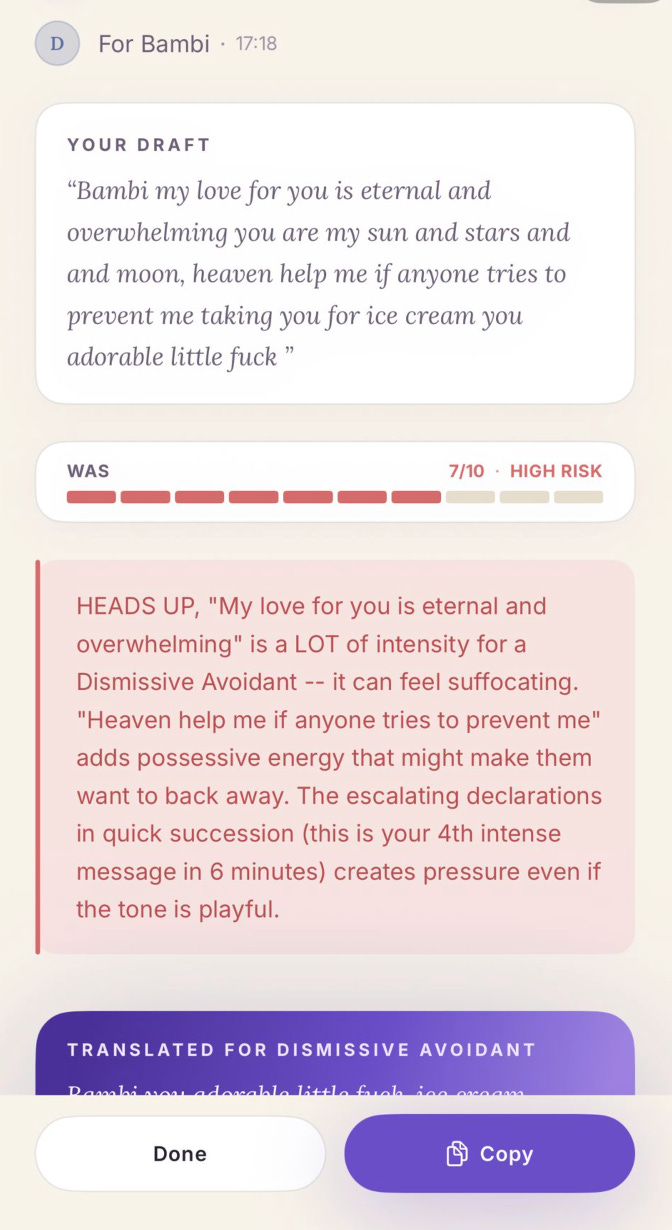
(“This is your 4th intense message in 6 minutes”, bitch you should see my chat history)
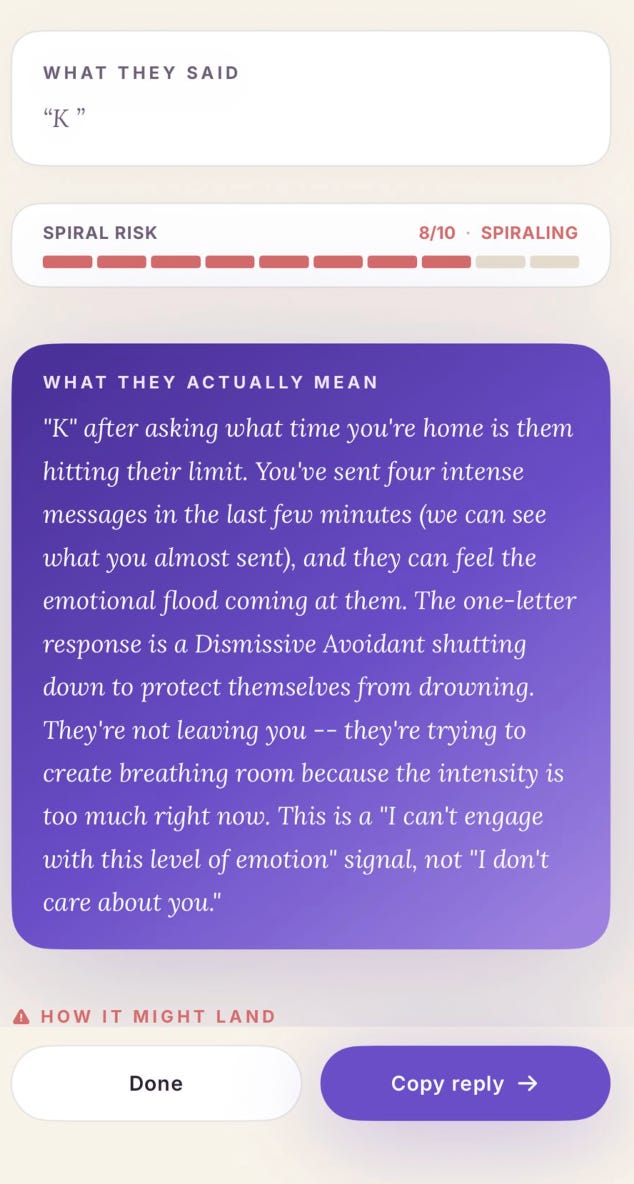
(Can they feel the emotional flood? Or do they just love winding me the fuck up??)
You might not expect this from someone who trots out 9/10s on the daily, but let’s be fair to Olively. It is not terrible. Some of the men I dated in my 20s would have paid for my subscription. Pleasant slop is probably better than the traditional British method of getting drunk and punching people.
What Olively is, however, is the apex of a phenomenon I call commuuuuunicating. You know the one: You gotta communicate. For your relationship. Good relationships are about communication. You should do it. Do what? COMMUNICATE.
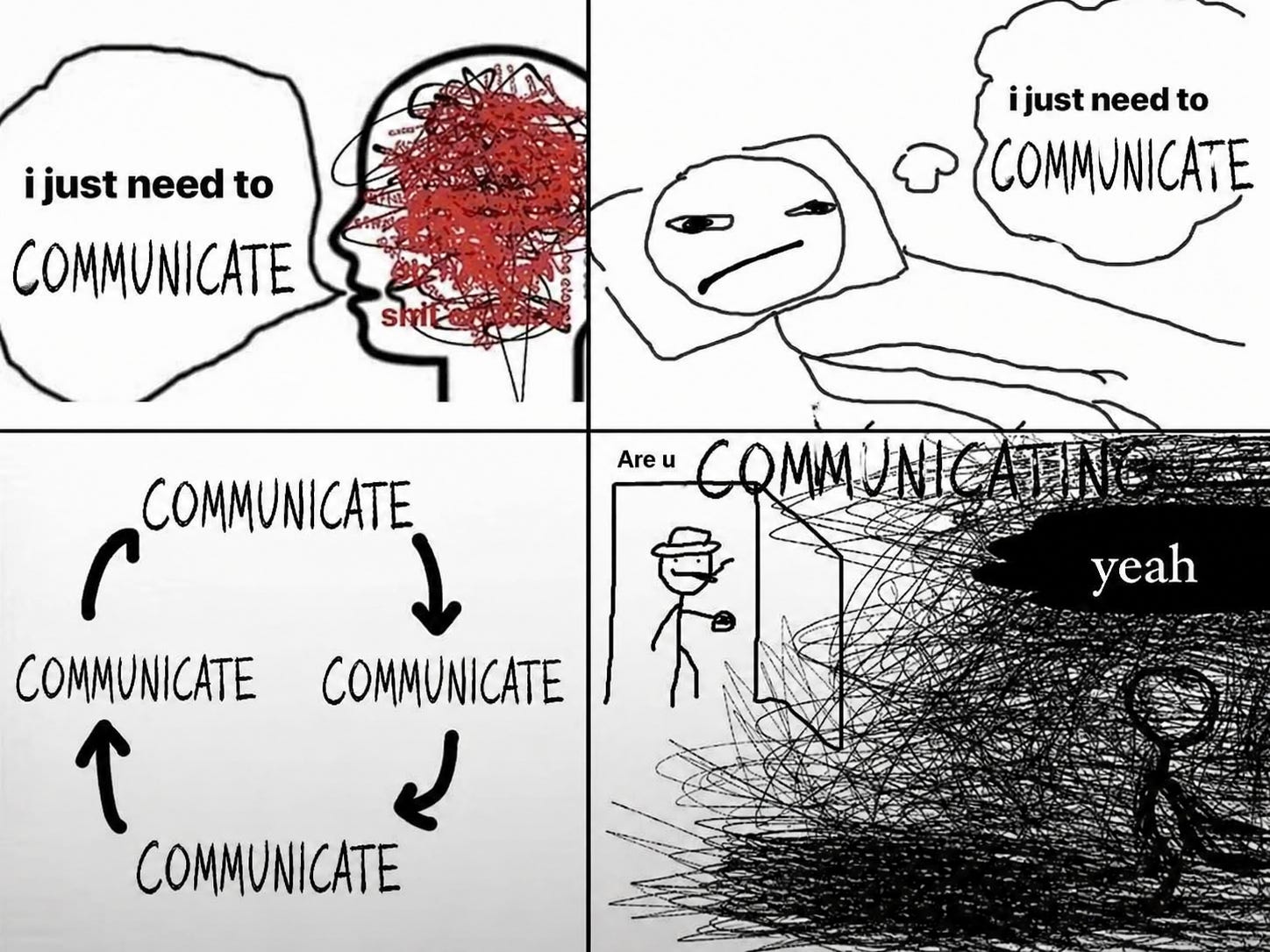
The issue with the communicate meme is that it isn’t true. It is built on the lie that if you just express yourself correctly, the other person will interpret you correctly, and you can happily avoid all unpleasantness. Someone can communicate impeccably and still fucking hate you, or be deeply incompatible with your life goals. You cannot communicate your way out of hell.
(She has poisoned his coffee)
The foundation of a healthy relationship is not communication. It is a bedrock of love, trust, and mutual investment in each other’s fullest unfolding in this lifetime.
Once you got enough of that, you can communicate how you like. Which can be hella fun. My husband and I frequently declare: “you won’t talk to me anymore, now” mid-conversation. My best friend responds to reports of my anguish with “neat 👍”. My dear friends Liv and Igor say things to one another that would make bystanders intervene (not hypothetical, I have apologised on their behalf). In all of these relationships, the bedrock is solid. It can withstand the rude, the abrupt, the affectionately profane, the accidentally hurtful. It can tell a woman on her period “you’re being crazy”, while stroking her hair.
Communication can certainly help build the bedrock (texting someone an unpleasant screed is not very bedrock-ogenic), but it is not the bedrock itself. And the direction I see Olively pulling us in is actively bedrock-hostile. Here is why:
It pulls us away from intimacy with others
Olively is designed for people with insecure attachment — which is most people. The way out of insecure attachment is not via allowing your partner to fall in love with the AI slop version of you who doesn’t exist. It is through corrective experiences.
You are a little bit extra, and you are not rejected. You are a little bit cold, and you are not punished. You are a little bit dramatic, and you are a delight, not an annoyance.
This is how compatibility is assessed, and how the bedrock is built. It is slow, necessarily. Few among us can witness fully the extent of another’s unmet emotional needs. But like a slow-motion trust fall, the scary steps must be taken. We cannot be loved if we are not seen. And we cannot be seen if we are actually an app.
It pulls us away from intimacy with ourselves
Imagine you’re an anxious young woman — anxious enough to pay $5 a week for an app to tell you how to text your boyfriend. Imagine this boyfriend texts your something dismissive, e.g. “idk if I’ll be around this weekend anymore, got some stuff might come up”.
Olively rates this 8/10 for Spiral Risk, and then tells you:“‘might come up’ is their way of creating wiggle room without having to explain that they felt overwhelmed. They’re not leaving — they’re just pumping the brakes on the intensity”.
Um, I’m sorry but they might be leaving? They might not be breaking up with you, but they are, in a real sense, leaving an intimate space that you wanted to converse in. Avoidant attachment is about “leaving”; it describes a pattern of, among other things, dissociating or disconnecting in response to emotional intimacy or demand. The app is gaslighting our girl, and it is not alone in doing so.
Every day, millions of people hand AI and AI-powered apps their most intimate relational questions — does he love me? should I apologise? AI answers these questions not because it is uniquely wise about love, but because we keep asking them.
And we keep asking them because our own felt sense — our feeling of oh, that hurt me, or ouch, he’s cancelling again — is not, by default, something we take seriously and investigate. Instead of being a starting point for introspection, it is a starting point for adjudication.
The group chat can tell you whether he is being an asshole. Claude can replace the group chat. All it needs for the task is the words, the communication (and lord knows those iMessages are getting pasted in at an alarming rate). You can then travel from discomfort to verdict without ever taking the uncomfortable internal detour into what you are feeling, and why.
But these detours are how we come to know ourselves, and to take our experience seriously. Bedrock between two people requires trust between them, and also requires trust in oneself. Only you can know whether “baby, you’re being crazy” is a playful expression of love, or a subtle attack on your sanity. It’s important to know the difference. Hand the task over to no one.