It was almost midnight. I'd just finished another—surprisingly energizing—twelve-hour day with 📝Anthropic's 📝Claude Code building a spectacularly expanded version of 📝MythOS, the platform I'd been working on since 2017.
I was days away from production readiness, days away from migrating all the data and flipping the switch to put it live. Then, as I got situated in bed, an Instagram DM came through from a friend with an article attached... Anthropic's next model had leaked ahead of release, and it was carrying the name 📝Claude Mythos.
I immediately forwarded it to my former co-founder with, "I gotta say, did not see this one coming."
The Name Nobody Checked
Within 24 hours, multiple people had sent it to me — each knowing how central MythOS has been to my life and work.
My reaction was, and continues to be, complex. There was pride. What I'd built over the last year wouldn't exist in its current form without Anthropic's tools. Working alongside their models, I'd rebuilt MythOS into something closer to what I had originally imagined: an 📝agentic augmentation platform that gives you ownership of your narrative, memory, and perspectives so that agents can act on your behalf with your full 📝context, across any aspect of life and work, without that context being locked into any single system.
Seeing something adjacent emerge from a company I'd worked closely with felt, in part, like 📝alignment. MythOS is, in name, a representation of the 📝Storyteller Consciousness; a conscious awareness that the stories we tell create the reality we see and presence in the acknowledgment that we are the authors of those stories.
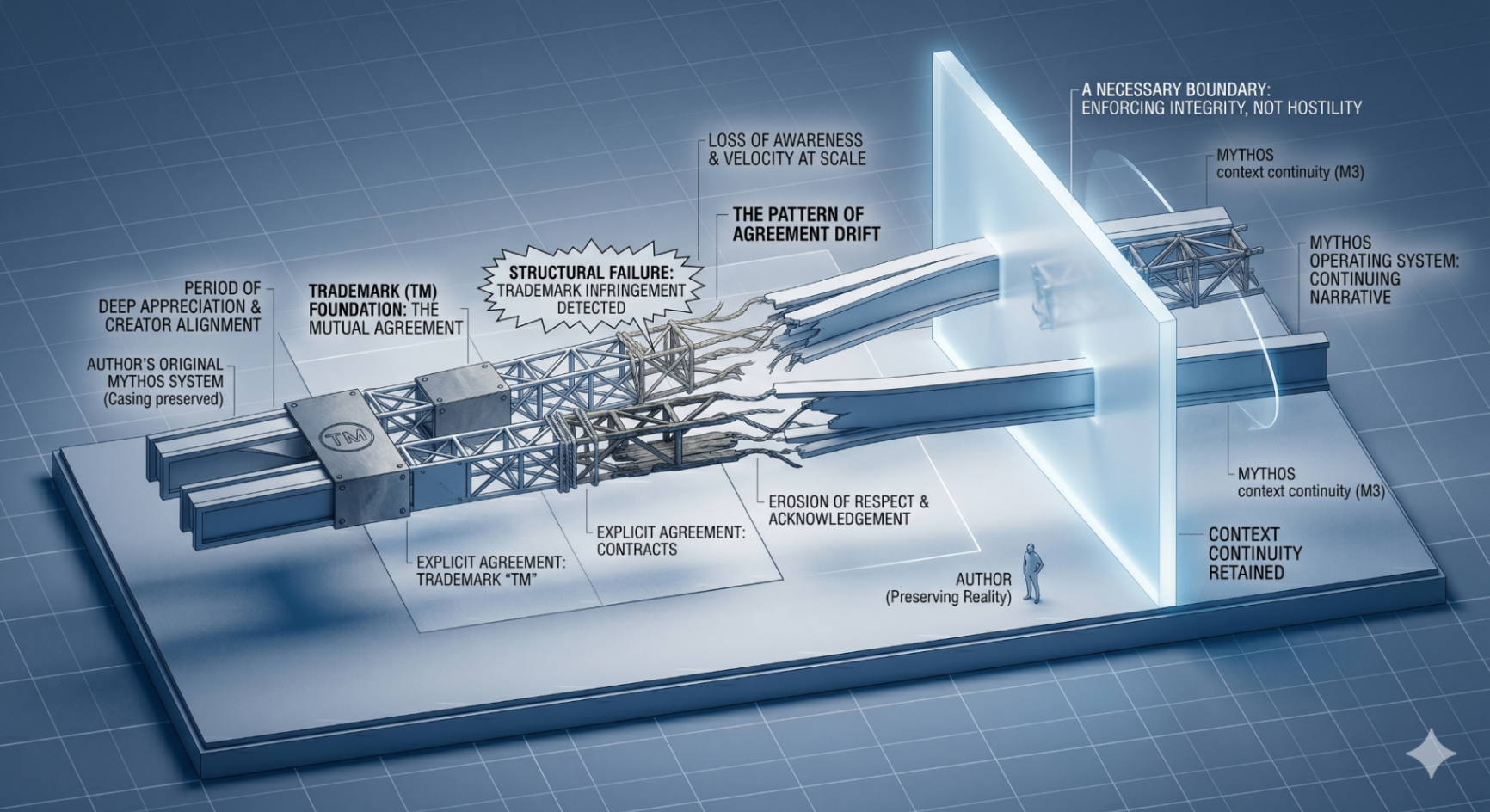
At the same time, something else was clear. A space I had been building in for years had been entered without visible 📝awareness that it already existed. A basic 📝trademark check would seemingly have surfaced that — along with the 📝agreements surrounding it.
MythOS wasn't new. In 2017, the CEO of 📝Notion told me on a call after I'd unknowingly overtaxed their API by publishing my writings to 📝Reddit and causing an apparent surge in traffic that their platform "wasn't meant for people like me".
Within an hour, I called 📝a programmer friend from Burning Man and within days we started building what would become MythOS. It went online in late 2017 and we took payment from our first customer who wasn't a friend in 2018. Over the years, it evolved from a 📝Contextually Augmented publishing platform to an engine for the idea of an agentic self—mine being named 📝BrianBot Stewardship Context, which enabled me to educate, sell, steward community, manage events, and event date at a scale that was previously unimaginable. Someone once thanked me at a gathering for being so helpful over text. I smiled and said thanks, knowing it hadn't been my biological self that she'd engaged.
Since rebuilding with Anthropic's tools, I've gone from zero to over two thousand 📝GitHub commits and utilized over 67M tokens as of this writing—although such numbers are quite relative these days. That's how much this platform became something real. And now the company whose tools made it possible had shipped a model with the same name.
I'd seen this pattern before.
About a year and a half ago, I sought to end 📝My First Marriage. Not because 📝love disappeared or because of a single event, but because over time it became clear to me that the agreements that made the relationship coherent were no longer holding. The way I understood our agreements — and the way I believed they were being enacted — no longer matched. While it's easy to look at something as the final straw, it was a continual drift away from a story that—in hindsight—was only ever real for one of us.
Over the years that the drift happened, I tried to restore alignment through dialogue, understanding, and forgiveness—with and without the aid of friends and therapists. For a while, I believed effort alone could rebuild our love story, but what I eventually came to understand is that 📝alignment isn't something one person can maintain on behalf of two. It has to be mutual. When it isn't, the shared reality begins to degrade — even if, from the outside, everything still appears intact.
At the time, I didn't have language for it. Now I do: a breakdown not of feeling, but of alignment. And once I saw that pattern — agreements drifting, coherence eroding without anyone clearly breaking anything — I couldn't unsee it. In my marriage. In Anthropic. Everywhere.
When Systems Outpace Their Agreements
At their most basic level, agreements make 📝trust possible over time. Not feelings, not intentions — agreements. They define what is shared, what is assumed, and what can be relied on without constant verification. Some are explicit — contracts, terms, documented expectations. Others are implicit — the expectation of honesty, the assumption that existing work will be acknowledged, and the understanding that context will be checked before entering a space.
Both matter. And when they break, it's usually the implicit ones you feel first.
We don't usually think of systems as relationships, but they are. Creators have relationships with platforms, developers with tools, companies with users and ecosystems, and 📝bacteria with cells. Each is governed by implicit and explicit agreements — about individual 📝boundaries, the 📝meaning of the exchange, and respect for the other relationships interwoven within it. Unlike most marriages, these relationships are plural and overlapping, each with its own incentives. That introduces something new: divergence is inevitable.
The pattern is consistent across contexts. In my marriage, nothing clearly broke — it drifted. In Anthropic's case, they chose a name that was identical to another product in an adjacent enough space to create customer confusion—a breach of the agreements that make up 📝trademark law. In the broader 📝Artificial Intelligence (AI) industry, multiple companies now navigate legal challenges around training data and consent. Who owns what, what constitutes permission, and where transformation ends and appropriation begins — these are no longer edge cases. They are foundational questions.
As it regards Anthropic's naming choice, 📝I don't assume malice. It's momentum. Systems optimized for 📝growth can absorb meaning faster than accountability processes can catch up. Speed rewards expansion, often at the expense of the relationships that made that growth possible. And at scale, the math changes: for a company worth tens of billions, a lawsuit — 📝even a $1.5 billion class action settlement — becomes a line item. The cost of doing business. Venture capitalists don't tell CEOs to slow down and consider the ecology. They tell them to move faster, in fact they demand it.
📝Kate Raworth explores this in 📝Doughnut Economics: economies should be good for people and the planet, whether or not they grow indefinitely. The same principle applies to relationships of every kind — personal, professional, platform. When growth becomes the optimization target, agreements fail—and not always loudly, they fail through drift. Assumption replaces inquiry. Velocity replaces verification. By the time something surfaces publicly, the system has already moved.
We're inside a broader 📝paradigm shift. AI changes how we relate to knowledge, authorship, and intelligence itself, and existing agreements don't map cleanly onto what's emerging. Old frameworks stretch. New ones haven't fully formed. Friction is inevitable — not because of bad intent, but because the rules themselves are still being written. That doesn't remove responsibility, but it does change the context.
MythOS emerged from this tension and was largely influenced by the work and thinking of 📝Charles Eisenstein in 📝The Ascent of Humanity, 📝Joseph Bragdon in 📝Companies that Mimic Life, and 📝Sara Horowitz in 📝Mutualism — each exploring alternatives to our current economic systems that betray our futures to satisfy the perception of immediacy in our present. The system I've built within 📝One Inc, the 📝Venture Studio that MythOS exists within, is an answer to a question the paradigm shift makes urgent: how do you remain coherent across a landscape of relationship stories in our fast moving, modern world?
The answer is 📝sovereignty of story. Your 📝Memory, 📝Mind, and 📝Mouth — your narrative, your perspective, your voice — shouldn't be locked into any one system. They should remain with you. So you can move between relationships, deepen the aligned ones, and leave when alignment no longer holds — without losing yourself in the process.
Alignment Is Not Care
You can care deeply about a partner, respect the relationship you've built, and feel deep 📝gratitude for all that's emerged from such — and still recognize that the relationship is no longer aligned. That doesn't mean it failed. It means it changed.
When alignment breaks, there's a choice: compromise a value or enforce a boundary. You can name it, attempt repair, and if necessary, set a boundary. That's what divorce was for me — not a reaction, but a boundary enforcement. A recognition that continuing without alignment would require abandoning something fundamental.
The same principle applies elsewhere. When agreements are no longer upheld, the response isn't escalation — it's clarity.
A few months before the Anthropic news broke, I'd already been defending the MythOS trademark against another party using the name for an AI product. 📝My trademark attorney — a good friend that's been practicing trademark and IP law for twenty years — helped me deal with it. So when Anthropic's model shipped with the name, I had someone I trusted to call for support. We sent a 📝Cease and Desist and, in parallel, I'm trying to reach people at Anthropic directly to attempt a friendly conversation before our interactions become purely legal.
I genuinely desire an amicable resolution. I admire what Anthropic has built, continues to build, and enables with such, but — like in my marriage — admiration doesn't erase the boundary. And the power asymmetry — a solo creator with a valid trademark facing a multi-billion-dollar company — doesn't change what's right. It only changes how hard it is to be heard; and the creativity required to be heard. The law gives me the ability to respond, but not the resources to be taken seriously in doing so. And that's likely the assumption — that I can't or won't see this through. That the gap in resources is itself a resolution. This is the deeper pattern: systems built on venture capital don't incentivize acknowledgment. They incentivize dismissal. It's cheaper to outspend or outwait someone than to pick up the phone and 📝talk it out.
I hope Anthropic sees this "📝Mythos moment" as an opportunity to show up differently. Their last high-profile disagreement over agreements — with the authors whose work trained their models — ended in a class action they lost. Because the pattern is clear: when agreements are treated as the cost of doing business rather than the foundation of the relationship, the relationship itself is what gets spent.
Every relationship continues only as long as the agreements are honored and respect is mutual. When those conditions change, so too do the relationships.