One of the things that is rarely talked about in publishing is race. There’s an unspoken rule that artists are not to put Black people as the lead character on their covers. The reasoning, as it was explained to me early in my career, is simple: white book buyers won’t buy it. They’ll pick it up, see a Black face on the cover, and set it back down, assuming it’s a “book for Black people.”
I’m a white guy. I grew up in a white neighborhood, went to school with mostly white kids, and came up in an industry that was, and largely still is, overwhelmingly white. And I’ll admit, sitting here and being honest with myself, that I haven’t put a lot of Black people on my covers. For a long time I told myself that was just the job. But the older I get, the less comfortable I am with that excuse. Looking back, I think some of that was unconscious racism, plain and simple. I try hard not to be a racist. I believe I’m not one, in my heart. But trying not to be something and actually not being it are two different things, and I think it’s important to be honest about that gap.
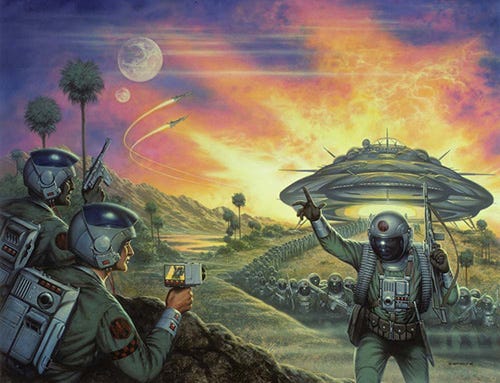
So it was against this backdrop that I was assigned John Dalmas’s The Regiment. And The Regiment presented me with a problem I couldn’t sidestep. All of the soldiers in the regiment are Black. That’s not a background detail or a throwaway line. It’s fundamental to the world Dalmas built, to the story itself. And I hate cover illustrations that directly mislead the reader.
One of my favorite cautionary tales in this industry is about an artist, a good, talented professional, was assigned a book but given only a scene description to work from. He went ahead and painted the cover featuring the lead character, turned it in, and thought nothing more of it. Then the book came out. His cover showed the lead character with two perfectly healthy arms. The problem? In the novel, the character had only one arm. Readers picked up the book, saw the cover, read the story, and thought the illustrator was an idiot, or worse, that he’d purposely misled them. What they didn’t know was that the illustrator had never been given the information he needed. He’s the one who took the blame. I did not want to fall into that trap.
So I went to the publisher, Jim Baen. I laid out the situation honestly. Here’s what the book is, here’s who these soldiers are, here’s the rule that everyone pretends doesn’t exist, and here’s why I can’t in good conscience follow it this time. And to his credit, Jim agreed. He said it plainly, it’s wrong to lie to the readers. I appreciated that more than I probably showed at the time.
The solution I landed on was that I gave the soldiers combat helmets that obscured most of their faces. If you look closely at that cover, you can see that the soldiers are Black. I made sure it was there.
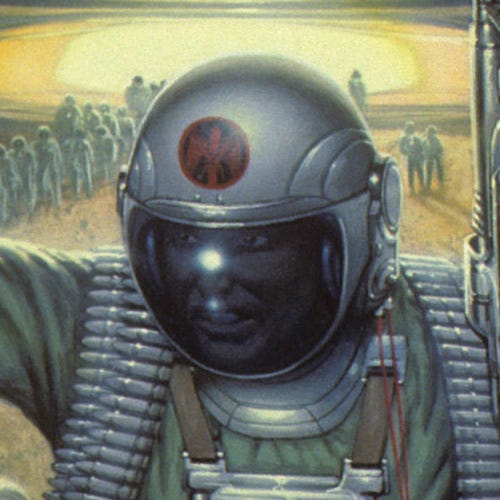
I didn’t whitewash John Dalmas’s vision. Was it a perfect solution? No. I wish I could have painted those soldiers’ faces without the helmet.

You might think that science fiction would be the last place this kind of thinking would survive. Science fiction is supposed to be about expansion. About imagining humanity at its best, reaching toward the stars, building civilizations across galaxies. It’s supposed to be about the radical possibility that people are people, no matter where they come from or what they look like. And yet, even in that far future, even among readers who will happily accept faster-than-light travel and aliens and the collapse of everything we know, some are put off by a face on a cover that doesn’t look like their own.
That tells you something about where we actually are, as opposed to where we like to think we are.