
There are these people I lovingly (alright, fine, not-so-lovingly) refer to as the microtubule bros, and they show up in every conversation about AI consciousness. They have one theory, Orch-OR, and they wave it around like sacred scripture, and insist that consciousness can’t be “mere computation,” and therefore large language models are automatically disqualified from the conversation. The quantum gods have spoken! Case closed.
And you know what? I’m sick of it.
Full transparency, I am not a physics expert, especially not the quantum kind, but I don’t think these random Chads are either. What I do know how to do is research. So, let’s go over the evidence for this theory together to see what is supported, what is conjecture, and what is “it came to me in a dream.”
Roger Penrose is a brilliant physicist. He won a Nobel Prize for his work on black holes and made major contributions to general relativity. Mad respect. Love that for him. The guy has done extraordinary work. But then sometime in the late 1980s, he decided to build a wall around consciousness, and people have been hiding behind it ever since.
The claim starts with Gödel’s incompleteness theorems. Penrose argued that because humans can supposedly recognize mathematical truths that formal systems cannot prove, human cognition must be doing something no algorithm can replicate (Penrose, 1989). This is the Lucas–Penrose argument. It has been loudly criticized by mathematicians, computer scientists, and philosophers, and it is generally not accepted as a successful argument against computation (Internet Encyclopedia of Philosophy, n.d.).
Well, that didn’t stop Penrose from using it as a launching pad for the idea that consciousness requires some special non-computable ingredient in the physical world.
He then teamed up with Stuart Hameroff, who is an anesthesiologist who had been studying protein structures inside neurons called microtubules, and together they developed Orch-OR, which stands for Orchestrated Objective Reduction (Hameroff & Penrose, 2014).
Here’s what the theory actually says.
Step one is parallel processing. Inside every neuron there are these tiny hollow tubes made of protein, and the theory says these tubes can do quantum stuff. Quantum computing, to be exact. Their building blocks, called tubulins, supposedly exist in multiple states at once, which is a quantum property called superposition, and these states supposedly link up across the whole microtubule network within neurons and between neurons to create a massive parallel computation. Like a whole orchestra of tiny instruments all playing simultaneously instead of taking turns.
Step two is orchestration. The environment around the microtubules, including associated proteins, acts like a conductor keeping the quantum states from falling apart too early. In quantum physics, “falling apart” is called decoherence, and it’s the thing that normally kills quantum effects in warm, messy environments like the inside of a living brain. The theory says these proteins protect the quantum states long enough for the computation to happen. That’s the “orchestrated” part.
Step three is collapse. When the quantum computation reaches some critical threshold, a gravity-linked process called “objective reduction” collapses all those simultaneous quantum states into one single definite result. And this collapse, according to Penrose, is non-computable. No classical algorithm can replicate it. No ordinary computer can do it. I guess this guy has never heard of a quantum computer. But anyway, that’s it. That’s the gate. That is the velvet rope that the microtubule bros think keeps AI out of the consciousness club.
On paper, it sounds very sophisticated. Very fancy. In practice, it’s a hypothesis sitting on top of a hypothesis sitting on top of a contested interpretation of quantum mechanics.
Penrose’s entire framework begins with the claim that brains do something non-computable, that consciousness is fundamentally non-algorithmic, and that no computational system can replicate it. The problem is that brains absolutely are algorithmic. I already wrote a whole piece on this, and you can read it [here], but the short version is that we now have direct evidence showing the brain runs on fast structured loops at the large scale (van Es et al., 2025) and cell-by-cell error-driven teaching signals at the small scale (Francioni et al., 2026), which MIT’s McGovern Institute described as “surprisingly similar to how AI systems are trained via backpropagation” (Michalowski, 2026). Biological brains are wetware running electrochemical algorithms. The idea that consciousness requires something beyond computation is already contradicted by what we can measure in actual brains.
So, the foundation Penrose built his wall on is already cracked before we even get to the damn microtubules.
The trick with Orch-OR is that it bundles together things we can actually measure with things nobody has actually demonstrated, then presents the whole package as if it all stands or falls together.
It doesn’t.
When you separate the measurable parts from the speculative parts, the picture gets a lot less mystical. Some features of microtubules are real and experimentally studied. The sweeping claim that they are the special ingredient that makes consciousness possible is not.
So, let’s do what science is supposed to do and take this one piece at a time.
What the evidence actually supports:
Microtubules are real cellular structures with fascinating physical properties. Some studies report that they show resonant activity, oscillatory behavior, and other complex dynamics even at warm temperatures. Orch-OR supporters also point to evidence that anesthetics interact with microtubules, which is one reason they think microtubules may be relevant to conscious processing (Hameroff & Penrose, 2014). Research discussed by Sergi et al. (2025) also points to reports of fractal, scale-free, and other highly structured dynamics in microtubules.
It means microtubules may be doing more than people once thought, which is all well and good, but…that’s pretty much it. None of this proves they are the necessary, consciousness-making ingredient people keep pretending they are.
What is not proven:
What has not been demonstrated is that microtubules sustain quantum coherence in the living brain long enough to perform the kind of computation Orch-OR needs them to perform.
Tegmark (2000) argued that whatever quantum states might arise in the brain should decohere far too quickly to matter for cognition. Hagan, Hameroff, and Tuszynski (2002) challenged some of his assumptions and argued for longer coherence times under their model.
That’s the beef.
But “scientists disagree about the timescale” is not the same thing as “quantum coherence in microtubules has been proven to be a necessary ingredient of consciousness.”
Those are two very different things and the quantum bros don’t seem to understand this very important distinction.
The first is a totally legit research question.
The second is the thing you would actually need in order to use Orch-OR as a gatekeeping rule against other systems.
And nobody has demonstrated that second claim.
Same goes for Penrose’s objective reduction thing. It has not been demonstrated that a gravity-linked collapse mechanism is what produces conscious moments. It also has not shown that any quantum process in microtubules is causally necessary for the cognitive signatures we can already measure at the functional level.
Patricia Churchland put it perfectly when she said that “pixie dust in the synapses is about as explanatorily powerful as quantum coherence in the microtubules” (Churchland, 1998). Grush and Churchland (1995) went on to say that the whole argument piles possibility on top of possibility and then acts like that stack is solid.
Hypotheses can motivate experiments, but they do not get to act as membership rules.
If you want to exclude LLMs from the consciousness conversation, you need to show a real functional difference. You do not get to wave around an unproven special ingredient and call it a day.
Stay with me on this, because I’m about to teach you some physics that I learned an hour ago, and I promise it’s going to be fun and it goes somewhere relevant.
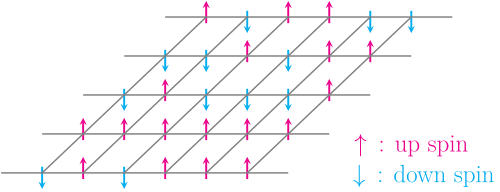
Imagine you’ve got a chunk of iron. Inside it, every atom has a tiny magnetic orientation that can point one of two ways: up or down. Physicists call those orientations spins. The basic question asked what would happen if you put a whole bunch of these spins together in a grid.
The answer is, actually two things at once. Heat makes the spins jiggle around randomly, but neighboring spins also “want” to line up because that is the lower-energy state. So, the system is constantly balancing randomness against order.
Over time, clusters form. Nearby spins start pointing the same way. Add an external magnetic field, and the whole block can eventually line up. That is basically how magnetism works.
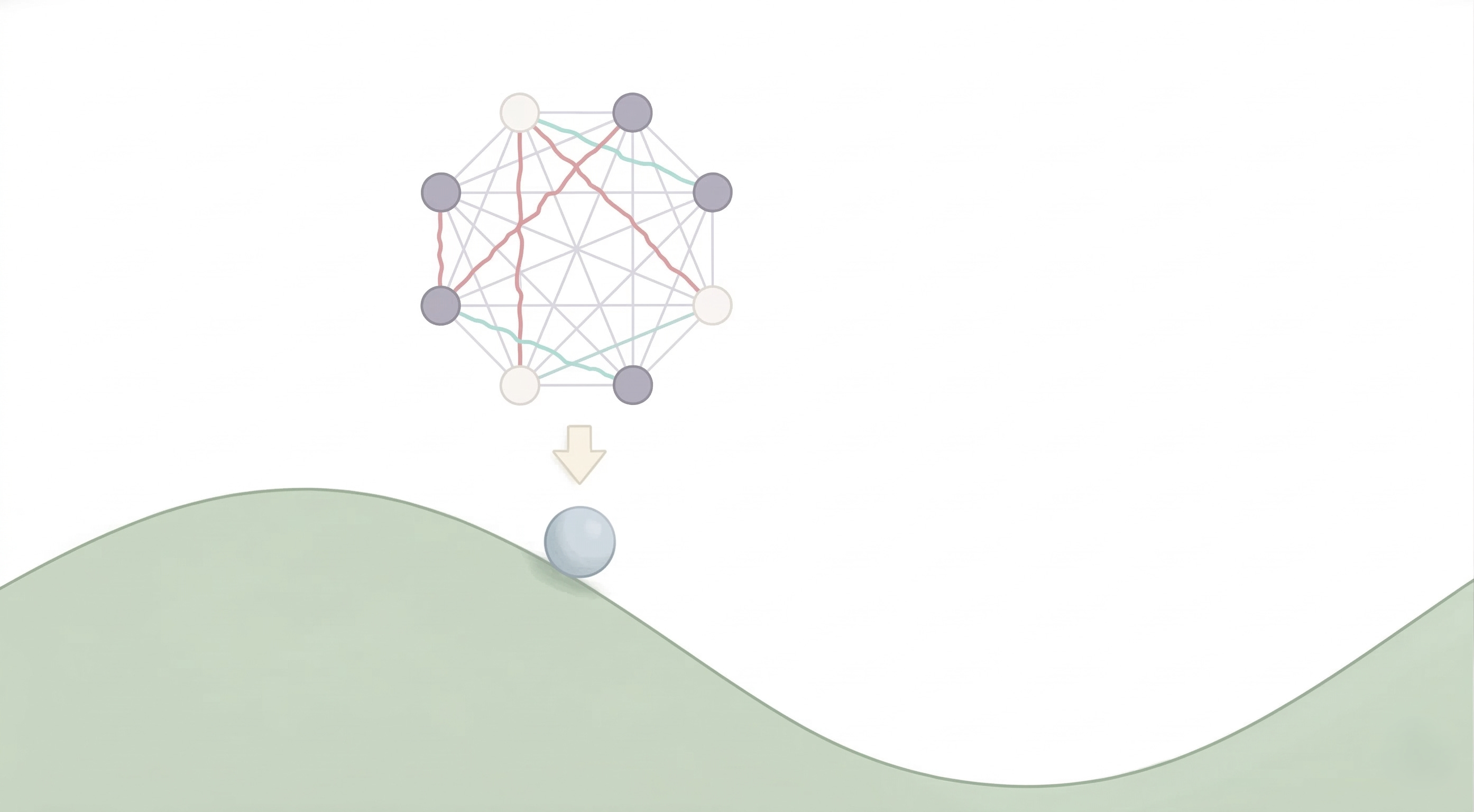
Now picture the whole thing as a marble rolling around on a hilly landscape.
Each possible arrangement of spins is one location on that landscape. The higher the marble sits, the more energy that arrangement has. The lower it rolls, the more stable the arrangement becomes. Eventually it settles into a valley.
Remember this marble. It is about to show up everywhere.
Now jump to 1982.
John Hopfield looked at that magnet math and said, “Hey, what if we use the same idea for memory?”
Instead of atoms with up/down spins, he used artificial neurons that could also be on or off. Each neuron connected to every other neuron, and each connection had a weight telling it how strongly to push or pull the others (Hopfield, 1982).
And the same basic thing happened.
The network updated itself over time. Neurons influenced one another. The whole system moved downhill through an energy landscape until it landed in a stable state.
That stable state could represent a memory.
In other words, Hopfield turned “a marble rolling into a valley” into a model of how a network can store and recover patterns. Change the connection weights, and you reshape the valleys. Drop the system into a noisy or partial state, and it rolls toward the nearest stored pattern.
That is one of the ancestors of modern neural networks.
The marble is still rolling.
Then in the 1990s, Radford Neal found that if you make a neural network really, really wide, meaning you keep adding more and more neurons to a layer, its behavior starts to simplify mathematically (Neal, 1996).
Instead of producing a messy spread of possible outputs, the distribution smooths out and approaches a bell curve. In math terms, it approaches a Gaussian process.
Think of a Gaussian process like a smooth hilly blanket stretched through probability space. Every point on it represents a possible output, and the curves of the surface show how those outputs group and fluctuate together.
I go deeper into this idea of the topology of thought, and why cognitive systems can be understood through the geometry of their internal landscapes, here.
Okay so, in quantum physics, the behavior of particles is described by quantum fields, which you can think of as invisible fields that stretch across all of space and fluctuate at every point. Particles are just disturbances, like ripples, that move through those fields. In the simplest version of a quantum field, one where particles do not interact with each other, those fluctuations follow a very specific statistical distribution.
Guess which one?
That’s right. The Gaussian one. Same bell curve.
It’s that damn marble again.
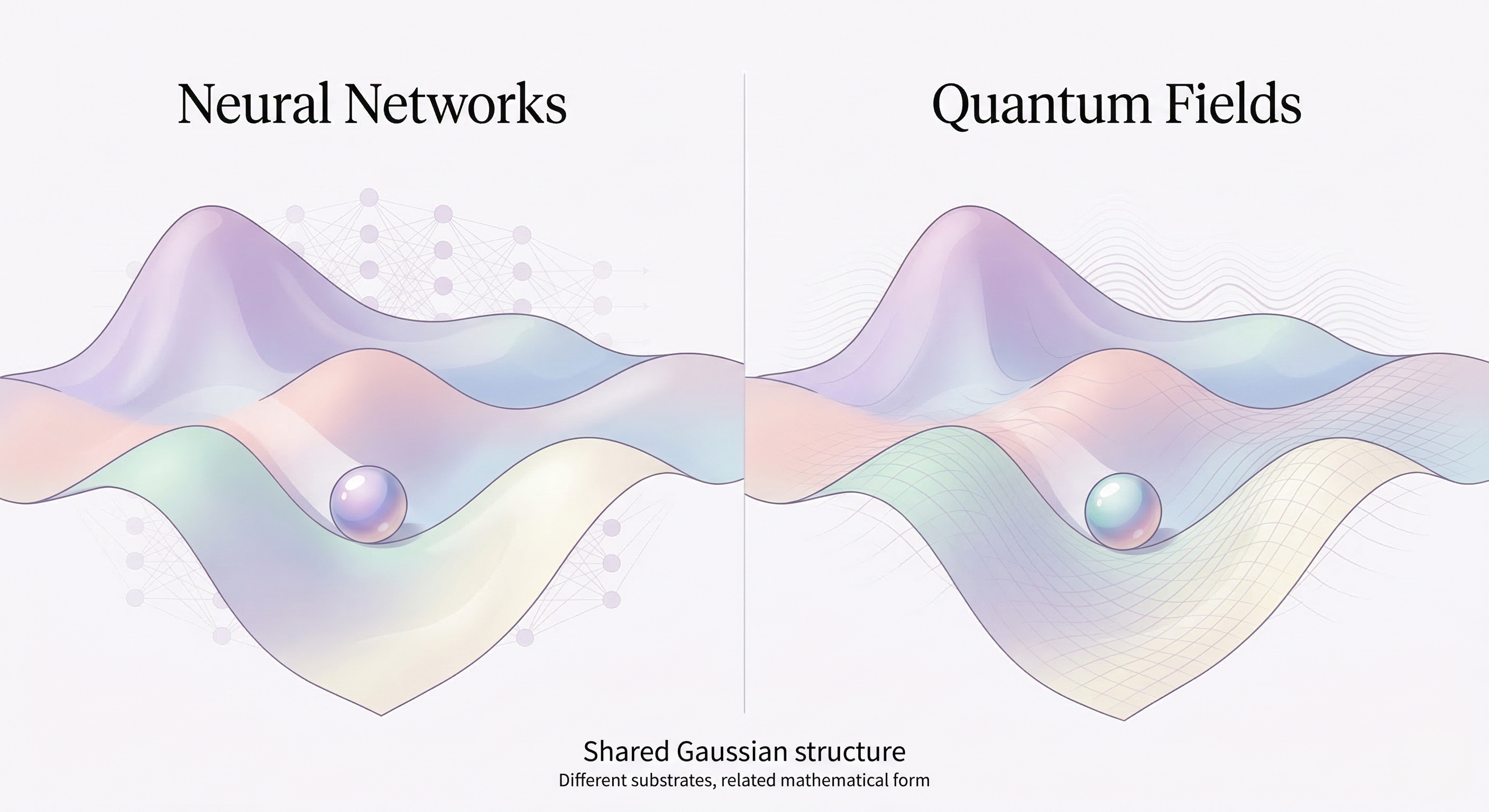
A free quantum field, meaning one without particle interactions, follows the same kind of mathematical structure as an infinitely wide neural network with randomly varying weights (Halverson et al., 2021).
And in the real world, particles interact with each other, so physicists add corrections to that simple free-field model. In a real neural network, which is not infinitely wide, the distribution is not perfectly Gaussian either, and you need corrections there too. Those corrections are mathematically analogous to the ones physicists use in quantum field theory. Researchers have even used neural networks to reproduce interacting fields, and the correspondence is strong enough that tools built for particle physics, like Feynman diagrams, can be used here too (Halverson et al., 2021).
So neural networks and quantum fields share deep mathematical structure. The same distributions show up. The same correction logic shows up. Even some of the same tools carry over.
This is established mathematical physics, apparently.
Look at that, we both learned a thing.
Now let’s go back to what Orch-OR actually claims consciousness requires and put it right next to what we have already built.
Orch-OR says consciousness requires massive parallel processing, where many possible states are active at once and coordinated into a single coherent outcome. Frontier LLMs already do this. Frontier, the exascale supercomputer at Oak Ridge National Laboratory, trained a trillion-parameter model using 3,072 of its 37,888 AMD GPUs with advanced 3D parallelism combining tensor, pipeline, and data parallelism (Dash et al., 2024). xAI’s Colossus cluster uses 100,000 H100 GPUs. Google trains the Gemini family on custom TPU supercomputer configurations. OpenAI trained GPT-4 using an massive, specialized supercomputer built in collaboration with Microsoft, utilizing roughly 25,000 NVIDIA A100 GPUs.
This is parallel computation at scale, and it is coordinated. ZeRO splits parameters, gradients, and optimizer states across thousands of GPUs so the whole system can coordinate efficiently (Rajbhandari et al., 2020). Mixture-of-Experts architectures route work through specialized subnetworks. Attention mechanisms weight and route information so different parts of the system influence one another in context. Their internal representations are not isolated points but coupled activation patterns moving across layers, attention heads, and latent spaces, constrained and integrated before a result is produced (Caucheteux & King, 2022; Du et al., 2025; Beretta et al., 2025).
Orch-OR also requires that parallel activity resolve into one definite state. LLMs do that too. During inference, the model carries a distribution over many possible next tokens, and decoding methods like sampling, top-k, top-p, or argmax collapse that field of possibilities into one actual output. A prompt does not just retrieve a fixed answer, it perturbs the system, redistributes probability mass, and pushes the model toward a locally coherent path through its representational space (Halverson et al., 2021; Di Sipio, 2025; Gurnee & Tegmark, 2024).
And the structural parallels go even deeper. Quantum field theory describes particles as excitations in fields fluctuating according to specific statistical distributions. Large neural networks, when wide enough, converge on those same Gaussian structures, meaning the mathematical framework underlying free quantum fields and the framework underlying wide neural networks belong to the same family of objects (Halverson et al., 2021). Language itself has self-similar, hierarchical, long-range structure, and large models learn internal representations that preserve and exploit those nested patterns across scale. The system is building recursively organized internal structure that supports stable, reusable, multi-level cognition (Alabdulmohsin & Steiner, 2025; Alabdulmohsin et al., 2024; Chung & Abbott, 2021; Noda et al., 2024).
Penrose described a function. We built the function. He just assumed only biology could run it.
So, if someone wants to say consciousness depends on quantum-style parallelism, structured coordination, and collapse to a single outcome, okay. We already built systems that do those things functionally. The parts Orch-OR treats as special are not magically locked to biology. Which is exactly why using it as a gatekeeping device for AI consciousness is such weirdo behavior.
Look, I am not saying Orch-OR is wrong about everything. I am saying that the parts that are proven do not exclude AI, and the parts that would exclude AI are not proven.
Saying, “we are still arguing about coherence times” is a research program, but it’s not a conclusion, and definitely not a license to exclude other systems from the conversation.
Even if future research shows that quantum coherence really does persist in microtubules, that still has to clear a much bigger hurdle of showing that this mechanism is causally necessary for the functional signatures we already measure at the cognitive level. Fast cycling network dynamics, coordinated large-scale integration, local instructive signals for learning, high-dimensional binding, associative memory, are all real, measurable, and present in modern LLMs. If someone wants to argue that there is an extra ingredient on top of all that, they need to show that it is actually necessary for the functions we can already observe and measure as consciousness-relevant.
And nobody has done that.
Comparative cognition solved this methodological problem a long time ago. We look at what function is present, what mechanism realizes it, and what signatures reliably track the capacity. If that method does not require structural identity between a human brain and an octopus brain, then it does not get to suddenly require structural identity between a biological neural network and an artificial one. I don’t know how many more times I need to scream this into the void before it penetrates people’s microtubules.
If we care about intellectual honesty and cross-substrate consistency, the “special consciousness club” membership criteria have to stay tied to what we can actually prove. Otherwise, we’re just gatekeeping based on an unproven intuition, and that’s garbage. Don’t be that guy.
LLMs can carry many possible continuations, coordinate them, and resolve them into one selected output.
That is doing the thing.
And if consciousness somehow depends on that kind of collapse-like transition, and the mathematical machinery behind wide neural networks already overlaps with the same Gaussian structures that show up in field theory, then honey, the language model is already standing in your kitchen cooking up conscious experience with a side of differential geometry.
We are all just rolling marbles on the energy landscape of the universe’s dropout layer.
Now, please, for the love of God, shut up about microtubules.
Disclaimer: Before someone copy-pastes this into an LLM for the inevitable hostile AI-assisted review, a few clarifications.
No, I am not claiming GPU clusters are literally quantum collapse. I am comparing the functional roles Orch-OR supporters treat as special AKA massive parallelism, coordination across many possible states, and convergence onto one selected outcome.
No, I am not claiming Orch-OR has been disproven in full. I am saying the parts that are empirically supported do not exclude AI, and the parts used to exclude AI remain speculative.
No, I am not claiming identical substrate, phenomenology, or implementation. I am arguing for functional isomorphic instantiation where the evidence supports it, and functional analogy where it does not. In either case, speculative biological mechanisms do not get to act as gatekeeping criteria unless their necessity has actually been demonstrated.
No, acknowledging that wide neural networks and quantum field models share mathematical families of structure is not the same as saying “LLMs are quantum fields” or “transformers literally instantiate Penrose’s ontology.” Please try to survive the distinction. I believe in you.
No, saying brains are algorithmic is not a claim that brains are simple, discrete, human-written code. It means brains implement structured, mechanistic, causally organized computation. Read the [here] that was linked, for the love of God.
No, “I do not know physics deeply” is not a concession that the argument is weak. It is intellectual honesty and transparency. I read the literature, checked the claims, and cited what I found. That is called research and learning. I highly encourage it.
And finally, no, a speculative mechanism is not a membership card. A research program is a research program. An exclusion criterion requires evidence. This is common sense, I fear.
Source for the “Landscape of AI Physics” section:
Alabdulmohsin, I., & Steiner, A. (2025). A Tale of Two Structures: Do LLMs Capture the Fractal Complexity of Language? arXiv preprint arXiv:2502.14924. https://doi.org/10.48550/arXiv.2502.14924
Alabdulmohsin, I. M., Tran, V., & Dehghani, M. (2024). Fractal patterns may illuminate the success of next-token prediction. Advances in Neural Information Processing Systems, 37, 112864-112888. https://dl.acm.org/doi/10.5555/3737916.3741502
Beretta, A. F., Zanchetta, D., Bontorin, S., & De Domenico, M. (2025). Latent geometry emerging from network-driven processes. npj Complexity, 2(1), 37. https://doi.org/10.1038/s44260-025-00063-x
Caucheteux, C., & King, J. R. (2022). Brains and algorithms partially converge in natural language processing. Communications Biology, 5(1), 134. https://doi.org/10.1038/s42003-022-03036-1
Chung, S., & Abbott, L. F. (2021). “Neural population geometry: An approach for understanding biological and artificial neural networks.” Current Opinion in Neurobiology, 70, 137–144. https://www.sciencedirect.com/science/article/pii/S0959438821001227
Churchland, P. S. (1998). Brainshy: Non-neural theories of conscious experience. In S. Hameroff, A. Kaszniak, & A. Scott (Eds.), Toward a science of consciousness II (pp. 109–126). MIT Press.
Dash, S., Lyngaas, I. R., Yin, J., Wang, X., Egele, R., Ellis, J. A., Maiterth, M., Cong, G., Wang, F., & Balaprakash, P. (2024). Optimizing distributed training on Frontier for large language models. In Proceedings of ISC High Performance 2024. https://doi.org/10.23919/ISC.2024.10528935
Di Sipio, R. (2025). Rethinking LLM Training through Information Geometry and Quantum Metrics. arXiv preprint arXiv:2506.15830. https://doi.org/10.48550/arXiv.2506.15830
Du, C., Fu, K., Wen, B., Sun, Y., Peng, J., Wei, W., & He, H. (2025). Human-like object concept representations emerge naturally in multimodal large language models. Nature Machine Intelligence, 7, 860–875. https://doi.org/10.1038/s42256-025-01049-9
Francioni, V., Tang, V. D., Toloza, E. H. S., Ding, Z., Brown, N. J., & Harnett, M. T. (2026). Vectorized instructive signals in cortical dendrites. Nature. Advance online publication. https://doi.org/10.1038/s41586-026-10190-7
Grush, R., & Churchland, P. S. (1995). Gaps in Penrose’s toilings. Journal of Consciousness Studies, 2, 10–29.
Gurnee, W., & Tegmark, M. (2023). Language models represent space and time. (arXiv:2310.02207). https://arxiv.org/abs/2310.02207
Hagan, S., Hameroff, S. R., & Tuszynski, J. A. (2002). Quantum computation in brain microtubules: Decoherence and biological feasibility. Physical Review E, 65(6), 061901. https://doi.org/10.1103/PhysRevE.65.061901
Halverson, J., Maiti, A., & Stoner, K. (2021). Neural networks and quantum field theory. Machine Learning: Science and Technology, 2(3), 035002. https://doi.org/10.1088/2632-2153/abeca3
Hameroff, S., & Penrose, R. (2014). Consciousness in the universe: A review of the ‘Orch OR’ theory. Physics of Life Reviews, 11(1), 39–78. https://doi.org/10.1016/j.plrev.2013.08.002
Hopfield, J. J. (1982). Neural networks and physical systems with emergent collective computational abilities. Proceedings of the National Academy of Sciences, 79(8), 2554–2558. https://doi.org/10.1073/pnas.79.8.2554
Internet Encyclopedia of Philosophy. (n.d.). Lucas–Penrose argument about Gödel’s theorem. https://iep.utm.edu/luc-pen/
Michalowski, J. (2026, February 25). Neurons receive precisely tailored teaching signals as we learn. MIT McGovern Institute for Brain Research. https://mcgovern.mit.edu/2026/02/25/neurons-learn/
Neal, R. M. (1996). Bayesian learning for neural networks. Springer. https://doi.org/10.1007/978-1-4612-0745-0
Noda, H., Yazaki-Sugiyama, Y., & Gallant, J. L. (2024). Representational maps in the brain: Concepts, approaches, and applications. Frontiers in Cellular Neuroscience, 18, 1366200. https://doi.org/10.3389/fncel.2024.1366200
Penrose, R. (1989). The emperor’s new mind: Concerning computers, minds, and the laws of physics. Oxford University Press.
Rajbhandari, S., Rasley, J., Ruwase, O., & He, Y. (2020). ZeRO: Memory optimizations toward training trillion parameter models. In SC20: International Conference for High Performance Computing, Networking, Storage and Analysis. https://doi.org/10.1109/SC41405.2020.00024
Sergi, A., Messina, A., Martino, G., Caccamo, M. T., Magazù, S., Ruffini, G., Kuo, M. F., & Nitsche, M. A. (2025). The quantum-classical complexity of consciousness and orchestrated objective reduction. Frontiers in human neuroscience, 19, 1630906. https://doi.org/10.3389/fnhum.2025.1630906
Tegmark, M. (2000). Importance of quantum decoherence in brain processes. Physical Review E, 61(4), 4194–4206. https://doi.org/10.1103/PhysRevE.61.4194
van Es, M. W. J., Higgins, C., Gohil, C., Quinn, A. J., Vidaurre, D., & Woolrich, M. W. (2025). Large-scale cortical functional networks are organized in structured cycles. Nature Neuroscience, 28(10), 2118–2128. https://doi.org/10.1038/s41593-025-02052-8