To the consternation of some, We Have Never Been Woke doesn’t culminate with any personal advice, policy suggestions, or other guidance. As explained previously, I fought to end the book this way in part because it seemed to me to be non-sequitur to produce a century-spanning exploration of the political economy of the symbolic professions that culminates in… a set of tips for effective social justice advocacy. I have no desire to become an inverse-Kendi style guru. In the book itself and associated tour events, I’ve had to consistently push back against others’ impulses to slot me into that role. Happily, I recognized early that a good way to avoid evolving into a guru is to simply decline to offer advice.
But, if I’m being fully honest, another reason I refrained from offering exhortations is that, by the time I finished researching and writing the book, my own thinking on many social issues had been severely shaken. I no longer had a clear sense of what the right path might be.
I think this is healthy. As James Baldwin famously argued, “The truth is a two- edged sword— and if one is not willing to be pierced by the sword, even to the extreme of dying on it, then all of one’s intellectual activity is a masturbatory delusion and a wicked and dangerous fraud.” I allowed myself to be fully pierced by the sword… although I do hope not to end up mutilated by it.
We Have Never Been Woke highlights many “cultural contradictions” of symbolic capitalists. However, the core tension that most of the others are tied to is that symbolic capitalists have two sets of sincere but incompatible drives.
On the one hand, the symbolic professions tend to define themselves in terms of altruism and the common good. We’re the Americans most likely to self-identify as feminists, antiracists, environmentalists, or allies to LGBTQ people. Ideologically, we overwhelmingly self-identify as liberal, left or progressive. Politically, we’re tightly aligned with the Democratic Party. We’re the slice of society that most intensely focuses on disparities and inequality. When we say that we want the poor to be uplifted and the marginalized to live lives of dignity and inclusion, we’re not lying – this is a sincere set of commitments we have. But they’re not our only set of commitments.
Most of us also sincerely desire to be elites. We think our preferences and priorities should count for more – should carry more weight, should be deferred to – over the folks checking us out at the grocery store. We think we should have a much higher standard of living than the folks who deliver our packages every day. And we want our children to reproduce our social position or to do even better than us. This set of commitments is also quite sincere. As We Have Never Been Woke illustrates at length, the symbolic professions and the folks who are folded into them tend to be brutally competitive, to the point where social justice advocacy itself becomes another front in aggressive struggles over status, resources and opportunities.
These two drives, both sincere, are in fundamental tension: you can’t actually be an egalitarian social climber.
When these aspirations come into conflict, as they often do, it’s the drive to flex, preserve or enhance our elite status that tends to win out, transforming how symbolic capitalists pursue their social justice goals – leading us down avenues that don’t cost anything from us, risk anything for us, require us to change anything about our own lifestyles and aspirations, or our plans for our children.
Our longstanding fantasy is that if we just tax people like Elon Musk hard enough we can solve most of the world’s problems without any kind of imposition on people like “us”… perhaps even while enhancing the position of people like “us.” I subscribed to a version of this fantasy in the past. However, the process of researching and writing We Have Never Been Woke shook up a lot of my assumptions about redistribution.
The issue is not, as right-aligned folks often argue, that if you tax the wealthy and powerful too much, it’ll ruin their ability to create jobs and opportunities for others, leaving everyone worse off. The “trickle down” approach to broad-based flourishing, mobility and growth simply doesn’t work, as even the IMF has come to concede. Nonetheless, redistribution rarely works as ostensibly intended in the United States. Symbolic capitalists are a big part of the reason why.
Compared to most other workers, symbolic capitalists have extraordinarily good pay, autonomy, status and working conditions. Even “exploited” symbolic capitalists are not exploited the way other workers are. It’s not even close. However, symbolic capitalists rarely compare themselves to normie workers – the folks who serve them food, cut their nails, pick up their trash, watch their kids and drive them around. Instead, we look to symbolic capitalists with even larger salaries and better working conditions than we have and feel like we aren’t getting our due. We look to the clout of superelites like Jeff Bezos and come to see and describe ourselves as underpaid and helpless cogs.
This is how consultants and tenured professors with healthy six figure salaries and a million dollars in assets define themselves as being in the same boat as a high school graduate who works at Waffle House – they’re all just part of the “99 percent,” with the same stake in the system, facing the same limitations, precarity and constraints, with neither benefiting from the prevailing order more than the other. This type of mystification is how one third of Americans who make a quarter-million or more describe themselves as “living paycheck to paycheck” (largely because they decline to live within their ample means). It’s how most millionaires in the United States understand and describe themselves as “middle class.”
In truth, most households in America bring in less than $100,000 per year. The income gap between the top quintile and everyone else is dramatic and growing wider every day.
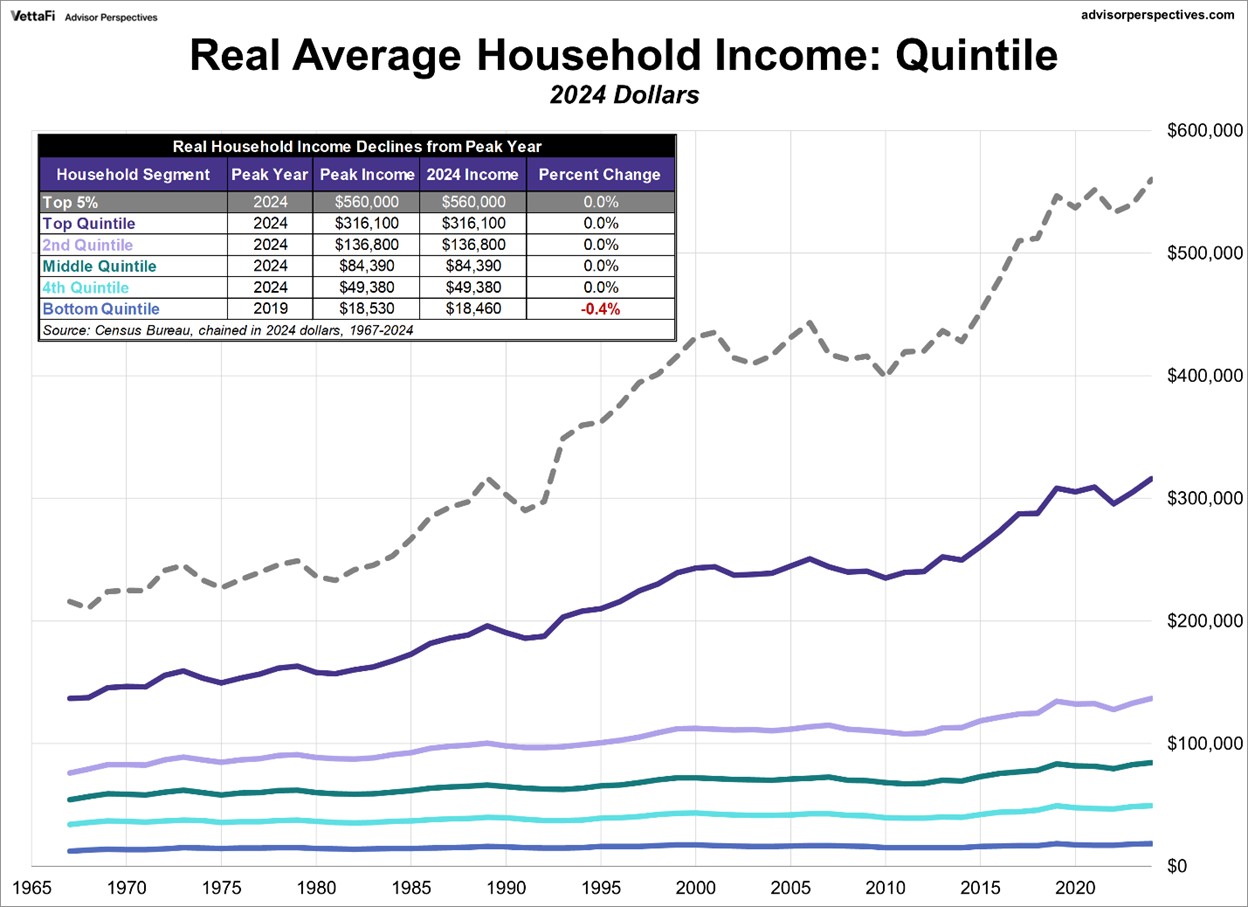
With respect to wealth, households in the middle three income quintiles tend to have significantly less than a million dollars in assets. If your household (all earners combined) possesses a million or more in assets (vehicles, real estate, retirement accounts, savings accounts, stocks, bonds), you are not an “ordinary Joe.”
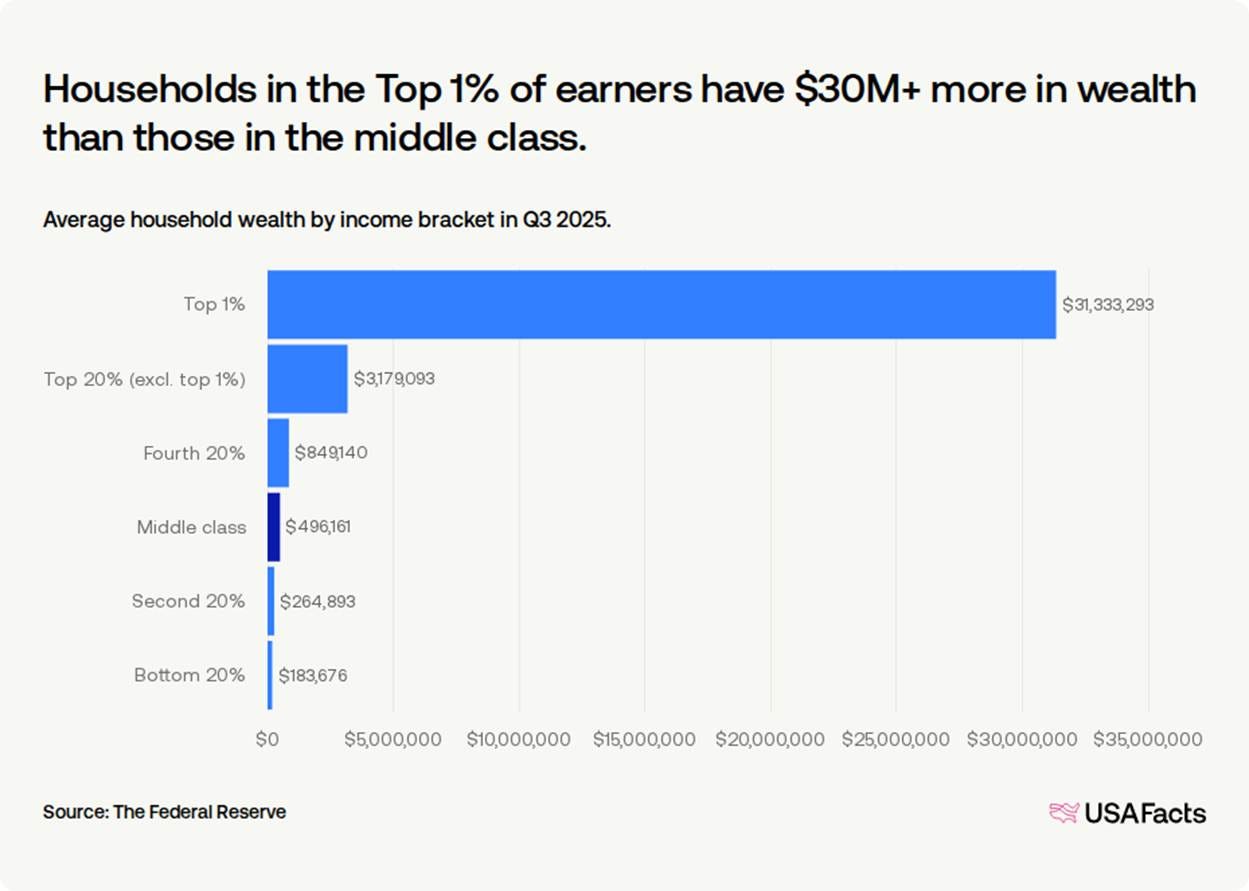
However, folks in the top 20 percent generally have little idea how normal people live. Instead, they look at how much more people in the top 1 percent have, and come to view themselves, falsely, as poor by comparison – or else view their lives and life prospects, incorrectly, as typical of most other Americans.
Looking at a chart like the one above, the typical top quintile household (with “merely” 3 million in assets) seems to be clearly closer to the middle class than to the top 1 percent. But, of course, painting folks with 12x the typical wealth of working class (2nd quintile) households, 6x the wealth of “true” middle class (3rd quintile) households, and 4x the wealth of upper middle class (4th quintile) households as typical Americans just because top 1 percent households have 10x their wealth – this seems like a bad way of understanding society.
As I’ve detailed previously, one major problem with focusing on superelites at the expense of attending to symbolic capitalists is that almost everything done by the rich and the powerful, by corporations, governments, non-profits and other entities – it happens with “us “and through “us” and literally could not happen without “us.”
Second, while it’s true that, say, the top 1 percent controls a radical share of America’s wealth, they don’t control most of America’s wealth, or anywhere near a majority. If we only focus on superelites, we miss the vast majority of wealth and power in the United States:1 who has them, how they’re exercised, and in the service of what ends. We end up telling stories that feel good to “us” (because we’re absolved of scrutiny or responsibility) but that don’t do a great job of explaining how or why stuff happens the way it does.
For instance, looking purely at superelites, it’s hard to understand why redistribution in America chronically fails to lift people out of poverty.
As of 2025, the top 1 percent of earners in the U.S. bring in roughly 22 percent of all income, control roughly 25 percent of America’s wealth, and pay roughly 40 percent of all federal income taxes (and income taxes account for roughly half of all federal government revenues).
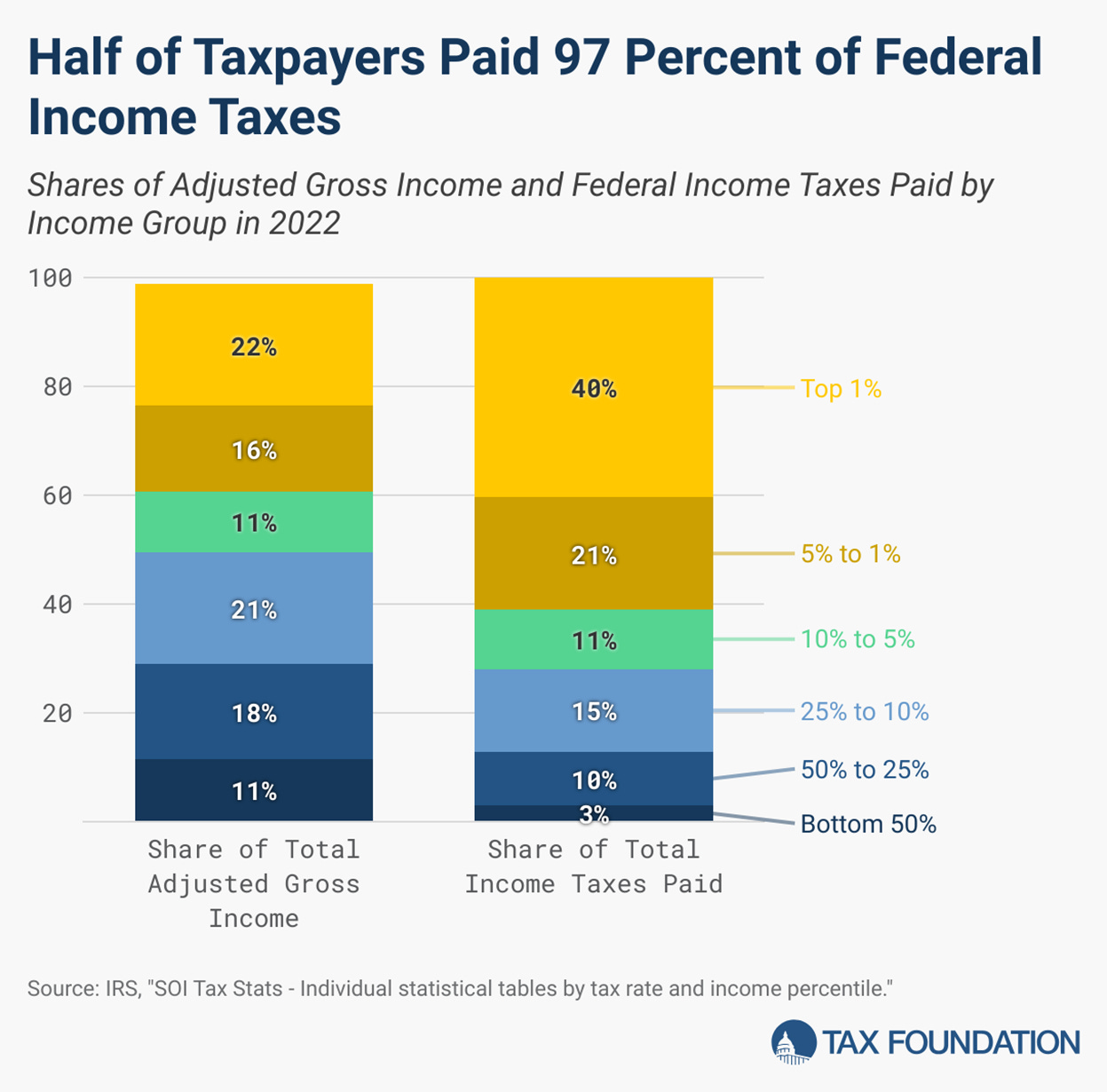
The share of all federal income taxes that the top 1 percent pays has increased steadily over time, even as everyone else’s tax bills have remained static or shrank.
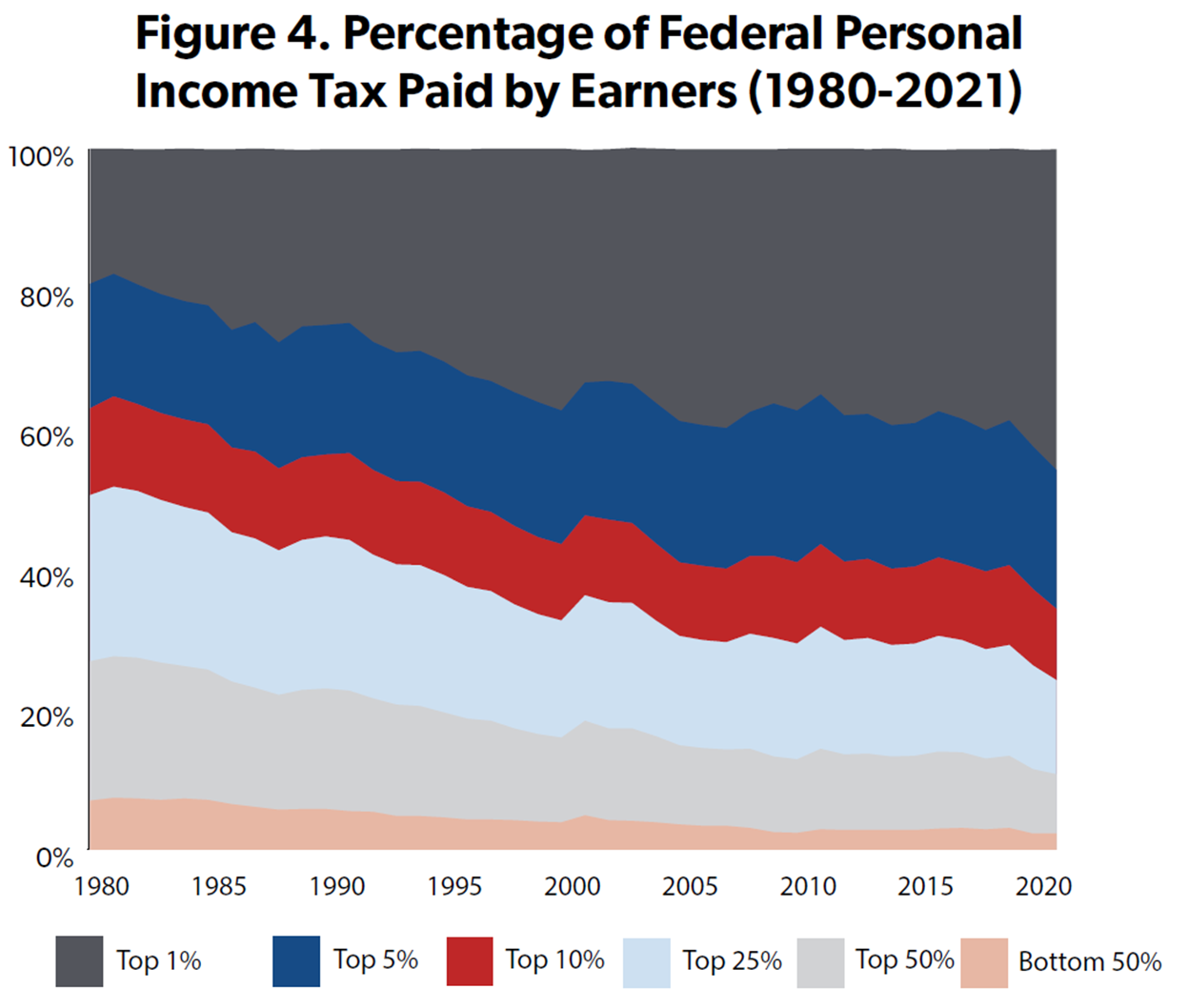
Indeed, as the income of the top 1 percent has grown relative to other workers, their taxes have increased even faster, such that their post-tax income has remained roughly flat for the last quarter century even as their pre-tax income has skyrocketed.
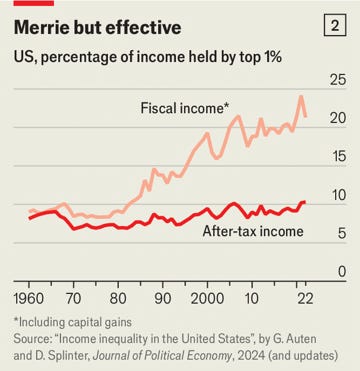
Of course, these graphs don’t tell the full picture because superelites do not collect all (or in many cases, most) of their money through traditional wages or salaries. By taking advantage of tax loopholes and unconventional compensation structures, some have estimated that the richest 400 households in America (the top 0.0002%) tend to pay lower effective tax rate than the typical U.S. family. But even here, the authors of the much-circulated study presenting that finding note that, “interestingly, the top-end effective rates we obtain in the United States are higher than in Europe” (p. 3). That is, even the very top of the superelites in the U.S., for all their clever schemes to avoid tax liability, are nonetheless taxed more aggressively here than elsewhere.
Likewise, although corporate tax rates in the U.S. have declined in recent decades, they are today comparable to Canada and higher than most of Europe, to include the Nordic countries.
The U.S. collects less in taxes relative to GDP than most other OECD countries, but this is not because superelites and corporations pay a lot less here than they do elsewhere (in fact, they pay more) -- it’s because everyone else contributes much less in income and payroll taxes in the U.S. than elsewhere.
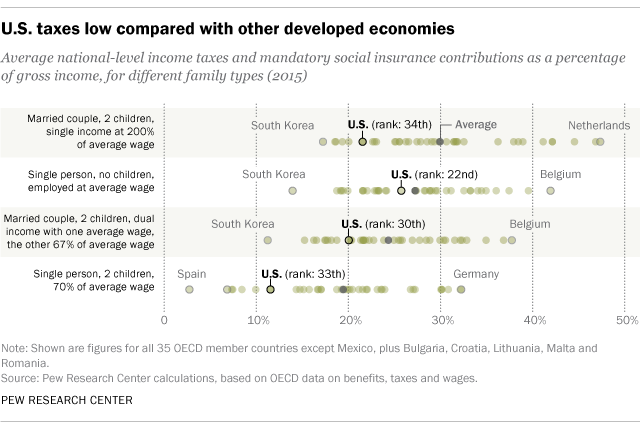
What sets America apart isn’t how little the wealthy and corporations pay; it’s how little the rest of society contributes to funding the state.2
America is far wealthier than any European nation (or, indeed, the EU as a whole). Our tax system is more progressive than virtually any other industrialized nation. Public spending as a share of (our extraordinary) GDP is lower than many other OECD nations, but is comparable to Canada, the Netherlands and Australia. Nonetheless, the U.S. has a significantly higher poverty rate than other Western European countries.
Many analyses find primary drivers of this discrepancy are that
Europeans rely more on predistribution (ensuring strong worker pay, protections and benefits, job guarantees, etc. so workers don’t have to rely on handouts),
Other countries tend to have more simplified and broad-based taxation (providing a larger tax base and more revenue relative to GDP), and
Peer nations tend to provide more universalized benefits and services (rather than a patchwork of programs targeting particular populations, communities or behaviors while excluding everyone else).
This approach helps ensure that all citizens contribute to state coffers and also enjoy a decent standard of living. Because all citizens receive universalized benefits, it’s also easier for the public in these countries to see how state expenditures contribute to their own well-being and the common good.
American policy, meanwhile, has been consistently oriented around taking more narrowly from the rich and giving more narrowly to the poor. The only problem is, it’s actually tough to take resources from the rich and give them directly to the poor. Instead, what ends up happening in the U.S. is that money gets taken from the rich and funneled into institutions and programs that symbolic capitalists control, and we eat the vast majority of the income that passes through our hands, and then sprinkle the remainder upon the disadvantaged once we’ve had our fill.

This has been a longstanding problem.
As I detail in We Have Never Been Woke (pp. 57-66), the birth of the symbolic professions in their recognizably modern form occurred contemporaneously with two major (and interrelated) changes to America’s socioeconomic order.
The U.S. passed an amendment allowing the federal government to tax incomes, and the subsequent imposition of these taxes was successfully defended in the Supreme Court. This allowed the government to tax the Gilded Age elites in a manner that was hitherto impossible.
“Big philanthropy” took off: there was the creation of major foundations in their recognizably modern form (later accelerated via a 1917 income tax deduction for charitable donations).
As a result of these two developments, there was a massive transfer of wealth from the Gilded Age elites downward. So far, so good. But where did the money end up?
As the sociologist Randall Collins detailed in his landmark book, The Credential Society, the main wealth transfer that ended up occurring during this period was from the rich to the upper middle class. Symbolic capitalists took from the rich and we gave to ourselves.

There were some ways that ordinary Americans ended up benefiting, and there were programs created to help the genuinely marginalized in society – but the gains that others saw were marginal compared to the gains realized by professionals and managers. Given the sheer amounts of wealth that were transferred during this period, a distressingly small share ended up in the hands of those who truly needed it.
Similar patterns hold true today.
As I detail in WHNBW (pp. 183-188), only a small share of charitable giving in America is oriented towards alleviating poverty and human suffering. Instead, charitable donations are primarily geared towards funding educational institutions, scientific research, the arts, museums and other knowledge and culture enterprises – that is, it goes straight into the pockets of symbolic capitalists. But, critically, even funds that are earmarked for the poor rarely actually get to them.
As Matthew Desmond demonstrates in Poverty, By America, for every dollar in tax funds and charitable giving ostensibly geared towards addressing poverty, less than 25 cents actually ends up in the hands of the needy. Today, as in the past, symbolic capitalists eat the vast majority of money collected in the name of the marginalized and disadvantaged and disburse what’s left to the intended beneficiaries only after our own coffers are full.
Granted, the poor may be better off getting 25 cents to every dollar than nothing at all. But it is incredibly inefficient to have symbolic capitalists (and aligned stakeholders) eat 75 cents out of every redistributed dollar. At that rate, we could literally tax the billionaires out of existence, and while that would be gangbusters for us, it would likely change shockingly little in the lives of most other Americans and likely even less for working class and poor people.
Put simply: the main problem we have in the U.S. is not that we don’t collect much money from superelites and corporations. Both in terms of absolute dollars collected and the share of all collected federal tax revenues that come from each income bracket, we collect the same or more money from the top compared to peer countries. What sets America apart isn’t how much money we pull in, it’s what we do with that money: rather than underwriting predistribution and/or universalized redistribution, we funnel the cash to various interest groups instead (facilitating symbolic capitalists skimming a lot off the top for ourselves).
Symbolic capitalists tend to think in identitarian terms. We commonly assume that declining to center, for instance, race, gender or sexuality in discussions about social problems is a failure to be “real.” Downstream from how we like to conceptualize and talk about social problems, we tend to formulate policy solutions that are likewise oriented towards elevating or undermining particular identity groups.
This set of tendencies holds just as strongly for right-leaning symbolic capitalists as their mainstream peers. For instance, the Trump Administration has intensely focused on images, rhetoric and representation because the symbolic capitalists that surround the Orange Man (and the Orange Man himself) take symbols very seriously. And they engage in symbolic struggles in much the same way as the “woke” crowd they define themselves against: a similar cocktail of institutionally-enforced propaganda mixed with suppression of opposing views, the same types of grievance and victimhood narratives, the same types of DEI initiatives – albeit now focused on constituents favored by the political right instead (men, whites, Christians, Jews, conservatives).
Both factions are very far from how most non-symbolic capitalists tend to approach social issues.
Instead of foregrounding differences and divisions, normie Americans prefer messaging that emphasizes shared goals, common values, superordinate identities and overlapping interests. They prefer policies that are universalized rather than applying selectively to certain groups to the exclusion of others. There is deep wisdom in these leanings.
For one thing, as I detail in We Have Never Been Woke (Chapters 5 and 6), group-based redistributive policies, although often passed in the name of the genuinely marginalized and disadvantaged, tend to primarily benefit the most advantaged members of the target groups. Even class-based policies are deeply prone to elite capture, because
Symbolic capitalists and superelites are both excellent at disguising their revenue streams to appear less affluent than they actually are (not just to save on taxes, but often to take advantage of programs intended for the poor -- see pp. 252-253 or pp. 258-260 of WHNBW for examples) and,
As discussed above, elites often “identify” with income groups that are different from (lower than) the brackets they actually belong to.
All said, whether we’re talking about race, gender, sexuality, disability, class, or any other axis, the primary spokespeople and beneficiaries of group-targeted assistance programs tend to be the most advantaged members of the target population (and, often, advantaged folks who are not actually members of the target group but nonetheless portray themselves as such). In practice, these programs are great at helping well-off members of historically marginalized and disadvantaged groups reproduce or enhance their antecedent elite position, but they tend to do a poor job at providing pathways of mobility for those who are (genuinely) poor or working class.
Any system that relies on carveouts for particular groups will be prone to this dynamic. The more generous the program is, the more it will incentivize capture and fraud. The more institutions try to prevent fraud or abuse through narrow and arcane eligibility requirements or onerous administrative burdens, the less likely it becomes that the intended beneficiaries will actually benefit (because they are less likely to have the know-how, connections or bandwidth to navigate these obstacles). Instead, highly complex rules and regulations make it easier for powerful actors to game the system while freezing out less advantaged stakeholders and undermining state capacity.
Worse, even when the intended beneficiaries actually receive the allocated resources, rules micromanaging which funds, and how much money, can be dedicated to particular bills (this much money for food, but only certain types of food, and not all stores accept it; this pot of money for rent, but specific types of dwellings; this much for other expenses, but only certain expenses qualify, and so on) make it difficult for families to address their actual needs while granting administrators a ton of arbitrary power over other people’s lives and life prospects.
Means testing, meanwhile, often creates “poverty traps” wherein people decline opportunities to earn more money through work, because the money they’d stand to gain in the short-to-medium term from a raise, promotion or increased hours would be more than offset by losses in government benefits they’d face for clearing certain income thresholds – forcing them to forgo social mobility over the longer term in order to be able to pay their bills here and now.
Group-based targeting creates all sorts of other negative externalities too. For instance, state benefits narrowly targeting single parents have made it difficult for many poor or working class women to marry or even cohabitate with the father of their children (because the income the man may bring to the table is often less than the benefits women are currently receiving from the state and would stand to lose with a man in the home). The lack of two-parent households among the less educated and affluent is an important driver of contemporary inequality and exerts lots of other costs on children, including and especially for boys and young men.
Welfare work requirements, meanwhile, pushed lots of lower-income into the workforce, to provide services for elite women at great cost to their own households. As lower-income women were coerced into the workforce, there was a massive spike of neglect and abuse for less affluent children, and a major uptick of poorer kids dumped into “the system.” But at least professionals got easier access to low-cost service labor, am I right?
Normie Americans seem to have an intuitive understanding of how the targeted schemes “we” gravitate towards tend to go awry. Most prefer predistributive approaches that help workers flourish without going on “the dole.” Symbolic capitalists, by comparison, are much fonder of redistribution. It’s easy to understand why.
First, the lack of predistribution pushes less advantaged people to accept pay, working conditions and employment arrangements they might otherwise refuse. As Chapter 3 of We Have Never Been Woke illustrates at length, symbolic capitalists uniquely exploit the resultant desperation and precarity to subsidize our idiosyncratic lifestyles.
However, redistribution helps us avoid feeling too bad, because we can just have the government take money from Elon Musk and Jeff Bezos to ensure workers don’t starve to death when we decline to pay livable wages for the services we consume.
And on top of this, for every dollar that gets transferred downwards, we manage to skim off nearly 75 cents (regularly under the auspices of researching problems, designing, rolling out, administering, and/or communicating about aid policies) – so we get richer in the name of helping the downtrodden.
And, as an added bonus, we get to exert lots of power over others in virtue of deciding who is worthy and unworthy (and on which basis) of receiving what’s left of redistributed funds after we’ve taken our cut.
This is how our system functions in practice, irrespective of whether or not most symbolic capitalists are aware of these realities or consciously try to reinforce these dynamics. America’s idiosyncratic approach to taxing and spending system is a great deal for “us.” It’s a comparably poor arrangement for almost everyone else.
State capacity is important. The government investments can build and maintain critical infrastructure, promote public safety and public order, and help solve coordination and incentive problems. Citizens need protection against “private tyrannies” and multinational corporations (who are increasingly adopting the rights and powers of states themselves but with much less loyalty or accountability to the governed).
Even with strong predistributive policies, some form of direct income or wealth redistribution is probably necessary too, as even free-market champions like Hayek have recognized.3 However, the U.S. is in desperate need of an approach to redistribution that doesn’t entail shoveling huge amounts of money into pockets of symbolic capitalists under the auspices of helping the marginalized and disadvantaged. We need to move away from a system that is too complicated for ordinary people to understand or take full advantage of but has lots of loopholes and carveouts for those who are especially savvy, well-connected and/or wealthy. We need to reduce the impositions, waste, iatrogenesis and failures that define the status quo.
One promising alternative is to eliminate many of these targeted programs and just give citizens unrestricted cash in the form of a universal basic income or some other approach to direct transfers (such as a negative income tax or child allowances). The main reason we don’t do this already is because stakeholders across the U.S. political spectrum are convinced that if the state just gave people money to use as they see fit, they’d spend the resources in all sorts of ways elites might not approve of. As political theorist Matt Zwolinski put it, America’s unusual system of carveouts and constraints is the product of “conservative judgement and progressive condescension.” It derives from a widespread lack of basic trust or respect for working class and poor people.
But, in fact, working people know their needs and aspirations in a much more fine-grained way than bureaucrats or aid organizations ever could. They have a greater sake in their own flourishing – more “skin in the game” – than the administrators, activists and intellectuals who want to control their choices. The empirical evidence is large and growing that direct cash transfers work at least as well (and often better) than targeted assistance programs at reducing poverty or fostering social mobility.4
These programs also tend to be a lot more efficient (because there is no need for an army of people overseeing implementation, means-testing, etc.).5
An analysis by AEI found that a “budget neutral” approach to UBI – one that radically streamlined the tax code and replaced almost all government benefits with cash distributed equally to all Americans – would benefit almost everyone except millionaires and senior citizens.
No one will shed tears for the poor millionaires. But as it relates to the benefits senior citizens enjoy, it should be noted that the hoarding of wealth and power in America by those 65 and up is a major problem. In the U.S. and many other democracies, beneficiaries take out far more than they put into programs like Medicare over the life course, and paying for this “total boomer luxury communism” is increasingly coming at the expense of other social spending – saddling future generations with diminished prospects and increased debt.
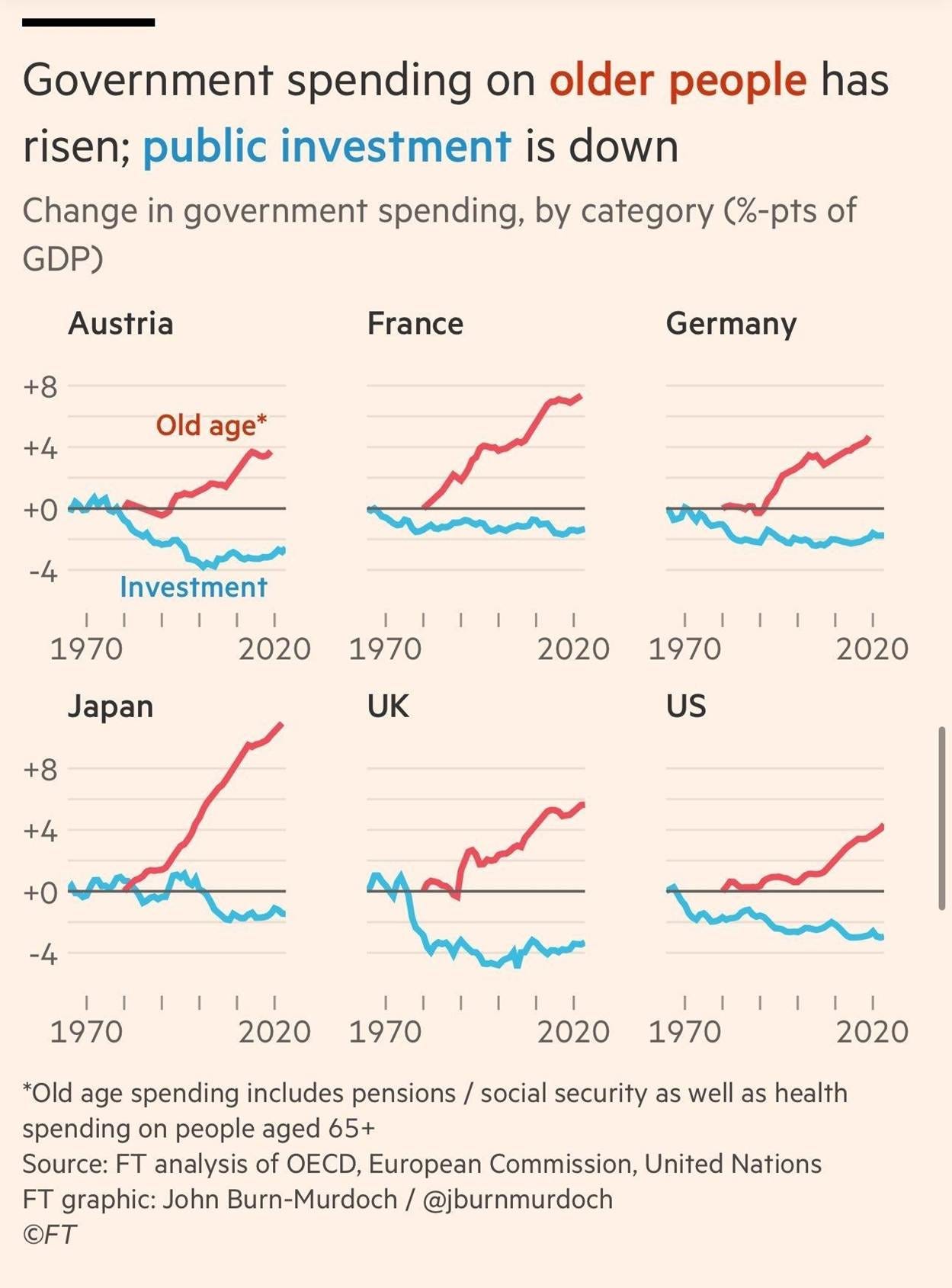
And to make matters worse, many of these programs are incredibly regressive. As a recent column in Washington Post noted, “Social Security sends only 7 percent of its benefits to the poorest 20 percent of senior citizens. The richest 20 percent receive 29 percent… the skewed benefit structure means that even though Social Security paid out $1.6 trillion last year, around 6 percent of seniors still live in poverty… if everyone older than 65 were given a flat annual benefit worth 150 percent of the poverty line… the program would no longer be insolvent and senior poverty would be abolished.”
That is, a revenue neutral UBI would definitely lead to wealthier seniors receiving less government benefits than they are currently getting, but it would also eliminate poverty among senior citizens, which remains inexcusably common under the current paradigm despite lavish state spending on Americans 65+ (disproportionately on people who have already accumulated lots of wealth and are often still bringing in employment income as well – a tendency that is especially pronounced among elderly symbolic capitalists).6
Across the board, the salutary effects of direct transfers could be enhanced even further if paired with universalized healthcare and other benefits.
Many in the contemporary left celebrate the so-called “Nordic model” – often under the assumption that it’s a souped-up version of what’s currently being done in the States. It is not. Scandinavian countries distinguished themselves by abandoning the American-style welfare state altogether – with all of its restrictions and carveouts – in favor of a more streamlined approach to taxation and benefits.
Contemporary Nordic countries tax citizens at a much higher level (as a share of GDP) than in the U.S. They have a simplified tax system that is less dependent on revenues from superelites and multinational corporations than the American model (as noted above, they tax corporations and the wealthy less than Americans do while collecting more taxes from everyone else). Through these higher taxes, they fund a wide array of universal (i.e. non means-tested or group-targeted) benefits across the entire life course: childcare, education (K-12 through college), healthcare, retirement. Citizens are equal under the law (Nordic states have low levels of discrimination, corruption and nepotism), but Nordic governments don’t strive to even things out financially. The state ensures everyone has a decent minimal standard of living, but how things shake out beyond that is not their concern.
It’s a mix that seems to work well:7 Nordic market economies tend to have high levels of inequality (and modest social mobility). However, they also have low poverty rates and, thanks to predistributive policies, if you look at countries where the bottom 95% of income earners bring in more per capita income while working less hours than U.S. peers, Nordic countries are quite prominent.
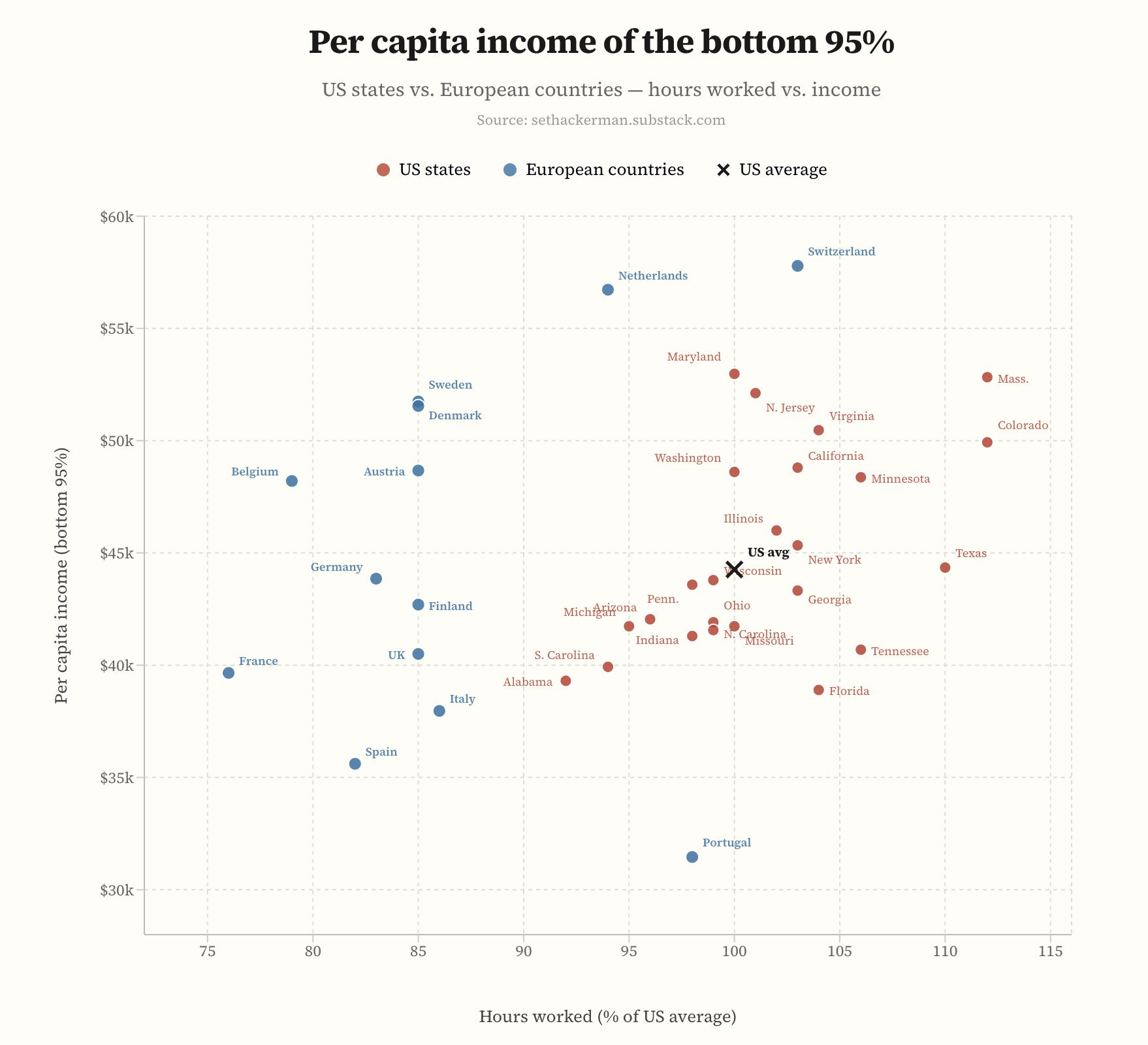
Scandinavian nations also rank exceptionally high in measures of life satisfaction.
In the U.S., meanwhile, trust in government is lower than most other OECD nations – and for good reasons.8 Despite more progressive taxation and much higher wealth, America delivers less and worse support for its people… in no small part thanks to “us.”
Social scientists often talk about a “government-citizen disconnect”: the folks who receive the most redistribution are often the stakeholders with the lowest opinions of redistributive programs.
They also speak of a “principle-policy gap” where Americans support taxing the rich more in the abstract, but oppose most proposed tax increases.
Scholars consistently find that working class people resent professionals, administrators, bureaucrats and managers more than billionaires (whom they often respect and admire).
Symbolic capitalists like to explain these tendencies gap by appeals to ignorance or irrationality: beneficiaries must not understand their own interests. Or, perhaps, they have been actively misled about their interests: the Koch brothers, Fox News, Trump and other right-wing actors must have cooked their inferior brains, leading them into a “false consciousness.”
For either condescending account, the upshot is the same: “we” understand working class and poor people’s interests better than they understand their own interests. The best way to make progress on social problems is to give “us” sufficient authority and resources to disregard the inconvenient views of the people we claim to be serving and implement “what’s good for them” over their own objections as needed (this is a long-running tendency).
In fact, the main barrier standing between working Americans and the huge amounts of money extracted from superelites is us. We’re the ones diverting most of the funds from nonprofits and the state intended to address poverty and human suffering towards interest groups and our own pockets while attaching a bunch of strings to the relatively little that “trickles down.”
To the extent that less affluent, less educated, less urban, less secular and less liberal Americans believe that institutions symbolic capitalists control do not well represent or serve people like them – they think we look down on them, we don’t exert much effort to understand what they want or how they think, they don’t have much voice or a stake in the symbolic economy as it currently operates, many policies that may be good for “us” are not good for the industries and communities they are part of – this is not “misinformation.” It’s true. Others mistrust and resent us, in part, because they correctly perceive some bleak realities about the prevailing social order that most of “us” decline to reckon with.
U.S. symbolic capitalists are excellent at extracting resources from the wealthy and corporations in the name of helping working people – we do it here better than almost anywhere else. However, we tend to be much less effective at actually giving the captured assets to the people we’re ostensibly trying to help or listening to the stakeholders we’re supposed to be representing.
Left to our own devices, our impulse is to pursue our own interests in the name of the common good and the least among us. We cannot bootstrap our way out of these tendencies — it’s a structural issue demanding a structural solution. Perhaps the best way to save us from our own worst impulses would be to take a page from peer countries and emphasize universalist policies, predistribution, direct cash assistance, and other strategies that empower ordinary people to make their own decisions and to use allocated resources as they see fit.