A few years ago, I was flying to a conference and next to me sat an older gentleman who happened to work for 40+ years in a traditional German corporation.
He was flying to Indonesia, to one of the offices of that corporation, to do a training for the countries C-level management. Apparently, that is what he is doing in his last years before retirement. He told me one of the advice about building a business that stayed with me for good. That is approximately what he said.
“Do you know why my company survived over a century? Longer than empires, entire countries, and many other companies that were much more famous. It is because it was never about being the best. It was not about being the one who released a revolutionary product or scaled production to an enormous size. It was about building to survive the hard times. My company was never the most innovative, never the fastest, never the one with the most breakthroughs. But it was always prepared when the crisis came. Its goal was not to lead, but to survive.”
In the past three years, reading each time about Sam Altman promising AGI and burning tons of cash, I kept thinking back to that conversation.
OpenAI only cares about leadership.
I even got an impression that they were way too arrogant to admit that one day it would no longer be a question of whether or not they are the first. The question whether or not they survive had never been on the table.
Leadership does not matter as much as some think. Peter Thiel in his book "Zero to One" wrote that in order to make your product successful it either needs to be the first of a kind or ten times cheaper. His book is a Bible for many young entrepreneurs, so unsurprisingly, OpenAI's initial dominance in the LLM world convinced many adventurous startup founders that they needed to follow OpenAI's lead. But being first means little to nothing long-term.
Here is a list of well-known companies, such as Perplexity, Midjourney, LangChain, and Cursor, that I split into two groups: those that are built to survive, and those that walk OpenAI's path and will most likely collapse together with OpenAI, or maybe even faster.
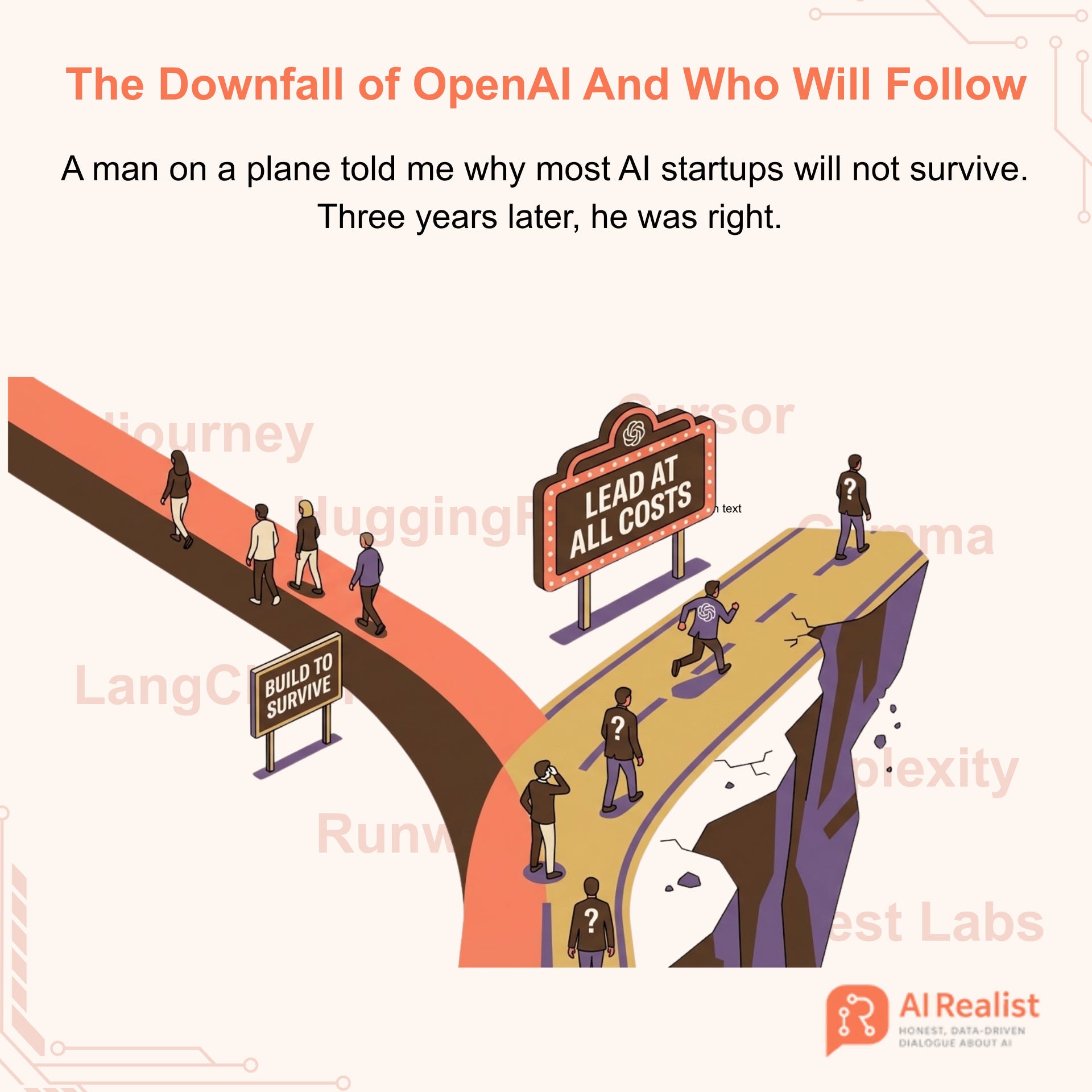
OpenAI’s approach to building a business is the eternal pursuit of leadership. It does not need to be realistic, achievable, or economically sane. The fundraising scheme has relied heavily on overpromising, and it only works as long as you maintain at least an illusion of leadership. No one can be a leader, forever. And if that is your only selling point: you do not build to survive but you build to hype.
The first time I seriously suspected that OpenAI was in deep trouble was when, after the first announcement of Sora in February 2024, no model was released.
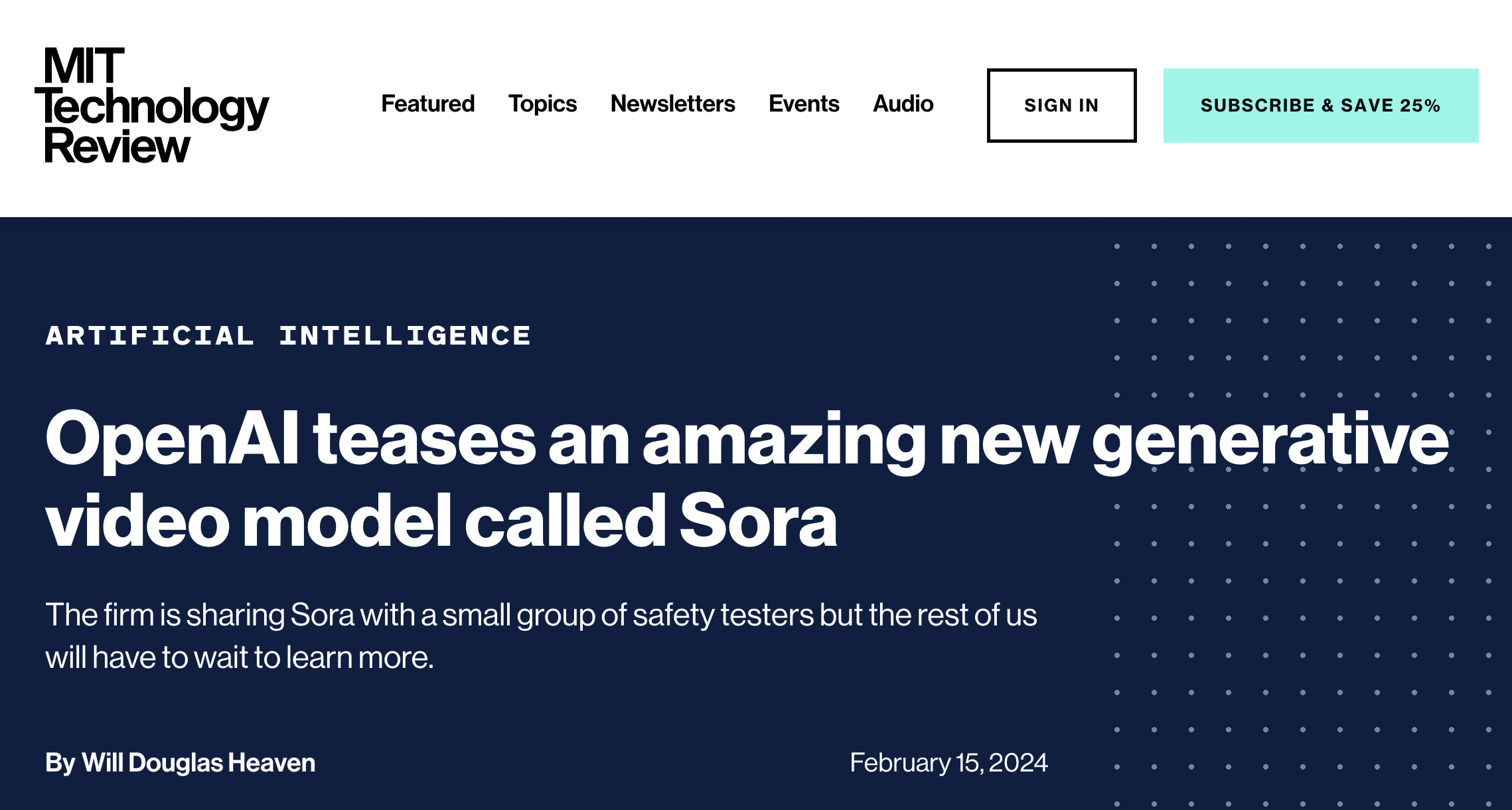
By April, I started wondering if they had lied. When it was finally published in December 2024, only after competitors like Runway Gen-3 Alpha and China’s Kling AI had already shipped, it was clear that “the world model” they had advertised was a very much flawed video model that had no understanding of the rules of physics.
Earlier this year, we introduced Sora, our model that can create realistic videos from text, and shared our initial research progress on world simulation. Sora serves as a foundation for AI that understands and simulates reality—an important step towards developing models that can interact with the physical world.
Though in the same post, OpenAI admitted as much: “It often generates unrealistic physics and struggles with complex actions over long durations.”
It was clear that they wanted to be first for not even image and video, but world models. Then a lot of random firsts started appearing: from an AI browser to an AI shopping platform with commercials, from the Jony Ive device acquisition to a social media app (which was probably the Sora app). They were making announcement after announcement, constantly talking about AGI and how they most likely knew how to build it. Sam Altman himself wrote on his blog that he was “now confident we know how to build AGI as we have traditionally understood it.”
They wanted to be the largest model provider. Have the largest user base. Make sure that clouds used them extensively.
In the background, they were burning through their budget. OpenAI is spending an estimated $15 million a day on inference for those who were not paying a cent to them. Who knows how much more budget all those side projects took.
They were number one in user traffic, too, but a large share of those users were freeloaders. Those people simply used the free tier. The Sora app generated $2.1 million in total lifetime revenue. It’s 3 hours of inference cost for OpenAI. While no public numbers are known, training a model like Sora probably cost 100M+ to OpenAI. What a poor return on investment!
So time went by and no AGI came. None of the promises came true. GPT-5 was probably not performing well enough on their internal tests. OpenAI had tried releasing GPT-4.5 earlier, which Sam Altman himself gave a lukewarm introduction, calling it a “giant, expensive model” that “won’t crush benchmarks.”
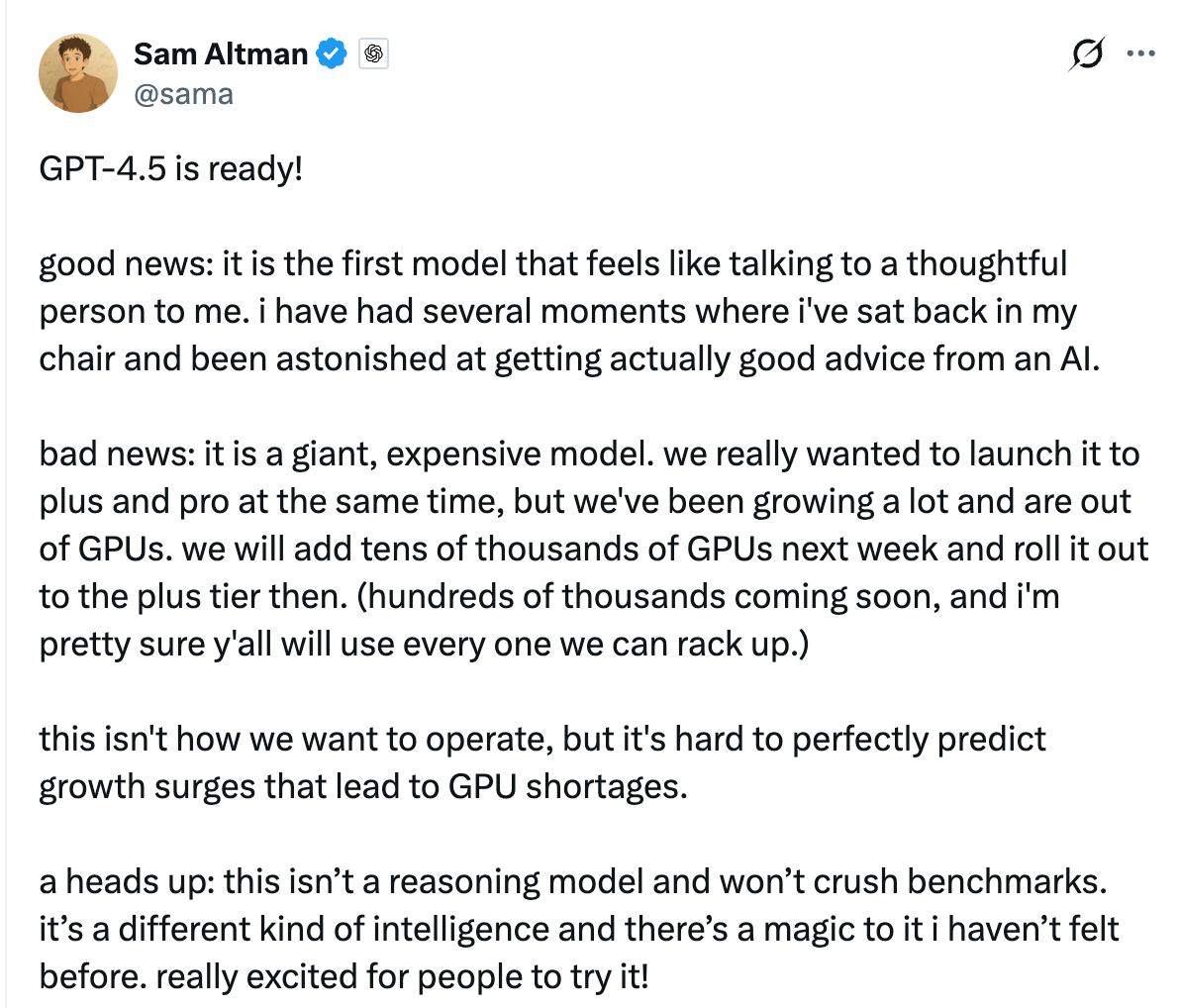
Eventually, they just had to release whatever they had. And that is when it became clear: they could not keep their leadership anymore. The model disappointed users, with Gary Marcus calling it “overhyped and underwhelming.” Even worse, users started demanding the return of the old model GPT-4o, complaining that GPT-5 felt like a downgrade. OpenAI had to cave in and restore access to GPT-4o within 24 hours. Within months, Google’s Gemini 3 outperformed GPT-5 across key benchmarks, and OpenAI’s enterprise market share fell from roughly half in 2023 to 27%.
That is when investors started wondering about the survival part of the plan. Nvidia’s Jensen Huang publicly clarified that the proposed $100 billion investment was “never a commitment”, adding: “They invited us to invest up to $100 billion and of course, we were very happy and honored that they invited us, but we will invest one step at a time.” The Wall Street Journal reported that Huang had privately criticized what he described as “a lack of discipline in OpenAI’s business approach.” Eventually, Huang ruled out the $100 billion figure entirely. Meanwhile, Microsoft started hedging its bets, striking a deal to integrate Anthropic’s models into Microsoft 365 Copilot.
In my opinion, OpenAI’s own arrogance blinded them to what few others saw in advance: without uncontested, perpetual leadership, they cannot survive.
Sam Altman declared Code Red after Gemini 3’s launch. Can you imagine any established company spiraling into panic when a competitor launches a marginally better product?
Code Red did not help, and they had to kill their first big mistake in trying to continue leading no matter what: their so-called world model, Sora. The planned $1 billion Disney partnership collapsed surprising Disney more than anyone.
Now let us take a look at other startups that rely mostly on promises to raise funding and try to follow the OpenAI pattern. And at those, that build to survive and keep on succeeding. Further on there are two lists - those who chase leadership and those who build to last.
Some of the companies below are ahead of OpenAI, while others are catching up, but they are all heading in the same strategic blueprint.
What they do: AI research lab founded in 2025 by former OpenAI CTO Mira Murati, attempting to build frontier models to compete with OpenAI, Anthropic, and Google DeepMind. Their only product so far is Tinker, a fine-tuning API in closed beta with no public pricing. They also released a very good and informative research paper on determinism in LLMs.
Why they are walking OpenAI’s path: $2 billion raised in seed funding at a $12 billion valuation with zero revenue. One gigawatt of Nvidia Vera Rubin compute committed. Co-founders already leaving to return to OpenAI. Also ongoing internal drama:
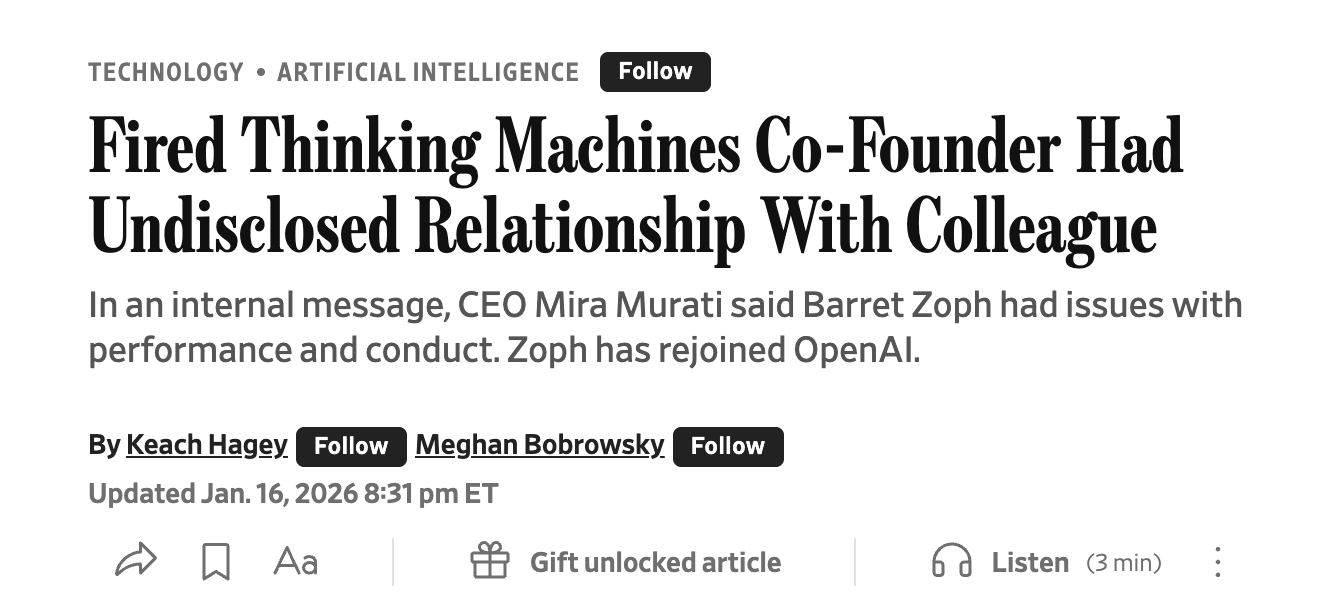
This is the purest copy of the OpenAI.
What to do if you need their services: You do not need their services, because they have none except for fine-tuning. If you need to fine-tune a model you can use Hugging Face, Together AI, or your cloud provider’s native fine-tuning tools. Plenty of options.
Further in the article: 10 more well-known startups and the discussion whether they build to survive or to hype
Free subscribers get my public analysis. The stuff Forbes and Die Welt cite.
Paid subscribers get what’s too honest to say publicly: Vendor comparisons that nobody with partnerships would dare publish. What out of millions of AI announcements is worth paying attention to. The PowerPoint engineering of consulting agencies compared to what actually works. And you can ask me anything about your AI decisions directly.
Founding members get all of that plus a 1:1 call with me. 45 minutes. 16 years in enterprise and research AI, from machine translation to production GenAI systems. Review your use case, validate your startup idea, or pressure-test your AI strategy. You decide how we spend this time.