I had a baby in 2014. The arrival of that little person totally transformed our lives, as they have a tendency of doing. Prior to their arrival, my husband and I had really made the most of London. We both worked in the world of ideas, and spent many evenings at talks, lectures and the theatre. We travelled to see our friends and felt very much part of the city. Suddenly, our whole world was our flat, the local park and the baby groups available in walking distance. We were two nerdy extraverts, hungry for good conversation about something other than nappies, naps and nursery places.
So we started inviting people for dinner. Initially, it was just our friends, and just one offs. Every time it felt like a bit of a lift, the finding a date, wondering about who to ask, individual back and forth about availability, planning a menu, shopping, cooking, washing up. We never regretted it, but we didn’t do it that often. Our friends didn’t want to come to us every time and we couldn’t afford babysitters.
I had heard a story about “chicken brick dinners” while living in Manchester, and been to a few with a group of friends who had decided to cook a whole chicken (in a clay thing called a brick) on a regular night. They would then just invite whoever was around1. One of us (I don’t remember who) suggested doing something similar in our tiny flat in London, and we decided that Mondays was a good night for catching people without plans. Sunday evening cooking also sounded a restful way to end the weekend. We started sending lists of Mondays to friends, and then friends of friends, neighbours, near strangers, people we had met at the swings or through work. We could squish eight of us at a pinch around the old gate-leg dining table, which when extended took up our entire living room.
Monday Night Dinners were born. Every other week, for more than a decade, we have cooked a big meal and invited an incredibly wide range of people over. We quickly stopped trying to curate the guest list (too much admin) which meant there were often people from wildly different worlds serving each other from the platters in the middle of the table. When we moved from our flat into a community house, we expanded the practice. Now we feed between 12 and 16 people once a fortnight for most of the year (with breaks for summer and over Christmas) and I calculated that about 1,500 people have been since they started. Many are repeat guests, but the group is different every time and there is always someone new. That figure doesn’t include the many other dinners, lunches, brunches and parties we host.
Our Monday dinners are bucking a trend. Derek Thompson in his excellent, thorough and sobering piece You Are No Longer Invited To Dinner shared these striking figures (from the US).
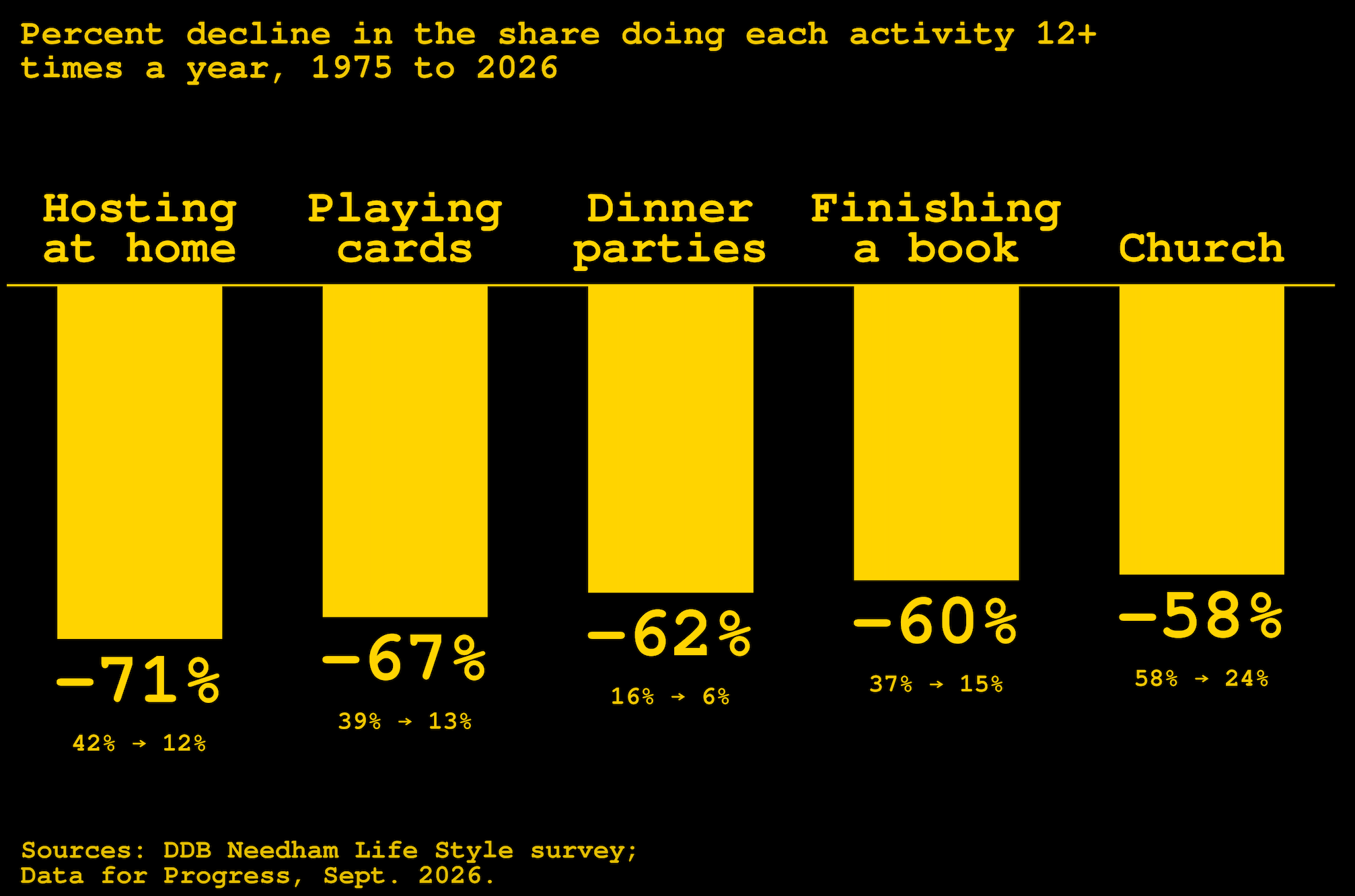
This is his theory about why:
Everybody might prefer, in the abstract, a world of dinner parties, neighborhood friendships, and spontaneous gatherings. But on any given Wednesday at 7:45pm., it is easier to look at a screen than to host a party; easier to listen to a podcast while doing yoga than to plan a gathering. This is not so much an individual failure as a coordination failure. Modernity has shifted leisure from activities that require coordination with other people toward activities that can be consumed without the permission or participation of others. Compared to TikTok, a dinner party is a terrible leisure technology. It requires matching schedules, cleaning the house, buying food, accommodating children and allergies, tolerating awkwardness, and taking the risk that the evening is mediocre. By contrast, what does television ask of us? Nothing. TikTok? Even less. We keep creating opportunities for downtime that eliminate the need for other people to be present. Not all progress is progress.
This has all kind of negative impacts. Regular habits of hospitality might seem “soft” but they are in fact politically, sociologically and spiritually radical and one of the best places to start if you are feeling afraid about the future. If you need reminding why regrowing our hospitality and sharing muscles are so vital in these times, here are two pieces:


If I’ve (hopefully) convinced you to give something similar, albeit possibly on a smaller scale a go, here is what we’ve learned. I cannot promise to make hospitality as easy as wasting an evening on TikTok, but the way we do it has reduced some of those other barriers.
Subscribe for free to continue reading
Enter your email and get every post from Fully Alive by Elizabeth Oldfield.