Warning: this article is likely to trigger many people, especially readers of this publication, since Asians are not the cause célèbre of basically any group which wants to signal that they defend the oppressed. If the previous sentence already offends you, the rest of the article is likely to send you into apoplectic convulsions. Caveat emptor!
I love America. It is a great nation — the greatest nation, even.
I’m a first-generation immigrant who’s been the beneficiary of The American Dream. I’m one of the huddled masses who flourished when embraced by the inspirational, foundational idea of America, a land where everyone is afforded the freedom to blossom.
I love America. 🇺🇸
I wanted to say that up front because, you might recall, many convenience stores owned by Middle Eastern and South Asian Americans needed to tape Don’t-Bomb-Us Signs™ on their front doors proudly declaring their love of America in the months following 9/11. A close Indian family relative, in fact, was physically assaulted after 9/11 because, you know, he looked like a terrorist.
So I want to be clear: I love America. And I say that without reservation, non-sarcastically. I believe in the promise of America and the highest of its ideals, and I’ve directly benefitted tremendously from growing up and living in these United States.
Don’t bomb me.

With that lengthy preamble as a framing to bookend the rest of this article, I wanted to share a personal story that has deeply affected me. In a way, this entire post is Fireside True Story™ Time.
My son Caleb applied for college in 2023. His profile:
Straight A’s in one of Washington State’s top high schools, except for one B.
1580 on the SATs (top 0.15%) and National Merit Semifinalist
A top score of 5 on eight AP tests
Several years of cross country, languages, drama, and roles in various plays
Summer software development internship at ProcessMaker and much volunteering at different organizations
A’s in college sophomore computer science and Calculus BC from courses at Johns Hopkins and University of Washington
Here are his results from applying to US universities:
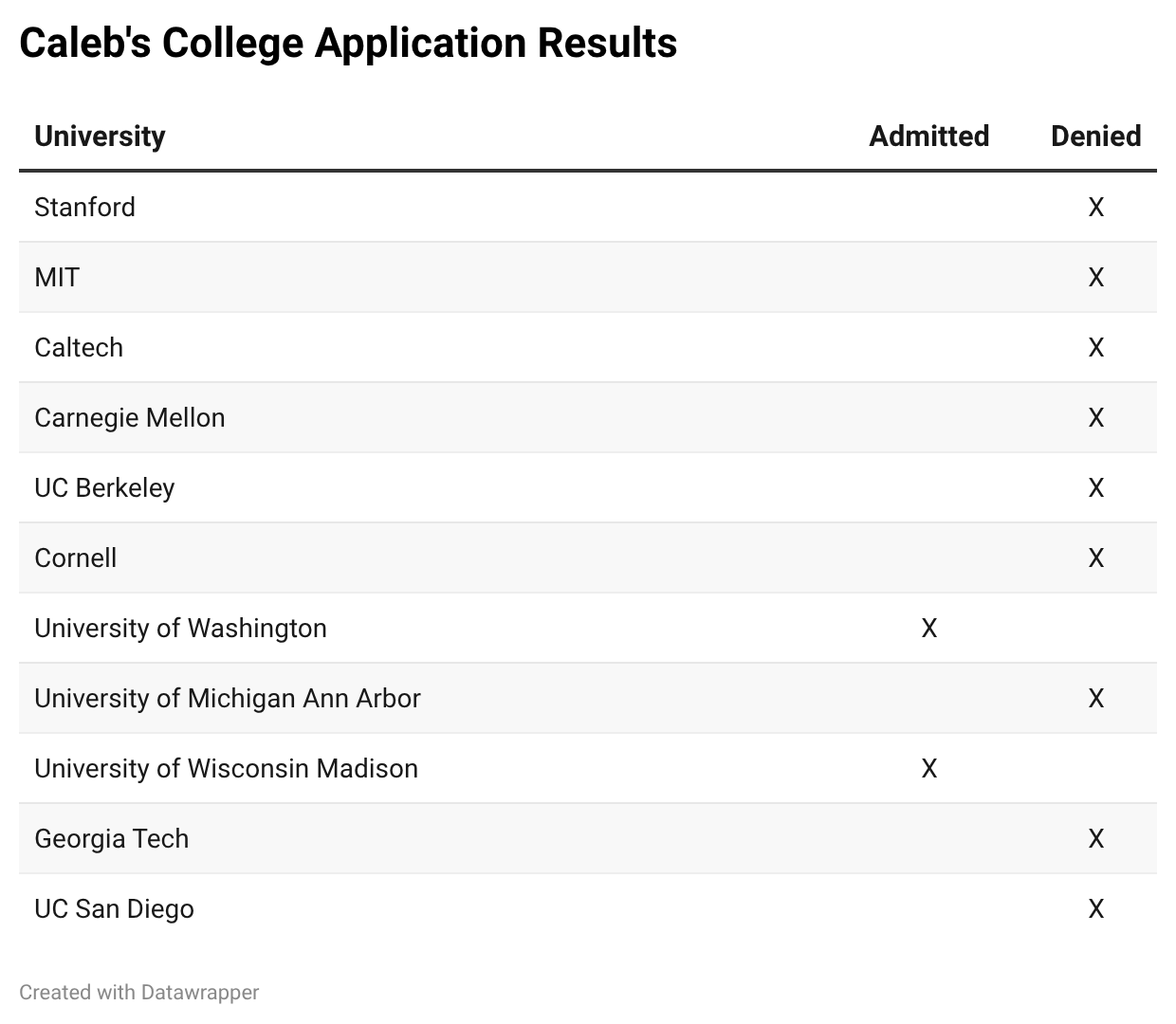
I would normally say the results speak for themselves, but there are so many implicit biases people bring into this topic that it might help to highlight a few things explicitly:
For every university where he was rejected, there were non-Asian classmates who were admitted with worse grades, test scores, and extracurriculars.
Of the two universities he was accepted, University of Washington gives preference to in-state students. He may well have been rejected by all but one university without this tailwind.
If you still feel there’s nothing wrong, imagine if Caleb’s last name were Stanton. Or Sanchez. Or Washington. It’s telling if your sense of fairness shifts based on that.
I had previously warned Caleb that as an Asian American male applying for a computer science degree in the US, he was absolutely the bottommost desired student demographic conceivable. Even so, I was floored his outcomes were much worse than I had tried to prepare him for.
Most people likely come into this article with already ossified prejudices on this topic, so I hesitate in attempting to make a structured argument for Asians because it’s unlikely to change minds. That said, I’ll endeavor to cover the most salient points.
If, however, you trust AI and have a preference for a specific reading of the facts in order to reinforce your existing beliefs, choose your own adventure via the following conversations:
ChatGPT if you want to be told there’s no proof of discrimination and that there’s nothing to worry about
Grok if you want to be told there have been many studies showing the effects of university admissions policies disadvantaging Asians
I’ll just target a few oft-repeated reactions.
Asians are one-dimensional. This comes up all the time, and I frankly think it’s stereotyping in the worst way. Many other sentences starting this way would get me insta-canceled (e.g. Jews are… Blacks are…). But somehow it’s commonly accepted in America to make statements like this about Asians without social defenestration. I don’t know why, but I suspect it might have to do with Asians being less politically active or vocal. (At least my parents would have told me to pipe down and not publish this post.) Or because many Asian Americans are doing reasonably well, so it’s not seen as “punching down.”
In the 2023 Supreme Court case regarding Harvard’s rejection of Asians, it came out that Asians were more likely to be rated by admissions officers as low on “likability,” “fit,” and “courage.” In other words, they felt Asians were less likable and wouldn’t fit well. The latter is tautologically true if admissions officers don’t want Asians, but the former seems prima facie evidence of inherent bias (i.e. “Asians are less likable”).
We need to fix the past injustices of American society. I completely agree. It’s not clear to me what the best approach is to do this, but I support the aspiration. An NBER paper studying 700,000 applicants showed that Asian Americans had 28% lower odds of admission than white applicants with similar test scores, GPAs, and extracurricular activities. South Asian applicants (e.g. Indian or Pakistani descent) faced the steepest penalty at 49% lower odds. My son Caleb is half Chinese and half Indian, so I’m guessing he lands between 28-49% lower odds than whites with the same scores, grades, and extracurriculars.
But here’s the thing: while I agree we should try to right the past wrongs of American society, does it make sense for that cost to be borne by Asian Americans? It was only 1952 when the McCarran-Walter Act ended exclusion of Asians from even settling in the US. You can bet Asians don’t benefit from the legacy admissions policies of America’s top universities.
I don’t believe Asians were ever treated unfairly in university admissions. If this is your position, I offer one chart showing the effects of the Supreme Court’s 2023 ruling declaring race-based admissions unconstitutional:
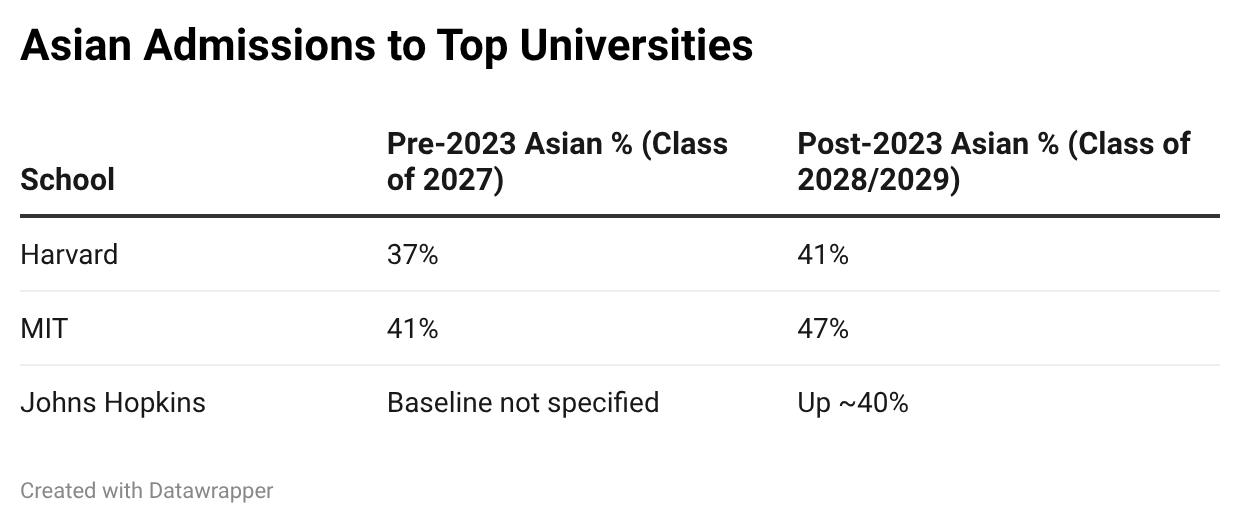
I don’t expect to change anyone’s mind with this article given the strongly-held preexisting beliefs most people have on this topic. In fact, broaching this subject at all probably alienates many of my readers. So why post at all?
I want to say this because I’m heartbroken for my son. Watching him receive rejection after rejection — when he was so obviously deserving of more, when he had worked so hard, when less deserving classmates got more — was crushing.
I’ve told my kids since childhood that America is the land of opportunity, that if you work hard, almost anything is possible here. It’s why my parents immigrated in the first place. I myself am proof positive of this clarion call, the beacon-on-a-hill promise of a shot at prosperity for all Americans. I still believe in that. I’m thankful for that.
But this promised check bounced for my son. It made me sad and angry to see how unfairly he was treated.
In fact, so sad and angry that I suggested to my then-11th-grade daughter, only half jokingly (in the darkest of comedic senses), that we change her legal last name to Sanchez. She’s already often mistaken for being Hispanic.
She stood justifiably aghast.
After recovering from shock at my outrageous suggestion, she simply said, “What would my friends think?”
This basic observation snapped me back to reality: that such boldfaced exploitation of the superstructure of college admissions, made during the key year of her applications, would stir up far too many uneasy feelings for classmates and teachers alike. With those uneasy feelings, you’d have to protest she was courting advantages while enjoying privileges natural-born Sanchezes don’t. You’d then have to answer the question, “Which privileges?” When my mom brought me to the US, she went from teaching science in a top Taiwanese high school to cleaning houses for below minimum wage. I remember watching her wipe kitchen floors on her hands and knees. My five-year-old self helped wring those washcloths out. Resolving all this is too much to expect for casual conversation on the campus of a little high school.
You’ll be happy to know my daughter remains a Su, with all associated disadvantages intact. We’ll see what happens with her college prospects next month.
Things at least ended well for Caleb, who had also wisely applied to UK universities, where grades and test scores matter far more than surnames. He was admitted into the majority of schools he applied to, including University College London and Imperial, both ranked in the top four CS universities in the UK. He now attends Imperial, where I’m positive he’s “likable,” “fits in,” and shows good “courage.”