Much has been said about how AI will distort the economy. The arguments are each compelling on their own, but there’s no coherence across thinkers about what will happen. The observations most often made include:
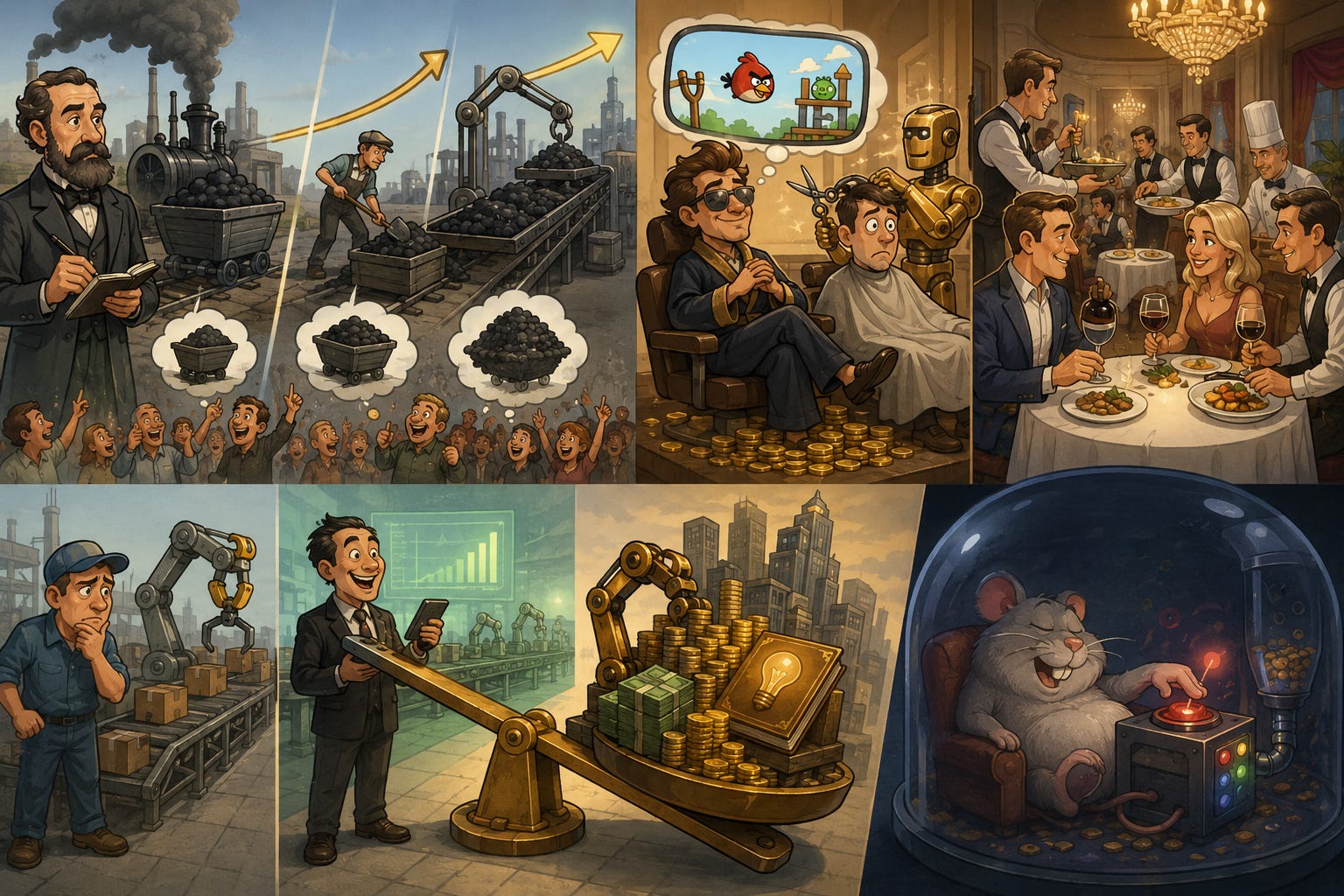
Jevon’s Paradox: we tend to consume more of something when it gets cheaper. Jevon originally studied how the use of coal increased with production efficiency. People sometimes map this argument to software engineering and other jobs: maybe as the cost of building software goes down, we’ll actually want far more of it. Our jobs are safe, so they say.
Baumol’s Cost Disease: as one industry gets more efficient, its earnings rise. This causes wages in unrelated industries to also go up. If your barber can use AI to create the next Angry Birds over the weekend, you can bet the amount he’d charge per haircut would be in the thousands.
Capital’s growing share of the economy. There’s a huge difference between you buying a robot and having it take your place in a factory vs. your boss buying that same robot. We’re currently on a trajectory toward capital and IP owners reaping much of the gains from automation.
Rise of labor as luxury. Expensive restaurants feature far more staff per customer. There’s a way in which the rich consume more labor. So perhaps, once again, our jobs are safe.
Loss of purpose in a world of plenty. Is it utopia when everyone has all their material needs and desires met? Or would we then be no different than the mouse which famously presses the dopamine button all day at the cost of even eating food, deliriously happy unto death?
I’ve become increasingly uncertain as I consider each of these categories over the past two years.
Does it strike you as suspicious, when people talk about technology displacing labor, that people keep giving the example of there being more bank tellers after ATMs were first rolled out? I get suspicious when a claim seems always and exclusively to be backed up by only one example.
When did you last work with a human teller at a bank? When did you last use an ATM? I’d think the answer to these two questions alone should say, from personal experience, it can’t possibly be the case that ATMs increased the demand for tellers. People claim that tellers simply do higher value things now (e.g. try to sell you all sorts of high-margin investment instruments), which may well be true.
Just trotting out the phrase “Jevon’s Paradox” doesn’t, in my mind, neatly resolve the question of whether, say, the number of software engineering jobs will skyrocket now that we have AI. Just as with the ATM/teller claim, it’s got to be more complicated. For instance:
Suppose demand for software will go through the roof. There seem already to be signs this is clearly happening (e.g. in my own life, I’ve now built a bunch of personal tools which I never would have prior to AI). This doesn’t necessarily mean even more software developers get hired. An important question is whether the pace of that increase in demand is exceeded by a decreasing number of super-developers piloting ever-improving AIs.
Or perhaps it goes the way of word processing. Every Manhattan skyscraper used to have multiple floors of “typing pools”: women who expertly typed other people’s memos all day. This no longer exists as a real job, since everybody just types their own documents now. Increasing demand for software could go this same direction: will we really need more software developers once AI is good enough to code for anyone, even people with no professional software background? Sure, it won’t be better than an expert’s output… but you’re no Hemingway, and yet no one’s complaining about your word processing.
Software continues to eat the world. But it’s not at all clear to me that software developers will inherit the Earth.
Intellectual labor represents perhaps ~50% of all labor, depending on which studies you read and what you feel qualifies. Suffice it to say, no matter what you believe, “a lot of labor requires thinking effort.” When the price of intelligence drops precipitously, as it has by 2-3 orders of magnitude in the past few years, we should rightly expect non-displaced jobs to cost more. (This analysis ignores entirely the question of whether robots might come for the other ~50% of labor, which focuses on physical work — this, if included, obviously exacerbates the situation.)
Philip Trammell and Dwarkesh Patel make this very argument, that some things are about to go nutty expensive. Baumol’s cost disease manifests in a way which Marc Andreessen humorously highlighted by declaring it’s now cheaper for you to fix a hole in your wall by covering it with a new flatscreen TV than it is to pay a drywall repairman to fix it.
These remarks all seem reasonable, but the following thoughts nag at me:
Those non-displaced tasks only cost more if they’re truly not displaced. In the case of your barber who could otherwise be making his own Angry Birds, your haircut would only cost thousands of dollars if there wasn’t a decent hair-cutting robot. How far Baumol’s reaches depends entirely on demand for human jobs which remain.
There’s also the question of how you got the magical thousands of dollars you spent getting a haircut. A world of “waiters serving waiters” doesn’t work. If the world has only a small number of people making a large amount of money, the economy doesn’t scale unboundedly. You can see this even in the spending patterns of billionaires today: sure, they spend a lot, but nowhere near the full amount they’re making.
I’ve not kept up with even half the criticism of Piketty’s Capital in the Twenty-first Century, though a key insight is that capital and labor traditionally balance because growth of capital eventually hits labor as its rate-limiting step (i.e. to make your piles of capital productive has traditionally required you to buy something at some point produced ultimately by labor).
So it’s not at all clear we’re destined for a runaway future where profits from RSI accrue exclusively to Tony Stark and a handful of other IP owners, followed by a revolution where the proletariat once again beheads the bourgeoisie. Open-weight models, for instance, call this future into question.
Which way this plays will likely hinge on McAfee and Brynjolfsson’s framing of the “bounty vs. the spread.” We are obviously heading toward a world of intellectual bounty; and since so many physical things are unlocked by intellectual discoveries and inventions, we’re also likely heading toward physical bounty (e.g. AI-designed robots and AI-enhanced agriculture).
The question is the spread: whether our governments, laws, and organizations are set to distribute the bounty broadly, or whether mass resentment will outpace that spread such that guillotines are once again lauded as instruments of expedient humane murder.
There’s a popular thought around labor as luxury:
The high ratio of restaurant staff at expensive restaurants
Hand-weaved Persian rugs
Spa days where the wealthy are waited upon by a bevy of professionals
Personal trainers and dog-walkers
While its undoubtedly true that the wealthy can purchase veritable battalions of servers, thus prolonging the durability of labor, it’s unclear to me that this is the type of future we want. To wit:
In nations with large wealth disparities, the wealthy don’t manage to lift the mass of lower-income people into the middle class even though they consume a ton of lower-income labor.
When I lived in Shanghai in 2008, it was cheaper for Microsoft to hire me a personal driver than for me to rent a car for myself. I had an “ah-yi” who cooked and cleaned on a salary that made her a minor real-estate maven in her rural hometown. Ordering even one McDonald’s Big Mac meal meant free delivery because the cost of labor was minuscule compared to the cost of Western fast food.
None of this makes for a broad middle class, because despite the near comical amounts of personal servants an uber-wealthy individual can employ, it’s simply not enough to give jobs to the entire broad base of lower-income families in economies where middle-class jobs don’t exist. America’s ~1,000 billionaires would each need to employ about 346,000 people as life coaches and personal yoga instructors for this to work.
When people talk about luxury-fueled labor, they rarely talk about the underbelly of some types of luxury labor spend.
Personal trainers might get quite a sense of accomplishment and feel appreciated for their expertise by their best customers.
People who weave Oriental rugs might have a sense of accomplishment, but here we’re clearly starting to verge on the territory where it’s unclear what the human-added value is. What is one really paying for when one tells one’s friends, proudly, that a rug took 8 months for an artisan in Iran to weave?
I’d imagine very few people would be happy about making a living as a human ottoman. Sure, it’s a thing only humans can do. But what, in this case, is exactly “the thing?” It’s to give another person the pleasure of domination, the thrill of being able to force a sentient being into subservience. The sort of person who enjoys this would love it even more if their ottoman was a PhD of astounding intellect, because the entire point is subjugation at tremendous opportunity cost. No amount of incredibly real VR simulation would satisfy this sort of desire, because the essence of the desire is the causing of sentient debasement.
Most luxury-oriented jobs don’t fall into that extreme a category, of course. But when all the meaningful self-respecting jobs get saturated, these types of things will begin to happen at the margins.
I’ve been worried for years about the loss of purpose that might come from joblessness even if everyday needs are taken care of by UBI. This is partly from my own experience of dealing with ennui after becoming unemployed, which I recount in the Peak Salvation podcast. (Surprisingly even to me, it’s in the top 0.5% of all podcasts.) But I’m increasingly beginning to think this perspective is colored by decades of experience in American white-collar work.
In contrast:
Europeans often don’t assign anywhere near the American amount of personal purpose and meaning to their work. I was fully 90 minutes into a walk in London’s Green Park with a fellow dad before it came out that he was the CEO of EDF, France’s largest energy company. There just seemed to be no reason for it to come up. Whereas we would have covered that fact within the first 5 sentences of meeting someone in America.
The wealthy today, whom we can think of as essentially being on terrifically high UBIs, don’t seem to struggle with loss of purpose. There are no doubt a set of them who do, but studies have shown empirically that, on average, the uber-wealthy are far happier than the average American. This suggests worries around loss of purpose might be the type thing which journalists and other high-income laborers worry about only because they’ve never experienced labor-ending wealth themselves.
The past year of reading about and experiencing the rapid change which AI is bringing to the software industry leads me to question some assumptions which I began this journey with 4 years ago when I first started using tab-completion AI in VS Code.
Economic and philosophic principles which used to seem clear to me now feel uncertain. The road ahead feels less sure than it’s ever felt in my life.