Flock is a license plate reader. It’s installed in some public intersections and records license plates and descriptions of the car and typically stored for 7 days. Police use it to assist in criminal investigations.
The question of how much surveillance we should accept is always fraught, but I feel like the anti-Flock hysteria from a very small but vocal online community is completely deranged.
Whenever this topic comes up in online forums, you get a predictable cacophony of the same arguments. It’s all so tiring, so I thought I’d collect and address each here.
Those who would give up essential Liberty, to purchase a little temporary Safety, deserve neither Liberty nor Safety
This is essentially the free square. People repeat it as though quoting Benjamin Franklin settles the question.
But a quote is not an argument. One could just as easily respond with John Locke:
“Where there is no law, there is no freedom.”
Or James Madison:
“You must first enable the government to control the governed; and in the next place oblige it to control itself.”
The Franklin quote is also usually stripped of its historical context. Franklin was not writing about personal privacy or government surveillance. The quote appeared in a 1755 dispute between the Pennsylvania Assembly and the colony’s governor over raising money for frontier defense while preserving the Assembly’s rights, particularly its insistence that the proprietary estates be taxed along with everyone else.
The broader principle may still resonate today. But Franklin was not offering an eighteenth-century opinion on automated license plate readers.
If you’re okay with Flock, why don’t you give me access to a 24/7 livestream of inside your home?
The Franklin quote is usually delivered with an air of sophistication. This one tends to be delivered with clever glee, as though the speaker has constructed an inescapable trap for anyone foolish enough to tolerate an automated license plate reader.
It’s a common style of online argument. It consists of three steps.
Step one: find two things that differ in nearly every relevant respect.
Public ≠ private
Street ≠ home
Car ≠ person
License plate or photograph of a car ≠ private conversation
Police officer ≠ anonymous person on the internet
Photographs at fixed locations ≠ continuous 24/7 video and audio
Step two: identify the broad category they share.
Both involve surveillance.
Step three: ask, “If you accept one, why don’t you accept the other?”
But accepting some surveillance does not logically require accepting all surveillance. Almost everyone already draws lines here.
It is entirely coherent to believe that there is a meaningful difference between a license plate reader at selected public intersections, with records retained for seven days and available to police for investigations, and microphones continuously recording every conversation inside your home.
Peta tries to pull this same crap, but people see right through it.

If you have nothing to hide, give me your address, location history and bank records
Of course I have things I want to keep private. But once again, a random person on the internet is not the same thing as the police, and every category of information is not equivalent.
The government already knows quite a lot about me. My car is registered. If an automated traffic camera records me speeding, the government can determine where to send the ticket. If a court issues an arrest warrant, police are not expected to pretend they do not know my address.
That does not imply that police should have unrestricted access to every place I have ever gone. There is plenty of room between those positions.
I can oppose creating a permanent, comprehensive record of everyone’s movements while still thinking it reasonable for police investigating a serious crime to determine whether a particular license plate passed certain public intersections during the previous seven days.
Flock doesn’t actually help solve crimes.
When confronted with evidence of Flock helping solve crimes, critics often move to questioning whether the technology is effective at all.
That is a strange hill to die on.
If police can enter a license plate and determine where that vehicle was recently observed, it would be surprising if that were never useful in an investigation.
There are straightforward examples. In August 2026, police in Galt, California said another agency contacted them about a suspected kidnapping. Officers searched Flock and located the suspect vehicle within five minutes. Police located the alleged victim and arrested the suspect.
You see a similar argument around ShotSpotter. The system uses networks of sensors to detect and estimate the location of gunfire. Here critics can’t argue about privacy (no constitutional right to shoot your gun in public). But they try to claim its inaccurate and discriminates on race, while conveniently ignoring the racial makeup of the victims.
Critics go to great lengths to try and claim that such technology is surely flawed. Never mind that triangulation has been around since 6 BC and training a machine learning model to detect gunfire is likely a first year machine learning project at university.
Flock is obviously unconstitutional. It is a warrantless search. The Fourth Amendment says so.
How do they know? Some combination of reading the 53 words that make up the Fourth Amendment and some anti-tech journalist telling them.
Ignore the fact that it a federal court has upheld an actual Flock deployment against a Fourth Amendment challenge.
Perhaps Flock is legal, but it is so objectionable that destroying the cameras is justified as civil resistance.
This produces a peculiar conception of democratic participation.
You could organize against the policy. Attend city-council meetings. File public-records requests. Support candidates who oppose the cameras. Lobby your state legislature. Bring litigation. Run for office. Convince your neighbors.
Or you can decide that because you personally regard a legally adopted policy as illegitimate, destroying public property is itself democratic.
That principle gets uncomfortable once generalized.
An anti-abortion activist could make precisely the same argument about bombing an abortion clinic. The fact that someone regards a legal institution as immoral or illegal does not grant them a right to destroy it.
This will all lead to a surveillance state.
This one is the argument that America will fall into a surveillance state, where every minor infraction will be relentlessly prosecuted. This is so removed from reality it’s difficult to take seriously.
For starters, America barely prosecutes people it already arrests.
We can begin reducing crime today if we were so inclined. We can just increase prison times, which would drastically reduce crime. Not because criminals are particularly sensitive to incentives, rather because criminals would be in jail and wouldn’t be able to terrorize the rest of us.
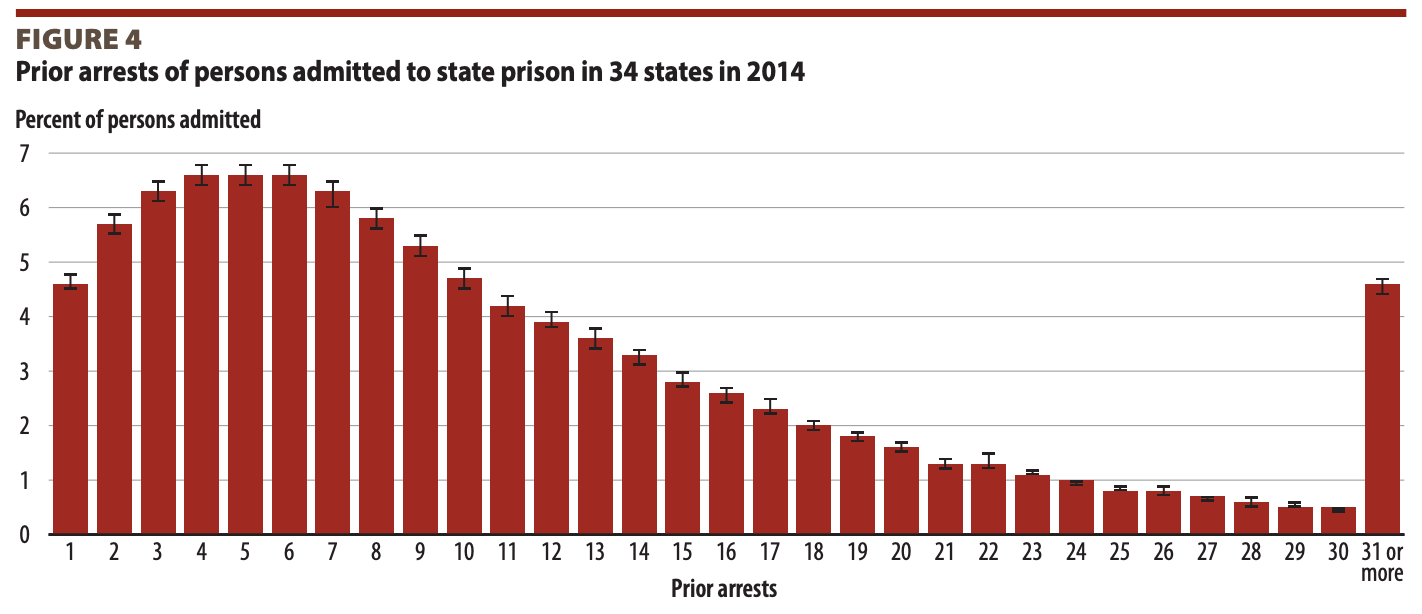
The number of prisoners that have had 15 or more prior arrests is over 26%
If we just switched over to a 15 strikes and you’re in jail until you’re an old man, we’d reduce arrests by 26%. America is a land of second and even third chances. But 15+?
I try not to make too much of the opinions of terminally online people. Normal people, you know, the people not spending their weekend vandalizing Teslas, just want to have a good life for themselves and their children.
Something shifted in the last 20 years or so that resulted in acceptance of chaos and disorder.
We were lied to that there were scores of people being arrested and sent to jail for simple possession. Now we accept fentanyl zombies in every major city and needle disposals at children’s parks.
We saw housing becoming more unaffordable. Now we accept homeless encampments taking up large swaths of public space.
We were told that we arrest too many people. Now we have to find a store attendant to buy a stick of deodorant.
It doesn’t have to be this way. Flock is arguably a reasonable trade off in helping apprehend criminals. But more importantly, it’s a stand against the general malaise that accepts criminality as a fact of life.