When a reporter once asked notorious bank robber Willie Sutton why he robbed banks, he replied simply: “because that’s where the money is.”
In 2026, he could’ve been talking about the National Sports Collectors Convention outside Chicago last weekend, where a $15,000 Patrick Mahomes card was stolen in broad daylight. A father and son - caught on video - lifting the plexiglass and swiping the card before blending into a crowd of thousands. Last I checked, the card and the absconders are still missing.
While social media accounts associated with the hobby - shorthand for the collectibles business - have been buzzing about it, there was zero local coverage. And very little reporting about the heist itself. It says a lot about the state of a trading card business valued at $50 billion and growing1 that the theft of a card worth thousands of dollars was a “dog bites man” nonstory.
When I started going to the National over a decade ago, it still felt very mom and pop. I remember watching Gaylord Perry sign small tubs of vaseline at a card table - and buying one myself. This year, in addition to the biggest ever eBay and Fanatics and Topps displays, Walmart activated. Arena Club built an experience where some of the estimated 130,000 attendees could make their own card.
“It felt a lot more corporate,” said Rob Shaw, a lifelong collector who writes the Ballpark Figures newsletter. “And the prices are just through the roof.”
A Michael Jordan 1986 Fleer rookie card - the canonical benchmark of the hobby - has nearly doubled in the last six months, rising from $23,000 in January to roughly $45,000 by mid year. In this kind of market, it almost feels like blue chips can only go in one direction.
Why now? Two structural reasons
The first is pricing transparency. Sports cards used to trade in an information vacuum - the same card might sell for $100 on Monday and $300 on Wednesday with no coherent explanation. Sites like Card Ladder and eBay’s completed sales data changed that. You can easily find out what prices are. That’s removed a big layer of risk and opened the market to buyers who previously couldn’t fully trust what they were paying.
The second is infrastructure. The COVID-era card boom attracted serious capital, which built the technology to make buying, selling, grading and storing cards a more modern experience2. What was once a hobby dependent on your ability to physically get to a card shop is now fully accessible from a phone.
In the original gold rush, the people who made money were selling the shovels. The collectors are still panning for gold - but the shovels are better than they’ve ever been. And the proliferation of ‘shovel’ brands - including Fanatics, Arena Club, Courtyard.io, Trove, and grading companies like PSA and CGC - indicate a belief that the underlying fundamentals are there to support this industry for years to come.
Trading card arbitrage is a thing… if you know what you’re doing
Here’s where it could get interesting if you think about cards as an asset class.
Case in point: Rob described a strategy a friend deployed with Luka Doncic’s rookie cards roughly seven years ago - before Doncic had proven himself at the NBA level. The friend bought hundreds of raw (ungraded) Prism rookie cards at roughly $60 each, paid approximately $15 per card to have them graded by PSA, and sold the PSA 10s - the highest grade - for $300 apiece eighteen months later. The math is straightforward: buy at $75 all-in, sell at $300, repeat at scale.
The same logic applies today to players at the beginning of their careers whose upside hasn’t yet been priced into the card market.
Here was my (very homer) suggestion: Caleb Wilson, the Chicago Bulls’ first-round pick out of North Carolina. Wilson had an impressive summer league - enough to suggest legitimate rookie-of-the-year contention. His rookie cards are available raw on eBay for a few dollars each.
The play, as Rob describes it: search eBay for “lot” - L-O-T - and find sellers liquidating large quantities of cards from box breaks, happy to move inventory at a discount. Buy at scale. Hold. If Wilson develops as expected, grade the best copies and sell the PSA 10s at a significant multiple.3
“If you’re that confident in Caleb,” Rob told me with the authority of a recently vindicated Knicks fan, “I would totally go out and try to buy at scale.” Confidence and Bulls fandom don’t typically belong in the same sentence but someone will be crazy enough to try it.
The three-tier framework
For readers who want to enter this market without making expensive mistakes, particularly in this economy, Rob offered a framework organized by budget:
At $10: buy raw. Find a player you believe in for the long term - Wembanyama, Cooper Flagg - and own the ungraded card. Store it properly. If the player’s career trajectory justifies it, grade it later. A $10 raw card that grades PSA 10 can realistically be worth several hundred dollars.
At $100: Rob pointed to two specific cards. Juan Soto’s base card, currently trading around $75, which he believes is significantly undervalued relative to Soto’s career trajectory. And Konnor Griffin, the Pirates’ top prospect, whose cards have pulled back on injury news and represent what he considers a buying opportunity in the $100-110 range.
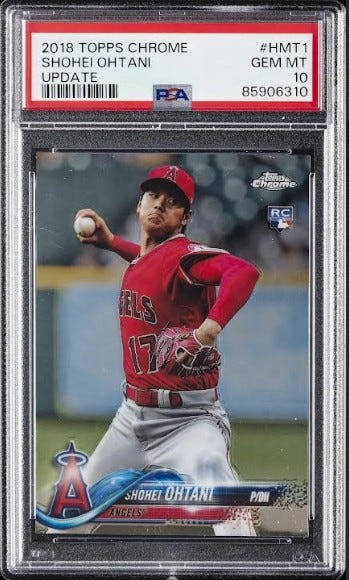
At $1,000: Shohei Ohtani’s base rookie card, currently trading around $1,000, which Rob believes will appreciate 15-20% by October as the Dodgers make their postseason run. For basketball, Victor Wembanyama’s Pink Ice Prism at approximately $1,100, with the NBA season and Christmas Day games serving as near-term catalysts.
Check out the full conversation with Rob below:
The episode is also available on YouTube:
The Extra Cookie: All these years going to the National, and I never fully appreciated Pokemon. Trading card games - like Pokemon, or Magic the Gathering - represent roughly 80 to 90 percent of the entire collectibles card market globally. Sports cards, for all the attention they receive in this newsletter, are the minority. Pokemon’s global appeal, combined with a fan base that spans nostalgic millennials and genuinely engaged children, gives it a demand floor that most sports cards cannot match.
Rob’s kids trade their own Pokémon cards at shows. They have been ripped off and they’ve learned from it. “It’s a great way to learn economics 101.”
He’s not wrong. Supply, demand, the power of information, the value of a trusted grade, the psychology of scarcity - it’s all here, on a piece of cardboard with a picture on it.4
Just keep those cards somewhere safe.