“You think it is helpful having a fluorescent green praying mantis coming into their offices telling them about German philosophy? Do you think that’s helpful? I can tell you it’s not helpful.”
That is Alex Karp, CEO of Palantir Technologies, discussing his disconnect with his own engineers, according to biographer Michael Steinberger’s excellent book, The Philosopher in the Valley.
For anyone interested in (or affected by) Palantir, Steinberger’s book is mandatory reading.
Elsewhere, we learn Peter Thiel, Palantir’s Chairman and true founder, waxes absolutely poetic talking about Karp.
“My riff on Alex is that he’s working out some psychological issues where he has to do things in this really, really hard way versus the straightforward, easy way.”
I have spent some time with Peter. I like him a lot. He’s a great guy.
I have not met Alex, but the book made me appreciate him.
I mean, aren’t we all working out psychological issues and doing things the really, really hard way? I’m not a praying mantis or green, but I get it. I am writing this, after all.
So, what I am about to go on and on about is not meant to be personal.
I was on the phone a couple months back with a former Speaker of the House who says he knows the Palantir guys well, but he wondered if I could tell him what they do.
I bet a lot of investors do not know what Palantir does either.
Simply put, Palantir sells software platforms to clients that act as enterprise-wide operating systems. Palantir does not sell a true off-the-shelf operating system. It has teams of Forward-Deployed Engineers (FDEs) that deploy, for months, to the client site to install and customize the operating system for the client. After weeks or months of customization, Palantir’s operating system allows organizations to retrieve, combine and analyze data from the client’s existing software installations. Palantir has been using “boot camp” demo sessions to get companies started with Palantir’s software on a shorter, less costly timeline.
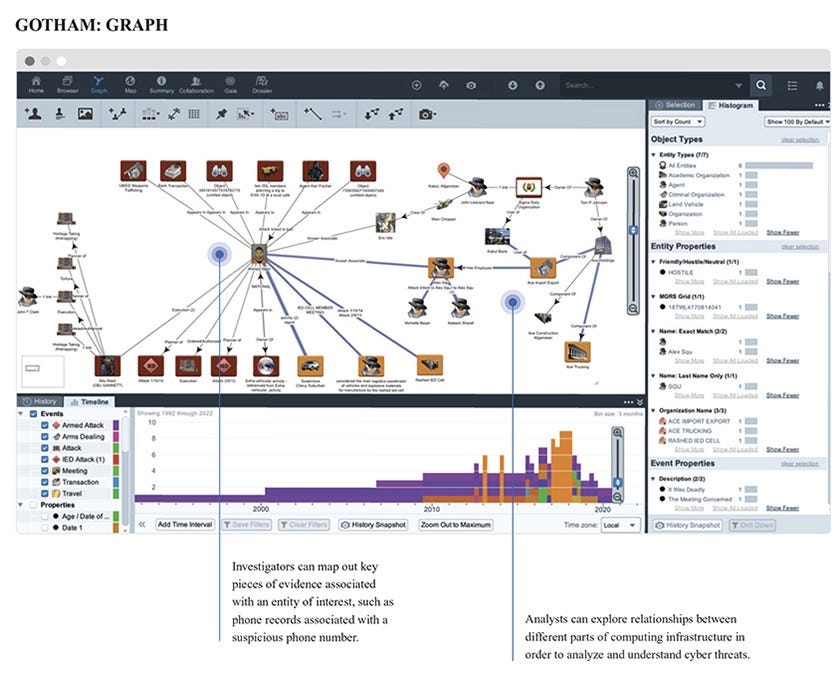
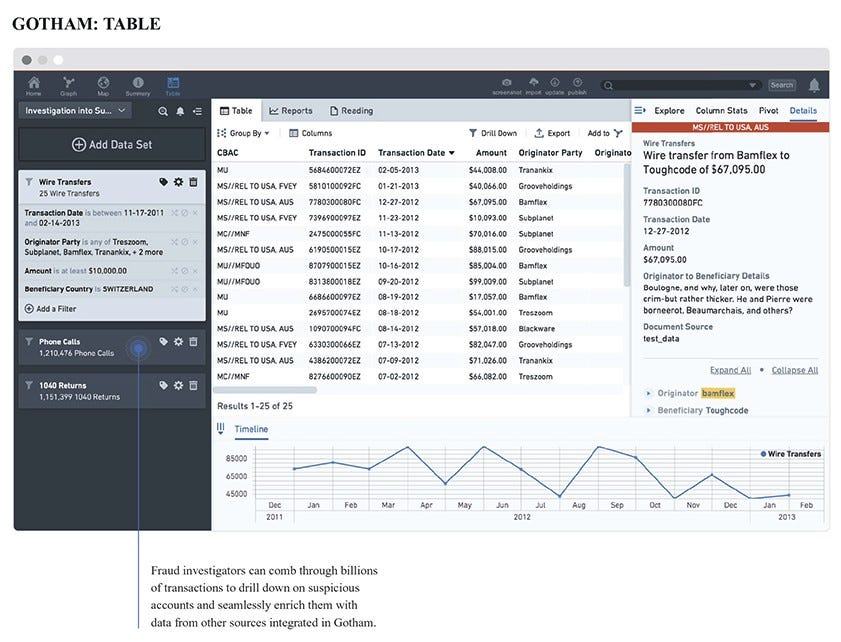
Gotham is Palantir’s long-standing primary operating system for government, defense, and intelligence operations. Gotham was developed with the CIA over years. More on that later.
At its IPO, this is what Palantir’s Gotham looked like.
Foundry is Palantir’s primary operating system for commercial enterprise clients. Again, at its IPO, this is what Palantir Foundry looked like.
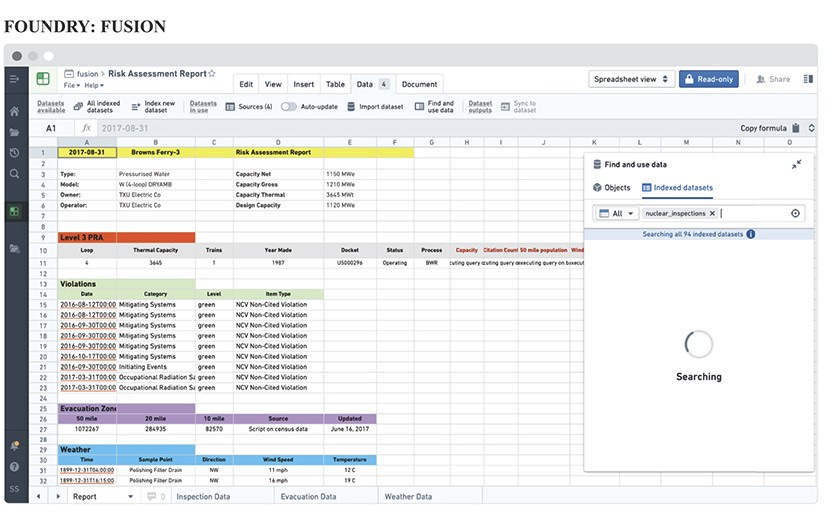
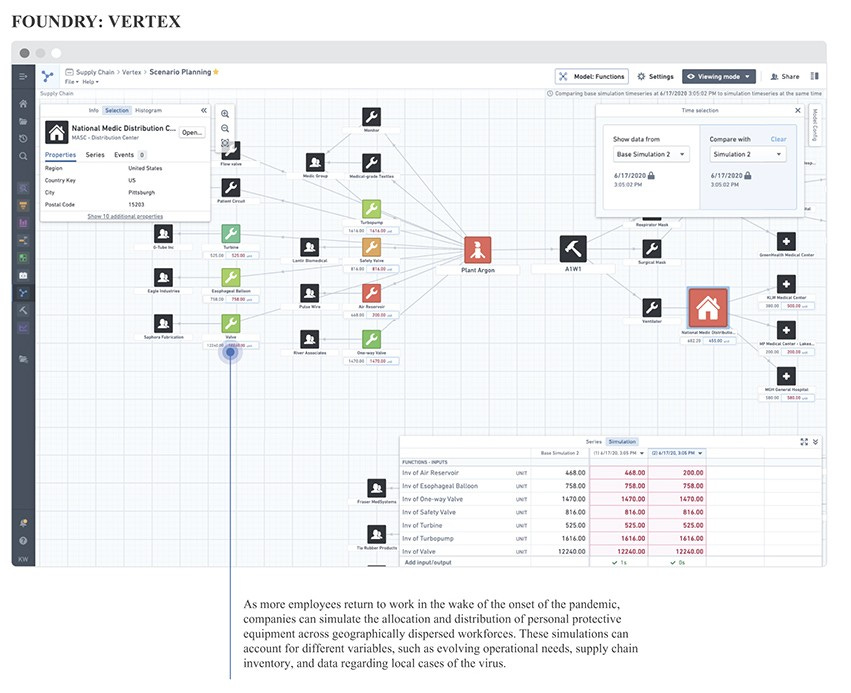
The above screenshots are courtesy of Palantir’s 2020 S-1.
Some of you may be thinking, how is it different from SAP or Oracle?
Well, that is a better question than it might seem.
Palantir does not replace complex, embedded systems like SAP or Oracle. It sits on top of them, integrating existing software into a cohesive operating environment. So, data from human resources, payroll, inventory management etc. are brought together in one spot for analysis and decision making across the enterprise. This custom centralized filing and retrieval system for the whole enterprise is what Palantir calls its “ontology.”
Palantir’s Form 10s champion this approach.
Our Software Does Not Displace Existing Systems, It Augments Them
Flexibility and openness are core tenets of our software. By integrating their existing solutions into our central operating system, organizations can choose to maintain key historic investments without having to rebuild their entire data infrastructure.
SAP and Oracle of course also require armies of FDEs aka implementation consultants to implement their software and transform the client’s capabilities.
SAP and Oracle do not trade at 80, 100x sales. Palantir is special. How special, one might ask.
Founded by Peter Thiel, Alex Karp and Stephen Cohen in 2003 with funding from In-Q-Tel, the CIA’s venture capital arm, Palantir was born of Silicon Valley royalty and the spookiest agency of government. Thiel had co-founded PayPal and belonged to the so-called PayPal mafia.
The initial software kernel that seeded Palantir was in fact a security protocol that allowed PayPal to beat back fraud in its early days.
Infamously, Palantir’s first contract with the CIA involved engineers making 200 biweekly trips to DC and back to Silicon Valley over more than three years. The CIA nicknamed Stephen Cohen, the head engineer, “Two Weeks.” This was some R&D alongside the installation, and it was expensive.
Despite the extensive handholding with Palantir contracts, the CIA deal led to a series of governmental contracts that were generally low dollar or no dollar, and did not come close to covering the cost of the teams of engineers needed to customize the software platform for each client. Palantir would go on to pile up $3.8 billion in losses as a private company before going public.
Mark Elliott, a Palantir engineer, said as much in Steinberger’s book. Here he is talking about Gotham and Metropolis, Palantir’s software/OS for financial services firms at the time.
They weren’t going to generate enough value for organizations that they’d want to pay us enough to make it worthwhile for us.
Remember that quote. That is the fundamental problem that Palantir has had to solve, and the fundamental reason Palantir lost money each year for the first twenty years of its existence. It needed emergency capital infusions multiple times, including an entity-preserving investment from SoftBank in 2019.
Thiel said of Palantir, according to Steinberger’s book:
If you had told me in 2004 that our first profitable quarter of business would be in the fourth quarter of 2022, that would’ve been very surprising.
Let’s spend some time on those money-losing years. This is fairly important, as it was a very long time for a company full of supposed geniuses to not make any money.