Let’s think about airlines and use Southwest as the platonic ideal of an average enterprise with lots of moving parts and legacy IT systems. How would things be different if they had automated software engineers bought with intelligence too cheap to meter?
In December 2022, Southwest Airlines had double digits percentage of its flights cancelled multiple days during the holiday season. On December 25th, 48% of the flights were cancelled.

From Wikipedia:
Initial investigations said outdated technology was to blame and an industry analyst said it was also due to airlines "running these razor thin margins". The number of full-time tech workers at Southwest declined by 27% from 2018 to 2021 while overall full-time employment at the airline declined by just 6% over the same period. (…) Rather than using standard commercial scheduling software like that used by other airlines, Southwest relied at the time on two proprietary and internally-maintained software programs, SkySolver and Crew Web Access. Although both programs were available as mobile apps, they frequently failed during even mild weather disruptions, forcing crews to telephone crew scheduling specialists. During the crisis, telephone operators at scheduling were overwhelmed, and crews found themselves waiting on hold for hours and being assigned to flights that had already been canceled, in turn preventing them operating other flights before their duty hours expired. The airline resorted to training 1,000 additional employees to help crews on the telephone.
In some sense, it’s quite obvious what AGI can do for them. Southwest can ask the AGI to make SkySolver and Crew Web Access better. I don’t think that’s a satisfactory solution. What AGI can do for Southwest is merely make their Jurassic IT systems work as intended? Let’s think a bit further.
Gemini is telling me that out of $100 of revenue, $39 will go to labor who touches the plane, and $6 will go to corporate headcount.
The main part of the labor will be pilots. Here, there will be two forces to keep the status quo. First, is that the airline industry is very conservative; Southwest would need an immense amount of evidence before regulators, customers, and even themselves would accept an airplane without anyone in the pilot seat. Second, this innovation will need to be done by Boeing, not Southwest. Third, airplanes are already super automated, and pilot wages only increase regardless. I don’t expect Southwest to hire less trained, cheaper pilots or to not hire pilots at all for their airplanes for the next 15 years.
Other labor cost has already been subject to high levels of automation. These days, you buy your ticket from Southwest’s website, not by calling the phone, and your luggage travels through automated treadmills.
If Southwest wanted to remove its staff at the boarding gate, they could with 2015 technology. Regulation and brand concerns are stopping them today. If one day the FAA allows e-gates, this would accrue to all airlines simultaneously, ticket prices would drop equally, and Southwest would only benefit from this small one-off increase in demand.
My core argument here is that Southwest already runs like a software hivemind. When their software stops working, the company stops working (not having a hub-and-spoke model certainly makes them less anti-fragile).
I am in no way saying things couldn’t be better. But what I am arguing here is that already an immense part of Southwest is intermediated by software.
This isn’t exclusive to airlines.
I was with my godfather the other day. He used to run bank branches. He explained how things used to work. He was basically running his own small bank. He worried about both sides of the balance sheet, and he would even be aggressive with non-performing loan recognition so that NII would look good: “We would try to declare the bad loans when we had a good month”.
The days of the account manager at your local bank branch looking at your eyes and deciding whether you’re a good credit are long over.
These days, a bank branch is just something at the edge of a big software system. Banks discovered a couple of decades ago that their credit algos were much better than letting their branch employees make credit decisions. The trend in the banking industry is towards less and less human input.
What is knowledge work, then?
Running N-of-1 processes where it doesn’t make sense to create software,
Creative work,
Adversarial work,
Sales,
Support for decision-making,
Creating more software processes.
Notice that LLMs impact all these fields. But at best, it accelerates the trends we have been seeing over the past decades.
What has happened is that as productivity increased, more and more labor and resources have been deployed to organizing production, not to production itself. That’s mostly the role of the finance sector. The finance sector is a tax society accepts because society believes that output and output growth is bigger with the presence of the finance sector organizing it.

corsaren@corsaren
What a lot of “AI won’t take the jobs” people don’t seem to understand is the degree to which white collar orgs are essentially structured to solve this chart. Imagine that each node is a person who actually does stuff (engineering, writing marking copy, drafting contracts,


Poe's Law, Esq: Poe's Lawyer @dyingscribe
I would love to steelman the “last mile human argument” but you’re not engaging at the level of steel. Especially, as said argument been getting less and less persuasive and strong over the course of 2025 alone, let alone the first 45 days of 2026 What you’re saying is not
6:59 PM · Feb 6, 2026 · 203K Views
77 Replies · 108 Reposts · 1.26K Likes
What LLMs do then? You can ask them to do the productive white-collar work: you can ask them for a legal opinion, and you can ask them for marketing copy. But LLMs also reduce the necessity to coordinate work. If one person can take responsibility for 10x more legal opinions or one person can oversee the production of 10x more marketing copy, your organization can be much simpler.
I have four comments here:
I believe the economy is very well organized. While I believe there’s always room to improve, I am skeptical that J.P. Morgan Chase & Co. or Southwest Airlines could be run at much better margins and/or economic profit only if they had more intelligence or paid less per unit of intelligence. Oh, and all your competitors will have access to the same LLMs.
Indeed, I believe the economy is getting more organized. You don’t see these days in the Wall Street Journal: "The economy is in a recession because of a natural end of the business cycle caused by inventories.” Everyone has a great SAP ERP implementation, and they have great visibility over their businesses. One way to understand why big tech doesn’t seem to hit the "you grow nominal GDP phase” is that they are the ones enabling it. And one way to interpret why the small-cap factor has been so poor over the past decades is that software exists as a cure for the increasing complexity of managing large companies. J.P. Morgan's share of total U.S. employment keeps rising because software keeps making it easier to run a larger and larger bank.
Notice that the fully automated J.P. Morgan Chase and Southwest Airlines still probably don’t have much need for intelligence. The Superintelligence would create processes and stand in the background, handling special cases. If the impact of LLMs were restricted to automating this type of knowledge work, I predict we would hardly have utopia. We would have a smaller laptop class, competition in the corporate sector would be much fiercer as more firms have access to genius talent, prices would be lower, and more people would work as personal trainers, therapists, and nurses.
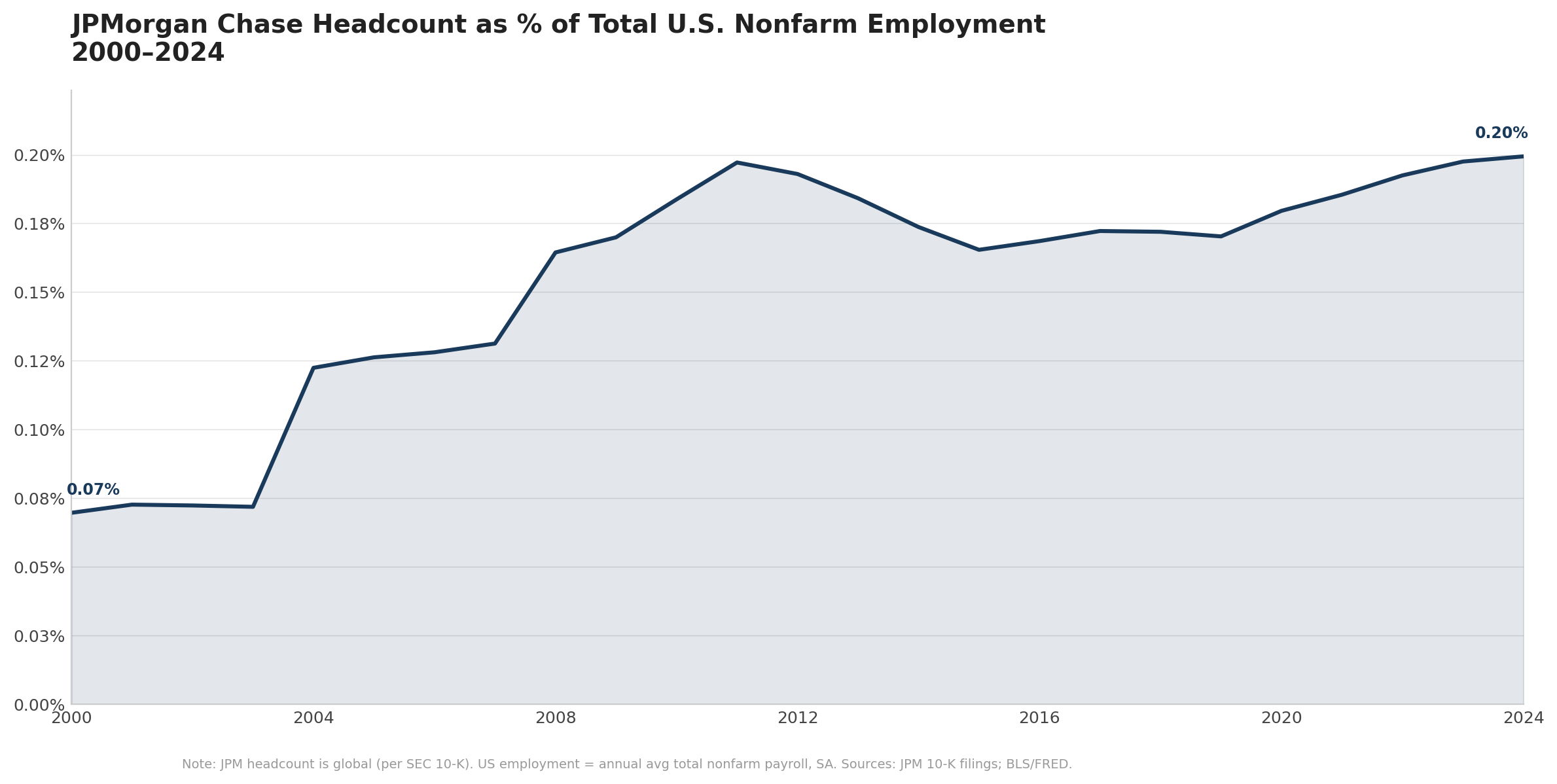
Saying that we don’t need much intelligence is extremely controversial, and I am certainly exaggerating to make a point here. The point I am trying to make is that we’ll have 100x more software. Software created by the LLMs (with some help from humans during the centaur phase) to put in code all the complexity and edge cases that these days are dealt with by humans. This means the hive mind will get bigger, and the human gears part of the hive mind will get smaller.
But the takeaway I want you to get is that’s hardly new! AGI will do little to Southwest, J.P. Morgan, and Walmart because these companies are already in a multi-decade process of creating software. And if you think, absent Attention is all you need, how would the world be in 2100, it’ll be very similar to the world AGI will bring to corporations.
From Dario Amodei’s Machines of Loving Grace:
To summarize the above, my basic prediction is that AI-enabled biology and medicine will allow us to compress the progress that human biologists would have achieved over the next 50-100 years into 5-10 years. I’ll refer to this as the “compressed 21st century”: the idea that after powerful AI is developed, we will in a few years make all the progress in biology and medicine that we would have made in the whole 21st century.
Although predicting what powerful AI can do in a few years remains inherently difficult and speculative, there is some concreteness to asking “what could humans do unaided in the next 100 years?”. Simply looking at what we’ve accomplished in the 20th century, or extrapolating from the first 2 decades of the 21st, or asking what “10 CRISPRs and 50 CAR-Ts” would get us, all offer practical, grounded ways to estimate the general level of progress we might expect from powerful AI.
While there’s reason to be optimistic about what a compressed 21st century would do in science (and there’s reason to be pessimistic about the deployment into society!), a compressed 21st century in airlines just means the app is better, they have optimized routes more, and we have no catastrophes on Christmas caused by software bugs in mainframe systems.