$\begingroup$
In April 2013 I discussed with Alan Sokal the following conjecture: if $P$ is a real polynomial with the property $|P(z)|<P(|z|)$ then some power of $P$ has positive coefficients. We did not prove it at that time.
In August, Ofer Zeitouni asked on MO to describe all possible limits of the so-called empirical measures of polynomials with positive coefficients. He needed this for his research on random polynomials. It immediately crossed my mind, that a proof of the Sokal's conjecture stated above will imply the answer to Zeitouni's question.
The final result was a paper by Walter Bergweiler, Alan Sokal and myself, https://www.math.purdue.edu/~eremenko/newprep.html where we prove the a necessary and sufficient conditions on a real polynomial for some power of it to have positive coefficients, and give an answer to Zeitouni's question. Zeros of polynomials with real positive coefficients
Edit. This story has a continuation, also related to MO. Another related question was asked on MO, and one of the answers contained a reference to a published proof of what I called "Sokal conjecture". It was essentially the same as our proof. So the net outcome was only a paper answering Zeitouni's question.
$\endgroup$
1
$\begingroup$
Our article D. Brumleve, J. D. Hamkins, and P. Schlicht, “The mate-in-n problem of infinite chess is decidable,” LNCS 7318(2012):78-88, arXiv:1201.5597, was inspired directly by Richard Stanley's question Decidability of chess on an infinite board.
Abstract. Infinite chess is chess played on an infinite edgeless chessboard. The familiar chess pieces move about according to their usual chess rules, and each player strives to place the opposing king into checkmate. The mate-in-n problem of infinite chess is the problem of determining whether a designated player can force a win from a given finite position in at most n moves. The main theorem of this article, confirming a conjecture of the second author and C. D. A. Evans, establishes that the mate-in-n problem of infinite chess is computably decidable, uniformly in the position and in n. The proof proceeds by showing that the mate-in-n problem is expressible in what we call the first-order structure of chess, which we prove (in the relevant fragment) is an automatic structure, whose theory is therefore decidable. An alternative argument proceeds via Presburger arithmetic, which is capable of interpreting the mate-in-n problem of infinite chess.
(This was a collaboration truly born on MathOverflow, as some of the authors have never met in person...)
$\endgroup$
7
$\begingroup$
A meta-answer: http://search.arxiv.org:8081/?query=mathoverflow&in= returns a list of 197 papers on the arXiv which mention MathOverflow.
Nearly all of these are actual citations, with a small number of papers about MathOverflow itself, and some number of papers which mention MathOverflow without giving full attribution according to the guidelines.
Perhaps at some point it would be interesting to analyze this full collection (which is clearly a significant superset of the things mentioned in other answers here).
$\endgroup$
6
$\begingroup$
This is an old and self-indulgent story; but it was such a charmingly unexpected bonus from my early use of MathOverflow, that I think it deserves to be recorded somewhere (my apologies for its length!):
tl;dr: As a serendipitous consequence of this MathOverflow question, the second answerer invited me to give my first-ever seminar talk as a grad student.
At the time I was a 2nd year grad student in topology, working on a project related to knot signatures. Specifically, I was hoping to relate this paper by Kirk and Livingston to some possibly novel computations I'd made, but I was having some basic difficulties, leading to this MathOverflow question. My question didn't mention the paper, since my confusion was quite preliminary to its content. In addition to a great answer by Emerton, I got another great answer from a mysterious user "Paul." In an illuminating response to my follow-up comment, Paul even mentioned the paper I'd been reading! In my surprised reply, I explained that this paper was in fact directly responsible for my question.
Paul eventually revealed by email that in a miraculous coincidence, he was in fact P. Kirk, one of the authors of that original, motivating paper! (This possibility had certainly never occurred to me). After more email exchanges, and more due to his kindness than my results, Paul actually invited me to talk in the Bloomington topology seminar, to discuss things in person. This led to my first ever "invited" seminar talk (Wayback Machine), and a truly fantastic visit to Bloomington, very formative as well as informative!
My computations themselves were never actually published, but they did make it into my thesis, which is on the arXiv (Chapter 3). This story, however, is not in my thesis! I'm glad I could record it somewhere. Please edit if appropriate!
$\endgroup$
3
$\begingroup$
Ben Green's paper on (not) computing the Möbius function arose from this question on MathOverflow.
Abstract. Any function $F : \{1,\dots,N\} \rightarrow \{-1,1\}$ such that $F(x)$ can be computed from the binary digits of $x$ using a bounded depth circuit is orthogonal to the Möbius function $\mu$ in the sense that $\frac{1}{N} \sum_{x \leq N} \mu(x)F(x) = o_{N \rightarrow \infty}(1)$. The proof combines a result of Linial, Mansour and Nisan with techniques of Kátai and Harman-Kátai, used in their work on finding primes with specified digits.
$\endgroup$
0
$\begingroup$
Tom Church, Melody Chan, and Joshua Grochow just posted their paper "Rotor-routing and spanning trees on planar graphs" to the arXiv here. It answers this MO question which was asked by Jordan Ellenberg.
$\endgroup$
$\begingroup$
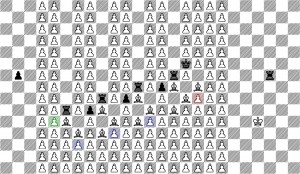
Our article, C. D. A. Evans and J. D. Hamkins, Transfinite game values in infinite chess, where we investigate the range of transfinite game values arising in infinite chess, grew directly out of Johan Wästlund's question Checkmate in $\omega$ moves?. In particular, we define the omega one of chess $\omega_1^{\frak{Ch}}$ to be the supremum of the ordinal game values that arise in the positions of infinite chess.
Abstract. In this article, we investigate the transfinite game values arising in infinite chess, providing both upper and lower bounds on the supremum of these values — the omega one of chess — denoted by $\omega_1^{\mathfrak{Ch}}$ in the context of finite positions and by $\omega_1^{\mathfrak{Ch}_{\!\!\!\!\sim}}$ in the context of all positions, including those with infinitely many pieces. For lower bounds, we present specific positions with transfinite game values of $\omega$, $\omega^2$, $\omega^2\cdot k$ and $\omega^3$. By embedding trees into chess, we show that there is a computable infinite chess position that is a win for white if the players are required to play according to a deterministic computable strategy, but which is a draw without that restriction. Finally, we prove that every countable ordinal arises as the game value of a position in infinite three-dimensional chess, and consequently the omega one of infinite three-dimensional chess is as large as it can be, namely, true $\omega_1$.
The article is 38 pages, with 18 figures detailing many interesting positions of infinite chess. My co-author Cory Evans holds the chess title of U.S. National Master.
Follow the links to see the chess positions, such as the following, which has value $\omega^2\cdot 4$.
$\endgroup$
$\begingroup$
This paper (details below) by Zhen Lin Low and Aaron Mazel-Gee cites not just MO but:
This collaboration would not have happened without the ‘Homotopy Theory’ chat room on MathOverflow.
arXiv.org > math > arXiv:1409.8192
From fractions to complete Segal spaces
Zhen Lin Low, Aaron Mazel-Gee
We show that the Rezk classification diagram of a relative category admitting a homotopical version of the two-sided calculus of fractions is a Segal space up to Reedy-fibrant replacement. In particular, the Rezk classification diagram of a closed model category in the sense of Quillen is a complete Segal space up to Reedy-fibrant replacement, resolving a conjecture of Rezk.
$\endgroup$
$\begingroup$
The paper A Counterexample to a Conjecture of Schwartz by Brandt, Chudnovsky, Kim, Liu, Norin, Scott, Seymour, and Thomassé answers this MO question of Felix Brandt. The question asks whether a weakened form of Schwartz’ Conjecture (a popular conjecture in Social Choice Theory) is true. The paper proves that even this weakened form of the conjecture is false, thus resolving Schwartz’ Conjecture in the negative. I think this is a nice example where one area calls on the expertise of another, and the call is answered.
Abstract. In 1990, motivated by applications in the social sciences, Thomas Schwartz made a conjecture about tournaments which would have had numerous attractive consequences. In particular, it implied that there is no tournament with a partition $A, B$ of its vertex set, such that every transitive subset of $A$ is in the out-neighbour set of some vertex in $B$, and vice versa. But in fact there is such a tournament, as we show in this paper, and so Schwartz’ conjecture is false. Our proof is non-constructive and uses the probabilistic method.
$\endgroup$
3
$\begingroup$
This MO question was asked in December of 2011, in line with a reference request for a senior thesis on odd perfect numbers completed in 1978. Subsequently, the OP has tried numerous ways to get hold of the thesis's author.
On August 24, 2013 Jim (Condict) Grace (the thesis's author) popped in to MO to respond to the original question.
$\endgroup$
2
$\begingroup$
My joint article with Justin Palumbo, The rigid relation principle, a new weak choice principle (Mathematical Logic Quarterly 58(6):394-398, 2012) grew out of our answers to my question, Does every set admit a rigid binary relation? (and how is this related to the Axiom of Choice?), which grew out of Mike Shulman's question, A rigid type of structure that can be put on every set?, on which I had made my very first post upon coming here to MathOverflow.
Abstract. The rigid relation principle asserts that every set admits a rigid binary relation. This follows from the axiom of choice, because well-orders are rigid, but we prove that it is neither equivalent to the axiom of choice nor provable in Zermelo-Fraenkel set theory without the axiom of choice. Thus, it is a new weak choice principle. Nevertheless, the restriction of the principle to sets of reals (among other general instances) is provable without the axiom of choice.
$\endgroup$
$\begingroup$
The question whether there is a non surjective bounded linear operator on $\ell_\infty$ that has dense range was answered in this paper by Amir Bahman Nasseri, Gideon Schechtman, Tomasz Tkocz, and me. An interesting aspect of the proof is that it uses a theorem proved by computer scientists to get a counterexample. So, in some sense, this question about operators on a non separable Banach space is connected to computer science!
$\endgroup$
$\begingroup$
I am frequently asked whether exponentials are "linearly independent". That is if we have a sequence of distinct complex numbers $\lambda_j$, whether $$\sum_{j} a_j\exp(\lambda_j z)\equiv 0$$ implies that all $a_j=0$. If the linear dependence above holds in all complex plane, this question was answered by A. F. Leontjev. All his books exist only in Russian, but I was asked this question so frequently that I wrote a short note, Linear independence of exponentials, explaining Leontjev's results, and posted it on Internet.
Then a question was asked on MO, On linear independence of exponentials, what if the linear dependence relation holds only for real $z$ (the $\lambda_j$ and $a_j$ are still complex). I could not find an answer in Leontjev's papers, and the result was a preprint https://www.math.purdue.edu/~eremenko/dvi/exp2.pdf
$\endgroup$
$\begingroup$
Keith Kearnes, together with co-authors Emil Kiss and Ágnes Szendrei, recently published a solution to Varieties where every algebra is free in this arxiv preprint. They prove a result under an even weaker hypothesis: that "a variety of algebras whose finitely generated members are free must be definitionally equivalent to the variety of sets, the variety of pointed sets, a variety of vector spaces over a division ring, or a variety of affine vector spaces over a division ring".
$\endgroup$
1
$\begingroup$
A nice question by Michael Hardy, How many rearrangements must fail to alter the value of a sum before you conclude that none do?, led to a recent 6-author collaboration, 5 or 6 of whom are MO patrons if I'm not mistaken.
- A. Blass, J. Brendle, W. Brian, J.D. Hamkins, M. Hardy, and P.B. Larson, The rearrangement number (manuscript under review).
See also this answer by Joel David Hamkins, https://mathoverflow.net/a/214779/2926, for more information. Please update this answer, Joel David, when this is published in a journal!
$\endgroup$
1
$\begingroup$
- In my paper Invariant curves and semiconjugacies of rational functions [Fund. Math. 219 (2012), no. 3, 263–270; MR3001243; DOI:10.4064/fm219-3-5], I proved a theorem characterizing Jordan analytic invariant curves of rational functions or certain type. My theorem implies that all such curves must be algebraic, but there was no examples except circles. I asked on Overflow whether there are any other examples, there was no answer for some time, then I offered a bounty.
The required examples were constructed by Peter Mueller. By that time my paper was already published, and I could not mention these examples in it, but Peter promised to include them in his own paper Decompositions of rational functions over real and complex numbers and a question about invariant curves.
Circles and rational functions
- When I asked this question "Analytic function avoiding elements of the modular group", I was working on a problem about Painleve VI. The answer was very illuminating, and eventually led to a solution of my problem on Painleve VI, which resulted in this paper, where I acknowledge the MO discussion.
$\endgroup$
2
$\begingroup$
The analog of the famous law of iterated logarithm for maximum eigenvalue of a random Gaussian matrix was asked here. Zeitouni's MO-answer was expanded (after significant effort) to a full answer for the limsup (including constants) and a partial answer for the liminf by Elliot Paquette and Ofer Zeitouni arxiv.org/abs/1505.05627 !
$\endgroup$
$\begingroup$
This MO question was the starting point for a joint work with Tao Mei where we study radial multipliers on the von Neumann algebras of hyperbolic groups. The paper is entitled Complete boundedness of the Heat Semigroups on the von Neumann Algebra of hyperbolic groups, and as the title suggests it contains among other a proof that, to our surprise, the heat semigroup, although not positive, is bounded on the von Neumann algebras of hyperbolic groups. The arXiv version is here, and it will soon appear in Transactions of the AMS.
$\endgroup$
$\begingroup$
$\endgroup$
$\begingroup$
In 2013 John Pardon solved the Hilbert-Smith conjecture for group actions on 3-manifolds. Lemma 2.17 of the paper was based on the answer to this mathoverflow question. I was quite surprised to receive an e-mail a few months after answering the question with a preprint resolving the conjecture, especially since I did not know the identity of the MO user (at the time he had a generic account name) or for what purpose the question was intended.
$\endgroup$
$\begingroup$
The MO question, "Shortest closed curve to inspect a sphere," was cited as the "initial stimulus" for the paper
Mohammad Ghomi, "The length, width,and inradius of space curves," (PDF download.)
He establishes a lowerbound of $6\sqrt{3}$ on the shortest inspection curve, more than $80$% of the conjectured $4 \pi$ lowerbound.
$\endgroup$
1
You must log in to answer this question.
Explore related questions
See similar questions with these tags.