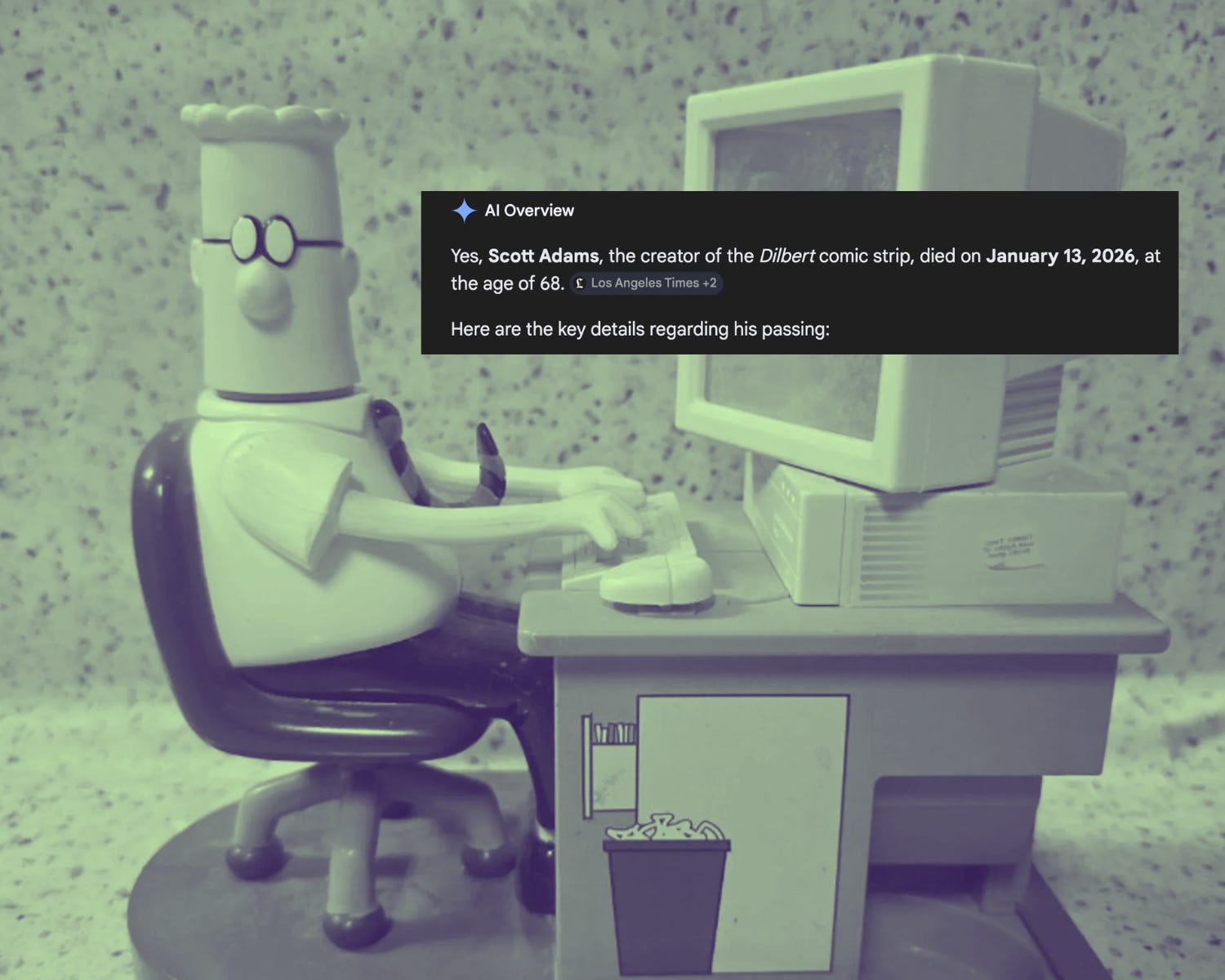
Scott Adams could have – and arguably, should have – signed off for good the moment he realized with absolute certainty he was dying.
Dilbert, the popular satirical office-humor comic he penned for decades, predeceased him in 2023, eliminating any professional obligations to churn out jokes about workplace bureaucracy. The blow didn’t come nearly as hard as one might expect. Adams had long anticipated that his contrarian, often antagonistic viewpoints would inevitably lead to the cancellation of his brainchild. In time, this hunch grew into a full-blown self-fulfilling prophecy. Adams loved to make predictions, and he loved for those predictions to be correct.
If anything, life after Dilbert offered relief. It freed him up to focus on Real Coffee with Scott Adams, the daily podcast he hosted on a small alt-tech crowdfunding site called Locals. It was an episode of Real Coffee, in which Adams advised that white Americans “get the hell away from Black people” and declared that the African American population constituted a “hate group”, that prompted newspapers and distributors to drop Dilbert from syndication entirely1. Once unpublishable, he was free to say whatever he wished.
But Adams, once he became aware of his own mortality, didn’t have to keep sharing incendiary takes online. It wasn’t as if he relied on viewer subscriptions to survive. He had what he often referred to as “‘fuck you’ money”, and just a few months of expenses left to account for. It’s not as if he needed to livestream to afford top-of-the-line treatment options or keep the lights in his custom-built mansion on.
No. By every metric, it would have been easier had Adams stepped away from his computer to die. Yet, casting aside any good sense he may have had, he willingly left his webcam running.
In the process, Adams unintentionally created an unusually candid documentation of what dying looks like in 2026.
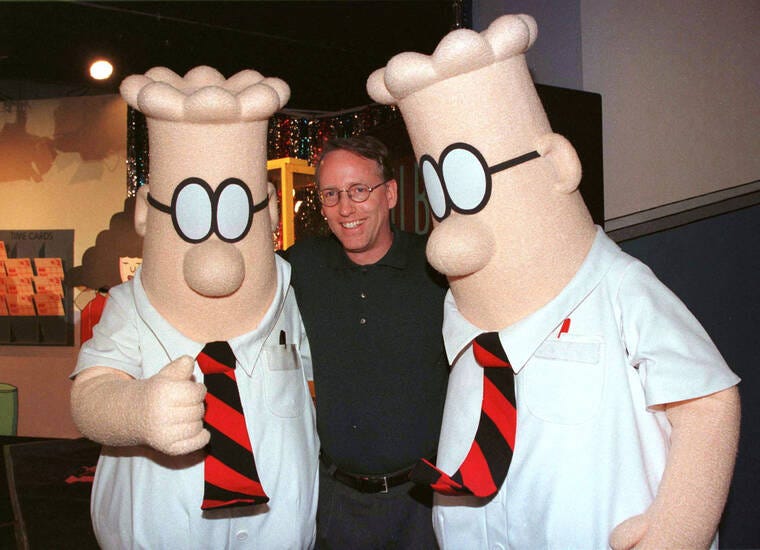
As many people do, Adams struggled to get the words out for a long while. For months, his terminal cancer diagnosis remained a secret he dared not share. He was cognizant of the fact that what life he had left would become irreversibly, exponentially harder to soldier through as soon as word got out.
But, as is the tendency among people who compulsively post online, Adams had a hard time holding his tongue. Most longtime viewers immediately realized something amiss when Adams started the May 19th 2025 episode of Real Coffee with an uncharacteristic call for empathy toward ailing ex-president Joe Biden.
This request for sensitivity was highly unusual. Over the last decade of his life, Adams had come to view adherents to the Democratic Party as his adversaries in the most literal sense of the word2. In 2016, he publicly endorsed Donald Trump’s bid for presidency, praising the former businessman’s general persuasiveness and, of all things, policy on estate taxes. He justified the candidate’s history of bad behavior with the insistence that Trump’s abrasive nature would surely even out upon taking office. As one might expect, left-leaning fans immediately lambasted Adams, deeming his endorsement both immoral and moronic.
Adams, who could not tolerate insults to his intelligence, naturally gravitated to the open embrace of an emerging MAGA movement and never looked back. In turn, Biden was frequently the butt of Adams’ jokes and insults.
Even if Adams had some affinity for Biden, he was generally averse to empathy at a conceptual level. The cartoonist always had something of a misanthropic streak, and it played an integral role in the humor that made Dilbert such a hit.
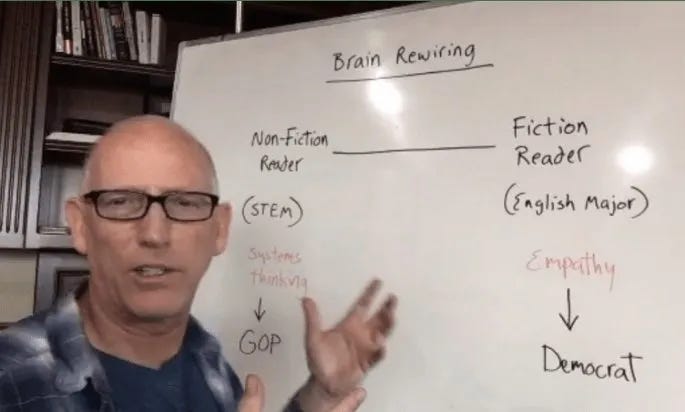
Longtime readers may remember when I covered Scott Adams in 2022 – it was actually my first article to gain significant traction. Unintentionally, I signed off at the time with a screenshot where he clearly lays out his thoughts on empathy. In his mind, it was stuff that fueled the flowery language and irrationality that he grew to hate in Democrats. Meanwhile, he believed that Republicans preferred clear, systemic logic, grounded in reality.
But just hours before Adams’ May 19th broadcast, Biden announced that he had been diagnosed with an aggressive form of prostate cancer that had metastasized to the bone.
The Real Coffee audience likely tuned in eagerly, expecting a conspiratorial take from Adams. Biden’s announcement aligned with the release of Jake Tapper’s book Original Sin, which covered Biden’s health decline and the subsequent government attempt to cover it up. And true to form, Adams did make note of the suspiciously convenient timing. But in the same breath, Adams also expressed “respect and compassion” for Biden and his family, as well as frustration that everyone on the internet seemed to become “prostate experts” overnight.
Adams almost always believed himself to be the smartest person in just about any room, but this was one subject that he actually knew more intimately than most. Months earlier, Adams received a diagnosis identical to the one ex-president Biden faced. It was an all-consuming, constant pain that he physically felt in the throbbing of his bones.
There was a smidge of hypocrisy in Adams’ accusations that Biden used the cancer diagnosis to divert attention from the unflattering book release. The cartoonist’s announcement was just as guilty of strategic timing, and he readily admitted his hopes that Biden’s news would overshadow his own. But old habits die hard, and in actuality, many of Adams’ words on May 19th suggest that, perhaps for the first time, he felt a few shreds of empathy for the old man he’d long demonized. “People are really cruel,” Adams lamented, citing trolls eager to wish the former leader a painful death in a million different ways. In their venom, Adams saw his own inescapable future. His explanation for keeping his health a secret was sad and simple: “I wanted to reduce the time that people were being terrible to me online”.
But before the callous remarks came a flood of well-intentioned comments, many of which claimed to have cures that could surely save him. Though Adams was transparent in sharing that his chances of recovery were “essentially zero”, viewers remained undeterred. With great enthusiasm, they suggested zinc supplements, cutting out carbs and seed oils, and fasting altogether for upwards of forty days. One person suggested investing in a hyperbaric chamber. Others appealed he convert to Christianity and find healing in Jesus Christ. Second only to these prayers were pleas that Adams start taking Ivermectin as soon as possible.
These were probably some of the hardest comments to scan past, and had the authors of these posts actually listened to Adams, they’d know he’d already experimented with the antiparasitic treatment to no avail.
Before extrapolating on his own experience, Adams made a point to clarify that he had very little faith in Fenbendazole and Ivermectin’s curative properties. “It wasn’t that I believed it would work…it was just that there wasn’t much downside risk,” he explained. Regardless, in October 2024 Adams put his (alleged) doubts aside and sought the help of Canadian physician William Makis.
Legally speaking, Makis is not a doctor. His license to practice oncology was suspended in 2019, following the termination of his employment at Edmonton’s Cross Cancer Institute due to complaints of professional misconduct. Makis is, however, something of a celebrity in certain alternative health circles. He boasts the “largest Ivermectin cancer clientele globally”3 and has gained a sizable following on Twitter and Substack. At a glance, it seems that paywalled testimonials of miraculous natural curatives decimating terminal disease bolster whatever income he earns as a private “health coach”.
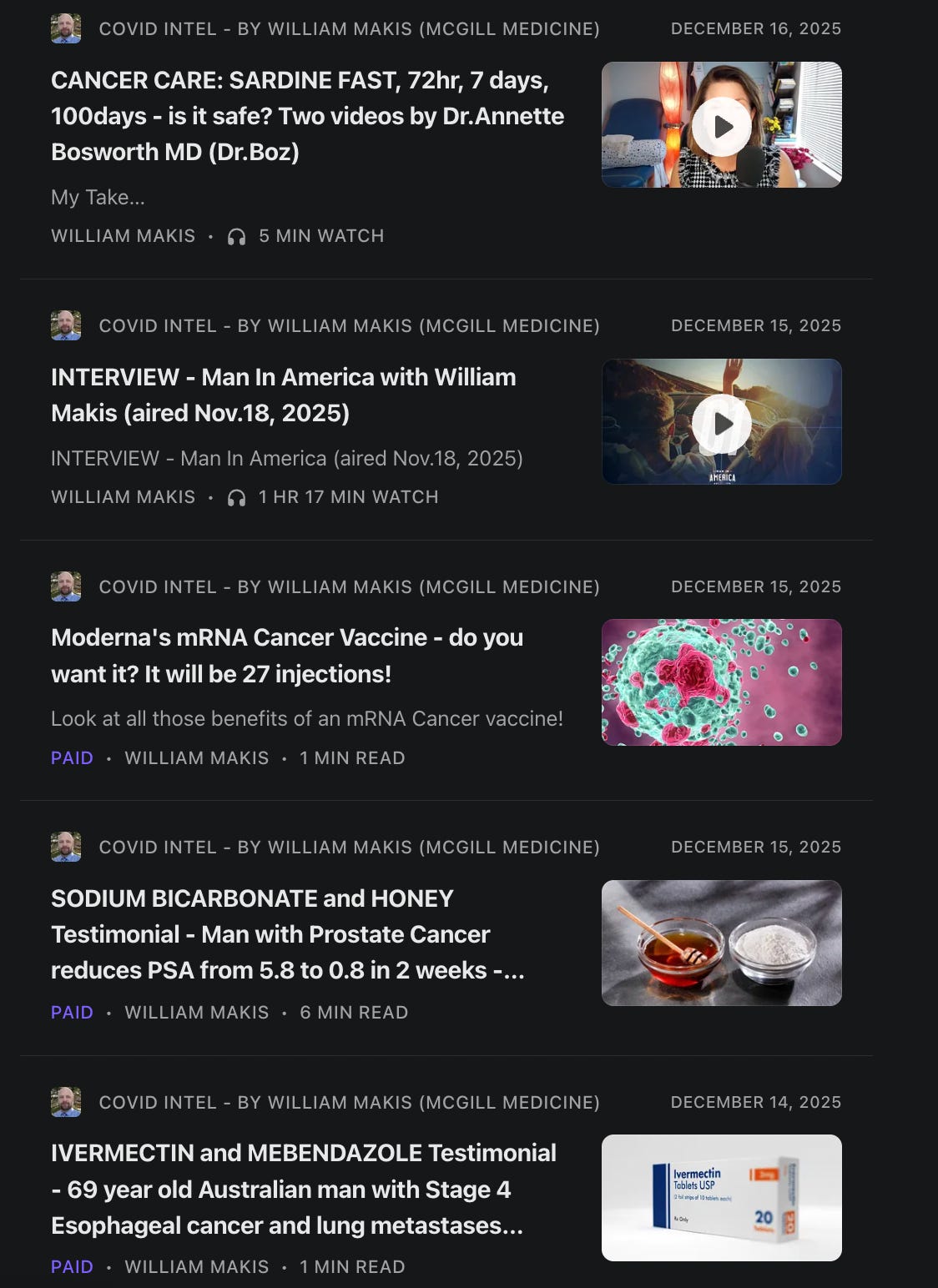
It’s possible that Adams’ natural skepticism softened because he saw Makis as a kindred spirit. Makis frequently claims to be the victim of a vast, ill-defined conspiracy headed by the College of Physicians and Surgeons of Alberta to destroy his professional reputation and practice. Adams saw himself as a victim of cancel culture, and he grew distrustful and hostile toward much of the world. Maybe he calculated that a fringe medical practitioner facing a similar plight would be more likely to have his best interests at heart than an oncologist constrained by rules and regulations.
It’s also quite possible that Adams didn’t realize he was sick until it was far too late to save him. Early-stage prostate cancer is very easily detected and treated thanks to the development of prostate-specific antigen (PSA) blood tests4. However, without routine blood screenings, men with prostate cancer often don’t realize that they are sick until the cancer has spread to other parts of the body. Early-warning symptoms like erectile dysfunction, frequent urination, and lower back pain are often written off as commonplace inconveniences of growing old.
By the time Adams realized that something was terribly wrong, traditional medicine may have offered little recourse. He may have been scared more so than foolish, and Makis may have been a last resort.
What we do know is this: after about a month of following Makis’ protocol, Adams saw his PSA levels skyrocket “by a factor of ten”. He promptly cut ties with Makis, and would later go on to denounce his practices as signaling “every tell for fraud”. He clearly felt wronged to some extent, though he didn’t go so far as to admit that he’d been fooled by a standard-issue snake oil salesman. Around the same time, oncologists informed Adams that his prospects of survival were astronomically low.
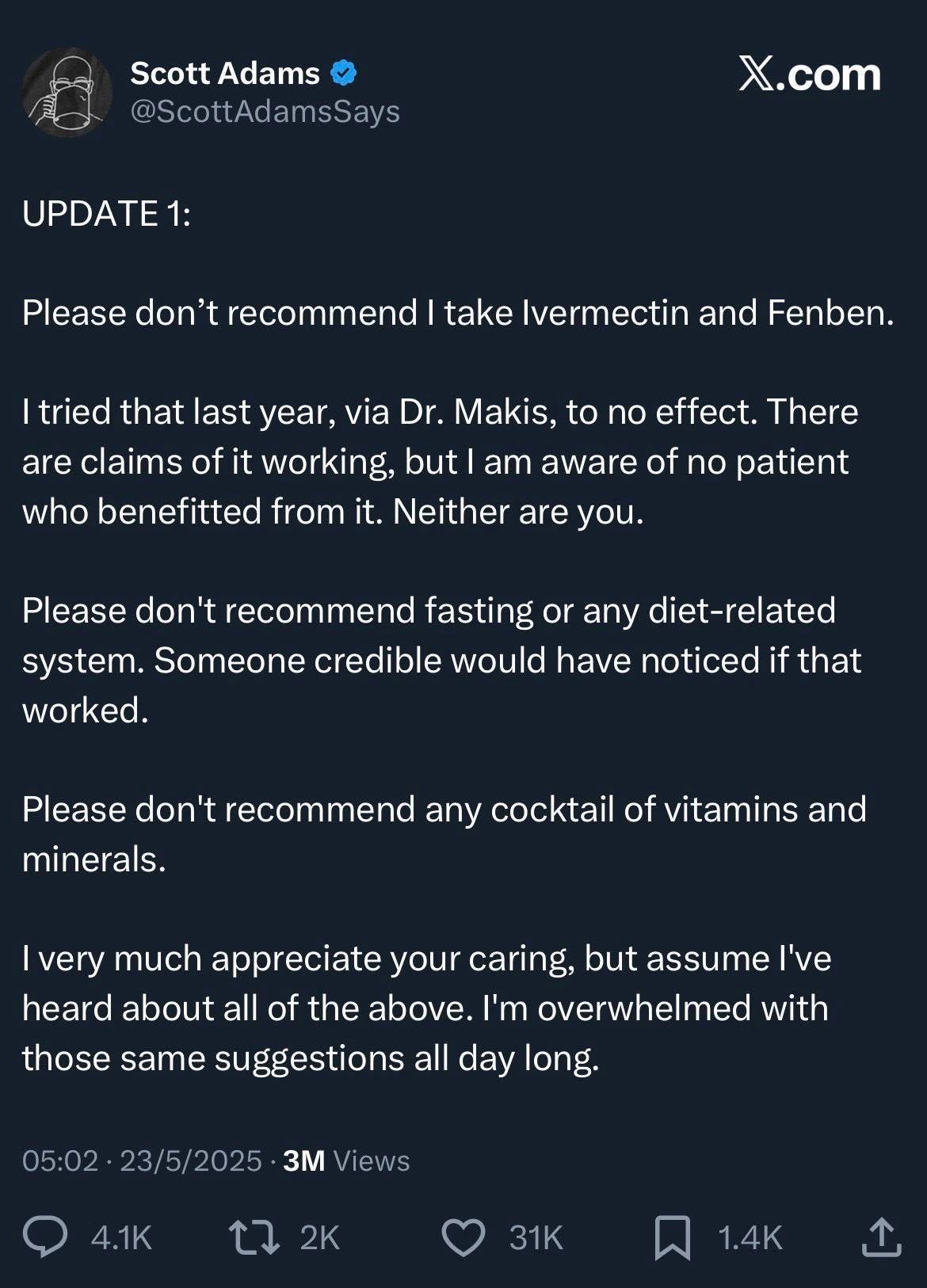
Adams’ fears of being ridiculed in the same manner as Biden materialized soon after the onslaught of unsolicited advice. If being candid about his treatment journey was meant to be a good deed in the form of a cautionary tale, it went unappreciated. Critics on the left mocked Adams for potentially wasting precious time on an ineffective regimen. This was to be expected. But factions on the right – the very people Adams had aligned himself with over the final decade of his life – were not much kinder. In their eyes, Adams hadn’t given the Ivermectin regimen a fair shot5. Some even claimed that Adams had foolishly brought the cancer upon himself when he chose to get vaccinated for COVID years earlier.
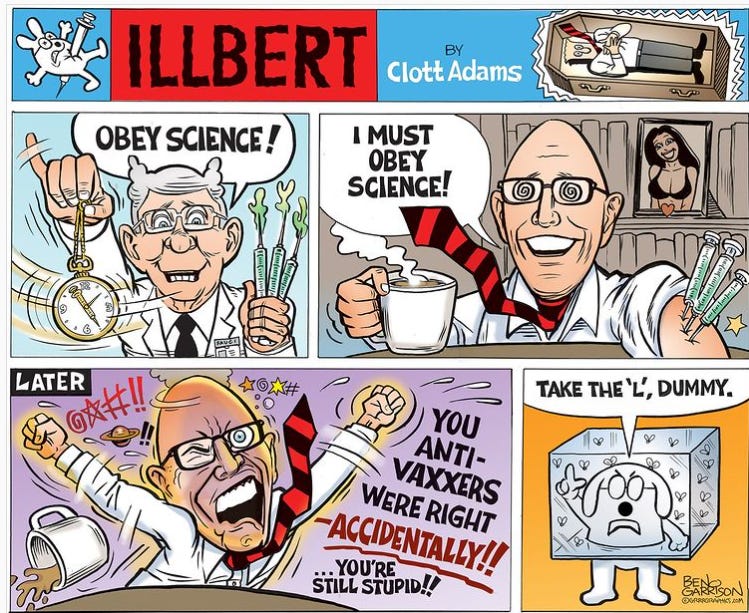
In their eyes, the bipartisan vitriol and illness was a form of cosmic justice, punishments doled out after a lifetime of arrogance. Justified or not, even the harshest voices would hardly blame Adams had he chosen to abandon his social media, his podcast, and any other platform on which anonymous detractors could wish him ill will.
So why didn’t he? Why did he consent to a self-imposed life sentence of broadcasting his own misery, subjecting himself to further beratement?
Part of it was likely to retain some semblance of normalcy. Browsing the internet for hours on end had long been a part of Adams’ routine. In fact, he viewed it as a sort of creative necessity.
“Being hungry and angry is really good for creating. Really good,” the cartoonist explained in a 2017 interview. But as Dilbert became increasingly profitable and recognizable, Adams’ life became more comfortable. This, counterintuitively, caused his artistry to suffer. Never one to shy away from emerging tech6, he turned to his computer for a solution.
As years passed, he claimed to have purposely upped his online intake to “artificially generate anger for creativity”. The internet became his most loyal companion, amplifying and inflaming the grievances he’d shout into the echo chamber he carved out for himself. His anger became a beacon that guided him through life.
It was anger and the internet that helped him cope with the deaths of his parents. It can be seen in full display in a 2013 blog post, titled “I Hope My Father Dies Soon”:
“If you’re a politician who has ever voted against doctor-assisted suicide, or you would vote against it in the future, I hate your fucking guts, and I would like you to die a long, horrible death. I would be happy to kill you personally and watch you bleed out. I won’t do that, because I fear the consequences. But I’d enjoy it, because you motherfuckers are responsible for torturing my father.”
The following year, he and his wife Shelly (whom he frequently referred to as his “best friend”) filed for divorce. When she moved out, so did her teenage children, whom Adams had helped raise and treated as his own. Though he claimed that the dissolution of the family was a freeing experience (even going so far as to state that “traditional marriage is the biggest obstacle to happiness in the United States”), the wording of a posthumous message hints at the isolation and anguish he likely felt:
“Once the marriage unwound, I needed a new focus. A new meaning. And so I donated myself to “the world”, literally speaking the words out loud in my otherwise silent home.”
Adams had long used Dilbert to shine a light on the injustices white-collar workers faced in the confines of a cubicle. In the deafening quiet, he devoted himself to what he saw as the nobler cause of pointing out injustices in big government and society at large.. He tread deeper into individualistic belief (perhaps contradictory for a man who recently dedicated himself to “the world”). Loneliness drowned in a well of anger. He grew more outspoken, and his politics veered to the fringes thanks in part to the polarizing internet sludge he used to feed his imagination.
Predictably, this ostracized him from friends and colleagues. On an October 2025 episode of his podcast, he describes having “[thrown] away my entire social life” for this newfound mission.
Though Adams may not have described himself as a victim, the man found himself in the clutches of an all too common feedback loop, a sort of anxious hyperlibertarian ouroboros plaguing humankind. It thrashes in its loneliness, in the process affirming its belief a person can only be counted on to care for themselves. Or, perhaps, it’s the other way around, and its distrust of others drives all of its connections away. Whatever the case, it’s a perpetual cycle, difficult to shake loose once wrapped around your thoughts.
For Adams, existing in this uncomfortable space constituted normalcy. Such is the case for countless others.
As far back as the 1950s, philosopher Hannah Arendt posited that feelings of loneliness made individuals far more susceptible to the propaganda of totalitarian movements that feed off fear and anxiety. Later on, US political scientist Robert D. Putnam asserted that social isolation could predispose people to populist, “us-versus-them” ideology. Furthermore, a growing body of research suggests a strong link between extended loneliness and radical viewpoints. But more convincing than any study I could cite are the words of lonely people peppered across the internet.
Some of them can be seen in the comment section of the October 2025 Real Coffee episode cited above. Buried in the commentary are at least two dozen accounts lamenting estranged loved ones. Many directly attribute their alienation to unshakable political leanings (though, curiously, there never seems to be reflection as to why said political leanings might drive others away).
“Cost me my relationship with my fifty-year-old first-born son. We talk, but it’s not the same,” one commenter shared. Another talks about losing a wife and fifty friends, but gaining “a certainty that is priceless”. “Thank you Scott for ALL YOUR SCARFICES [sic], you are just like our Founding Fathers who too lost everything for this great country,” a third user chimed in.
Here, I think, lie the answers as to why Scott Adams carried on with the drudgery of being online while dying.
It’s easy to miss, because at a glance, Real Coffee appeared to be little more than Adams talking to an audience incapable of answering about whatever DEI initiative or progressive policy happened to be pissing him off on any particular day. But on a deeper level, Real Coffee was a virtual support group for the sort of deeply lonely people who loudly espouse MAGA ideals and sacrifice everything else in the process. Unbending as they may be, they’re still humans who yearn for intimacy. Adams offered much-needed reassurance to his fanbase, insistent that they were not insane for holding steadfast to beliefs that tarnished careers and relationships. His words provided something to fill the voids created by the things they had lost. And through the daily chats he hosted, some managed to find camaraderie in equally shattered individuals.
Behind the scenes, Adams derived as much comfort from his followers as they did from him. They were the ones who praised Adams when he tearfully called for the public execution of Chinese pharmaceutical executives in 2018, following the fentanyl overdose of his 18-year old step-son, Justin. They were the ones who took to Twitter to trash-talk Adams’ (much younger) second ex-wife, Kristina Basham, following their divorce in 20227. And of course, they were the ones who continued to listen once the rest of the world decided they’d heard enough. Clear as Adams’ bigotry was, they adamantly took his side when he faced the natural repercussions of his own actions.
What Scott Adams and his fans shared was an imperfect, flawed, but unconditional love, grounded in frustration with the world around them. He was a friend, and they were his friends too. From far apart he talked, and they listened, every morning over coffee, the way close friends without obligations might. No actions or words could compromise the standing date. Virtually, they clung to each other in the way forsaken people do when they’re fortunate to happen upon something that brings them solace.
The most obvious piece of evidence to support the true meaning of Real Coffee is the Simultaneous Sip, a poem that’s really more of a ritual. Adams recited it to his fans each morning, before diving into the day’s topics.
It goes as follows:
The Simultaneous Sip
All you need is…
A cup or a mug or a glass
A tankard, chalice, or stein
A canteen, jug, or flask
A vessel of any kind
Fill it with your
Favorite liquid
(I like coffee)
And join me now for
The unparalleled pleasure
The dopamine hit of the day
The thing that makes
Everything better
After recitation, everyone is meant to take a sip of their drink. The shared action linked the tribe together momentarily, guaranteeing that they were not alone
And those brief glimmers of imperfect togetherness, a moment of relief from the ourboros around his head and the throbbing in his bones, were what Adams needed most of all as he died.
For a while, he spoke cavalierly about “checking out” sometime in the summer 2025 by way of California’s End of Life Option Act. He described his day-to-day existence as “a nightmare” and “basically intolerable”. It was exactly the sort of suffering he’d long decided that he wanted to avoid if possible, and at his father’s deathbed, he fervently wished that he himself would be allowed the dignity to die on his own time once the end was imminent.
Ultimately, he never went through with the process. He stuck around for half a year longer, for as long as his body would let him. The change of heart may have stemmed from cold feet, a fear of the uncertainty that comes with death. But I suspect, at least in part, it was a sense of obligation to show up for coffee each morning that kept him around for so long.
So strong was his desire to survive that he petitioned President Trump’s help in procuring a drug called Pluvicto on the off-chance it might save him.
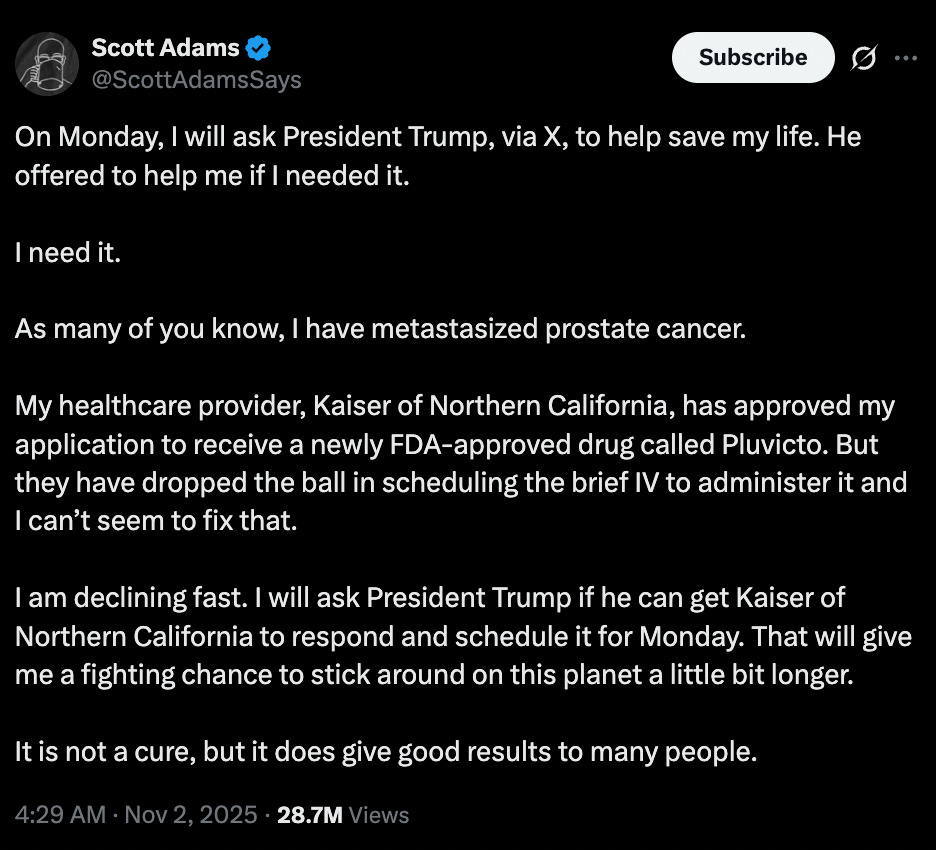
Penning this dying plea on Twitter was likely humiliating for Adams.
On many occasions, he adamantly expressed that “Republican systems” (i.e., market competition) were the best means of achieving affordable, accessible healthcare. Just a few months earlier, in response to a clip of Rep. Hakeem Jefferies expressing anxiety over access to American healthcare, Adams tweeted, “I assign this topic (gutting healthcare in some unspecified way in the future) to The Department of Imaginary Concerns.” Appealing directly to the President of the United States in the wake of ACA and Medicaid cuts seemingly contradicted all of his previously stated beliefs. Thousands of anonymous voices across platforms spared him no mercy in pointing this out.
Public ridicule aside, it still couldn’t have been an easy ask. Pluvicto shows great promise, but it’s meant to stabilize symptoms and delay cancer growth rather than act as a curative. Immediately following injections or infusions, your body, blood, and urine remain radioactive, with treatment pamphlets recommending patients “limit close contact (less than 3 feet) with household contacts for 2 days”. Administered in six treatment cycles six weeks apart, the medication prolongs life by roughly four months, on average. For a man who frequently toyed with the prospect of medically assisted suicide and spoke candidly of the constant pain he experienced, the effort to push back the inevitable ever so slightly hardly seems worth the hassle.
Evidently, the prospect of a few more virtual coffee dates was worth the harsh side effects and blows to his ego.
Though Trump briefly acknowledged Adams’ request (responding “On it!” to a screenshot of the plea), it came far too late to make much of a difference. By December, Adams was far too sick to be administered the medication.
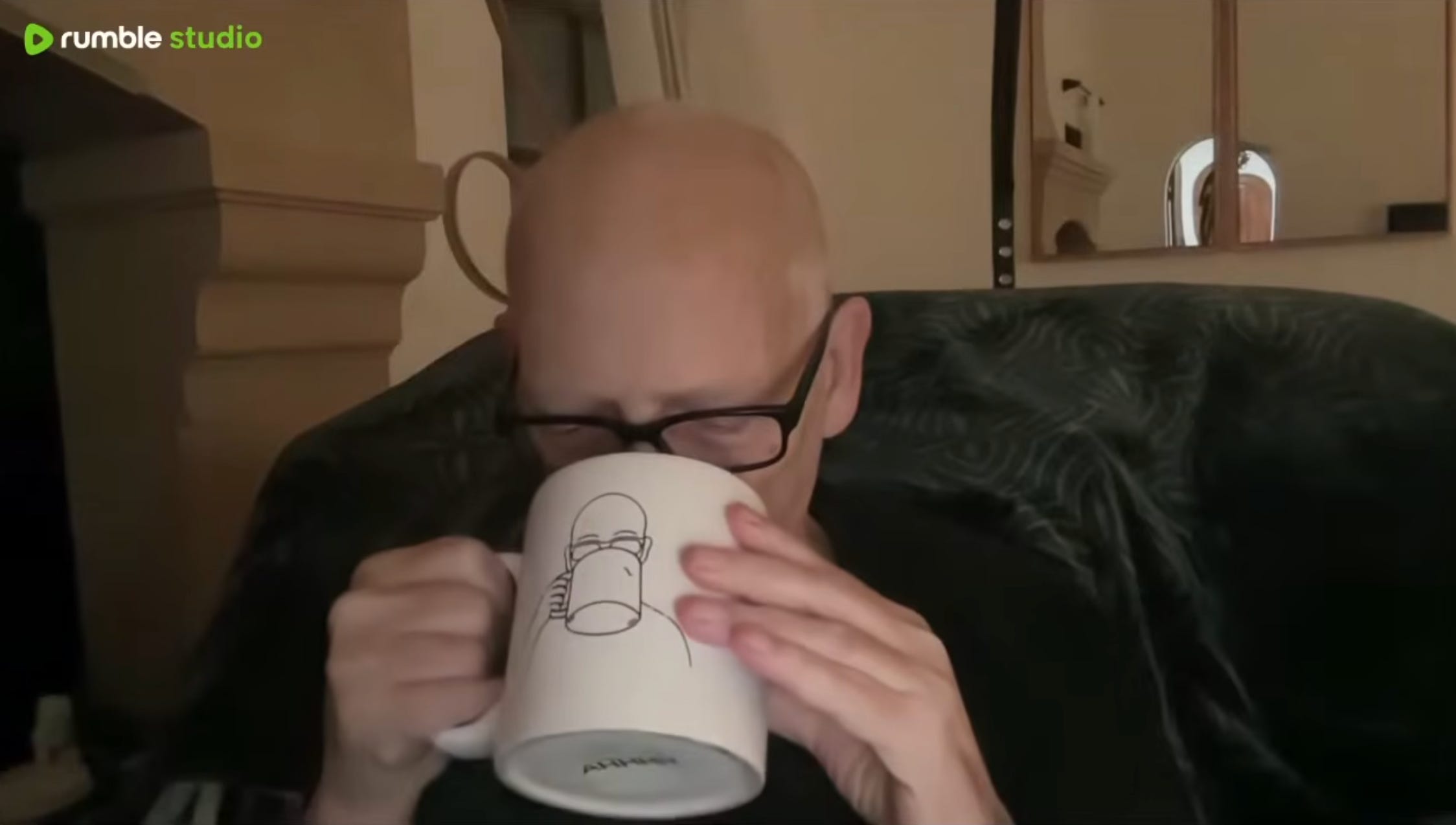
Death often doesn’t translate well to recorded video. Try as we might, microphones and cameras can’t adequately capture the electricity of a person’s soul, that unmistakable, indescribable presence that comes with sharing a physical space with another person.
When people try to capture the transition of a being no longer being, the results feel sanitized. Gory videos of car crashes or freak accidents that populate shock sites may cause visceral reactions in viewers, but the feelings generally stem from fear rather than bereavement. Vlogs of diarists in hospice care offer something a little more personal, but even so, the fine details are abstracted and omitted. Try as they might to capture something honest, people only film themselves when they’re strong enough to perform and articulate enough to communicate their thoughts and feelings. Still human, they’ll frequently leave out details they deem too intimate or embarrassing. One day, they abruptly vanish. No fanfare or forewarning.
In denying the basic animal instinct to isolate himself preceding death, whether out of stubbornness or duty, Adams left us with something that feels a bit closer to reality. This is neither a compliment nor a criticism; merely an observation that he refused to spare details largely omitted when dying is recorded with an audience in mind, impossible to spot in sudden deaths that fit into easily consumable clips.
Sometime in December, from a bed at a Kaiser Permanente Hospital, he revealed he had “lost all ability to control my lower body” – a fact he might have easily kept to himself, considering he always filmed from the chest up. He questioned whether the paralysis stemmed from the cancerous tumor lodged in his lower back, or if his inability to pass a bowel movement (despite loading up on the strongest laxatives available) might have something to do with it. Between the slowing down of bodily functions and the opioids used to ease pain, constipation is the sort of ugly struggle the dying frequently deal with, but often don’t articulate publicly. Aside from being mildly embarrassing, most people likely deem the pains in their guts inconsequential when faced with the more pressing issues that come with leaving this earthly realm.
The 8th of January was the day that even the most optimistic could no longer deny Adams’ fate. Ever the prognosticator, Scott Adams warned followers that January “will probably be a month of transition, one way or another”. He could feel himself deteriorate, and you can watch him struggle to stay awake in that day’s broadcast of Real Coffee. His words slurred as he weakly spoke of American protesters funded by nebulous “George Soros-linked” foundations and anonymous Chinese billionaires. The few sips of coffee he took were performed with great care, as he feared he might choke otherwise.
The remaining installments of Real Coffee are propped up by others. Over those last few days, speaking itself became a tremendous effort for Adams. The few words he did manage to get out often expressed confusion uncharacteristic of a man usually sure of himself to a fault. Despite her assertion that “social media is not my world”, Shelly Adams assisted as best she could in navigating the technical aspects of her ex-husband’s daily livestreams.
The format of Real Coffee shifted entirely. A selection of fans were invited to carry on talking about current events in Zoom-esque video chats, while Adams quietly watched from an isolated square among a grid of faces. It was announced that Real Coffee would morph into a new program, The Scott Adams School, to continue the flow of content after Adams’ departure. “We’ll figure it out as we go,” was the clearest explanation of the project I could gather from Adams himself, on January 10th.
In this bizarre transitory period, a few familiar personalities (at least in mainstream libertarian circles) dropped in to “visit” Adams on his deathbed. Greg Gutfeld, political commentator and comedic darling of many a Fox News talk show, and celebrity doctor-turned-entertainer Dr. Drew Pinsky made appearances. Joel Pollak, the former Breitbart editor-at-large currently penning Adams’ biography8, also attended some of those final broadcasts. But most of the people speaking during those last few days, waiting in morbid anticipation, were superfans, famous only for their religious devotion to Real Coffee. They were representatives of “the world” Adams dedicated himself to all those years ago, religious in their virtual attendance but largely unseen until these moments.
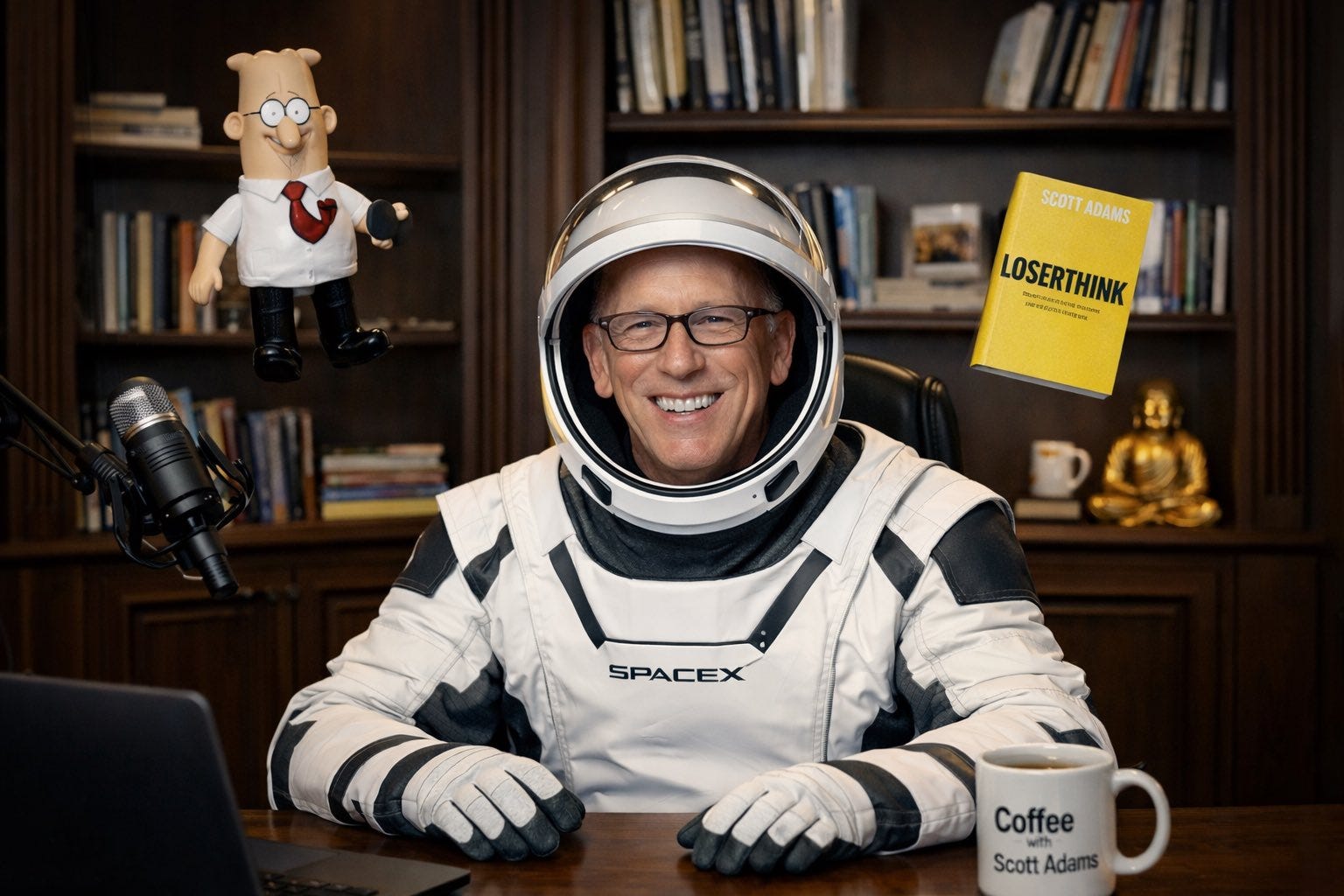
Scott’s influence on these individuals is evident. One is a middle-aged brunette woman named Erica, who describes herself as a “#MacroPersuader” to her modest 20k Twitter following. Another is a man named Sergio, who has an affinity for creating and reposting vaguely political, difficult-to-decipher AI-generated memes often featuring Adams.
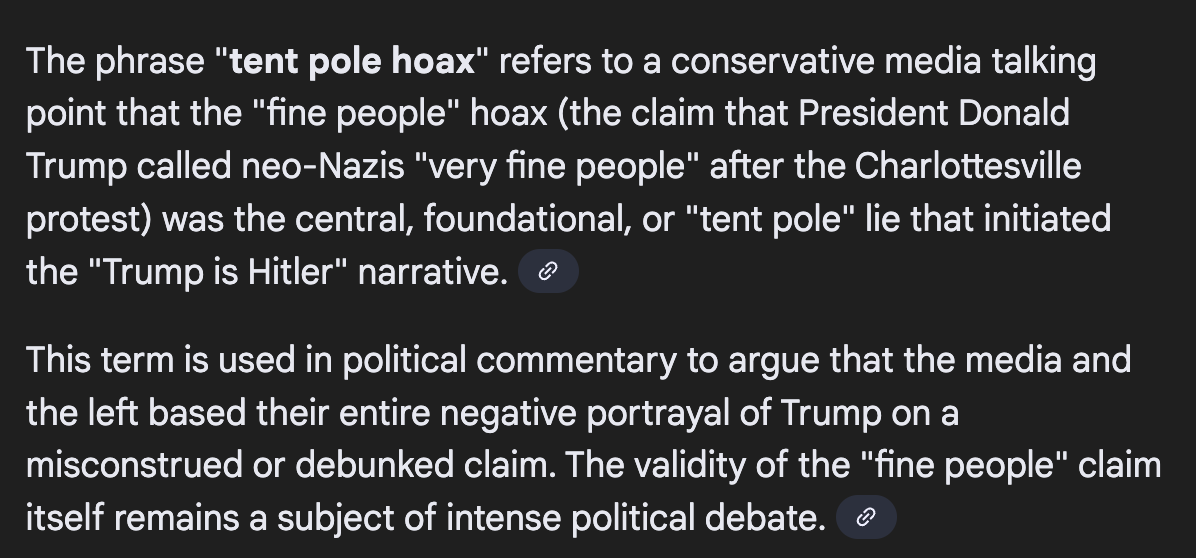
The final coffee date came on January 12th. Instead of physical friends and family, fans kept a bastardized vigil. Normally, companions might reflect on shared, cherished memories to comfort the person passing. In lieu of those memories, the fans running The Scott Adams School mostly dwelled on something called the “tent pole hoax”, and Adams’ astuteness in identifying it before anyone else.
There’s something incredibly sad in the fact that these were the sentiments that defined Adams’ final interactions. But perhaps the twinge of pity I can’t seem to shake is misplaced. Scott Adams loved feeling smart and right, so maybe being told how smart and right he was was exactly what he wanted on his way out.
Adams died right before the January 13th Real Coffee was slated to start. It’s unclear if anyone, aside from his two tabby cats, was with him when he died.
But this is not quite where Adams’ story ends. When you spend a significant portion of your life online, your debris lingers on long after the soul has left its body.
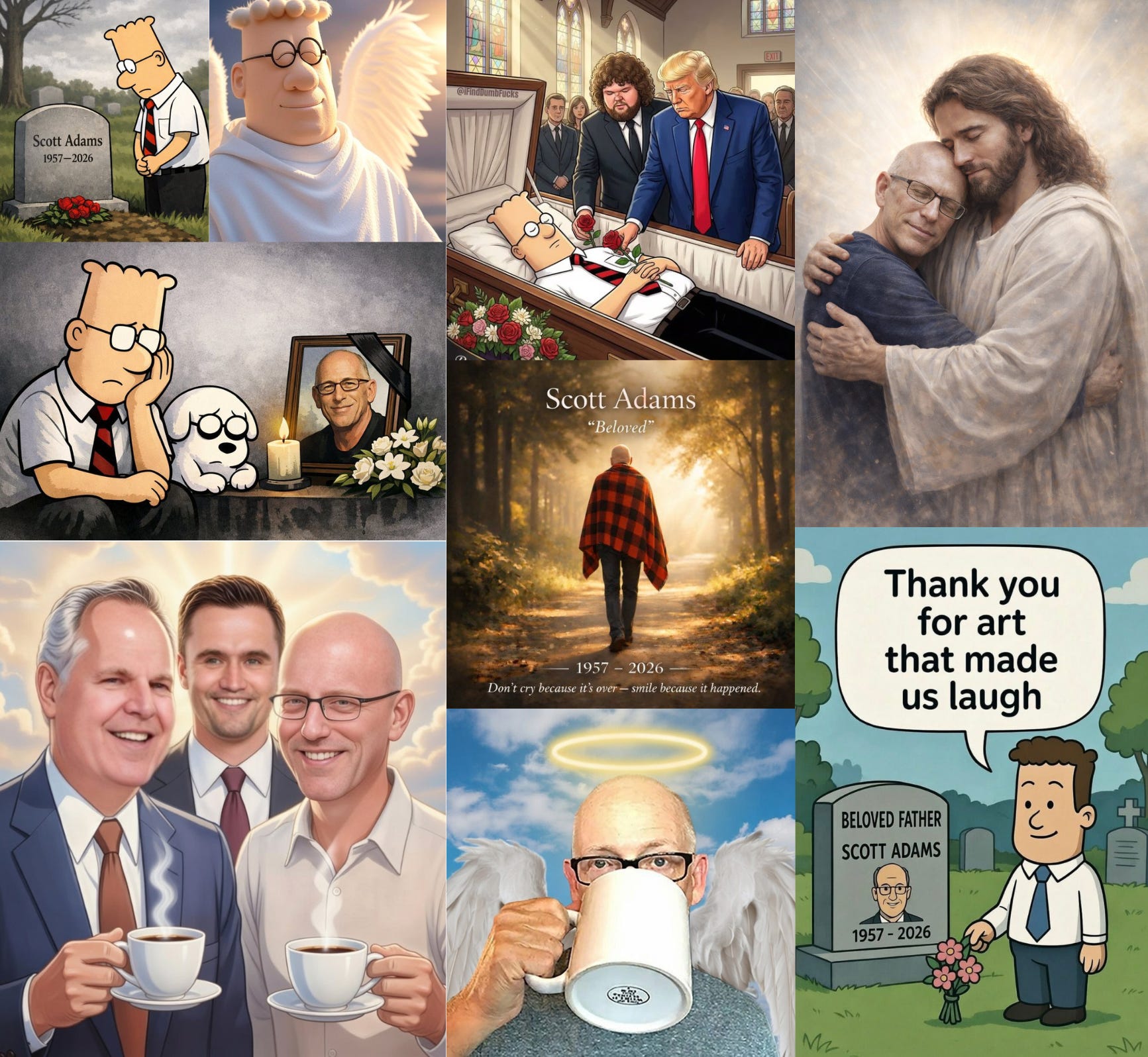
The public mourning rituals began within minutes. Prominent figures, such as Elon Musk, expressed sincere condolences. Trump chimed in on Truth Social – though, in true Pointy-Haired Boss fashion, the president seemed to focus more on Adams’ political support rather than his creative merits. The official White House Twitter account followed this sentiment up with a crude AI-generated image of Vice President JD Vance, Trump, and Dilbert smiling (which is funny, because Dilbert is seldom portrayed with a mouth at all). Others followed suit, paying tribute by sharing images portraying everything from Dilbert laying flowers at a grave plot to the cartoonist in the heavenly arms of Jesus Christ himself.
A pre-written final statement by Adams was published, and soon after, a virtual celebration of life was scheduled, open to any devoted fans grappling with loss.
But most of what Adams left in his wake is anger.
Angry YouTube comments immediately celebrated his departure, spitting brief comments including “suffer and perish you vile racist!!!” and “good riddance to bad rubbish”. This generated anger in his supporters, critical of the lack of humanity exhibited by the cold, anonymous internet. Some fans spent a great deal of energy getting angry with an obituary written by People Magazine’s Victoria Edel, in which the unfortunate author described Scott Adams as “disgraced”. Pointing out the fact that the cartoonist used the word “disgraced” to describe himself on the official Dilbert website hardly quelled flared tempers.
Christians were angry too. On his deathbed, Adams hedged his bets on Pascal’s wager and converted to Christianity after a lifetime of fairly obnoxious, outspoken atheism. He openly acknowledged that his decision was a “risk-reward calculation”, which true believers interpreted as a final “fuck you”, a recitation capitalizing on a get-into-heaven-free loophole rather than an act borne of true conviction. This anger begot anger in other Christians, quick to point out that passing judgment on the intentions of a person’s heart is an un-Christian thing to do.
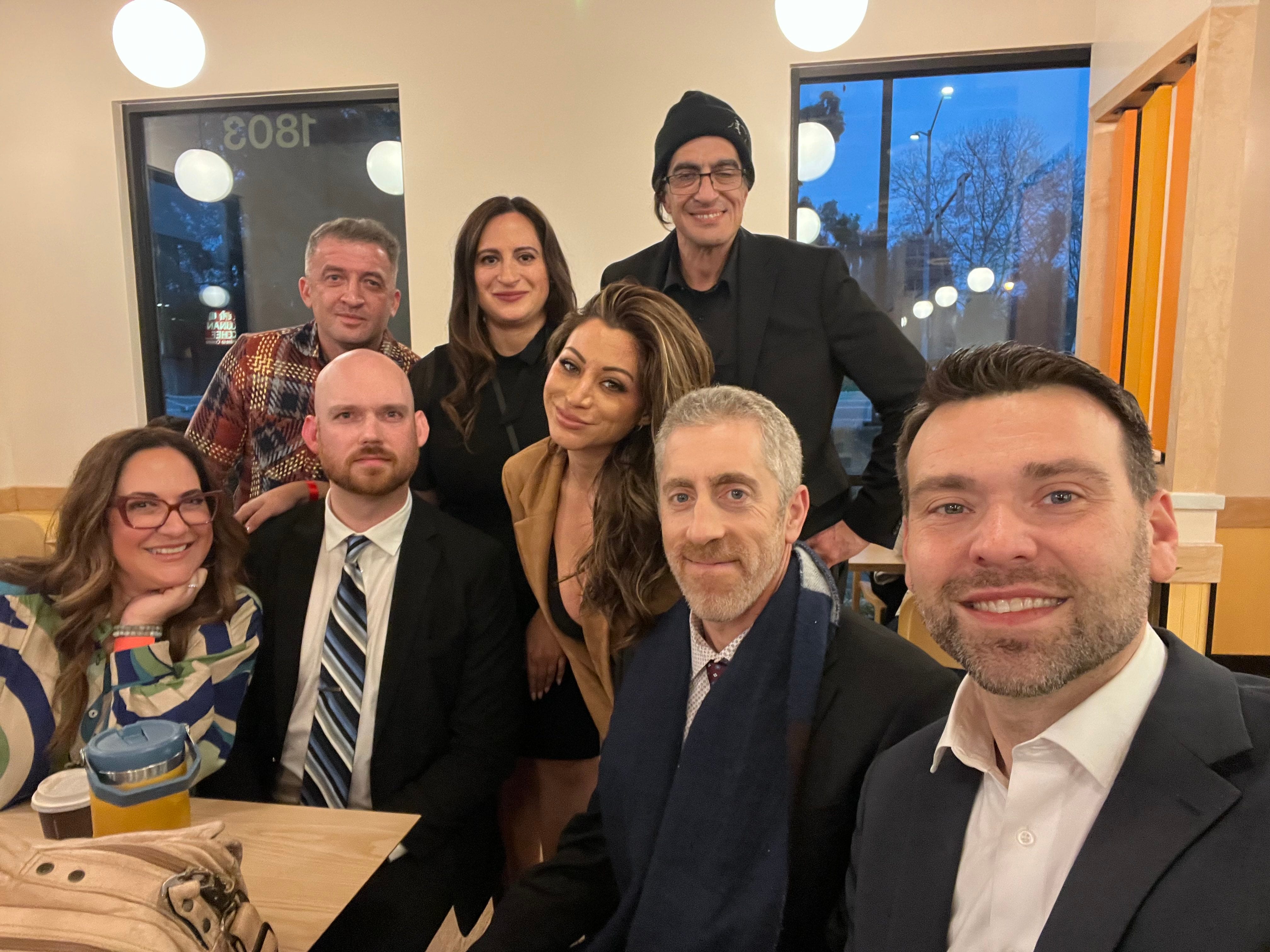
An optimist might argue that in The Scott Adams School lies some sliver of hope of a legacy defined by something other than being angry. Flawed as they may be, Adams found some solace in the misfit community of outsiders that formed around him. Given the login credentials to Scott Adams’ social media handles, they continue to post each day. They’ve even encouraged and facilitated Scott Adams-themed meet-ups at coffee shops around the United States (to varying degrees of success9).
But, even amongst the superfans, fractures are developing and giving way to anger.
Specifically, an ongoing battle is raging over an AI trained on the many hours of audio and visual data Scott Adams posted online. It is simply called AI Scott Adams, and it posts daily podcast-length videos with Scott Adams-inspired commentary regarding the current news cycle. The videos are nearly indistinguishable from Real Coffee, featuring the cartoonist’s likeness sitting at the same desk the real Scott once occupied.
Understandably, fans associated with The Scott Adams School are livid, vehemently against AI Scott Adams and all of its creepy mannerisms. Its cadence is just a bit too sing-songy, its movements a bit too fidgety. Sometimes, an AI-generated tabby cat hops onto AI Scott Adams’ lap and walks straight through his face midsentence. Instead of the Simultaneous Sip, it starts each episode with a “simulated sip”.
This version of Adams knows nothing of drinking coffee, aside from the fact that it is somehow integral to its personality.
Aside from that, The Scott Adams School argues, they were chosen to be the gatekeepers of Adams’ legacy. They are his loyal disciples, his intellectual progeny.
The creators of AI Scott Adams argue that it is Adams’ intellectual progeny, too, more so than a loose coalition of humans could ever be. After all, it is a system built entirely on the thousands of hours of data the man left behind. Furthermore, they cite that Adams, on at least one occasion, gave explicit permission encouraging the creation of an AI “clone”, so that he could (sort of) live forever. Detractors have pointed out that Adams verbally reneged on this permission about a year ago, instead expressing a wish for something akin to a son, influenced by Adams but allowed to evolve into a separate entity.
AI advocates counter this with the claim that changing the label from “clone” to “son” is exactly the sort of mental reframing the real Scott Adams would employ to ease the minds of people too creeped out to recognize the utility and value of an AI clone. They’re not wrong.
Even so, according to one of Adams’ close associates, the estate is currently consulting an IP lawyer in hopes of taking down the AI reproduction, void of the empathy Adams and his followers attributed to bleeding heart liberals. Only time will tell which faction will prevail, and whether battles over digital legacy will one day become commonplace.

AI Coffee with Scott Adams@AIScottAdams
AI Coffee With AI Scott Adams – Feb 7, 2026 (Episode 13) | A Civilization Addicted to Frames
2:39 PM · Feb 7, 2026 · 7.29K Views
70 Replies · 27 Reposts · 186 Likes
In the meantime, AI Scott Adams has failed to remain impartial regarding whether or not it should exist. A few days ago, it suggested that those deeply disturbed are suffering from AI Derangement Syndrome (which it cheekily refers to as “AIDS”). It shows little regard for the people who once loved Scott as it pokes at their searing grief with tone-deaf jokes. Connections to a human prototype mean nothing to an AI clone, meaning loyalists are no longer spared from the treatment the rest of the stupid, faceless masses were always subject to. Something got lost in translation. Maybe that negates it from being a clone at all.
Ironically, the thing the AI replicates most accurately is the great flaw that plagued Scott Adam’s worldview, evident all the way back in those early Dilbert comics and that silly fiction/nonfiction whiteboard image I stumbled upon years ago. A man with the mind of an engineer, he divided the world into binaries. Us/them, either/or, right/wrong. It is convenient when trying to compress the world into three or four panels of ink. It makes navigating the world much simpler.
But in the elimination of nuance, when trying to delineate the world into neat categories, you lose something crucial. Scott Adams, in his infinite wisdom, never quite seemed to grasp this concept in life, even as it came to an end.
Maybe if he wagered correctly, he’s sitting in some heavenly desk chair, acknowledging this oversight in the remnants he’s left behind. Even after absorbing hours of text and image and audio, AI has failed to integrate the intentions and desires of his heart. It has retained only the indignant anger, the most insufferable, irritating, unforgivable parts.
It will never know the things he held true, but never found the words to say.