In case you are looking for an unusual business card, company badge or event badge holder, then this article is for you: A DIY RFID badge and business card with bling-bling addressable RGB LEDs to impress your customer, clients, friends at work or at a conference, packed with electronics. Plus it includes 10 original tools from Victorinox, the manufacturer of the Swiss Army Knife.

Outline
This article describes a project creating a versatile ‘business card and badge holder’. The idea was to have a versatile tool:
- PCB Business Card (to pass to clients or friends)
- PCB Badge and card holder (company badge, conference event badge)
To make it versatile, the its not only made of PCB material, but very flexible and features many add-ons for your needs:
- Bare and inexpensive PCB business card, with silkscreen QR code for contact or company information
- Add logos: special copper areas on the front and back for laser engraver (logos, text, name, …)
- Add RFID: Intelligent business card with RFID antenna, used to store contact information
- Add MCU: ARM Cortex-M0 dual-core (RP2040) micro-controller with 1.5 MByte MSD (USB thumb drive)
- Add Hackability: Load your own software through UF2 booloader. Use the ARM SWD debug interface through the USB-C connector pins, or use the exposed SWD debug pins.
- Add Battery: Circuit includes USB-C LiPo charging and power boost circuit.
- Add bling-bling: footprints for 8 or 16 addressable LEDs (SK6812).
- Use the LEDs to illuminate the badge holder.
- Use the LEDs to build an edge-lit acrylic sign.
- Make it a Swiss Army Knife: Holder for different Swiss Cards, extra business cards and company badge.
Thickness of the design is from 0.8 mm (PCB Business card with RFID) up to 10 mm with card holder, Acrylic insert, battery, company badge and Victorinox Swiss Card.
The project has been created for the Lucerne University of Applied Sciences and Arts, and files are on GitHub.

PCBs
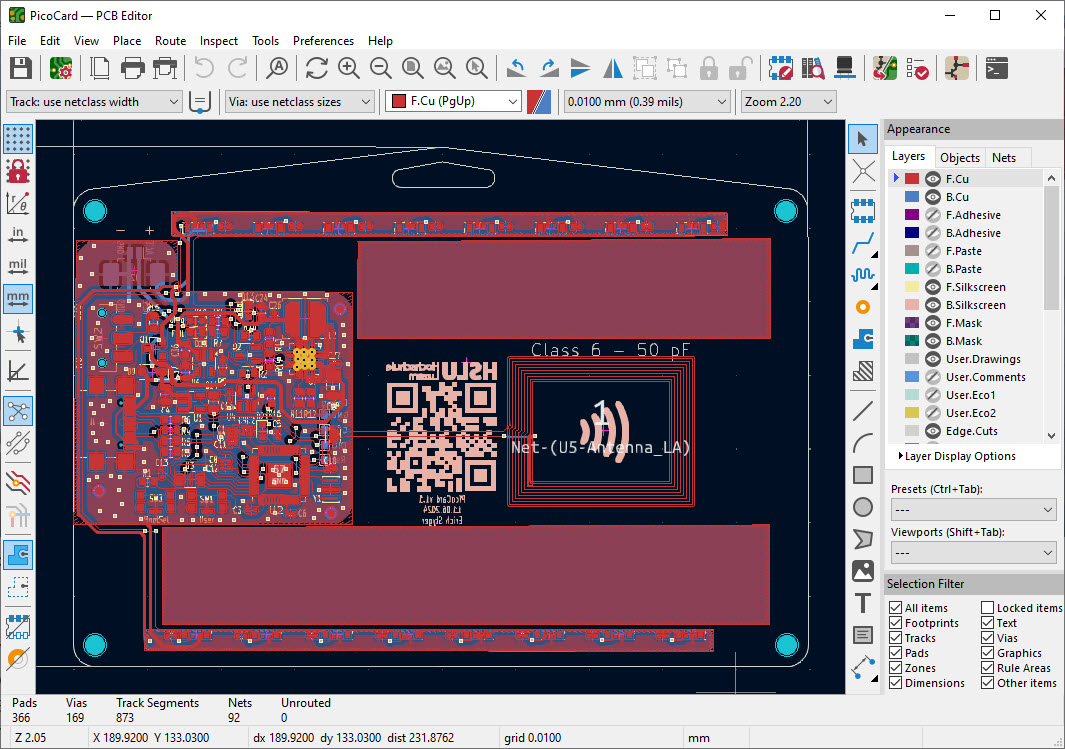
The PCB is created with KiCad and is available in two different layouts:
- Standard PCB business card (credit card size (86×54 mm) for 8 LEDs
- Larger business card and PCB Badge Holder (100×70 mm) for 16 LEDs

PCB Colors
I experimented with different PCB colors (solder masks): green, blue and black. To me, the black version looks the best, but I had to tweak the footprints because PCBWay would only manufacture black PCBs with a minimum solder mask pad distance of 0.22 mm.

Hardware
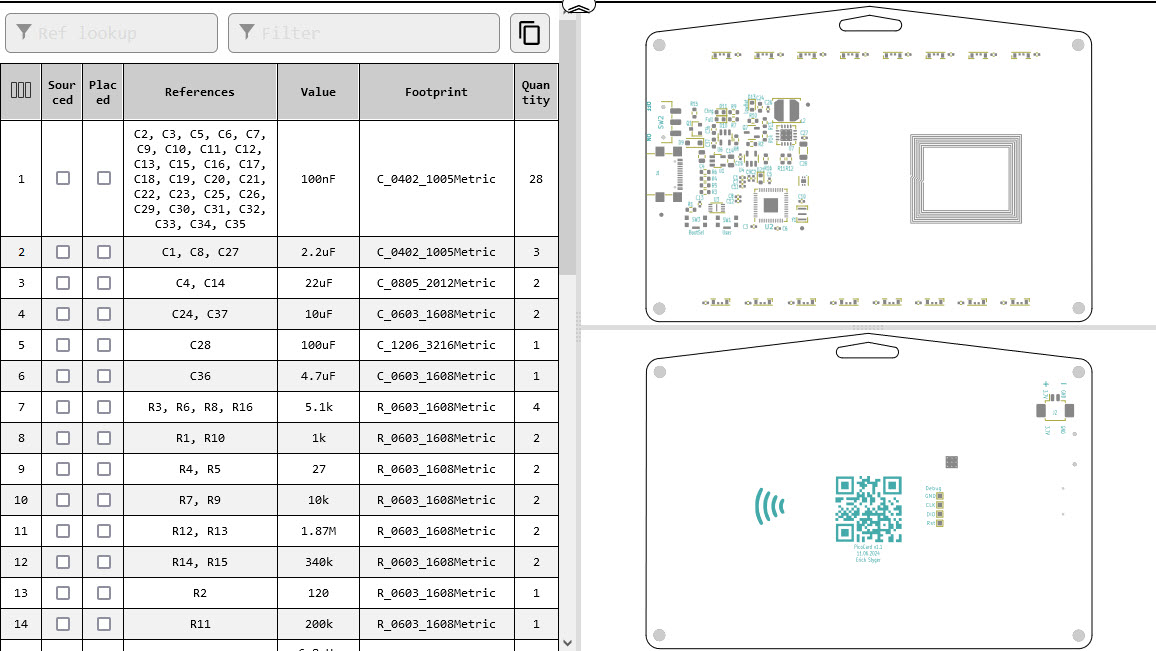
The hardware files (schematics, BOM, Gerbers) are available in the project on GitHub.
The circuit is the same for both PCBs, except that the business card only version is smaller and thus has 8 instead of 16 RGB LEDs. The PCBs have a thickness of 0.8 mm:
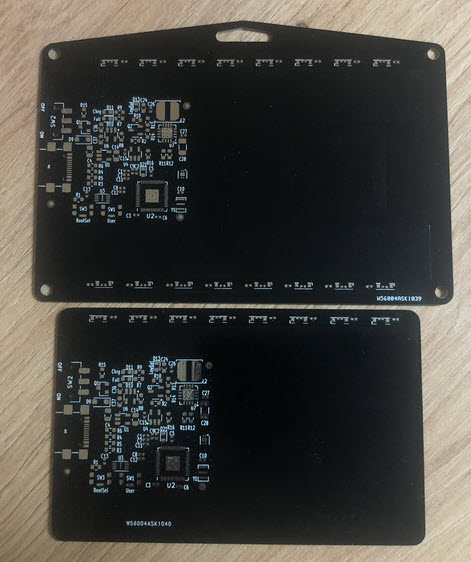
The design is using ‘side’ LEDs to illuminate laser engraved acrylic which can be placed on the badge or business card.
Below a rendering with the call-outs for some of the components:
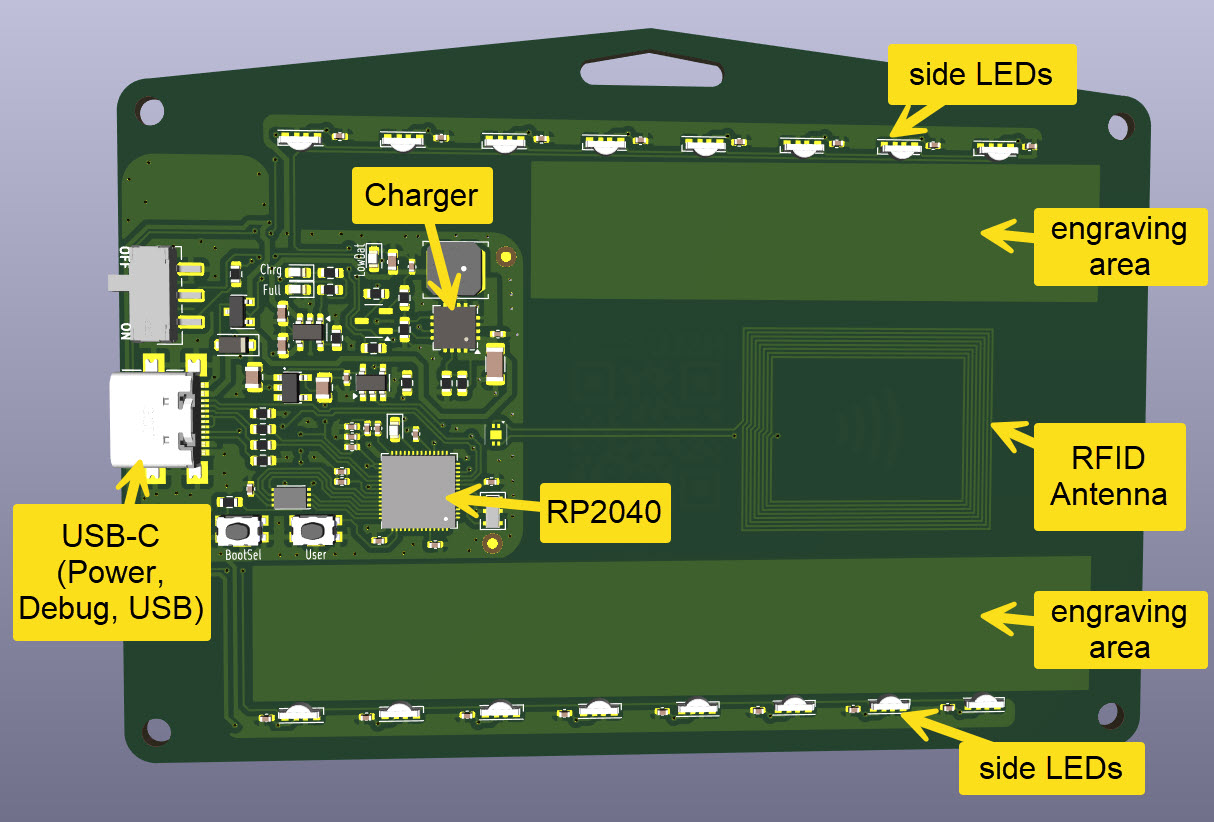
The copper areas on the top and bottom are used for customization with a laser engraver.

💡 Ideally the area around the RFID antenna would a full keep-out area, but with the tuned antenna it works very well with smart phone RFID reader and writers, plus it even works with an additional RFID card place on top or back of it.
LEDs
Below a picture of the credit card size PCB populated:
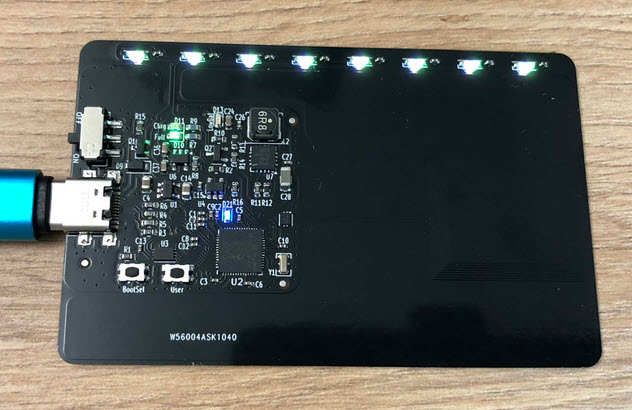
Up to 16 RGB LEDs can be addressed and controlled individually, creating colorful effects.

Edge-lit Acrylic LED Sign
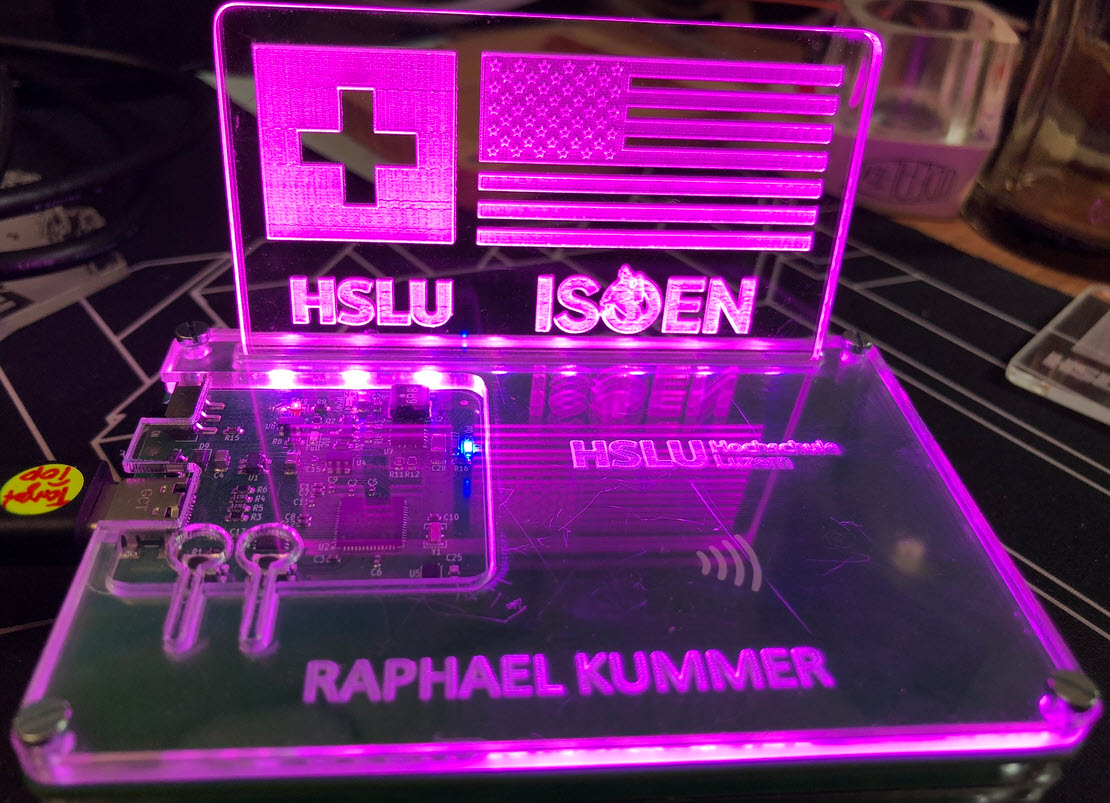
The business card or badge holder servers as edge-lit acrylic display or sign, with the help of a different front cover and the laser-cut and engraved sign:
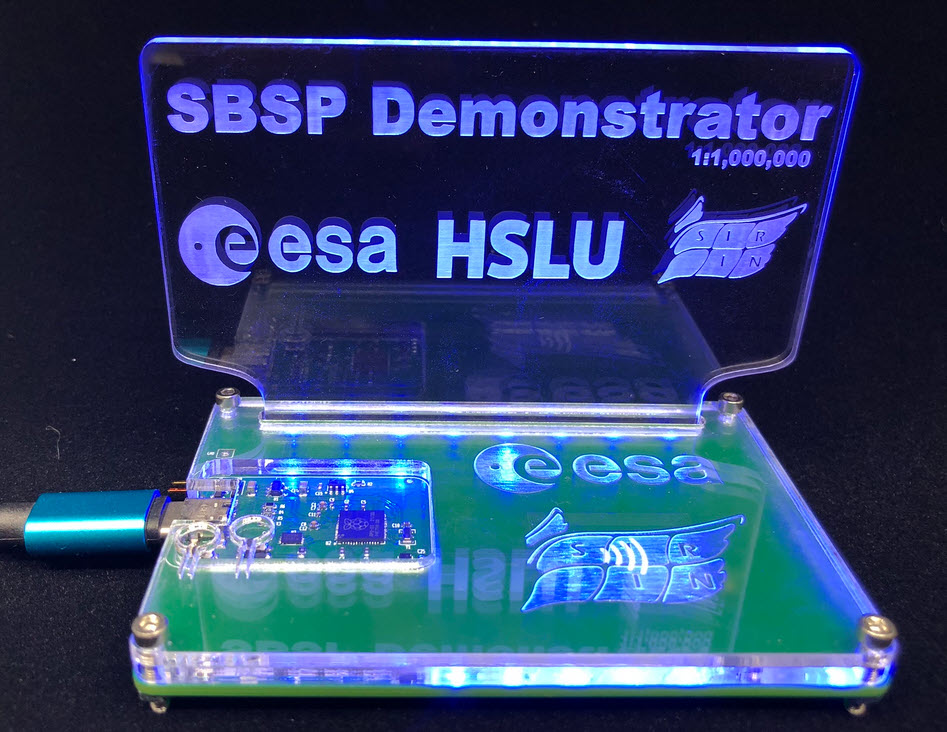
Below an example for the ISOEN conference:

Battery
An optional rechargeable battery can be connected and placed on the back side. Below a 85 mA LiPo battery inside the 3D printed compartment on the back:
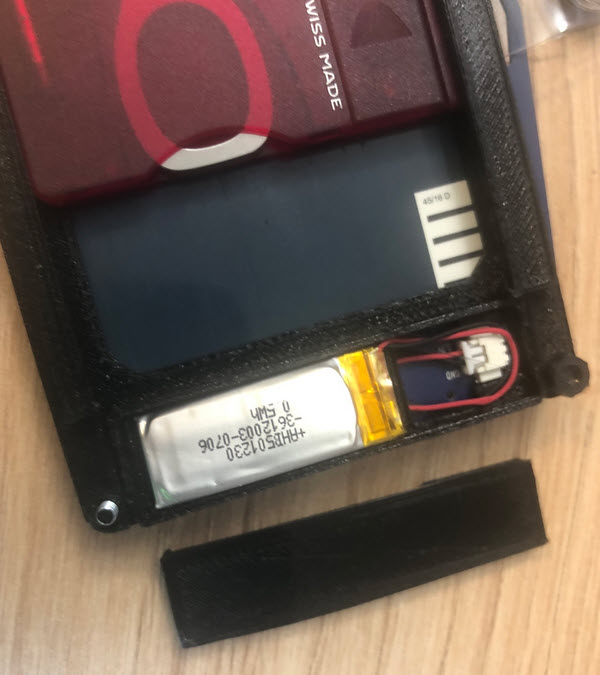
The battery adds 4 mm in thickness on the back, but that extra space can be used for business cards, company RFID badge card or even a Swiss Army Knife card with different tools.
Software
The software on GitHub is using VS Code and FreeRTOS.
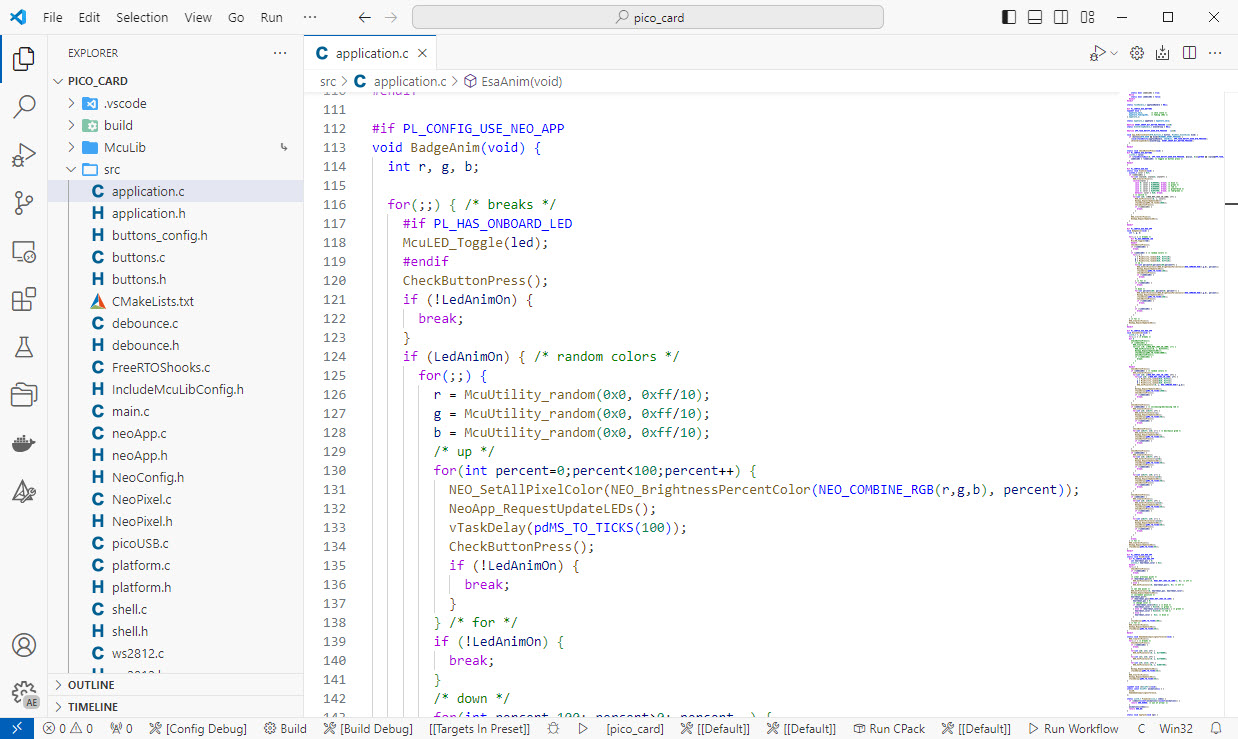
With the McuLib, it offers different options, including running a littlfs-to-USB-MSD gateway: that way the badge serves as portable memory device (USB Memory stick) with 2 MByte of FLASH memory (around 1.5 MByte available for the file system).
Exposed Copper
The usual way for PCB business cards is to use the silkscreen for name or contact information. I wanted to have a more flexible way, plus let the name or contact information really shine.

With a laser engraver, I can remove the black solder mask, and the result is a shiny and beautiful copper surface:

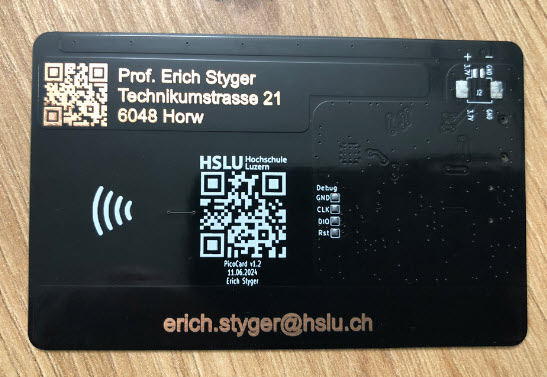
The exposed shiny copper with the black solder mask makes a really good contrast. The exposed copper is covered with clear protection film to avoid oxidation.
The laser engraving enables to create custom business cards on demand, using the same PCB:

On the back of the holder, there is plenty of space to hold a company badge, RFID access card or a set of business cards.

The company RFID badge fits in between, and with the arrangement of both RFID antennas the badge RFID and the holder RFID do not interfere with each other.
Holder Back Stacking
On the back of the holder, different options can be stacked and combined: battery, card holders and Victorinox Swiss Card holder:

For example, one can combine the battery with the Swiss Card holder only, or only using card holders for badge and business cards, making it very flexible.
Optional Acrylic Cover
With the side LEDs I can illuminate a laser cut-and-engraved 2 mm acrylic insert:

The acrylic (PMMA) insert is placed inside a 3D-printed holder to cover the LEDs and to hold the insert.
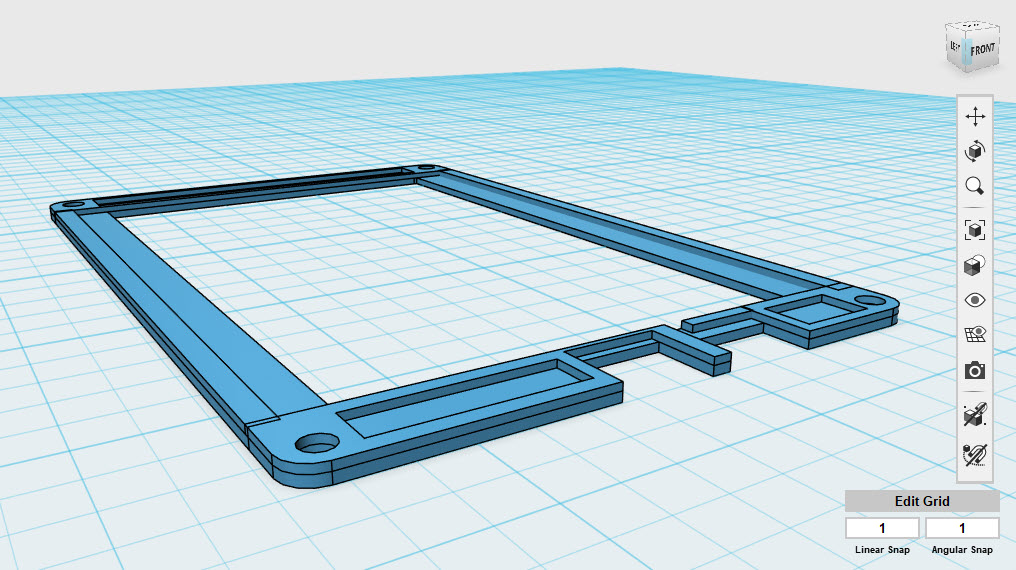
Then a 1 mm acrylic is placed on top as protection for the circuit. Because the 1 mm cover acrylic is placed directly on the two buttons, it can be directly used (‘bended’) on the bottoms, keeping everything nicely in place and clean.
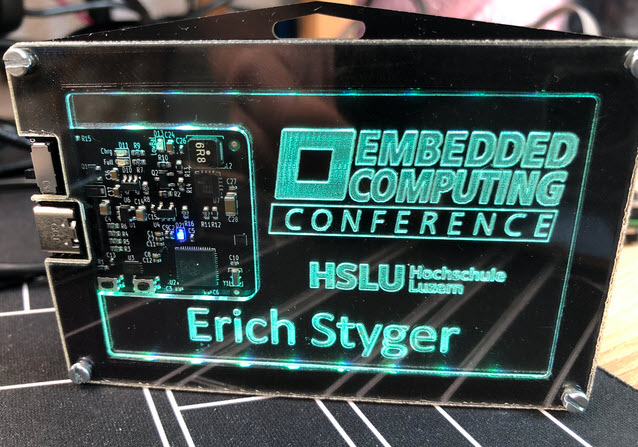
Another usage is to use it as conference badge (below for the Embedded Computing Conference):
Swiss Army Knife
Another optional insert is the possibility to add one of the five available Victorinox Swiss Cards, basically a Swiss-Army-Knife as a business card:
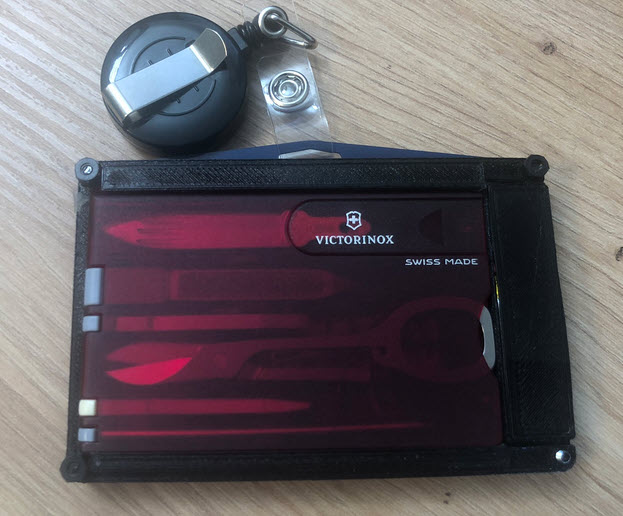
The card slidew-out like any other add-ons on the back:
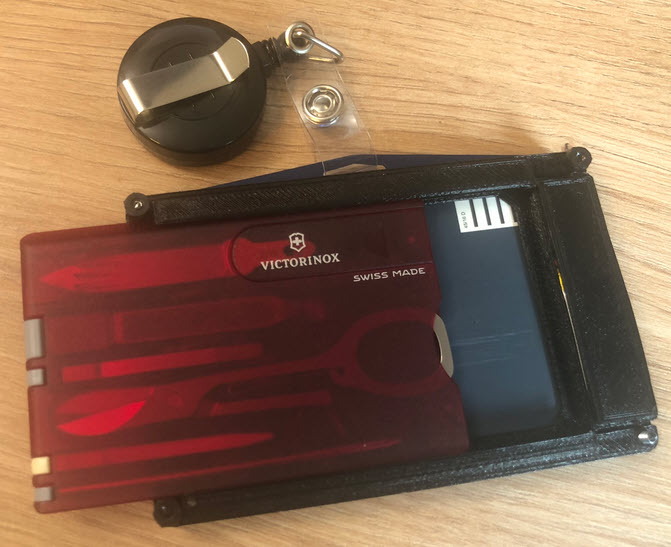
Above I’m using the ‘classic’ card in red with 10 tools (blade, scissors, screwdriver, ruler, pin, tweezers, toothpick, ballpoint pen, nail file, blade). They are available in different colors and with different tools.
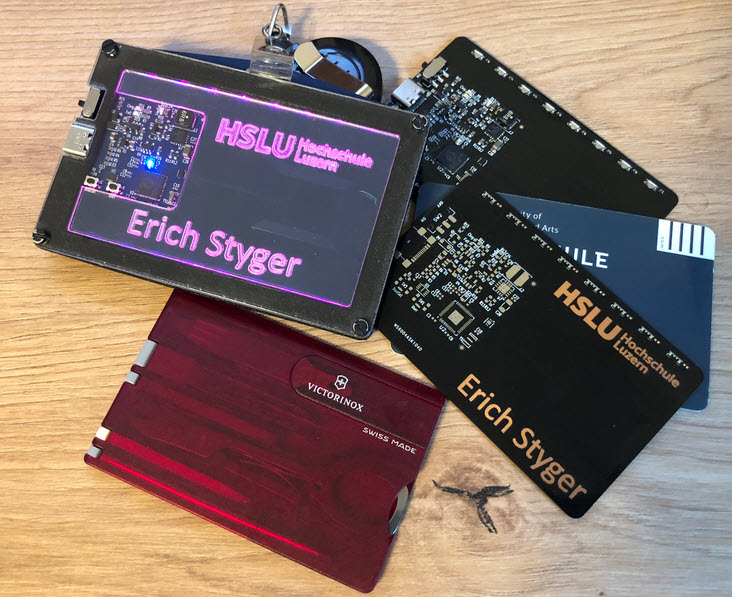
Below the complete solution: battery operated RFID Badge holder with 16 LED, with the cards stored on the back of it:
Summary
I’m really happy with the result of this project which has evolved over the last two months. I have a 0.8mm PCB business card with RFID to hold my contact information. The business card includes the NXP NTAG213 RFID IC and can be customized with a laser engraver. The circuit includes the hack-able RP2040 micro-controller, a battery charging circuit and up to 16 addressable LEDs to create a light show for the badge or for a desktop acrylic light-up sign.
It combines a versatile and flexible company RFID badge holder, going up to 10 mm carrying a LiPo battery, company RFID badge, extra business cards plus the Victorinox Swiss Card with extra tools, making it a true ‘Swiss Army Knife Business Card and Badge’.
If you want to build your own: files see the files on GitHub.
Happy badging 🙂