Say you want to study a bunch of alien rocks. Our planet is rich in scientists and sophisticated rock-examining machinery, so one approach is to put them all on a rocket and send them to where the rocks are. But our best machines are big and too delicate to fit on a rocket, and the scientists themselves are fragile—we have managed to keep a few of them alive in low Earth orbit, but they struggle to get any science done there.
So another idea is to bring rocks back home. And so sample return has been a top goal of planetary science for thirty years or more.
There have been some successes! Most famously, the Apollo astronauts brought back a few hundred kilograms of moon rocks. In 2004, a mission called Stardust flew past the comet Wild 2 and brought back dust grains from the comet’s coma. In 2005, the Japanese Hayabusa probe landed on an asteroid called 25143 Itokawa and brought back a little surface dust for study. Its successor, Hayabusa2, did the same for an asteroid called 162173 Ryugu in 2018. And in 2023, a mission called OSIRIS-REx returned to Earth carrying a sample from the asteroid 101955 Bennu.
Investigations from these missions have been fruitful and have built expectations for a Mars sample return mission, which would bring the full power of Earth laboratories to bear on some astrobiologically interesting rocks the Perseverance rover found on Mars. The circumstantial evidence for early life on Mars is now strong, and there’s a widespread hope that analyzing samples on Earth would have spectacular results, more than enough to galvanize public support for future Mars missions.
The trouble with grabbing samples from Mars is that the planet has more gravity than any asteroid or comet. To lift a 10 kg sample off the surface to orbit takes a 350 kilogram rocket. That 350 kilogram rocket has to land on a specialized vehicle weighing a couple of tons. The lander in turn has to enter the Martian atmosphere in a suitably large aeroshell, which then needs a rocket big enough to launch it in one piece from Earth. These kinds of requirements propagate across the mission, and pretty soon you’re talking real money.
NASA also holds some deeply fundamentalist beliefs about planetary contamination that complicate the mission and (crucially) increase the weight of any return container. Comets and asteroids are considered low-risk and don’t require this level of fussiness, but NASA treats Mars as if it’s knee-deep in space Ebola, creating a lot of hoops for itself to jump through to prevent the smallest speck of frozen Mars dust from killing us all.
All of this makes the sample return mission NASA and the European Space Agency embarked on in 2018 the most complex and ambitious planetary mission design ever attempted, with multiple spacecraft and rovers passing samples to one another in (depending on your point of view) either a graceful cosmic ballet, or a Rube Goldberg design from an agency that has lost the ability to do things simply.
The easiest way to describe Mars Sample Return is to introduce the players.
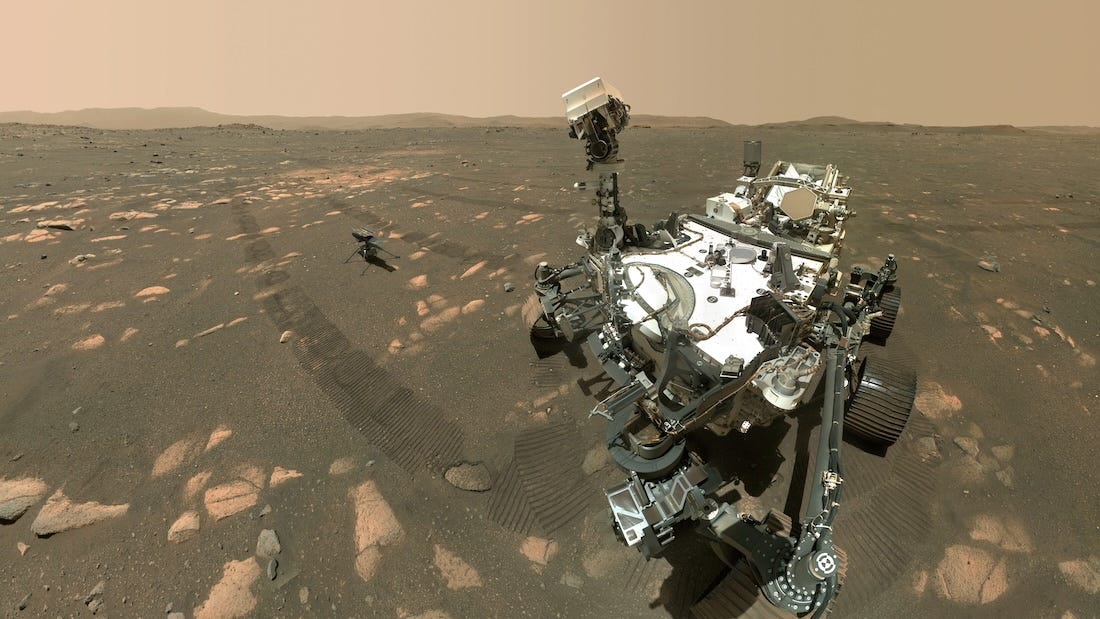
The Perseverance rover, which landed in 2020, is the one part of the Mars sample return program that made it to Mars. The rover has been collecting samples around Jezero crater and storing them in a set of 43 titanium tubes designed to be returned to Earth.
Before leaving Jezero in 2022, Perseverance left ten tubes cached at the bottom of the crater, as an insurance policy. The rest of the samples remain on board the rover, and will either stay there or be dropped near a potential landing site, depending on the state of health of the vehicle. NASA recently certified the plutonium-powered rover for another 100 km of travel and expects it to remain active into the 2030s.
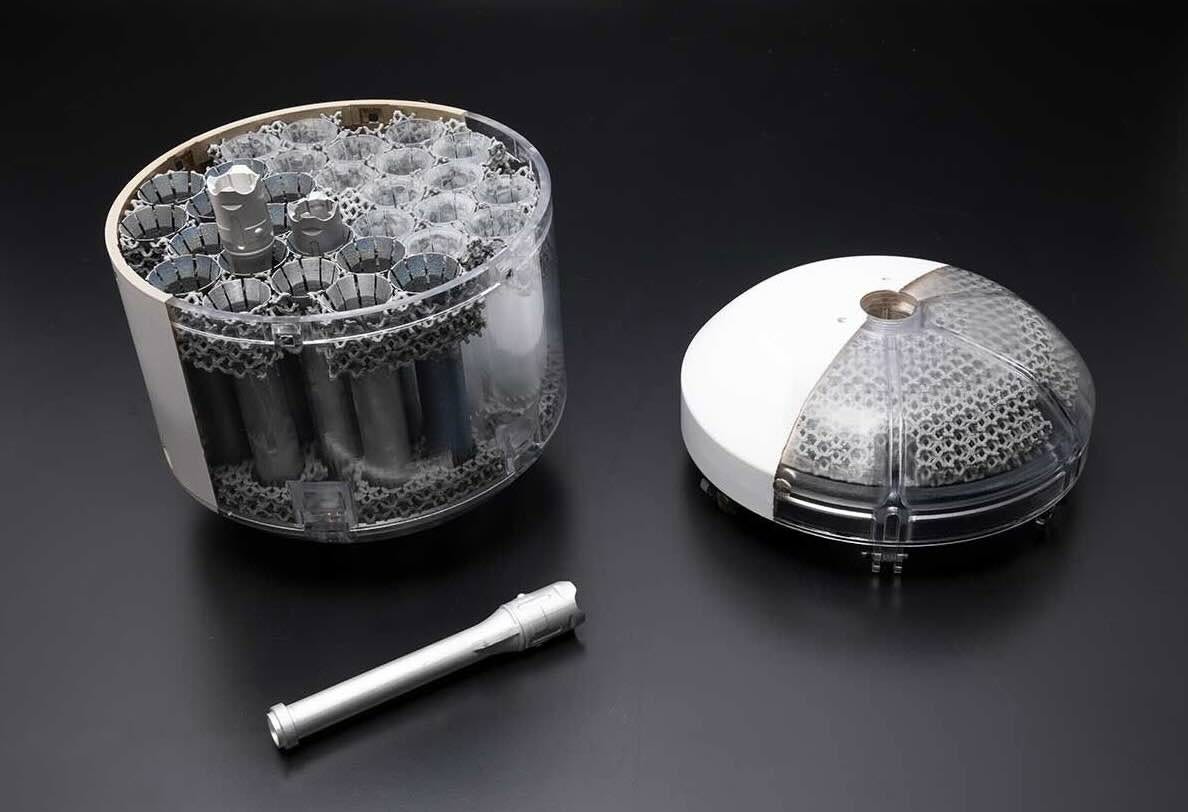
The Orbiting Sample is a small 5 kilogram basket that resembles a salad shooter. It is designed to bring the sample tubes collected by Perseverance back to Earth, and forms the through line for the sample return mission—its weight and dimensions set the size of pretty much every other spacecraft in this list.
The Orbiting Sample is meant to arrive on Mars on a lander, which also carries a rocket to fire it back into space. Once the sample tubes are secured inside, the rocket launches the assembly into low Mars orbit, where another spacecraft is supposed to find and collect it, performing some fussy cleaning steps during the process. This second spacecraft then puts the Orbiting Sample inside a heat shield and returns it to Earth to crash-land gently in the Utah desert.1
At that point there are more fussy cleaning steps before the recovered assembly is taken to a special containment facility to begin the long work of unboxing samples and distributing them to specialized laboratories for study.
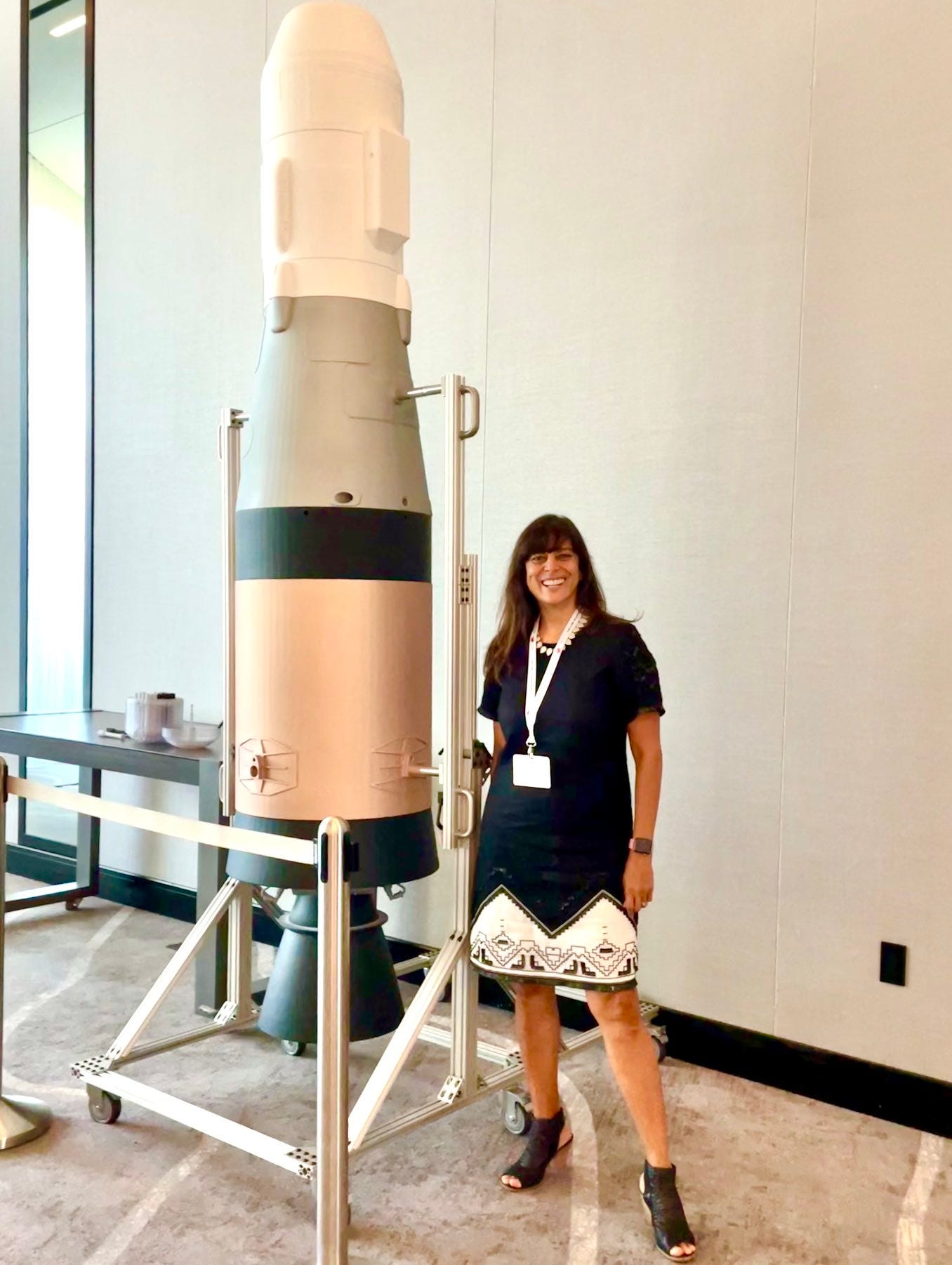
The Mars Ascent Vehicle is a stubby little rocket whose job it is to put the Orbiting Sample into Martian orbit. The rocket has to be powerful enough to get its payload into space, but also small enough (both in terms of dimensions and weight) to fit into the lander that brings it to the surface of Mars.
One challenge for the ascent rocket is temperature. The U.S. arsenal has plenty of stubby rockets that can sit in storage for years and still fire reliably, but none of them are designed to work in conditions as cold as the Ascent Vehicle would experience on Mars. And in fact, no one has ever launched a rocket from the surface of another planet, making the Ascent Vehicle the technically riskiest link in the chain of events meant to carry the collected samples home.
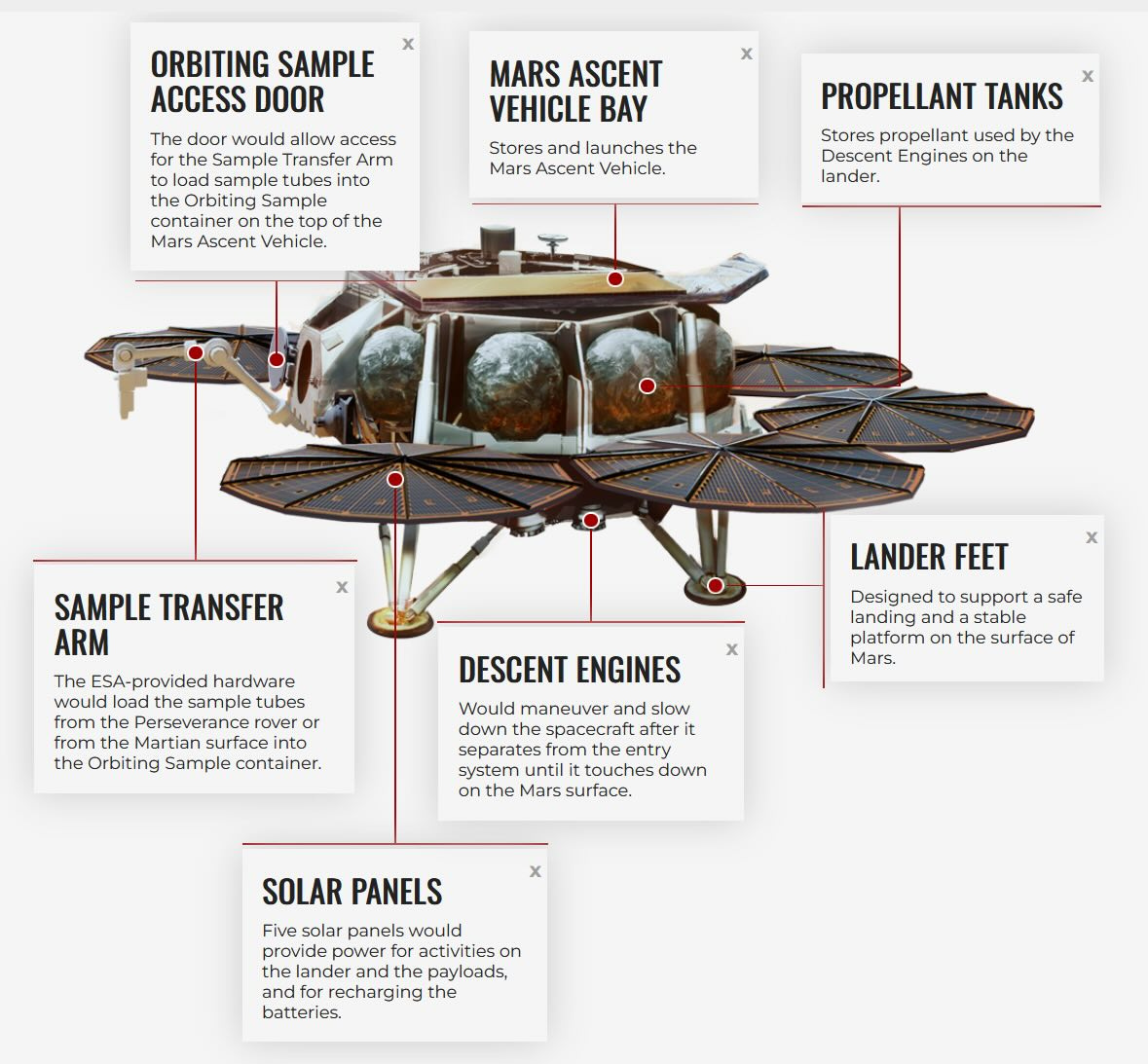
The Sample Retrieval Lander is a lander of size meant to deliver the ascent rocket and empty Orbiting Sample to the Martian surface. It is supposed to land as close as it can to Perseverance (or wherever the rover finally decides to lay down its burden of sample tubes), and this need for a precision landing drives its enormous bulk. In the initial design, this big boy carried yet another spacecraft:
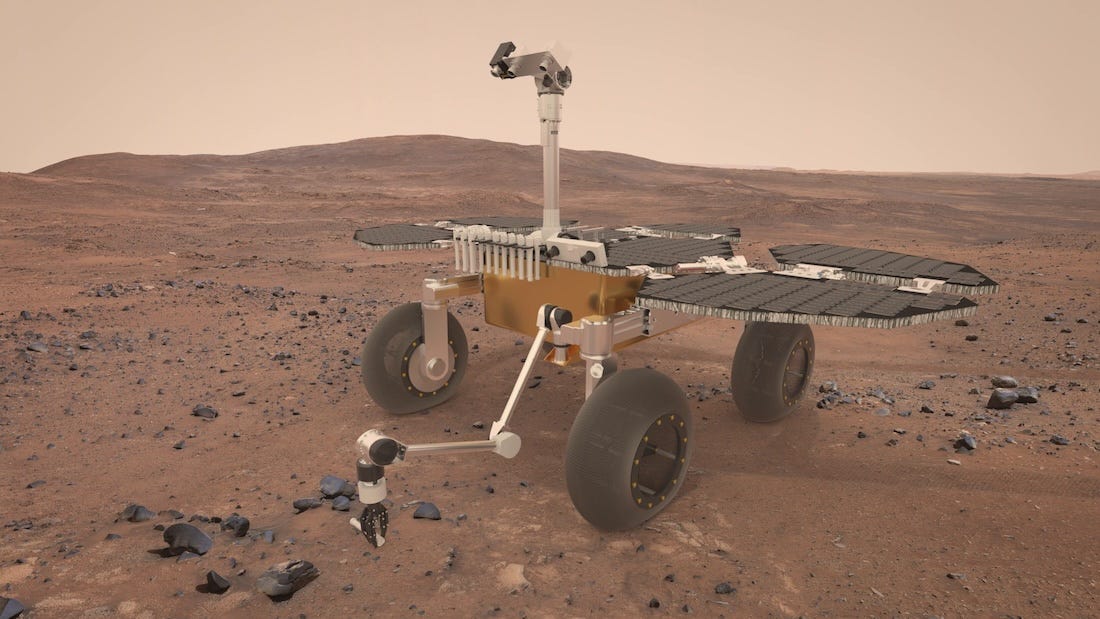
The Fetch Rover is a small rover with a long arm. It arrives on Mars along with the Sample Retrieval Lander, or possibly on its own (one of many parts of the design that never stabilized). The Fetch Rover’s job is to physically pick up sample tubes from the Martian surface and place them in the Orbiting Sample. In the best case, the Sample Retrieval Lander will have landed very close to the samples, and the Fetch Rover won’t have much work to do. In other scenarios, there might be some distance to cover between the lander and the sample cache, and the Fetch Rover then shuttles back and forth between them.
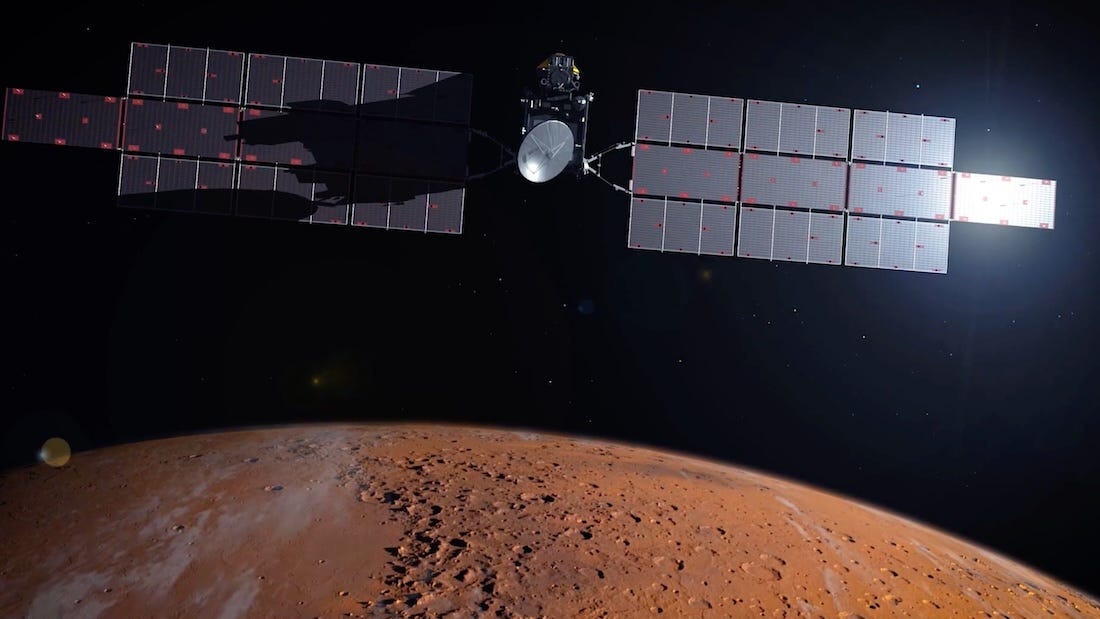
The final piece of the puzzle is a giant spacecraft called the Earth Return Orbiter. Its job is to find the Orbiting Sample in orbit around Mars, collect it, and take it back to Earth. The collection step is a convoluted sequence that includes zapping the exterior of the Orbiting Sample with ultraviolet light to eliminate the remote possibility of contaminating Earth with dust-borne Martian life.2 For the same reason, the orbiter diverts from Earth into a lonely graveyard orbit around the sun after delivering its payload.
And that, in its essentials, is Mars Sample Return. For those keeping track, the mission includes two rovers, two orbiters, three launches from Earth, one first-time-ever launch from Mars, and a challenging treasure hunt in low Mars orbit for the Orbiting Sample, which carries no beacon and is about the size of a basketball.3 Two of the vehicles needed—the Earth Return Orbiter and the Sample Return Lander—would be the largest spacecraft of their kind ever built.
If this design strikes you as a little much, you are not alone. The only mission remotely comparable to Mars Sample Return is the original plan for the Artemis moon landings, which included double-digit launches and a complicated cast of spacecraft (Orion, Gateway, tankers, the Human Landing System) performing an orbital dance that left the nagging impression that there had to be an easier way to do all this.
There are some oddities to the mission architecture. Perseverance was designed so there is no way to remove samples from its interior if it dies—NASA would have to make a decision to drop them while the rover was still working. The Fetch Lander cost more than half a billion dollars and by design did almost nothing. Its job was to hand samples to the lander, which could also receive them directly from Perseverance. The Earth Return Orbiter would be, for no clear reason, the largest space probe ever built, powered by a suite of solar panels more than forty meters across. The Sample Return Lander weighs three times more than anything anyone has ever tried to land on Mars before.
The sole purpose of this beefy team of robots was to return about 500 grams of material from Mars to Earth. But as the mission blew through its budget estimates and started looking for things to cut, the inevitable happened. NASA started reducing the number of samples the return mission would carry. Congress, lacking an appreciation for the absurd, killed the program before NASA could take the process to its logical conclusion and design a sample return mission that would come back to Earth carrying nothing. But the result was much the same.
It’s notable that Chinese scientists, who are flying their own sample return mission to Mars in 2030, have chosen a design with just two spacecraft, a sampler/ascent rocket and orbiting return vehicle. Critics of the Chinese plan argue that this ‘grab and go’ sample mission has less nuance and scientific value than the carefully curated suite of samples waiting on board Perseverance. The Chinese would probably counter that much of the science value in sample return goes away if you don’t actually return the samples to Earth.
The reasons Mars Sample Return died are interesting and complex enough to deserve their own post. For now I’ll start with a timeline of the project, to help readers keep track of its various twists and turns later.
April 2018 - NASA and the European Space Agency (ESA) agree on a tentative sample return mission to fly in 2020.
July 2019 - NASA and ESA settle on the basic architecture of the mission. ESA will build the Fetch Rover and Earth Return Orbiter, NASA carries the rest.
July 2020 - Perseverance departs for Mars on an Atlas V rocket.
October 2020 - The first Independent Review Board report on Mars sample return makes numerous recommendations while continuing to strongly endorse the project. The estimated development cost to NASA at this point is $3.8-$4.4 billion.
February 2021 - Perseverance lands in Jezero Crater and begins roving.
April 2022 - The National Academies release the Planetary Science Decadal Survey, a consensus document that sets the scientific community’s official priorities for the next decade of planetary exploration. As in the previous two decades, the survey reconfirms Mars sample return as the top priority for planetary science.
July 2022 - The Fetch Rover is cut from the mission design. Perseverance is now expected to deposit the samples directly into the Return Lander, with a pair of Ingenuity-style helicopters (!) added to the mission as backup.
May 2023 - NASA establishes a second Independent Review Board, making sample return the first NASA science mission to require two review boards.
September 2023 - the new IRB report says NASA has no chance of meeting its stated budget or timeline. The report estimates sample return will cost up to $11 billion and might not return a sample to Earth before 2040.
November 2023 - the program is put on hold while NASA contemplates how to respond to the IRB report.
April 2024 - NASA Administrator Bill Nelson calls both the cost and timeline of the mission unacceptable, and asks industry to submit proposals for flying the Mars sample return mission more cheaply.
June 2024 - NASA selects eight outside proposals (from about forty received) for further study, plus three proposals from inside the agency.
July 2024 - A paper announces that Curiosity has found strong evidence of ancient microbial life in an ancient lakebed deposit at Gale Crater.
January 2025 - NASA announces it will explore two landing options for Mars Sample Return. The first is basically the status quo, the second “will capitalize on using new commercial capabilities to deliver the lander payload to the surface of Mars,” a phrase most observers interpret as a reference to SpaceX’s Starship rocket.
April 2025 - NASA publishes a revised architecture that uses a smaller ascent rocket and moves the cumbersome sterilization step from the Earth Return Orbiter to the surface of Mars.
May 2025 - Trump’s proposed budget cancels Mars Sample Return, part of a wider gutting of science programs at NASA.
September 2025 - Imagery and sampling from Perseverance show strong evidence for ancient microbial life in a mudstone at Bright Angel, near Jezero Crater.
January 2026 - Congress passes a NASA funding bill with no provision for Mars Sample Return beyond a $110 million line item marked ‘Mars Future Missions’.
February 2026 - Musk announces SpaceX is putting its Mars plans on hold to pivot to the Moon, eliminating Starship as a viable option for saving the mission.