Radiation is the ultimate limiting factor in human space flight. It has been the elephant in the spacecraft since the 1960s, when it first became clear that tiny particles rather than micrometeoroids were the high-speed threat to worry about in space, and it sets bounds on what parts of the Solar System are reachable by human explorers riding chemical rockets.
Mars is near the limit of where human beings can go on a small spacecraft. In a sense, it’s bad luck that Nature tempted us with a barely livable planet close enough to reach with rudimentary technology. If not for Mars, the next step for human spaceflight would be finding ways to build spaceships the size of ocean liners instead of trying to fly people around in a space Prius, and then we could go explore more interesting destinations in the Solar System.
But you go to space with the planets you’re dealt.
Traditionally, the chief strategies for dealing with radiation risk in Mars planning have been optimism and denial. Optimists posit the emergence of magic technologies (mostly drugs), while denialists argue that radiation levels on Mars are just a healthy part of clean Martian living.
While the radiation environment around Mars is now well-characterized, the biological effects of this radiation (which is difficult to simulate on Earth) remain a matter of conjecture. By current estimates1, a Mars-bound crew on a 1,000 day mission would face between a 2% and 15% chance of radiation-induced death during or after the mission. The uncertainty in the figure is almost all due to our deficient understanding of the non-targeted effects of heavy ion radiation, particularly at the chronic dose rate that Mars-bound astronauts would experience.
This uncertainty makes the long-running debate between ‘it’s not a problem’ and ‘it’s a showstopper’ factions impossible to adjudicate until we have better data.
Rather than stake out a side, I want to briefly sketch out the radiation problem opportunity and frame it in terms of tradeoffs.
There are two different radiation hazards facing a Mars mission, both linked to the eleven year solar cycle. You can think of one as acute and the other as chronic.
High Energy Protons
The acute radiation hazard to a Mars mission comes from the Sun who, like Yosemite Sam, is forever firing off bursts of high-energy protons in all directions. The frequency of these bursts, called solar particle events (SPEs), rises and ebbs with the eleven year solar cycle. When the sun is at its most active, there may be several solar eruptions a day, while during solar minima there may be just one event every few days. Events can last from hours to days, and energetic ones will have an onset time measured in minutes.
These energetic burst of protons follow magnetic field lines outward from the Sun at a large fraction of the speed of light, and can carry enough energy to kill an unprotected crew. NASA was lucky to dodge one storm in August of 1972 that happened to fall between Apollo missions; if astronauts had been on the Moon at the time, they would have experienced acute and incapacitating radiation sickness.2
A Mars-bound spacecraft can expect to be hit by a half dozen or so proton events of unknown duration and severity. The spacecraft that carried Curiosity to Mars (at around the midpoint of a solar cycle) recorded five solar proton events during its eight month transit, and this seems like a reasonable baseline to work from for a human mission.
There are enough atoms in a spacecraft to give the crew significant protection from high-energy protons, provided they have advance warning. Most spacecraft designs include a shelter where the crew can go hide behind water tanks, propellant, or two years’ worth of their accumulated frozen feces, reducing their exposure by an order of magnitude during the peak hours of such an event. Modern designs also have a kind of plastic body armor for astronauts to wear over sensitive organs.
The biggest risk is being caught unprepared, particularly if any crew members are working outside the spacecraft when the burst arrives. No space suit can adequately protect against high-energy protons. Our ability to give a crew early warning depends on our planet’s position relative to the spacecraft. On a long-stay mission trajectory, where Earth usually sits along the lines of magnetic flux that connect the Sun and the spacecraft, the warning time can be as little as 22 minutes. On a short-stay profile, where the crew is on the far side of the Sun from Earth, there might be no warning at all.
The thin Martian atmosphere is an effective shield against most solar protons (those with energies below about 150 MeV). Astronauts on Mars can also build themselves a shelter out of rocks or ice to hide in. So it’s fair to consider solar protons a threat to crews only while they are in transit.
Galactic Cosmic Rays
The chronic radiation hazard on a Mars mission comes from little bits of charged supernova shrapnel that zip around the solar system in all directions, a crossfire of high-energy particles collectively called Galactic Cosmic Radiation (GCR).
The most vigorous of these particles can carry an impressive amount of energy. One celebrity cosmic ray in 1991 arrived on Earth at 99.999999999999999999999% the speed of light, a single proton packing the momentum of a little leaguer’s fastball. While such monster ions are rare, there are enough high-energy particles in the sky to make galactic cosmic radiation the biggest health risk to a crew. Unnervingly, astronauts can observe this radiation directly by closing their eyes and waiting for a particle to smash into their retina. These flashes are sometimes bright enough to wake them up from sleep, a personal memento mori arriving from a faraway star.
There’s no practical way to shield astronauts against the high energy component of galactic radiation. In fact, attempts at partial shielding make the problem worse, because high energy cosmic rays colliding with the metal walls of the spacecraft will create a cascade of highly penetrating secondary neutrons, increasing the total dose absorbed by the crew. (Something similar happens in the Earth’s atmosphere. There’s an area around 20km altitude called the Regener-Pfotzer maximum where the radiation dose from cosmic rays is much higher than at higher altitudes).
You can think of this as the Hürtgen Forest problem. If someone is firing artillery shells at you, instinct tells you to go hide behind something. But if you hide inside a grove of trees, the exploding artillery shells will send giant splinters of wood raining down on your foxhole, making you less safe than you were in the open.
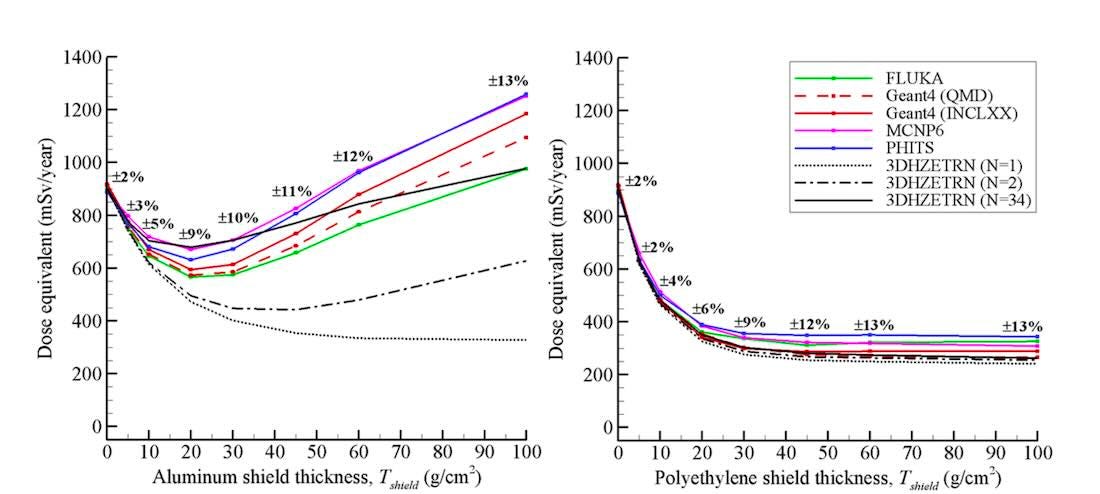
The same situation obtains in space. The first few centimeters of shielding (the walls of the spacecraft) block a significant fraction of cosmic rays. But after that, things get worse before they get better. To thoroughly shield against cosmic rays would take a layer of water or plastic many meters thick,3 which is simply impossible until we’re willing to build a bigger rocket.
The best defense against cosmic rays is to stay home under a thick blanket of air and a good magnetic field. The second-best defense is to go fast and time one’s travel to coincide with the peak of the solar cycle, when the sun’s swelling magnetic field reduces the cosmic ray flux in the inner Solar System by about half. Unfortunately, that’s also the time the Sun will be spitting protons at you like an angry cat.
But since the risk from solar proton events and galactic cosmic radiation is anti-correlated, you have to pick your poison. And as terrifying as it sounds to fly during solar maximum, it’s better than absorbing the cumulative dose from a sky full of invisible particle accelerators taking pot shots right at you.
NASA measures radiation hazard in Sieverts, a derived unit that tries to convert the objective dose measured by physical detectors into a quantifiable measure of cancer risk.
There are problems with the Sievert! There are also problems with NASA’s career limit of 600 mSv! But I will ignore all of this and take the numbers at face value to get a relative sense of scale.
A typical ISS astronaut gets hit by 0.3 mSv/day of cosmic rays.4 An astronaut on the Moon, outside of Earth’s magnetosphere, would see a cosmic ray flux about four times stronger. On Phobos, the larger of the Martian moons, that flux would be a little higher still, since GCR intensity goes up with distance from the Sun. On Mars itself, where the atmosphere provides some degree of protection, the relative flux goes down to about 2.5 times what we see on the space station.
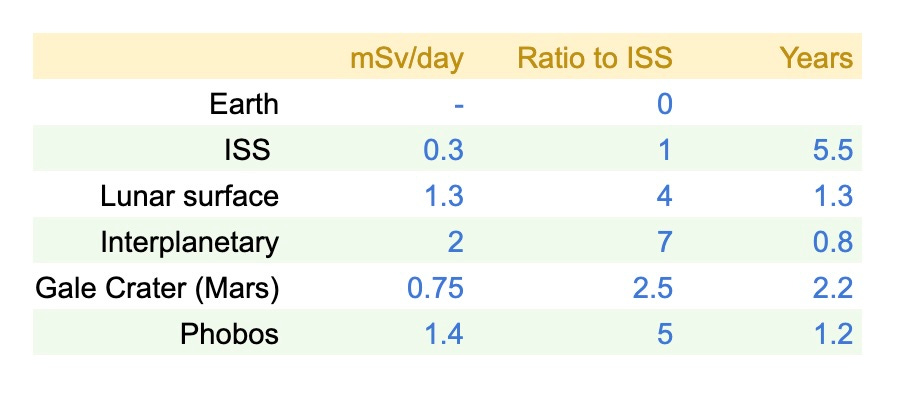
Finally there is free space, the long coast phase between the Earth and Mars. During this phase, when the only thing between the crew and shrapnel from every ancient supernova in the Local Group is a wall of boxed dinners, radiation exposure will be highest. Astronauts en route to Mars experience a cosmic ray flux about seven times higher than on the International Space Station.
So from a cosmic ray standpoint, every day spent in space is equivalent to about three days on Mars, or a week on the space station.
What does this mean for your Martian commute?
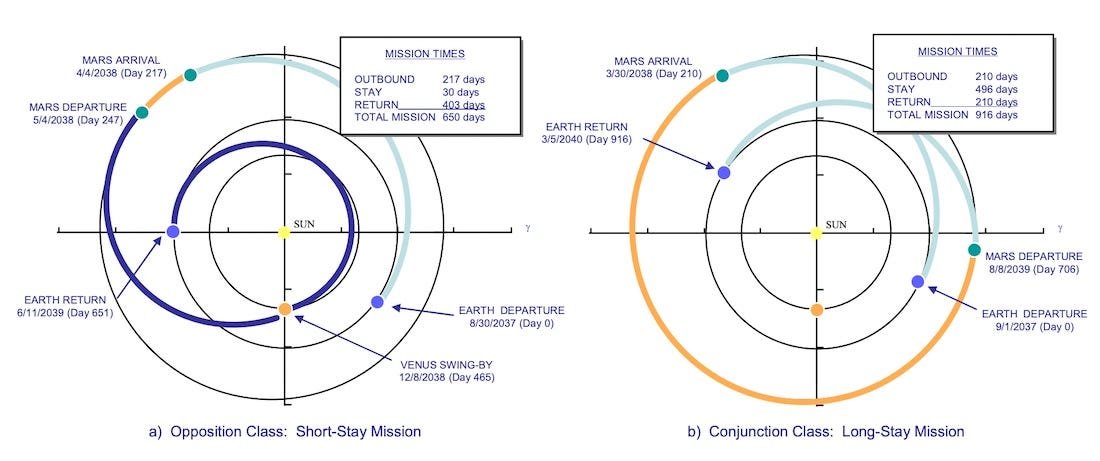
Recall that there are two broad classes of Mars mission, a long-stay profile and a short-stay profile. One is shorter but spends almost all of its time in space, the other is a year longer and includes a long residency on the Martian surface.
We can use these mission templates to get a rough sense of cosmic ray exposure. The diagram below shows a 1120 day long-stay mission that starts with a 90 day shakedown period in high Earth orbit. The red line shows the cumulative GCR dose at solar minimum; the blue line shows the same at solar maximum:
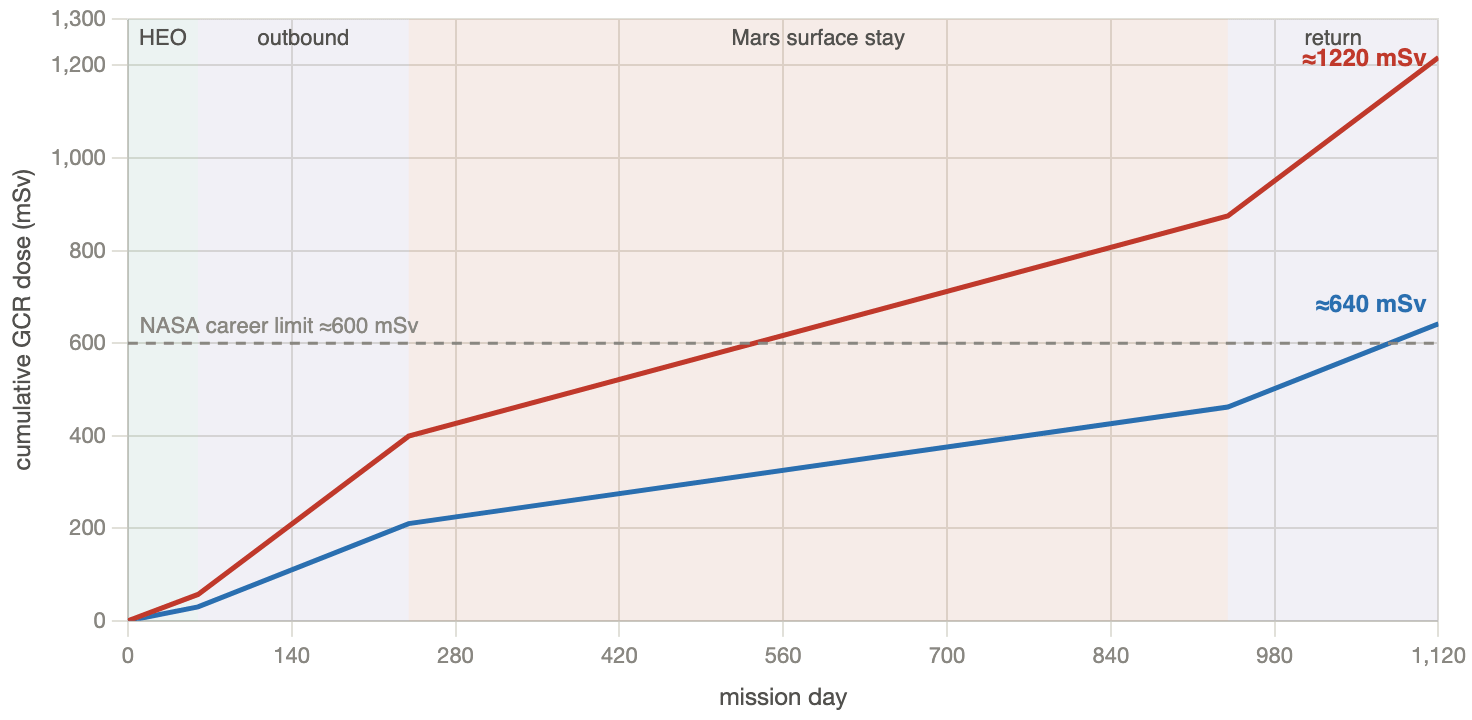
As you can see, the solar cycle is the biggest factor in radiation exposure. Flying at solar maximum exposes the crew to just over the NASA career limit, while flying at solar minimum doubles the dose. The daily dose astronauts receive on Mars is much lower than in space, but because of the length of the mission, it is a significant contributor to the total.
Here’s a similar chart for the short-stay mission profile:
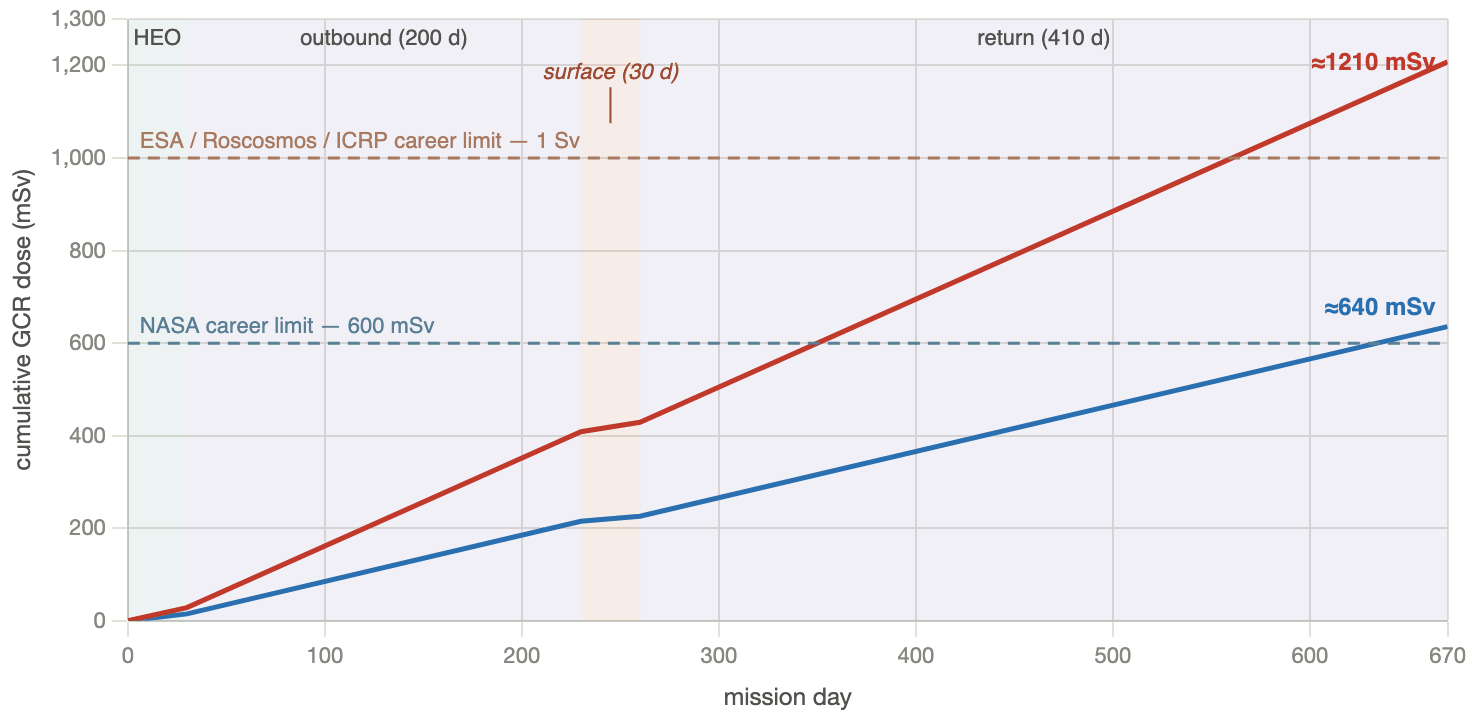
Surprisingly, despite the shorter mission time (650 days vs. 1000) and very different trajectory, the total cosmic ray dose on both types of mission is roughly the same.
There’s not a lot we can do to radiation-proof a short stay mission. Its duration is dictated by orbital mechanics (the relative movements of Mars and Earth), and as I explained above, there’s no good way to add shielding to chemical rockets.
But with the long stay mission, there are options! One way to get the dose down is for the crew to bury their shelter under regolith (Martian rocks and soil). If the crew spend the first month of their time on Mars shoveling two meters of rocks onto their home, we get a cumulative radiation graph that looks like this:
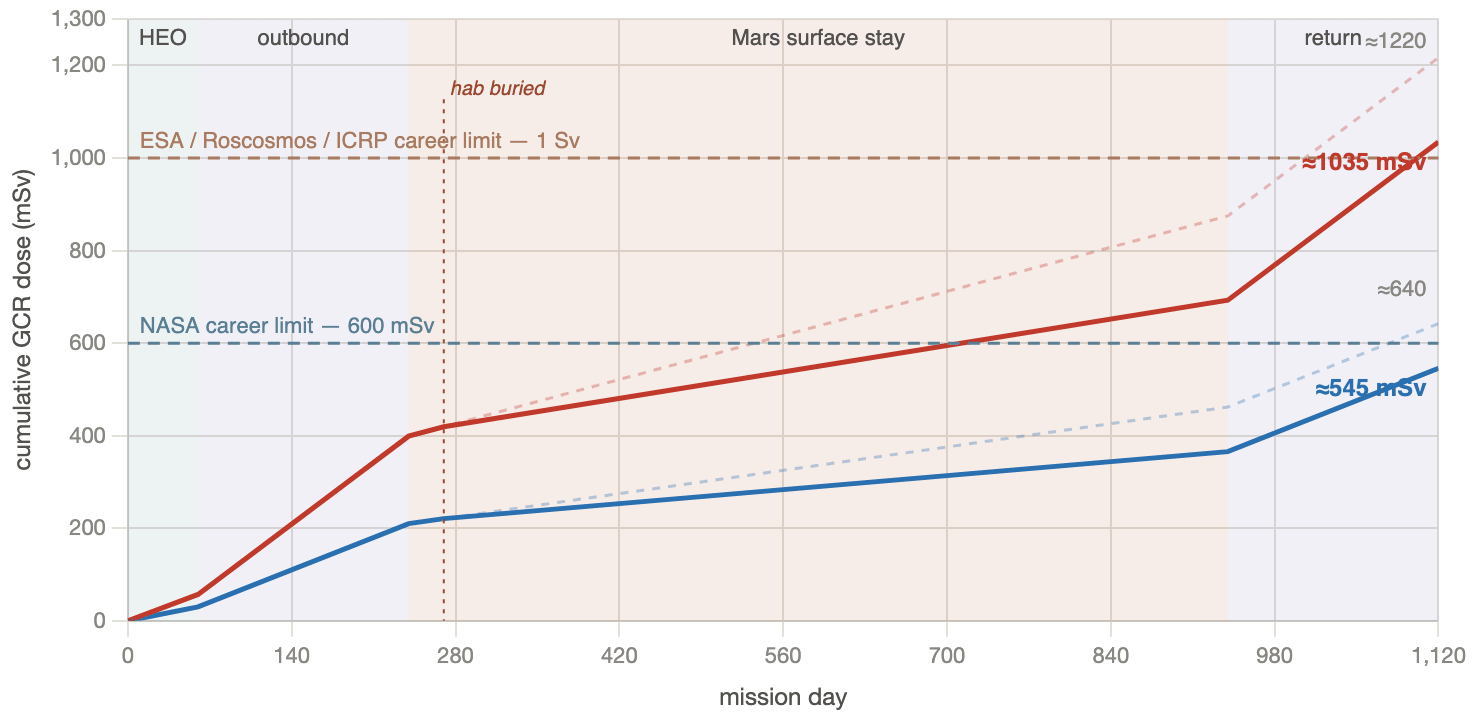
This is better, but not by a lot, since most of the total exposure comes from those six-month trips to Mars and back.
So a second idea is to make those transits faster, shortening the punishing periods of full exposure in deep space. With orbital refueling, significant handwaving, and oceans of money, it would be possible to get transit times down to 90 days. In that case, exposure would look like this:
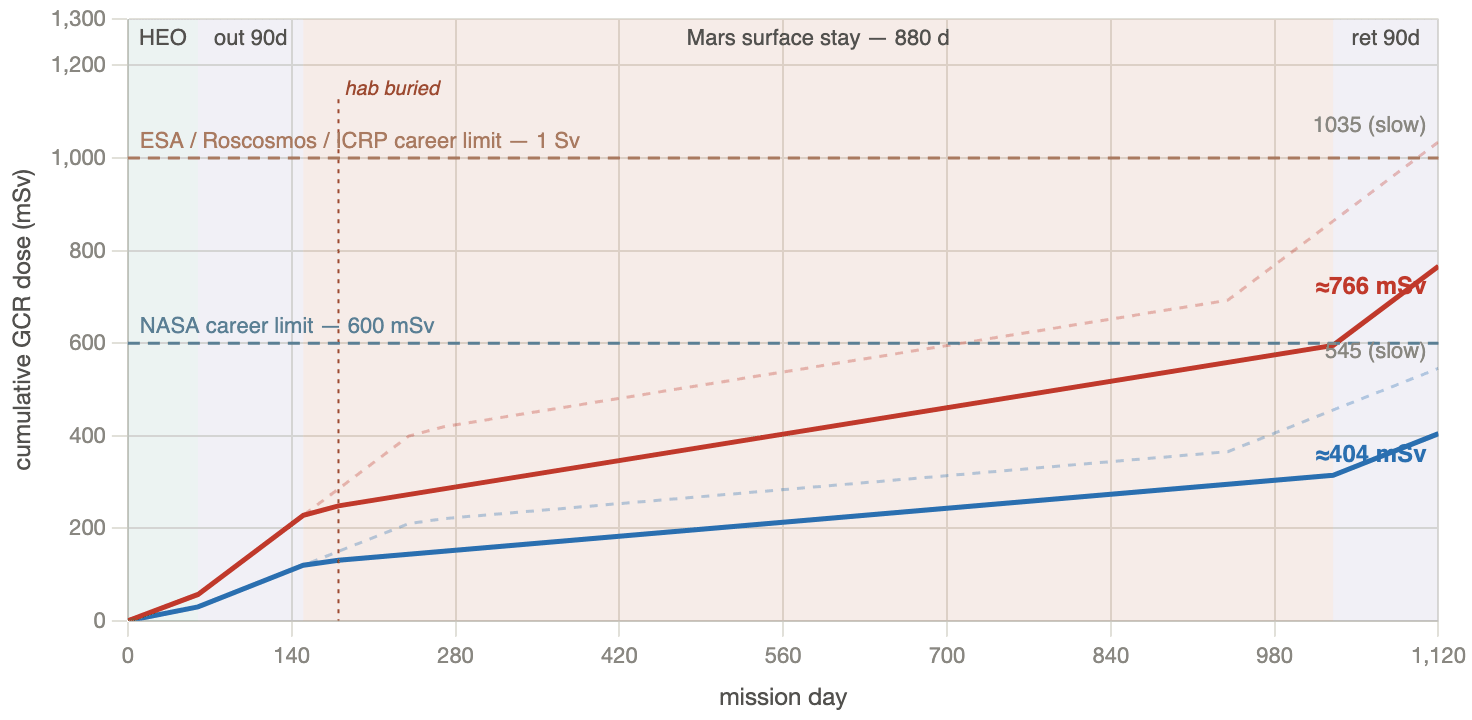
This is a reduction of one third, at a pretty steep cost in space bulldozers and magic rockets. Flying at solar maximum, meanwhile, gets you about a 40% reduction for free.
So one tempting lesson is that we should always fly at the peak of the solar cycle, solar protons be damned.
The trouble is, we never know what kind of solar maximum we’re in for. Not only is the peak of a cycle hard to predict (the 11 year duration is an average), but its magnitude as measured by sunspot activity can vary by a factor of three. Moreover, the most intense maxima tend to be compressed in time, so that the peaks can only cover a portion of a three-year mission.
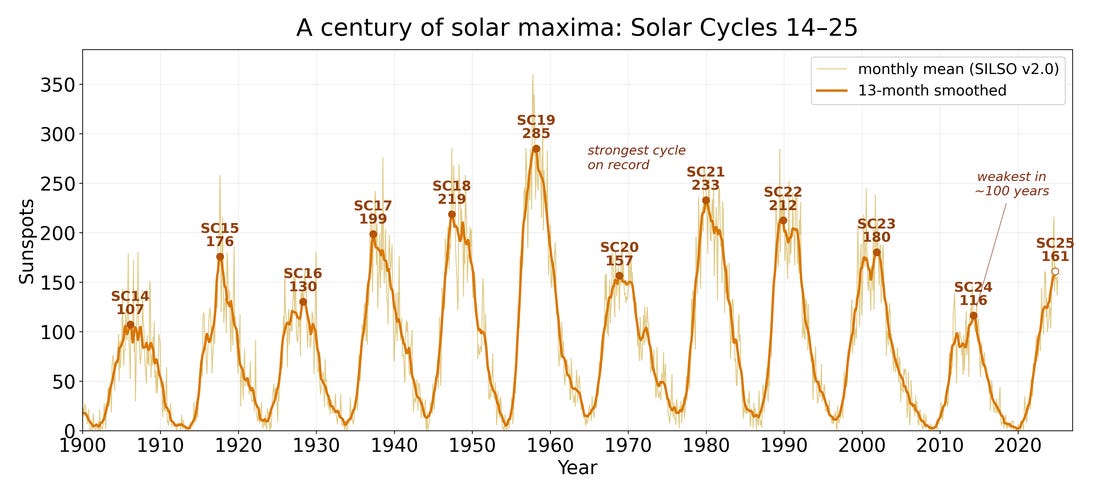
A final fillip is that we have no guarantee that the peak of a solar cycle will line up with energetically favorable launch windows for Mars, which recur on a ~15 year cycle.
The porkchop plot below shows launch windows to Mars for the period 2030-2060. Areas in blue and green show a combination of departure date and transit time that is achievable with chemical rockets, while the orange and pink areas are energetically haram.
You can see that a great opportunity for a fast transit exists in the 2035-36 period and also happens to coincide with a solar maximum. After that, though, the two cycles go out of phase. The predicted solar maximum in 2046 coincides with bad orbital juju that makes it hard to reach Mars, while the excellent launch windows in 2050-2052 happen right at the predicted solar minimum.
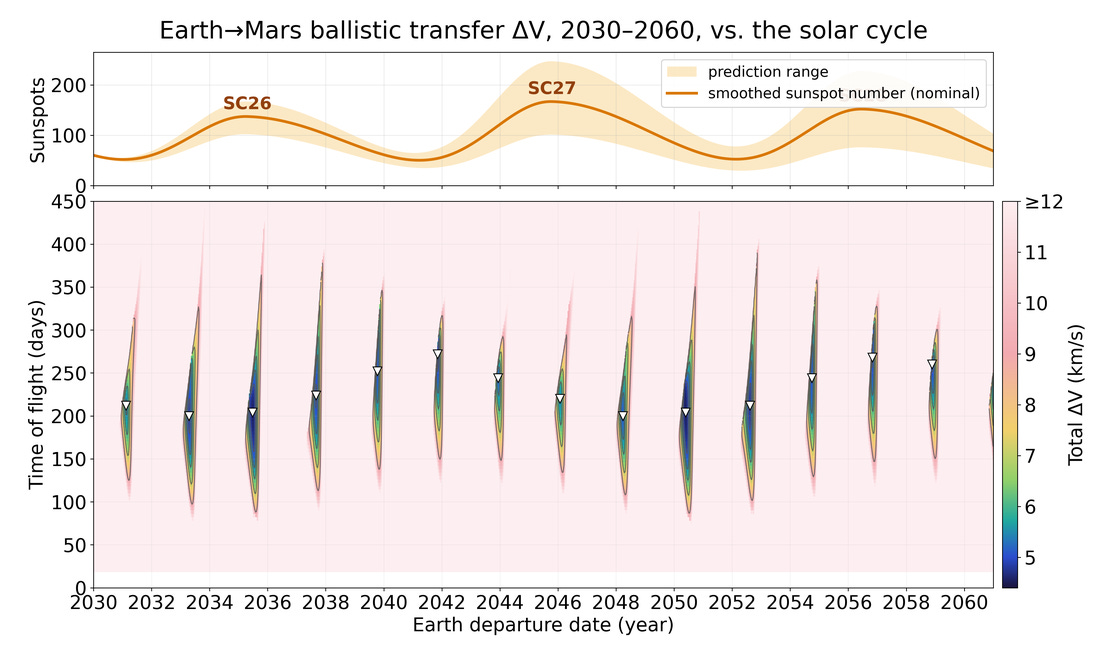
All this makes it very important to figure out just how much radiation an astronaut can take. We can get bend the exposure curve down with a lot of effort, but do we really have to?
I can think of at least five important tradeoffs that depend on the answer.
Solar Maximum vs. Other Times
So far in this post I’ve made solar maximum sound like the greatest thing since the wheel. But the solar proton risk on short stay missions is very real, and rises quadratically with approach to the Sun.5 It would be nice to avoid it!
Solar storms can also badly interfere with communications, and make it harder to explore far from the spacecraft. For that reason, it would be nice to know if we can get away with visiting Mars in the radiation “shoulder season”, or even during solar minima.
If it turns out missions are limited to the period around solar maximum, that ties Mars exploration to the 11 year solar cycle and makes many exploration paradigms (like the inbound crew relieving and potentially rescuing active crew) impossible. It also means there may be decades when we can’t go to Mars at all.
Women vs. Old Men
One delicate issue is that radiation is kind of sexist. A space dad can take more of a radiological beating than a woman in her thirties. NASA’s blanket 600 mSv limit is based on a 3% chance of radiation exposure-induced death (REID). But this is a risk that varies a lot with age and sex. A 55 year old male astronaut could spend 256 days in deep space at solar minimum before hitting the limit, while a 35 year old woman would hit it after 159 days. (A 55 year old woman would have 201 days).6
This ties in to some other sex differences in space flight. Older women are of course more susceptible to bone loss, but women in general are also less of a burden on life support systems, which would make an all-female Mars crew easier to design for.
NASA insists that having a unisex career limit is an ethical stand, but it’s possible that Mars missions will only be feasible for the least radiologically sensitive astronaut cohorts, and that this may cut across some politically uncomfortable lines.
Mission vs. Lifetime Risk
Measures like REID don’t distinguish between the chance that an astronaut develops aggressive leukemia halfway through a mission, or six years after landing. But in practical terms, this matters a lot. If everyone gets radiation-induced cataracts on Mars and can’t see, then that crew is going to die, even though a similar affliction back on Earth would be eminently survivable.
The question of prompt risk also drives aspects of mission design, like whether to send chemo drugs along on a Mars mission (and figure out how to keep them out of the life support loop).
At a minimum, we need to know if risks that astronauts are exposing themselves to are ones that might have a rapid onset. This extends beyond cancer to particularly poorly-understood areas like heavy-ion-induced cognitive deficits and cardiovascular damage.
Abort Scenarios
Another tradeoff is planning for contingencies. Let’s say the crew arrives at Mars and the heat shield on their lander looks broken. Is it riskier to attempt the landing or stay on the spacecraft? Or how about a toxic leak in the habitat halfway through the surface mission? Is it safer to try to clean it up and live in the residue, or abort to orbit?
We need to know the extent to which a purely orbital long-stay mission (1,000 days in deep space) is a death sentence to be able to make these kinds of decisions. Note that this drives not just operations, but mission design. If abort-to-orbit is survivable, then the orbiting transit vehicle should be made oversized and outfitted as a potential lifeboat. If the crew absolutely has to stay on Mars, then there will need to be more redundancy (and more downmass) at the landing site. These decisions have to be made in the early design phase.
Contamination
Shielding on Mars has significant consequences for contamination risk. If you bury a human habitat under soil, you are creating a large warm area (complete with meltwater) that becomes a potential habitat to terrestrial microbes, and giving them a royal highway into the subsurface. The same holds true if you build the human habitat inside a cave or lava tube, natural radiation shelters that are among the most promising habitats for finding relic life on Mars.
We need to know if we can get away with keeping astronauts in the open and minimizing ground disturbance, or if health and survival concerns require digging up the ground. That in turn will affect the choice of landing site.
Longtime readers will know what’s coming next. To gather enough data to make these tradeoffs, we need to perform long-duration animal tests outside the Earth’s magnetosphere, and eventually send some volunteers up there to get irradiated.
This necessary research program front-loads Mars exploration with years of ISS-like missions to nowhere. On the bright side, it gives NASA something to do while we wait for the 15 year Mars transit cycle and the 11 year solar cycle to sync back up again in our sunset years.
But the upshot is that we should just! send! robots!
The lion of all things Mars-radiation-related is Francis Cucinotta. For an excellent summary of the radiation problem, see How Safe Is Safe Enough? Radiation Risk for a Human Mission to Mars. (2013) DOI 10.1371/journal.pone.0074988
Cucinotta also has strong words about NASA’s 600 mSv radiation limit. A proposed change to astronaut exposures limits is a giant leap backwards
for radiation protection (2021) DOI: 10.1016/j.lssr.2021.07.005
A terrific and exhaustive overview of the radiation environment on a Mars mission: Radiation environment for future human exploration on the surface of Mars: the current understanding based on MSL/RAD dose measurements (2021) DOI 10.1007/s00159-021-00136-5